Bonsai Care in February: Monthly Task Checklist


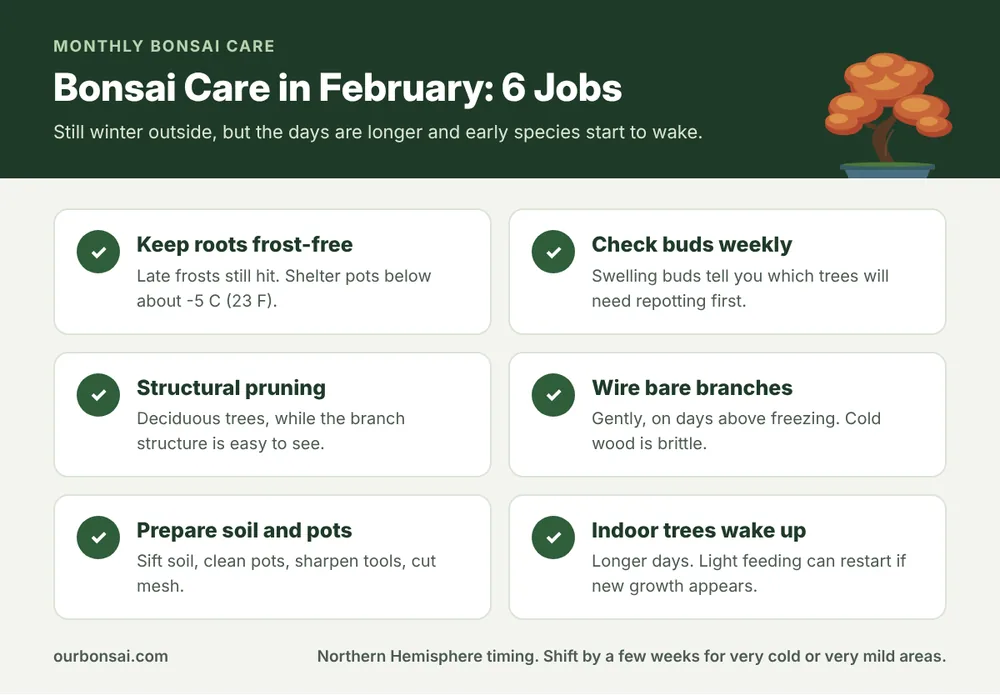
Bonsai care in February is mostly preparation. Outdoors, hardy trees are still dormant, so roots need shelter from frosts below about -5 C (23 F), watering should stay occasional (often every 5 to 10 days for dormant deciduous trees), and there is still no fertilizer. But by the second half of the month, buds on early species like trident maple and Chinese elm start to swell in mild areas, which means repotting season is 2 to 6 weeks away. February is the time to do structural pruning and wiring on deciduous trees, sift soil, clean pots and sharpen tools. Indoors, tropical trees respond to the longer days, and light feeding can restart once you see fresh growth.
In this guide
This guide follows the month in three parts, because early and late February can feel like different seasons. It assumes a Northern Hemisphere temperate climate. In Australia or South Africa, February is late summer.
Early February: still deep winter
For most of North America and Europe, the first two weeks of February are cold, and outdoor trees should be left alone.
- Frost protection. Keep trees in their cold frame, unheated garage, or sunk into a garden bed. A late cold snap after a mild spell is the riskiest moment, because a tree that has begun to wake up is less cold-tolerant.
- Watering. Check every few days, water only when the surface is dry, and do it in the morning on a day above freezing. Evergreens in sunny cold frames dry faster than you would expect.
- Pests. Look along the branches of deciduous trees for scale insects and overwintering eggs. A gentle scrub with an old toothbrush removes most of them. Our page on scale on bonsai trees shows what to look for.
Indoor trees, meanwhile, are still coping with low light and dry heated air. Our guide to watering indoor bonsai in winter covers the indoor side.
Mid-February: pruning and wiring
With the leaves gone, deciduous trees show their full branch structure. This is the best time of year to see what needs to change.
Structural pruning. Remove crossing branches, branches growing straight up or down, and anything that crowds the silhouette. Cuts made now heal quickly once growth starts in a few weeks. The timing is explained in more detail in our guide on when to prune deciduous bonsai.
A caution for maples: they can bleed sap from cuts in late winter as pressure builds in the wood. Bleeding rarely harms the tree, but many growers make big maple cuts in early winter or wait until after the leaves open.
Wiring. Bare deciduous branches are easy to wire now. Cold wood is brittle, so bend gently and work on a mild day. Remove any wire put on last year that is starting to bite into the bark before spring growth thickens the branches further.
Pines and junipers. Leave major work for later. Check old wire and remove dead needles, but save candle and shoot work for spring.
Late February: getting ready for repotting
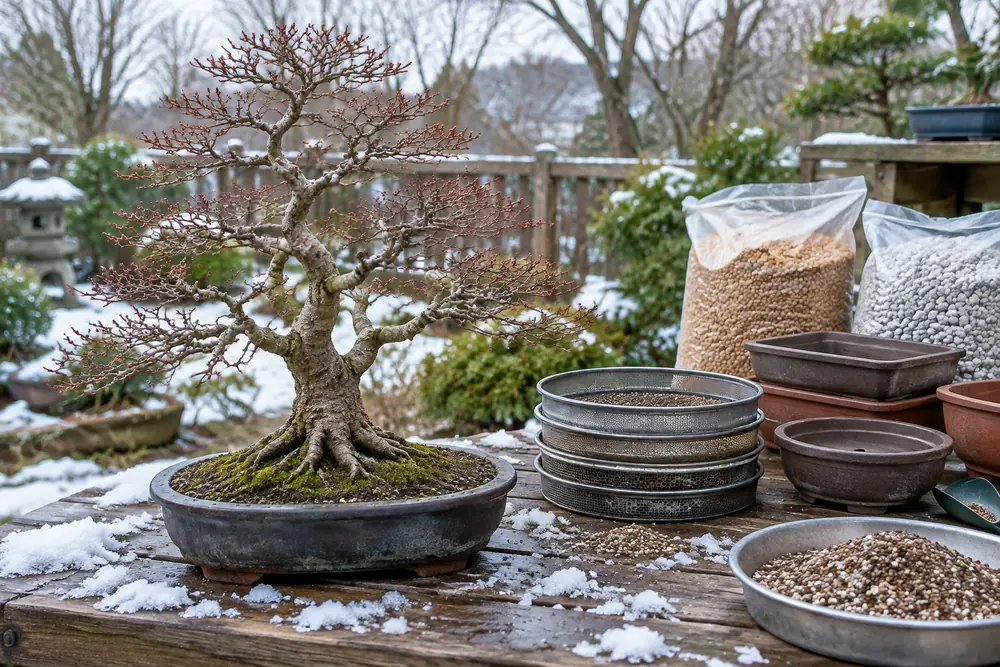
By the end of the month, look closely at the buds every few days. When they swell, turn glossy and begin to show color, roots are getting ready to grow, and that is the moment many species want repotting.
Trees that usually wake first:
- trident maple and Chinese elm,
- Japanese maple in mild areas,
- flowering quince and early-flowering apricot,
- larch, whose buds swell early and turn green fast.
Prepare everything now so you are not caught out:
- Sift your soil. Akadama, pumice and lava, each sieved to remove dust. Our page on bonsai soil mix ratios helps you plan the blends.
- Clean pots. Scrub off old soil and lime scale. A soak in a weak bleach solution, then a thorough rinse, kills fungal spores.
- Cut drainage mesh and pre-cut tie-down wires for each pot.
- Sharpen and oil tools. Root scissors and concave cutters work much better sharp. See our bonsai repotting tools guide if anything needs replacing.
- Make a repotting list. Which trees are root-bound, which were repotted last year and can wait, and which are weak and should be left alone.
Indoor trees in February
Day length increases by more than an hour over the month in mid-latitudes. Tropical trees notice. Ficus, schefflera and Fukien tea often start pushing new leaves even in a window.
- Light: If you use a grow light, keep it on 12 to 14 hours. If you do not, now is a good time to move trees to the brightest window you have.
- Feeding: Once new leaves appear, restart a balanced liquid fertilizer at half strength every 2 weeks.
- Pruning: Light trimming of long shoots is fine. Save heavy pruning and repotting for late spring, when it is warm enough for strong root growth.
- Pests: Spider mites and scale build up through winter in warm, dry rooms. Check leaf undersides weekly.
Seeds and propagation
February is a good time to start cold stratification for seeds of temperate trees such as maples, pines and elms. Many need 60 to 90 days of cold, moist conditions before they will germinate. A bag of damp sand in the refrigerator works. Our article on bonsai seed germination time lists typical times for common species.
Bonsai care in February at a glance
| Tree type | Main job | Water | Feed |
|---|---|---|---|
| Hardy deciduous | Structural pruning, wiring, watch buds | Every 5 to 10 days, when dry | No |
| Hardy evergreen | Frost and wind protection, remove old wire | Every 5 to 10 days, when dry | No |
| Subtropical (olive, pomegranate) | Keep cool and bright, frost-free | When dry | No, or very light |
| Tropical indoor | More light, pest checks | Every 3 to 7 days, when dry | Restart at half strength if growing |
Common February mistakes
- Repotting everything on the first warm weekend. Wait for swelling buds on each tree; a mild spell is not spring.
- Bringing a tree out of shelter too early. A tree that starts growing in a warm garage is very vulnerable to a hard frost in March.
- Feeding outdoor trees. No fertilizer until leaves have opened after repotting.
- Ignoring old wire. It can scar branches within weeks once spring growth starts.
Frequently asked questions
Can I repot my bonsai in February?
Some early species in mild climates, yes, if the buds are clearly swelling. For most trees and most regions, March is the safer month.
Should I start fertilizing in February?
Not outdoor trees. Indoor tropical trees that are clearly growing can get a half-strength feed.
Is it too cold to wire in February?
On freezing days, yes, because branches snap more easily. On mild days above about 5 C (41 F), wiring deciduous trees is fine.
My indoor ficus is growing long, pale shoots. Why?
Not enough light for the warmth of the room. Add a grow light or move it to a brighter window, and trim the long shoots back once growth balances out.
Final thoughts
February rewards preparation. Keep outdoor roots safe from late frost, do your structural pruning while the branches are bare, and have soil, pots and tools ready before the buds tell you it is time. For the science of how temperate trees time their wake-up, the Wikipedia article on dormancy is a useful read, and for year-round basics, our bonsai care hub has the essentials.