How to Get Rid of Thrips on Bonsai: Complete Treatment Guide

Quick Answer
To get rid of thrips on bonsai, isolate the affected tree, confirm the insects are thrips, rinse exposed pests away, remove badly damaged growth, and use a plant-labeled contact treatment when needed. Recheck the tree repeatedly because eggs can be hidden inside plant tissue, and the UC IPM thrips guidance recommends combining several control methods instead of relying on one pesticide.
What to do first
- Isolate the bonsai: Move it away from healthy trees and houseplants.
- Confirm thrips: Look for slender insects, silvery feeding marks, distorted leaves, and dark fecal specks.
- Rinse the foliage: A controlled stream of water can remove many exposed adults and larvae.
- Remove heavy damage: Prune badly infested leaves or tender shoots when the tree can tolerate it.
- Treat carefully: Consider insecticidal soap, horticultural oil, neem products, or another labeled thrips treatment.
- Keep checking: One treatment often misses hidden insects or later-emerging stages.
Most important tip
- Do not increase pesticide strength or frequency beyond the product label. Bonsai foliage can be sensitive to spray injury.
Thrips can make a healthy bonsai look battered surprisingly quickly. Their feeding often leaves pale streaks, distorted new growth, and tiny dark specks.
The good news is that a small infestation is manageable. This guide explains how to identify thrips, treat them safely, and reduce the chance they return.
In This Guide
- What Do Thrips Look Like on a Bonsai?
- How Do You Get Rid of Thrips on Bonsai Step by Step?
- Which Thrips Treatment Works Best on Bonsai?
- How Often Should You Treat a Bonsai for Thrips?
- How Do You Protect a Bonsai During Thrips Treatment?
- How Do You Stop Thrips From Coming Back?
- Frequently Asked Questions
What Do Thrips Look Like on a Bonsai?
Thrips are tiny, slender insects that often measure around 1/16 inch long. Adults may appear yellowish, tan, brown, or nearly black.
Definition: Thrips are small insects in the order Thysanoptera. Plant-feeding species damage foliage by breaking plant cells and feeding on their contents.
You may notice the damage before seeing the insect. Thrips often hide inside buds, folded leaves, tender shoots, and protected leaf surfaces.
Common signs of thrips on bonsai
- Silvery streaks or patches: Feeding can leave pale, reflective-looking scars on leaves.
- Distorted growth: Young foliage may curl, twist, wrinkle, or develop unevenly.
- Dark specks: Small black or dark spots may be thrips excrement.
- Damaged buds: Tender buds and flowers can become scarred or deformed.
- Tiny moving insects: Thrips often run quickly when disturbed.
- Premature leaf decline: Heavily damaged foliage may yellow, brown, or drop.
The University of Minnesota Extension guide to indoor plant insects describes thrips as small, slender pests that can cause irregular silvery streaks and distorted flowers.
How to confirm thrips before treating
Hold a sheet of white paper beneath suspicious foliage. Tap or gently shake the branch above it.
Tiny slender insects moving across the paper support a thrips diagnosis. A hand lens makes identification easier.
- Inspect leaf undersides.
- Check tender shoot tips.
- Look inside flowers and buds.
- Examine folded or curled leaves.
- Use yellow or blue sticky cards to monitor flying adults.
Sticky traps are useful for detection. They should not be treated as a complete control method.
Pay extra attention to Ficus bonsai
Some Ficus can suffer from Cuban laurel thrips. These thrips can cause young leaves to fold tightly around the insects.
That protected growth makes contact sprays harder to use effectively. Severely distorted leaves may require careful removal as part of the treatment plan.
Section Takeaway: Confirm living thrips before spraying. Silvery damage alone can resemble mites, environmental stress, or other plant problems.
How Do You Get Rid of Thrips on Bonsai Step by Step?
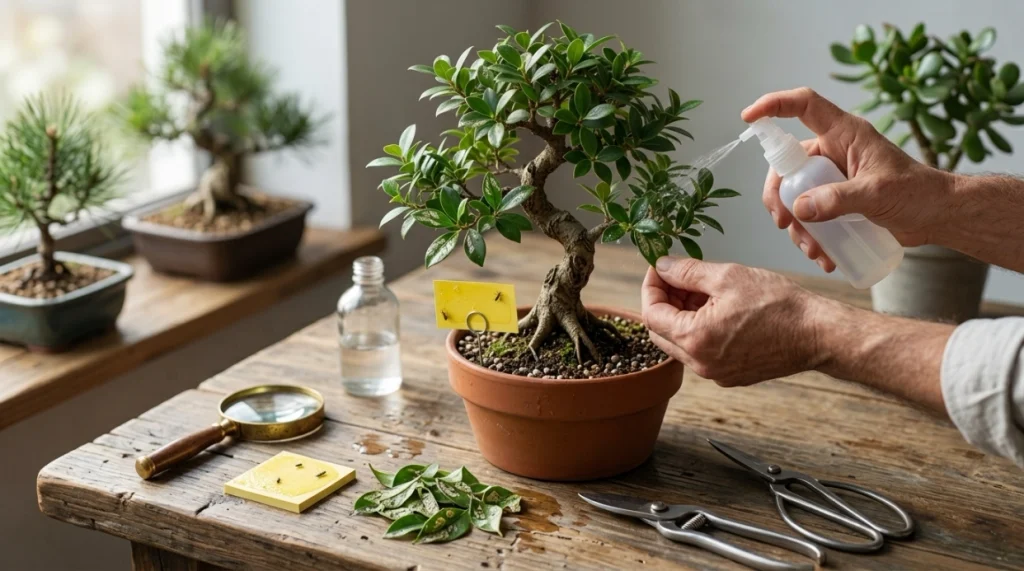
The most dependable approach combines isolation, physical removal, sanitation, targeted treatment, and follow-up inspections. Avoid expecting one spray to solve the entire infestation.
- Separate the bonsai immediately. Keep it away from nearby bonsai and houseplants so adults cannot easily move between plants.
- Confirm the pest. Check damaged foliage, buds, new growth, and leaf undersides before choosing a treatment.
- Rinse exposed thrips away. Use a controlled stream of water where the species and foliage can tolerate it.
- Remove badly infested material. Discard heavily distorted leaves or shoots that contain protected colonies.
- Clean the growing area. Remove fallen leaves, dead flowers, and plant debris around the pot and bench.
- Apply an appropriate treatment if needed. Use only a pesticide or contact product labeled for the plant and pest.
- Reinspect repeatedly. Check fresh growth and protected areas for surviving or newly emerged thrips.
Why one treatment may not be enough
The thrips life cycle includes egg, feeding larval stages, nonfeeding prepupal and pupal stages, and adults. Eggs of many pest species are inserted into plant tissue.
Some species also spend nonfeeding developmental stages away from exposed foliage. That makes complete control with one contact application unlikely.
Warm conditions can shorten development considerably. Some thrips can complete a generation in only a few weeks.
- Inspect new leaves as they open.
- Check shoots that looked clean during the first treatment.
- Replace monitoring traps when they become dirty.
- Follow the pesticide label for legal reapplication intervals.
Should you prune a bonsai with thrips?
Removing a few heavily infested leaves or tender shoots can reduce pest numbers. It can also expose insects hiding inside distorted growth.
Avoid combining severe pest stress with major structural pruning. The goal is sanitation, not redesigning the tree.
Pro tip: If removing a live branch would permanently change the bonsai’s structure, consult an experienced grower or local bonsai club before making the cut.
Section Takeaway: Treat the infestation as a cycle, not a single event. Remove exposed pests now, then keep checking for later stages.
Which Thrips Treatment Works Best on Bonsai?
There is no single best product for every bonsai. The right option depends on pest location, tree species, infestation level, and product labeling.
| Method | Best Use | Main Limitation |
|---|---|---|
| Water rinse | Removing exposed adults and larvae | Does not reach hidden eggs or protected insects |
| Insecticidal soap | Exposed thrips on foliage | Requires direct contact and thorough coverage |
| Horticultural oil | Contact control on suitable plants | May injure sensitive or stressed foliage |
| Neem-based product | Certain labeled foliage treatments | Coverage matters and plant sensitivity varies |
| Spinosad product | Persistent infestations when the label permits | Must follow label restrictions and pollinator precautions |
| Sticky traps | Monitoring flying adults | Will not eliminate eggs or larvae on the tree |
Insecticidal soap
Insecticidal soap works mainly through direct contact. Spray coverage matters because hidden thrips may escape treatment.
Do not substitute household dishwashing liquid. Formulated insecticidal soaps have labeled instructions for plant use.
Horticultural oil and neem products
Horticultural oils can suppress exposed soft-bodied pests. However, oils can damage sensitive plants under unsuitable conditions.
Neem-based products vary in formulation. Use only a product whose label permits application to the plant and target pest.
Spinosad
Spinosad can be useful against certain thrips and may outperform some simple contact sprays. It is still a pesticide and must be used according to its label.
Pay close attention to pollinator restrictions if the bonsai flowers outdoors. Never apply more product because an infestation looks severe.
For general species-specific care alongside pest control, the Bonsai Empire care section is a useful reminder that placement, watering, and general vigor still matter during treatment.
How Often Should You Treat a Bonsai for Thrips?
Follow the reapplication interval printed on the product label. Do not invent a faster schedule to try to kill thrips sooner.
Between treatments, inspect the tree every few days. Focus on new foliage, buds, folded leaves, and previously damaged areas.
- After rinsing: Recheck for moving insects once the foliage dries.
- After pruning: Watch the remaining shoot tips for fresh distortion.
- After a spray: Look for surviving adults and newly emerging larvae.
- During quarantine: Continue checking neighboring plants for symptoms.
Old thrips scars will not disappear after the insects die. Judge success by the absence of living pests and healthier new growth.
This distinction matters. Damaged leaves may stay silvered, twisted, or scarred until they eventually drop or are removed.
How Do You Protect a Bonsai During Thrips Treatment?
A bonsai already weakened by heat, drought, root trouble, or recent repotting may react badly to aggressive treatment. Stabilize basic care while controlling the insects.
Test unfamiliar sprays first
Apply a small amount to a limited section when the label permits a test application. Check for leaf spotting, discoloration, or burning before treating the entire canopy.
- Do not spray a drought-stressed tree.
- Avoid treating severely wilted foliage.
- Do not exceed the labeled concentration.
- Check restrictions involving heat, sunlight, sulfur, or other products.
- Avoid letting foliar pesticides flood the bonsai soil unless the label allows that use.
Keep normal bonsai care steady
Do not suddenly change every part of the tree’s routine. Maintain appropriate watering, light, drainage, and ventilation for that species.
Excess fertilizer is not a cure. Soft, nitrogen-rich growth can sometimes encourage pest problems.
If the tree is already weak, avoid heavy wiring, repotting, or major styling unless another urgent problem requires it. Give the tree enough stability to recover.
The American Bonsai Society also provides educational resources and local club connections that can help when species sensitivity or serious decline makes treatment uncertain.
How Do You Stop Thrips From Coming Back?
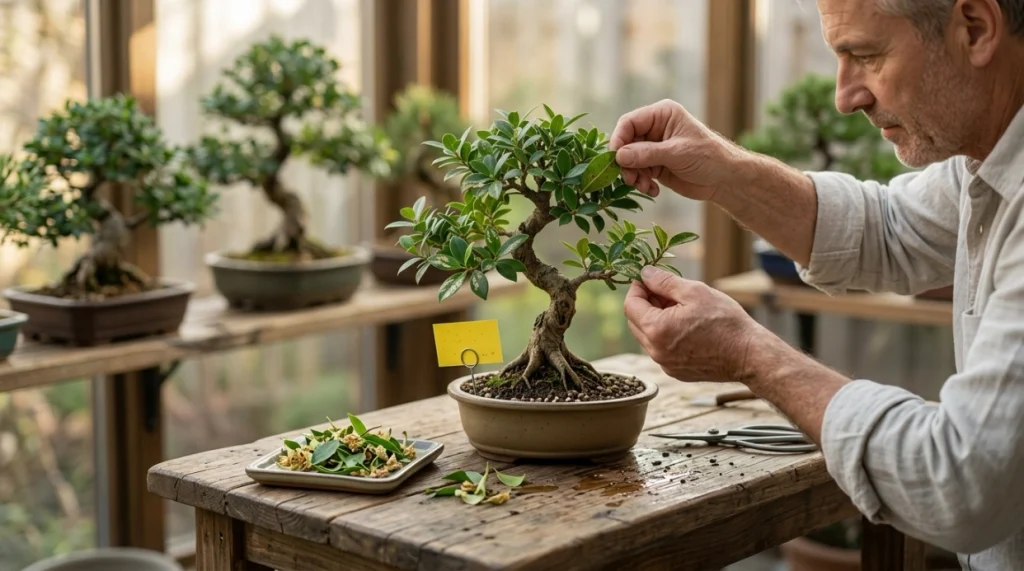
Prevention starts with detecting thrips before their population becomes large. This matters most when you bring new bonsai or companion plants into a collection.
Quarantine new plants
Keep new trees separated long enough to inspect fresh growth and hidden foliage. Look beneath leaves and inside buds rather than checking only the visible canopy.
Inspect while watering
Use watering time as a quick pest check. A weekly close inspection can reveal subtle feeding marks before widespread damage develops.
- Inspect shoot tips and young leaves.
- Check foliage undersides.
- Remove dead leaves and spent flowers.
- Keep the growing area clean.
- Monitor suspicious trees with sticky cards.
- Avoid unnecessary high-nitrogen feeding.
Watch nearby plants
Adult thrips can move between plants. A treated bonsai may become infested again if surrounding plants still carry the pest.
Check houseplants, nursery stock, flowering plants, and recently purchased material near the bonsai. Treat the infestation as a collection-level problem when several plants show symptoms.
Do not confuse prevention with constant spraying
Routine pesticide spraying without a confirmed pest can create unnecessary risks. Monitoring and correct identification should come first.
As of 2026, integrated pest management remains the sensible approach: identify the pest, use cultural and physical controls, then add targeted products when necessary.
Section Takeaway: The best long-term defense is early detection. Quarantine new plants, inspect often, and avoid spraying without evidence of an active pest.
Frequently Asked Questions
Can thrips kill a bonsai tree?
Heavy thrips populations can weaken foliage, damage new growth, and reduce vigor. Established woody trees may tolerate some feeding, but a stressed or small bonsai deserves prompt attention because repeated damage can interfere with recovery and development.
Can I wash thrips off my bonsai with water?
Yes. A controlled water rinse can remove many exposed thrips from suitable foliage, making it a useful first step. It will not remove every egg or protected life stage, so continued inspection is still necessary.
Does neem oil get rid of thrips on bonsai?
Some neem-based products are labeled for thrips and can help when insects are exposed. Neem is not automatically safe for every bonsai, so check the product label and test sensitive foliage before full application.
Are sticky traps enough to eliminate thrips?
No. Sticky cards mainly catch flying adults and help monitor activity. Eggs and immature thrips remain on or within the plant, so traps should support other control methods rather than replace them.
Why do thrips keep coming back after spraying?
Eggs may remain protected inside plant tissue, while hidden larvae can escape contact sprays. Reinvasion from nearby infested plants is also possible. Repeat inspections and label-directed treatment are usually more effective than one application.
Should I repot a bonsai because it has thrips?
Usually not. Thrips mainly damage above-ground plant tissue, although some species have developmental stages away from the foliage. Repotting adds root stress and should not be done solely because you found thrips unless another root or soil problem requires it.
How do I know the thrips are finally gone?
Look for the absence of living insects and healthy new growth rather than expecting old scars to disappear. Continue monitoring buds, shoot tips, leaf undersides, and sticky cards after the last visible insects are gone.
Final takeaway: Start by isolating the bonsai and confirming thrips. Remove exposed pests, clean up badly infested growth, use a labeled treatment when needed, and keep inspecting until new growth stays clean. Careful follow-up is more valuable than using a stronger spray.
