
How to Prevent Pests and Diseases on Bonsai Trees
Few things are more frustrating than watching a healthy bonsai develop sticky leaves, yellow foliage, strange spots, webbing, or dying branches. Because a bonsai grows in a small container with a limited root system, pest and disease problems can become serious faster than they might on a full-size landscape tree.
Learning how to prevent pests and diseases on bonsai trees is therefore more useful than simply knowing how to treat an infestation after it appears.
Prevention starts with healthy growing conditions. Correct watering, suitable light, good airflow, clean tools, regular inspection, and careful handling of new trees can prevent many common problems. This guide explains those habits, what warning signs to watch for, and when a bonsai problem needs more experienced help.
Quick Answer
The best way to prevent pests and diseases on bonsai trees is to keep the tree vigorous, avoid overwatering, provide suitable light and airflow, inspect leaves and branches regularly, quarantine new plants, remove unhealthy material, and keep tools clean. Catching a problem early usually makes it much easier to control.
Why Healthy Bonsai Are Less Vulnerable
Pests and diseases can attack otherwise healthy plants, so good care does not make a bonsai immune. However, stressed trees generally have fewer resources available for recovery.
Bonsai can become stressed by:
- Too much or too little water
- Poor drainage
- Incorrect light exposure
- Excessive fertilizer
- Root-bound or deteriorated soil
- Severe pruning or root work
- Extreme heat, cold, or dry indoor air
- Growing an outdoor species permanently indoors
A juniper struggling in a dim living room, for example, is unlikely to stay as vigorous as one receiving appropriate outdoor light and seasonal conditions.
Likewise, a bonsai sitting constantly in waterlogged soil may develop declining roots even if its leaves initially appear healthy.
Prevention begins with species-appropriate care, not pesticide use.
1. Inspect Your Bonsai Regularly
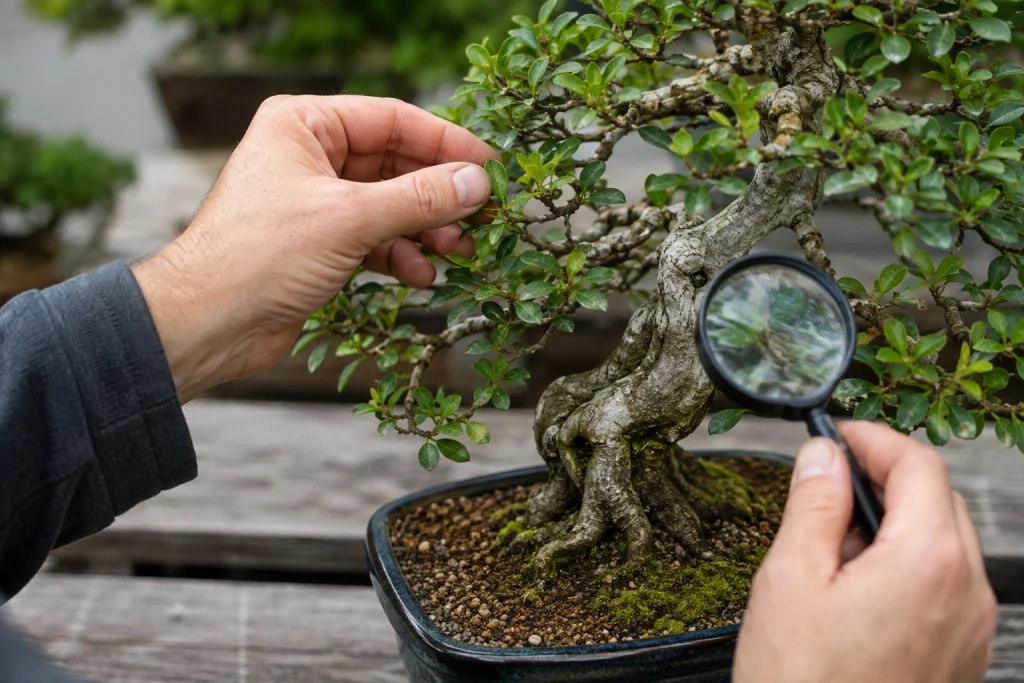
One of the simplest preventive habits is also one of the most effective: look closely at your tree.
Do not wait until an entire branch is covered in insects.
Check your bonsai whenever you water it, and perform a more detailed inspection at least weekly during active growth.
Look at:
- New shoots
- Leaf tips and edges
- Undersides of leaves
- Leaf joints
- Branch forks
- Bark crevices
- The trunk base
- Surface roots
- Soil surface
- Drainage holes
Common pests such as aphids, spider mites, scale insects, mealybugs, whiteflies, and fungus gnats may first appear in protected areas rather than on the most visible parts of the tree.
The University of Minnesota Extension’s guidance on indoor plant insects similarly recommends inspecting plants while performing routine jobs such as watering and fertilizing. (University of Minnesota Extension)
Watch for indirect signs too
You may notice damage before you see the actual pest.
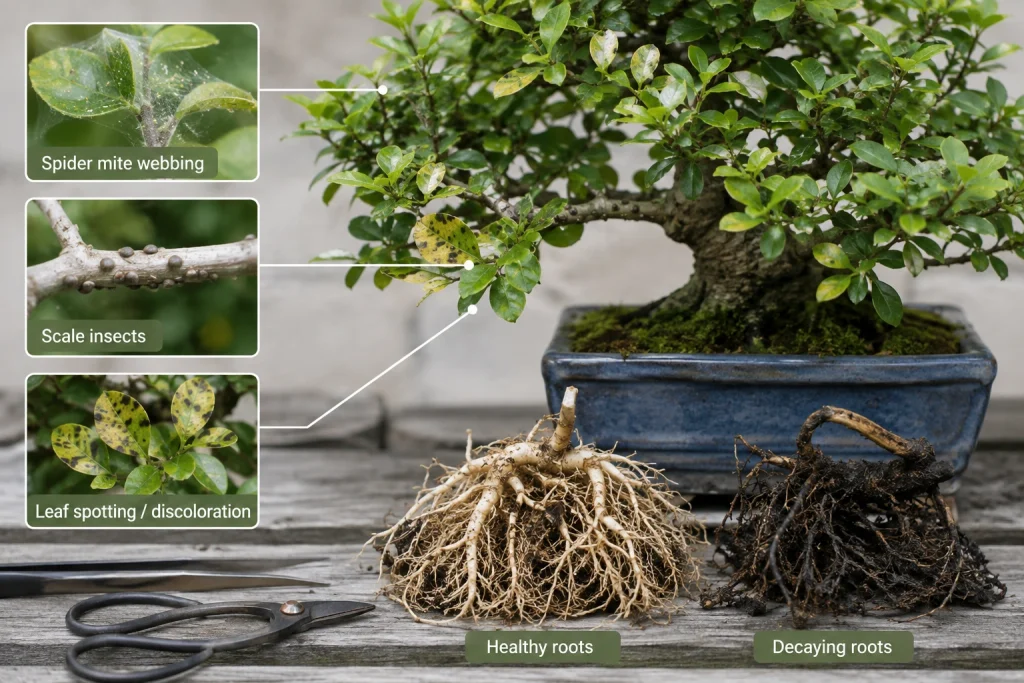
Warning signs include:
- Sticky leaves or surfaces beneath the tree
- Fine webbing between leaves
- Small bumps attached to stems
- White cotton-like material
- Distorted new growth
- Speckled or stippled leaves
- Sudden leaf yellowing
- Blackened shoots
- Unusual leaf spots
- Mushy roots
- Sour or unpleasant-smelling soil
- Branch dieback
- Noticeably reduced vigor
A single yellow leaf is not automatically evidence of disease. Consider the whole tree and its recent care before deciding that treatment is necessary.
2. Get Watering Right
Poor watering habits are responsible for many bonsai health problems.
The goal is not to keep the soil permanently wet or to let it become bone-dry on a fixed schedule. Instead, water according to the tree, soil, weather, season, and moisture level.
Overly wet conditions reduce the air available around roots and can contribute to root decline. Constant moisture may also favor organisms such as fungus gnats. University of Minnesota Extension specifically notes that overwatering and poor drainage can contribute to root rot and pest problems in container-grown plants. (University of Minnesota Extension)
A better watering routine
- Check the soil before watering.
- Water when the species and growing medium actually need it.
- Water thoroughly enough to wet the root mass.
- Allow excess water to escape through the drainage holes.
- Never leave the bonsai permanently standing in a tray of water unless a particular growing technique specifically requires it.
Do not rely solely on a schedule such as “water every two days.”
A small bonsai in summer sun may need water much sooner than a larger tree during cool, cloudy weather.
Warning: If the tree is suddenly wilting while the soil remains constantly wet, do not automatically add more water. Root problems can prevent damaged roots from supplying water to the foliage even when the pot is saturated.
3. Use Free-Draining, Species-Appropriate Bonsai Soil
Bonsai soil needs to balance moisture retention with drainage and oxygen around the roots.
Compacted garden soil usually performs poorly in shallow bonsai containers because it can remain dense and poorly aerated.
Common bonsai soil ingredients include materials such as akadama, pumice, lava rock, pine bark, and other appropriately sized components. The ideal mixture depends on the tree, climate, pot, and watering habits.
Tropical trees in warm conditions may need a different balance from pines or junipers grown outdoors.
Do not assume that the most expensive bonsai soil is automatically the best. Particle structure, drainage, moisture retention, and species suitability matter more than packaging.
Beginners often benefit from a reliable premixed bonsai substrate because it removes some guesswork. More experienced growers may prefer mixing components themselves to suit individual species and climates.
4. Give the Tree the Light and Environment Its Species Requires
A bonsai should not be classified as “indoor” simply because it is small.
Many traditional bonsai species—including junipers, pines, maples, and elms—perform best outdoors and may need natural seasonal changes.
Tropical and subtropical species such as many ficus varieties tolerate indoor cultivation more readily, provided they receive adequate light and suitable temperatures.
Insufficient light can weaken growth over time. University of Minnesota Extension explains that plants depend on adequate light for photosynthesis and energy production. (University of Minnesota Extension)
Before buying a bonsai, ask:
- Is this species tropical, deciduous, or evergreen?
- Does it normally grow indoors or outdoors?
- How much direct sunlight does it tolerate?
- Does it require winter dormancy?
- Can I realistically provide those conditions?
Choosing a species that suits your environment is often easier and cheaper than constantly trying to correct stress later.
5. Provide Good Airflow Without Creating Harsh Conditions
Crowded, stagnant growing areas can keep foliage damp for longer periods.
Give trees enough space that air can move around the foliage. This is particularly important if you maintain several bonsai together.
Avoid continuously wetting leaves late in the day when drying conditions are poor. Some plant diseases are encouraged when susceptible foliage remains wet. UC Integrated Pest Management, for example, recommends avoiding unnecessary foliage wetting as part of controlling certain fungal diseases. (UC IPM)
Good airflow does not mean placing a delicate tropical bonsai directly in freezing drafts, strong air-conditioning, or constant hot wind.
The objective is healthy air movement, not environmental stress.
6. Quarantine New Bonsai and Other Plants
A new tree is one of the easiest ways to introduce pests into an established collection.
Do not immediately place a recently purchased bonsai among your healthiest trees.
The University of Minnesota Extension recommends isolating newly acquired plants for one to two weeks so hidden pest problems have time to become visible. (University of Minnesota Extension)
During quarantine:
- Check underneath leaves.
- Examine branch joints and bark.
- Inspect the soil.
- Look for scale, mealybugs, mites, aphids, and flying insects.
- Monitor new growth.
- Keep the plant away from the main collection.
Also inspect houseplants before placing them beside indoor bonsai.
A $20 houseplant carrying spider mites can create a problem for a bonsai collection worth considerably more.
Expert Tip: Keep one inexpensive magnifying lens near your bonsai area. Checking suspicious leaf speckling at 5–10× magnification can help you notice mites, eggs, scale crawlers, and other tiny problems before deciding whether treatment is necessary.
7. Keep Pots, Benches, and Tools Clean
Dead leaves, discarded branches, old soil, and weeds around bonsai benches can create hiding places for pests or retain unnecessary moisture.
Remove fallen material rather than allowing it to accumulate around containers.
Pruning tools should also be kept sharp and clean. Penn State Extension notes that sharp tools produce cleaner cuts and recommends keeping pruning equipment clean to reduce the risk of spreading pests and diseases. (Penn State Extension)
Pay particular attention to sanitation when working on a tree that may have an infectious disease.
Do not prune a suspicious branch and immediately use the same dirty tool on five healthy bonsai.
After working on diseased material, clean or disinfect equipment using a method appropriate for the tool and pathogen involved, and dry metal tools properly afterward to reduce corrosion.
8. Prune Carefully and Avoid Unnecessary Wounds
Pruning is essential to bonsai development, but every cut is also an injury the tree must seal or compartmentalize.
Use sharp bonsai scissors, concave cutters, or suitable branch cutters rather than crushing or tearing branches with poor-quality tools.
Cheap tools can be adequate for occasional beginner work, but durability and edge quality vary considerably. If you maintain multiple bonsai, a well-made pair of pruning scissors and a quality concave cutter are generally more useful long-term investments than owning many specialized low-quality tools.
Avoid major pruning when a tree is already badly stressed unless removal of dead or diseased tissue is necessary.
Heavy root work, major branch removal, and repotting should not automatically be combined on a weak tree. Species, season, and tree vigor need to guide the decision.
9. Feed for Healthy Growth, Not Maximum Growth
Fertilizer helps replace nutrients used by a container-grown tree, but more fertilizer does not automatically produce better health.
Excessive feeding can create unwanted growth, damage roots in some circumstances, or push soft growth that may be harder to manage.
Choose a fertilizer suitable for your bonsai and apply it according to the product directions and the tree’s growth cycle.
Reduce or stop feeding when appropriate for:
- Severe stress
- Recently damaged roots
- Dormancy
- Species-specific seasonal requirements
- Extreme weather conditions
A sick bonsai does not necessarily need fertilizer. First determine why it is declining.
10. Respond to Problems With Integrated Pest Management
Reaching immediately for the strongest pesticide is rarely the best first step.
A more sensible approach is integrated pest management (IPM). The U.S. Environmental Protection Agency’s IPM principles emphasize combining monitoring, prevention, identification, and appropriate control methods while minimizing unnecessary risks. (US EPA)
For a bonsai owner, that means:
- Identify the problem.
- Isolate the affected tree when appropriate.
- Correct environmental causes.
- Remove pests manually when practical.
- Prune badly affected material when safe for the tree.
- Consider lower-impact treatments when suitable.
- Use pesticides only when needed and appropriate for the identified problem.
Do not treat a fungal problem with an insecticide or spray scale insects with a product that does not list them as a target pest.
If a pesticide is required, follow the product label exactly. EPA pesticide safety guidance stresses that the label provides directions necessary for safe and effective use. (EPA NERL)
Be especially cautious around children, pets, beneficial insects, edible plants, and enclosed indoor spaces.
Bonsai Warning Signs: What They May Mean
| Warning sign | Possible cause | First action |
|---|---|---|
| Fine webbing and pale speckled leaves | Spider mites | Isolate and inspect leaf undersides |
| Sticky leaves | Aphids, scale, or other sap-feeding insects | Search stems and leaf joints |
| White cottony patches | Mealybugs | Isolate and confirm infestation |
| Tiny flies around wet soil | Fungus gnats | Review watering and soil moisture |
| Black or brown leaf spots | Disease, moisture problem, sun injury, or stress | Check recent conditions before treating |
| Yellow leaves with saturated soil | Possible overwatering or root trouble | Check drainage and roots if appropriate |
| Mushy, dark roots | Root decay | Reduce stress and assess root health |
| Sudden branch dieback | Root, vascular, disease, pest, or environmental problem | Diagnose before pruning heavily |
| Weak elongated growth | Often inadequate light | Review species light requirements |
| General loss of vigor | Multiple possible causes | Review watering, roots, light, pests, and season |
A symptom is a clue, not a diagnosis. Several different problems can produce similar-looking leaves.
A Simple Bonsai Prevention Routine
You do not need a complicated pest-control program.
Every time you water
Check the foliage, soil surface, and general vigor.
Once a week
Look underneath leaves, examine branch joints, check new shoots, and watch for insects, webbing, sticky residue, or unusual spots.
Once a month during active growth
Review the tree’s overall condition:
- Is drainage still good?
- Has the soil begun breaking down?
- Are roots blocking drainage holes?
- Is the tree receiving enough light?
- Is foliage becoming too dense for airflow?
- Are nearby plants healthy?
Seasonally
Adjust watering, feeding, sun exposure, frost protection, and maintenance according to the species.
The same routine should not be used unchanged throughout the entire year.
Common Mistakes Bonsai Owners Should Avoid
- Watering by calendar instead of checking the tree. Environmental conditions can change water demand dramatically.
- Keeping outdoor bonsai indoors permanently. Junipers and many other temperate species need outdoor conditions.
- Spraying before identifying the problem. The wrong chemical wastes money and can harm the tree or surrounding environment.
- Ignoring leaf undersides. Many pests remain hidden there during early infestations.
- Placing a new bonsai directly into the collection. Quarantine it first.
- Using dirty pruning tools across multiple trees. This can move contaminated material between plants.
- Fertilizing a severely stressed tree because it looks weak. Weak growth does not always mean nutrient deficiency.
- Repotting every sick bonsai immediately. Root disturbance can make an already stressed tree worse.
- Doing major pruning and major root work simultaneously without understanding the species. Beginners should be conservative with high-stress procedures.
- Assuming every yellow leaf means disease. Seasonal changes, watering errors, root problems, nutrient issues, and normal aging can look similar.
When to Ask an Experienced Bonsai Grower or Arborist
Minor aphid infestations or obvious watering mistakes can often be corrected at home. More serious situations deserve experienced help.
Consult an experienced bonsai grower, qualified plant-health professional, extension service, or arborist when:
- A valuable or old bonsai declines rapidly.
- Major branches suddenly die.
- The trunk develops spreading lesions or cankers.
- Most roots are dark, soft, or deteriorating.
- You cannot identify the pest or disease.
- Treatment repeatedly fails.
- Several bonsai develop the same symptoms.
- You suspect a regulated or invasive pest.
- Major root pruning is being considered on a weak tree.
- You are unsure whether diseased structural branches can be removed safely.
For valuable specimens, guessing can cost much more than seeking knowledgeable advice.
Photograph the whole tree, affected leaves, bark, roots if exposed, and the growing environment before asking for help. Also record recent watering, fertilizer, repotting, pruning, and weather changes.
That information makes diagnosis much easier.
FAQs
Can healthy bonsai still get pests?
Yes. Healthy bonsai can still attract aphids, mites, scale insects, caterpillars, and other pests. Good care improves vigor and makes regular monitoring easier, but it does not create complete pest resistance.
How often should I inspect my bonsai for pests?
Give the tree a quick check whenever you water and perform a closer inspection approximately once a week during active growth. Warm conditions can allow some pest populations to increase quickly.
Should I spray my bonsai regularly to prevent insects?
Usually not. Routine pesticide spraying without identifying a target pest may be unnecessary. Monitoring, quarantine, sanitation, correct watering, and healthy growing conditions should form the foundation of prevention.
Does overwatering cause bonsai disease?
Overwatering does not directly create every disease, but continuously saturated, poorly aerated soil can damage roots and contribute to conditions favorable to root problems. Correct drainage and watering are especially important in shallow bonsai pots.
Should I quarantine a new bonsai?
Yes. Keeping a new bonsai separated for at least one to two weeks gives you time to discover pests that were difficult to see when the tree was purchased. (University of Minnesota Extension)
Can I use regular houseplant pesticides on bonsai?
Only when the product label allows use on the relevant plant and lists the pest you are trying to control. Follow every label direction, including application rate, precautions, protective equipment, and location restrictions.
Should I repot a bonsai as soon as I suspect root rot?
Not automatically. Repotting and root pruning add stress. First evaluate the tree’s condition, soil, drainage, species, and season. If much of the root system is deteriorating or you are unsure how aggressively to remove damaged roots, seek experienced bonsai guidance.
Conclusion
Learning how to prevent pests and diseases on bonsai trees is mainly about creating conditions in which problems are noticed early rather than trying to sterilize the tree’s environment.
Water according to actual need, use free-draining soil, provide species-appropriate light, maintain airflow, quarantine new plants, inspect your trees regularly, and keep tools and growing areas clean.
Most importantly, diagnose before treating. A yellow leaf, dying branch, or weak shoot can have several causes, and unnecessary pruning, repotting, fertilizer, or pesticide use can make a stressed bonsai worse.
Make regular inspection part of your normal watering routine. Those few extra minutes are one of the easiest ways to protect your bonsai’s health, structure, and appearance for years to come.