How Poor Airflow Causes Bonsai Diseases

Quick Answer
Poor airflow can increase bonsai disease risk by allowing humid air to linger around dense foliage and slowing the drying of wet leaves. These conditions can favor fungal diseases such as powdery mildew and some leaf spots, especially when temperatures and moisture levels suit the pathogen. Improve gentle air circulation, space trees apart, keep foliage from staying wet unnecessarily, and maintain well-draining soil. For symptoms and other possible causes, consult this guide to fungal diseases in bonsai trees.
Warning Signs of Poor Air Circulation
- Slow-drying leaves: Foliage remains damp long after watering or rain.
- White powdery patches: Powdery mildew may be developing on susceptible foliage.
- Leaf spots: Brown, black, or discolored lesions may indicate disease or environmental stress.
- Dense inner growth: Overlapping leaves and crowded branches restrict movement of air through the canopy.
- Persistent dampness: Moss, algae, or mold on constantly moist surfaces can indicate excessive moisture, although none alone confirms a foliage disease.
How to Check Your Bonsai
- Check the inner canopy, leaf undersides, and branch junctions for moisture and unusual growth.
- Look for overcrowded placement, blocked ventilation, and soil that remains wet longer than expected.
- Improve gentle circulation without exposing sensitive trees to harsh drafts or sudden temperature changes.
Poor airflow is an often-overlooked reason bonsai trees become more vulnerable to disease. Even when watering and sunlight seem appropriate, trapped moisture around leaves can create conditions that favor certain fungal pathogens.
In this guide, I’ll explain how stagnant air affects bonsai foliage, which diseases become more likely, and how to improve ventilation without stressing your tree. I’ll also cover the difference between an airflow problem and symptoms caused by watering, light, or root damage.
In This Guide
- How does poor airflow affect bonsai health?
- Which bonsai diseases are linked to poor airflow?
- What are the signs of poor airflow?
- How can you improve bonsai air circulation?
- How do airflow, watering, and humidity work together?
- How should you diagnose and manage suspected disease?
- Frequently asked questions
How Does Poor Airflow Affect Bonsai Health?
Poor airflow allows moist air to linger around leaves and branches, often slowing the drying of wet foliage. When a susceptible bonsai stays damp under favorable temperatures, certain disease-causing fungi can infect plant tissue more easily.
What is poor airflow in bonsai care?
Poor airflow is inadequate movement of air through and around a bonsai’s canopy and growing space. It commonly occurs when branches overlap heavily, several pots sit close together, or an indoor tree occupies a poorly ventilated corner.
Air circulation helps exchange the humid air surrounding foliage with air from the wider environment. It also supports more even drying after rain, watering, or condensation.
Air movement doesn’t sterilize a tree or eliminate fungal spores. It helps make the environment less favorable for some diseases.
Why does moisture around leaves matter?
Many fungal pathogens need particular combinations of moisture, temperature, and susceptible plant tissue to establish an infection. Prolonged leaf wetness can provide a useful opportunity for some pathogens to germinate and penetrate leaves.
When airflow is restricted, leaves within a dense canopy may remain wet long after exposed foliage has dried. The difference can be especially noticeable after overnight humidity, rain, or watering late in the day.
However, high humidity and wet leaves are not interchangeable. Some diseases can develop under high relative humidity without a visible film of water, while others depend more strongly on leaf wetness.
Why bonsai can be especially vulnerable
Bonsai training often creates compact branches and dense foliage. That structure can make it harder for air and light to reach the inner canopy.
Indoor tropical species may also sit in rooms where windows remain closed or ventilation is limited. Outdoor trees can experience similar problems when grouped tightly beneath a sheltered bench or placed against a solid wall.
- Dense foliage: Overlapping leaves can trap humid air inside the canopy.
- Crowded placement: Closely packed pots can limit circulation between trees.
- Persistent humidity: Warm, humid conditions can prolong moisture retention.
- Incorrect watering: Frequent unnecessary wetting can keep foliage damp.
For a broader overview of related problems, see the site’s guide to bonsai pests and diseases.
Section Takeaway: Poor airflow doesn’t create disease by itself, but it can increase the time foliage stays damp and make conditions more favorable for certain pathogens.
Which Bonsai Diseases Are Linked to Poor Airflow?
Poor air circulation is associated with greater risk from some fungal diseases, particularly when it coincides with high humidity, dense growth, and prolonged leaf wetness. The exact disease depends on the bonsai species and the pathogen present.
Powdery mildew
Powdery mildew commonly appears as white or gray powder-like patches on leaf surfaces and young shoots. In susceptible plants, the affected foliage may become distorted, discolored, or less vigorous.
Some powdery mildew fungi can develop without a continuous film of water on the leaf surface. High humidity, crowded foliage, and limited circulation may still favor disease development.
Don’t assume every white deposit is mildew. Mineral residue, dried spray deposits, and other pests can sometimes look similar.
Leaf spots and blights
Leaf spots may appear as small brown, black, reddish, or yellow-edged lesions. Several fungal and bacterial diseases can produce similar symptoms, so appearance alone may not identify the cause.
Some leaf-spot pathogens spread or infect more readily when foliage remains wet. Crowded canopies can extend wet periods and make it harder to inspect affected leaves promptly.
Deciduous bonsai such as maples and elms can experience different leaf diseases depending on the species and local conditions. The University of Wisconsin’s bonsai disease reference describes several diseases and the environmental conditions that favor them.
Mold on dead plant material
Gray or fuzzy growth on dead leaves, dying shoots, or decaying debris may indicate mold growing on damaged organic material. Such growth isn’t always evidence that a living tree has an active infectious disease.
Remove fallen leaves and dead material promptly. If the growth spreads onto living tissue or the tree continues declining, investigate further rather than relying on sanitation alone.
Can poor airflow cause root rot?
Not directly in the same way that prolonged leaf wetness can favor some foliar diseases. Root rot is more closely associated with susceptible pathogens, unhealthy roots, and conditions such as poor drainage or persistently saturated growing media.
Indoor environments that are poorly ventilated may also be humid, but moving air around the foliage won’t correct waterlogged soil. Roots need both moisture and oxygen.
| Problem | Typical clue | What to investigate |
|---|---|---|
| Powdery mildew | White or gray powdery patches | Foliage, humidity, canopy density |
| Leaf spot | Distinct brown or black lesions | Disease progression, leaf wetness, species |
| Mold on debris | Fuzzy growth on dead leaves or decaying material | Sanitation and persistent dampness |
| Root rot | Decline despite wet soil; roots may be dark and soft | Drainage, root health, watering, pathogens |
Section Takeaway: Poor airflow most directly affects the moisture conditions around foliage. Root problems require a separate assessment of drainage, soil, and root health.
What Are the Signs of Poor Airflow Around a Bonsai?
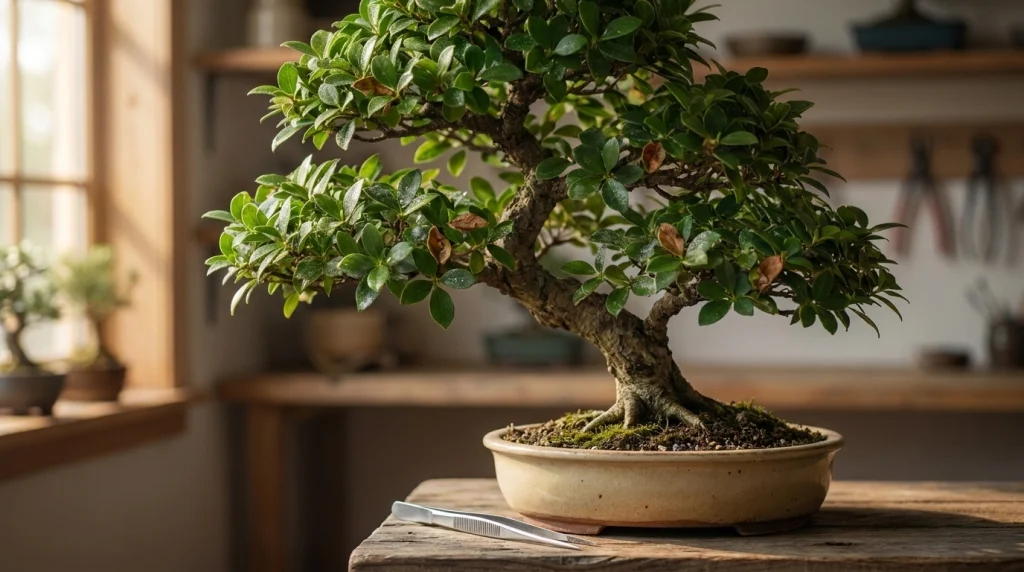
Look for patterns rather than relying on a single damaged leaf. Slow-drying inner foliage, crowded branches, and recurring leaf symptoms together provide stronger clues than any one sign.
Inspect the inner canopy
Check the shaded areas inside the tree, especially where several branches cross or leaves overlap. These areas may stay damp longer than the outer canopy.
Look for:
- Leaves that remain wet long after exposed leaves have dried.
- White powdery growth or spreading leaf lesions.
- Dead leaves trapped between branches.
- Very dense shoots blocking the canopy’s interior.
- Repeated disease symptoms in the same sheltered area.
Check the growing environment
Consider where the tree sits and how the surrounding air moves. A bonsai placed in a closed display cabinet or tight corner may receive less circulation than one on an open, suitable growing bench.
Also examine the watering routine, drainage, light exposure, and recent weather. Yellow leaves and browning can result from underwatering, root damage, sun scorch, seasonal changes, or pests rather than poor airflow.
Separate symptoms from causes
White patches may indicate mildew, but brown leaf tips alone don’t prove an airflow problem. Likewise, a damp soil surface doesn’t establish that the foliage canopy is poorly ventilated.
Photograph affected areas and record when symptoms first appeared. Note recent rain, watering, changes in placement, and any pruning or treatment.
When the cause remains unclear, compare your observations with a reliable diagnostic guide such as the bonsai problem diagnosis guide before applying treatment.
Section Takeaway: Diagnose the full growing environment, not just the visible damage. Airflow is one factor among several that can influence bonsai health.
How Can You Improve Bonsai Air Circulation?
You can often improve airflow by spacing trees, clearing dead debris, choosing a more suitable position, and managing overly dense foliage. Start with environmental adjustments before considering major pruning.
Give each tree enough space
Avoid pushing pots tightly together, particularly during warm, humid weather. Leave enough room for air to move between the foliage and for you to inspect each tree comfortably.
There is no universal spacing measurement for every bonsai. A small, open juniper canopy needs a different arrangement from a dense tropical ficus or a broad-leaved maple.
Choose a suitable position
Outdoor bonsai generally benefit from an open growing area with species-appropriate light and natural air movement. Avoid permanently enclosing trees in a stagnant, damp space.
For indoor tropical bonsai, provide adequate room ventilation while maintaining suitable warmth and light. Don’t place a tree directly in the path of a powerful fan, heater, or air-conditioning vent.
Strong drafts can dry foliage rapidly, damage sensitive growth, or cause temperature stress. The goal is gentle circulation, not constant forceful wind.
Manage dense foliage carefully
Overlapping growth can limit airflow through the canopy, but aggressive pruning is not a universal solution. Removing too much healthy foliage can weaken a tree and interfere with its recovery.
Begin by removing fallen leaves and clearly dead material. If a canopy needs structural thinning, consider the species, season, health, and intended design before making cuts.
Pro tip: If significant live branches must be removed, consult an experienced bonsai grower or local bonsai club before making irreversible cuts, especially when the tree is already unhealthy.
Use fans carefully indoors
A small fan can help circulate room air when natural ventilation is limited. Aim for gentle, indirect movement across the growing area rather than a concentrated stream directly at the foliage.
Check the tree after changing the setup. If leaves dry unusually fast, become brittle, or show signs of cold or heat stress, adjust the fan position or intensity.
Keep the growing area clean
Remove fallen foliage, decaying plant matter, and debris from benches. Clean tools between trees when disease is suspected, and avoid moving contaminated material between healthy plants.
Sanitation reduces potential sources of infection and makes early symptoms easier to spot. It works best alongside proper watering, drainage, light, and ventilation.
Section Takeaway: Improve circulation gently and gradually. Spacing, sanitation, and appropriate placement should come before drastic pruning or forceful fan use.
How Do Airflow, Watering, and Humidity Work Together?
Airflow, humidity, and watering influence one another, but they are not interchangeable. Healthy bonsai care balances the tree’s need for moisture with sufficient drying and oxygen around its roots.
Does high humidity always cause disease?
No. Many tropical bonsai tolerate or benefit from moderate to high humidity when their other growing needs are met. Disease risk depends on the species, pathogen, temperature, foliage wetness, and length of exposure.
The problem is not simply a high humidity reading. Risk rises when conditions repeatedly favor a particular pathogen and the tree has susceptible tissue.
Should you stop misting your bonsai?
Not every bonsai needs routine misting, and misting is not a substitute for watering the roots. Frequent leaf wetting may be unhelpful when foliage stays damp for long periods, especially in a crowded or poorly ventilated area.
If you mist, consider the species and environment, and allow foliage to dry appropriately. Don’t use misting to compensate for inadequate root watering or unsuitable humidity.
How should you water to reduce disease risk?
Water according to the tree’s needs, not a fixed calendar. Soil type, pot size, weather, season, species, and root density all affect how quickly the growing medium dries.
- Check the growing medium regularly, especially during active growth and hot weather.
- Water thoroughly when needed and allow excess water to drain.
- Avoid routinely wetting foliage late in the day when it cannot dry before night.
- Keep drainage holes clear and investigate soil that stays saturated unusually long.
- Adjust care for the species rather than following one routine for every tree.
Watering in the morning can give foliage more time to dry when leaves become wet during watering. However, root watering remains the priority, and a bonsai should not be left thirsty simply to keep its leaves dry.
How do soil and root health fit in?
Good bonsai substrate provides both moisture retention and air spaces around the roots. Compacted or poorly draining soil can remain saturated and contribute to root decline even when the foliage has plenty of airflow.
If a tree wilts while its soil remains wet, don’t automatically add more water. Check drainage and investigate root health carefully before deciding on a remedy.
Section Takeaway: Healthy care combines suitable airflow, sensible leaf-wetting practices, appropriate humidity, and well-draining soil. Correcting only one factor may not solve the problem.
How Should You Diagnose and Manage Suspected Disease?
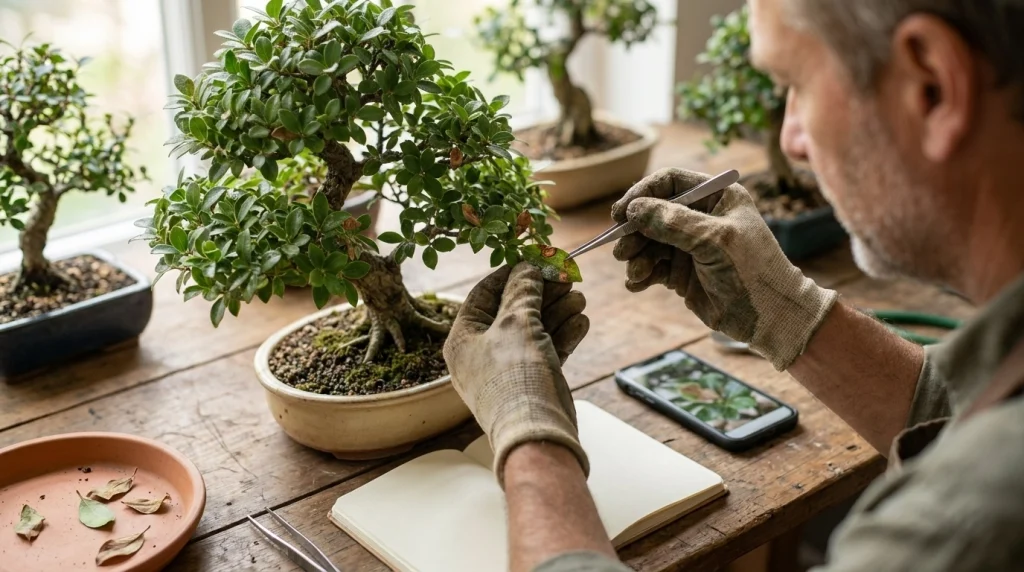
If your bonsai develops suspicious growth or spreading leaf damage, identify the likely problem before treating it. Improving airflow helps prevention, but an established infection may require additional measures.
Follow a simple diagnostic process
- Inspect the symptoms. Photograph spots, powdery patches, damaged shoots, and affected leaf undersides.
- Check the environment. Review spacing, ventilation, recent rain, watering, light, and temperature.
- Remove debris. Clear fallen leaves and clearly dead material without stripping healthy foliage.
- Improve circulation. Adjust the tree’s position and spacing where appropriate.
- Monitor progression. Take repeat photographs and watch whether new growth develops symptoms.
- Confirm the cause. Seek specialist advice if the damage spreads, the diagnosis is uncertain, or branches begin dying back.
When should you use a fungicide?
Use a fungicide only when the suspected disease and product label justify it. Different pathogens require different treatments, and some symptoms that resemble fungal disease are caused by environmental stress or bacteria.
Check that the product is labeled for the relevant plant and disease, and follow all application directions. Test or confirm suitability for sensitive species when the label or reliable guidance calls for it.
Don’t combine multiple treatments or apply chemicals repeatedly without a clear diagnosis. Unnecessary applications may damage foliage and expose people, pets, and beneficial organisms to avoidable risks.
When does a bonsai need expert help?
Seek experienced help when disease spreads rapidly, several branches die back, roots appear soft and decayed, or the tree declines despite correcting its environment. These symptoms can indicate a more serious problem than stagnant air alone.
The Royal Horticultural Society’s bonsai guidance provides broader care information, including common problems. A local bonsai club or horticultural diagnostic service can help identify a disease affecting a particular species.
Section Takeaway: Improve airflow while investigating the actual cause of the symptoms. Environmental corrections and disease-specific treatment serve different purposes.
Frequently Asked Questions
Can poor airflow kill a bonsai?
Poor airflow alone does not usually kill a healthy bonsai immediately, but it can contribute to recurring disease under favorable conditions. Serious infections, prolonged root problems, or several combined stresses can eventually cause major decline or death.
Does every bonsai need a fan?
No. Many outdoor bonsai receive adequate natural air movement, while indoor trees may benefit from better room ventilation. Use a fan only when needed, and avoid strong direct airflow that rapidly dries foliage or exposes the tree to temperature stress.
Can poor airflow cause powdery mildew?
Poor airflow can create conditions that favor powdery mildew on susceptible plants, particularly in humid, crowded canopies. However, the disease also depends on the specific fungus and environmental conditions, and not every white patch is mildew.
Is high humidity bad for bonsai?
Not necessarily. Some tropical bonsai tolerate or benefit from higher humidity, while many outdoor species need different conditions. Problems arise when humidity, leaf wetness, temperature, and poor circulation combine to favor disease or when the environment does not suit the species.
Should I prune my bonsai to improve airflow?
Pruning can improve circulation through an excessively dense canopy, but heavy pruning may weaken an unhealthy tree. Remove dead debris first and assess the species, season, and tree condition before cutting healthy branches.
Can better airflow cure an existing fungal infection?
Better airflow can reduce favorable conditions for some fungal diseases, but it may not eliminate an established infection. Remove affected debris where appropriate, identify the pathogen, and use a suitable labeled treatment if needed.
How can I tell whether a bonsai has poor airflow or overwatering problems?
Poor airflow is suggested by slow-drying inner foliage and crowded placement, while overwatering concerns may include persistently saturated soil, poor drainage, and declining roots. Both can occur together, so examine foliage, substrate, and root health rather than relying on one symptom.
Keep Your Bonsai Healthy With Better Air Circulation
Good airflow is a simple but important part of preventing bonsai disease. By allowing foliage to dry appropriately, keeping trees from becoming overcrowded, and maintaining clean growing conditions, you can reduce the environmental conditions that favor some fungal problems.
Start with small changes: space your pots, remove dead leaves, check ventilation, and review your watering routine. Then monitor new growth and investigate symptoms that continue or spread.
Healthy bonsai care is about balance. Give your tree the light, moisture, drainage, and gentle air movement its species needs, and you’ll be better prepared to prevent disease before it becomes serious.