Bonsai Pests and Diseases: Complete Guide for Beginners

A few yellow leaves, tiny webs, sticky residue, or a branch that suddenly starts dying can make any bonsai owner worry. Because bonsai trees grow in small containers with limited soil and root space, problems can become noticeable quickly.
The good news is that many bonsai pests and diseases are manageable when you recognize the warning signs early. The key is to identify whether you are dealing with an insect, mite, fungal or root disease, or simply a care problem that looks like disease.
This beginner-friendly guide explains the most common bonsai pests, typical diseases, warning signs, treatment options, prevention methods, and when a struggling tree needs experienced help.
Quick Answer
Bonsai pests and diseases are usually easiest to manage when detected early. Common problems include aphids, spider mites, scale, mealybugs, fungus gnats, root rot, leaf spots, and powdery mildew. Isolate affected trees, identify the problem before treating it, correct poor growing conditions, and use pesticides only when necessary and according to the label.
Are Bonsai Trees More Vulnerable to Pests and Diseases?
A bonsai is not a genetically miniature tree. In most cases, it is a normal tree or shrub species kept small through pruning, root management, and container cultivation.
That means it can attract many of the same insects and develop many of the same diseases as a full-sized version of the species.
The difference is that a bonsai has less room for error. Its relatively small root system and limited soil volume mean prolonged overwatering, severe drought, poor drainage, or heavy pest pressure can reduce vigor quickly.
A healthy bonsai can usually tolerate minor pest activity better than an already stressed tree.
Common stress factors include:
- Too much or too little water
- Poorly draining soil
- Insufficient light
- Keeping an outdoor species indoors
- Excessive fertilizer
- Heavy pruning at the wrong time
- Recent repotting or root pruning
- Extreme heat or cold
- Poor air circulation
Do not assume every yellow or falling leaf means disease. Watering, seasonal leaf drop, temperature changes, insufficient light, and root stress can produce similar symptoms.
Bonsai Pest and Disease Warning Signs
Inspecting your bonsai regularly is one of the most useful habits you can develop.
Pay special attention to new shoots, leaf undersides, branch junctions, bark crevices, the soil surface, and drainage holes.
| Warning sign | Possible problem | First thing to check |
|---|---|---|
| Fine webbing and speckled leaves | Spider mites | Leaf undersides |
| Sticky leaves or branches | Aphids, scale, mealybugs | Stems and new growth |
| White cotton-like material | Mealybugs | Leaf joints and branches |
| Small brown or gray bumps | Scale insects | Bark and stems |
| Tiny flies around soil | Fungus gnats | Wet growing medium |
| Yellowing plus wilting | Root trouble or watering stress | Soil moisture and roots |
| Brown or black leaf spots | Fungal/bacterial disease or stress | Leaf condition and airflow |
| White powder on leaves | Powdery mildew | Both leaf surfaces |
| Black, soft, mushy roots | Root rot | Root system |
| Sudden branch dieback | Disease, root damage, pests, or severe stress | Entire tree |
Some symptoms overlap, so diagnosis should come before treatment.
Common Bonsai Pests
Many bonsai pests are tiny. A hand lens or inexpensive magnifying glass can make identification much easier.
The University of Minnesota Extension guidance on indoor plant insects describes several common plant pests and emphasizes checking leaves closely for insects and feeding damage. (University of Minnesota Extension)
Aphids
Aphids are small, soft-bodied insects commonly found around tender shoots, buds, and new leaves.
They feed by removing plant sap. A light infestation may cause little lasting harm, but larger populations can weaken young growth.
Look for:
- Clusters of tiny insects
- Curled or distorted new leaves
- Sticky residue called honeydew
- Ants visiting the tree
- Weak new shoots
For a small infestation, carefully removing or washing away aphids may be enough. Heavier infestations may require a product labeled for the plant and pest.
Always inspect again several days later because one treatment may not remove every life stage.
Spider Mites
Spider mites are among the pests bonsai growers should learn to recognize early.
They are not insects; they are tiny relatives of spiders. Their size makes individual mites difficult to see without magnification.
Common signs include:
- Fine webbing
- Pale dots or stippling on leaves
- Bronze or faded foliage
- Premature leaf drop
- Tiny moving dots underneath leaves
Spider mite populations can increase quickly under favorable conditions. University of Minnesota Extension notes that fine webbing and speckled or mottled foliage are useful diagnostic signs and that mites often occur on leaf undersides. (University of Minnesota Extension)
Do not assume misting alone will cure a mite infestation. You still need to inspect the tree and use an appropriate control method when pest numbers are significant.
Scale Insects
Scale insects often look more like bumps on a branch than insects.
Depending on the type, they may appear brown, tan, white, waxy, or shell-like. Adult scale may remain attached to stems and leaves while feeding.
Signs include:
- Small stationary bumps
- Sticky foliage
- Yellow leaves
- Reduced vigor
- Black sooty growth developing on sticky honeydew
A few accessible scale insects can sometimes be removed manually with care.
Large infestations are more difficult because scale insects have life stages with different susceptibility to treatments. Correct identification becomes especially important before applying insecticides or horticultural oils.
Mealybugs
Mealybugs are easy to recognize once you know what to look for.
They often appear as small white insects surrounded by cotton-like or waxy material.
Check:
- Branch junctions
- Leaf axils
- Under leaves
- Around exposed roots
- Tight bark crevices
Mealybugs also produce honeydew and can spread between plants.
Isolate an affected bonsai from nearby trees as soon as practical.
Fungus Gnats
Small dark flies hovering around a bonsai pot may be fungus gnats.
The adults are mostly a nuisance, while their larvae live in moist organic growing media. Continually wet soil can encourage their populations.
Fungus gnats are therefore sometimes an important clue that the growing medium is staying wet for too long.
Do not respond by allowing a water-loving bonsai to become severely dry. Instead, review:
- Soil drainage
- Watering frequency
- Pot drainage holes
- Soil composition
- Species-specific moisture needs
Improving growing conditions is often more useful than repeatedly killing adult gnats.
Whiteflies and Thrips
Whiteflies and thrips can also affect container plants.
Whiteflies often fly up when disturbed, while thrips are slender insects that can scar, distort, or discolor leaves.
Both can be difficult for beginners to identify accurately. A magnifier and clear close-up photographs can help.
How to Check a Bonsai for Pests
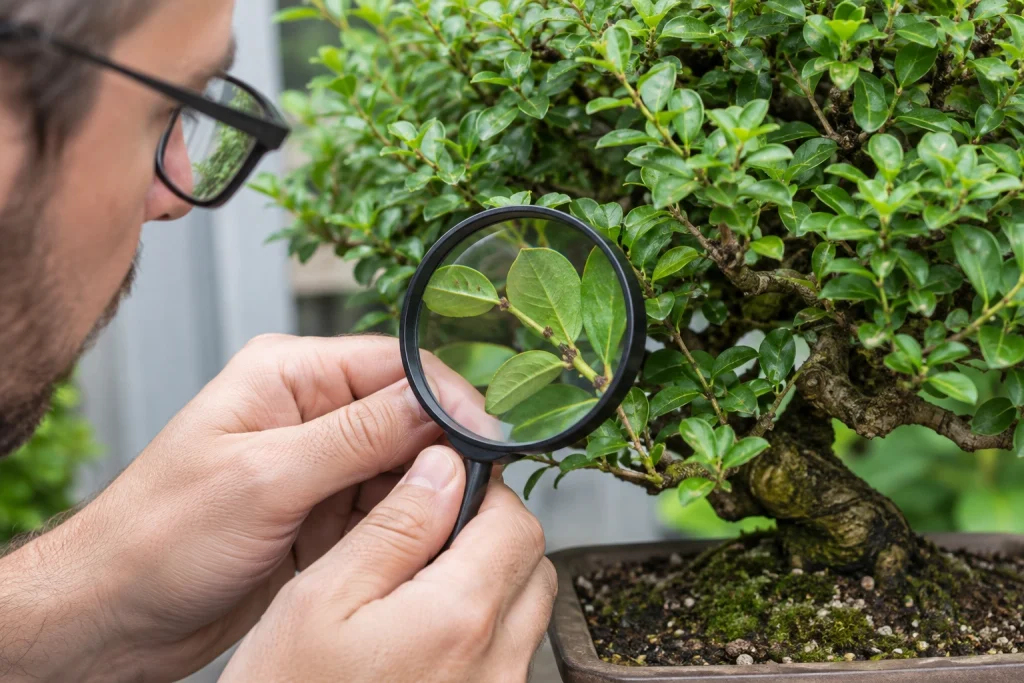
Use the same inspection routine every time.
- Move the bonsai away from other plants. This reduces the chance of pests spreading while you investigate.
- Look at the newest growth. Tender shoots are common feeding sites for sap-feeding pests.
- Turn leaves over. Spider mites, scale, aphids, and other pests may hide underneath.
- Inspect the trunk and branches. Look for bumps, cotton-like material, damaged bark, or unusual discoloration.
- Check the soil surface. Watch for insects, excessive moisture, mold-like growth, or decaying organic matter.
- Use a magnifying glass. Tiny mites and juvenile insects can otherwise be missed.
- Photograph the symptoms. Pictures make it easier to compare changes or ask an experienced grower for help.
Common Bonsai Diseases
Not every bonsai disease is caused by the same type of organism, and visual symptoms alone do not always identify the exact pathogen.
For beginners, the safest approach is to recognize symptom patterns and correct obvious environmental problems before reaching for fungicides.
Root Rot
Root rot is one of the most serious problems for container-grown trees.
The term describes deterioration of roots associated with disease organisms and unfavorable root-zone conditions. Excessively wet growing media and poor drainage can create conditions favorable to several root-rot pathogens.
According to University of Maryland Extension guidance on root rots, warning signs can include yellowing, browning, wilting, poor growth, and brown-to-black roots that become soft or mushy. (University of Maryland Extension)
Possible bonsai warning signs include:
- Tree wilts even though soil remains wet
- Leaves turn yellow without an obvious seasonal reason
- Growth becomes weak
- Roots smell unhealthy or appear black
- Fine feeder roots disappear
- Roots feel soft instead of firm
Do not automatically repot and heavily root-prune a severely weakened tree. Major root work can add another layer of stress.
First determine why the root zone is failing. The problem may involve poor drainage, inappropriate soil, excessive watering, a blocked drainage hole, or disease.
Fungal Leaf Spots
Fungal leaf spots may appear as tan, brown, reddish, or black lesions.
The spots can remain small or enlarge and merge into damaged areas. Severe disease can eventually contribute to leaf loss and shoot decline.
University of Maryland Extension’s fungal leaf spot guidance notes that reducing leaf wetness and improving air circulation can help lessen conditions favorable for infection. (University of Maryland Extension)
If you suspect leaf spot:
- Remove badly affected fallen leaves
- Keep the growing area clean
- Avoid unnecessarily keeping foliage wet
- Improve air movement
- Avoid crowding trees together
- Identify the disease before applying fungicide
Do not remove most of the foliage from a weak bonsai simply because a few leaves are spotted.
Powdery Mildew
Powdery mildew usually appears as white or gray powdery patches on leaves, shoots, or buds.
It is caused by a group of fungi. University of Minnesota Extension notes that infected foliage can become yellow, distorted, or prematurely shed in more severe cases. (University of Minnesota Extension)
Good spacing and airflow are useful preventive measures.
If only a small portion is affected, removing infected material may help, provided doing so will not excessively defoliate the tree.
Bacterial and Other Leaf Diseases
Some bacterial diseases can produce dark, water-soaked-looking lesions that may resemble fungal spots.
This is one reason treatment based only on a quick visual guess can fail.
If damage spreads rapidly despite improved care, professional or extension-based diagnosis may be worthwhile.
Pest, Disease, or Care Problem? How to Tell
A stressed bonsai frequently gets misdiagnosed as a diseased bonsai.
Before treating anything, ask yourself:
Did the problem begin after a care change?
Think about recent:
- Repotting
- Root pruning
- Wiring
- Major branch pruning
- Fertilizing
- Relocation
- Heat waves
- Cold exposure
- Indoor-to-outdoor movement
- Changes in watering
If the foliage suddenly scorched one day after moving a shade-grown tree into intense sunlight, an insecticide is unlikely to solve the problem.
Likewise, wilting in wet soil should make you inspect root health rather than simply adding more water.
Expert Tip: Before treating a sick bonsai, photograph the whole tree, leaves, trunk, soil, and roots if safely visible. Comparing photographs over several days often reveals whether the problem is spreading, stabilizing, or related to changing growing conditions.
How to Treat Bonsai Pests Safely
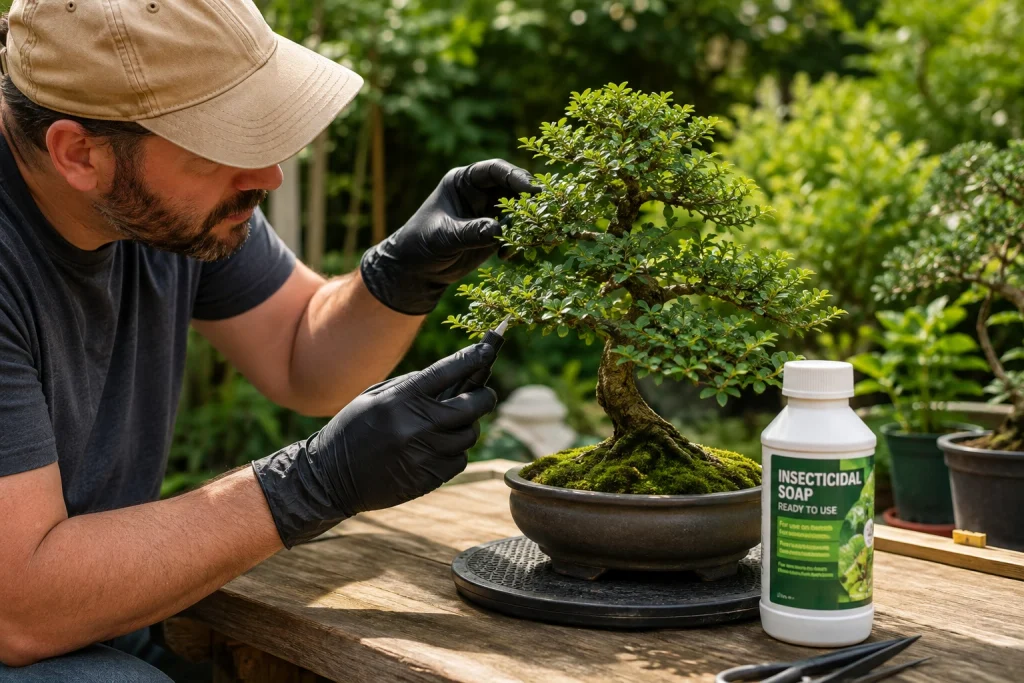
Treatment should begin with the least disruptive option likely to work.
1. Isolate the Bonsai
Move the affected plant away from other trees.
Inspect nearby plants because pests may already have spread.
2. Identify the Pest
Avoid spraying an unknown pest with whatever product happens to be available.
Different pests respond differently to treatment.
3. Use Physical Controls When Practical
Small infestations may sometimes be reduced by:
- Washing pests from foliage
- Manually removing scale
- Removing heavily infested individual leaves
- Cleaning dead plant material
- Pruning a badly infested shoot when horticulturally safe
4. Choose a Properly Labeled Product If Needed
Insecticidal soaps, horticultural oils, and other pest-control products may be useful in certain situations, but species tolerance and product labeling matter.
Some bonsai foliage can be sensitive to sprays, especially during heat, intense sunlight, drought stress, or immediately after major horticultural work.
The EPA advises gardeners to use non-chemical controls where practical and, when pesticide use is necessary, to read and follow the entire product label, including application rates and safety precautions. (US EPA)
You can review the EPA’s pesticide safety recommendations before using a pesticide around your home, children, or pets. (US EPA)
Never assume that doubling the concentration makes a treatment more effective. It can injure the plant and increase unnecessary exposure.
5. Recheck the Tree
Pest control is rarely a spray-once-and-forget process.
Inspect the bonsai at intervals appropriate to the pest and product instructions. Eggs or immature life stages may remain after the first treatment.
How to Prevent Bonsai Pests and Diseases
Prevention usually costs less and puts less stress on the tree than treating a severe infestation.
Quarantine New Bonsai
Keep newly purchased bonsai separated from your established collection long enough to inspect them carefully.
Look beneath leaves and around branches instead of judging the tree only from a distance.
Keep Your Tools Clean
Dirty pruning scissors, root cutters, or other tools can move contaminated plant material between trees.
Clean your tools regularly, and disinfect them appropriately when working on suspicious or diseased tissue.
Use Suitable Bonsai Soil
Good bonsai soil must balance drainage, aeration, and moisture retention.
The correct mix depends on factors such as species, climate, pot size, and watering habits.
A tropical ficus, moisture-loving deciduous species, and drought-tolerant conifer should not automatically receive identical care.
Water According to the Tree, Not the Calendar
A rule such as “water every two days” ignores weather, species, soil, pot size, and season.
Check the growing medium and water when the individual bonsai needs it.
Persistent saturation can contribute to root problems, while repeated severe drying can weaken the tree and make recovery from other stress more difficult.
Provide Appropriate Light and Airflow
Light requirements differ between species.
Many commonly sold juniper bonsai, for example, are outdoor trees rather than permanent indoor houseplants.
Tropical bonsai may tolerate or require indoor protection in cold climates, but they still need adequate light and suitable growing conditions.
Healthy growth is one of your best defenses against secondary problems.
What Does Bonsai Pest Treatment Cost?
Minor infestations are usually inexpensive to address if detected early.
A beginner may only need basic items such as:
- Hand lens or magnifier
- Clean pruning scissors
- Disposable gloves
- Appropriate pest treatment
- Replacement soil when repotting is actually necessary
Basic supplies may cost only a modest amount, while repeated treatments, specialized products, diagnostic services, or replacing a valuable mature bonsai can cost considerably more.
Buy treatment products for suitability, not simply the lowest price. A large, inexpensive bottle is poor value if it is inappropriate for the pest or unsafe for the species being treated.
Quality bonsai tools can also last many years if maintained properly, but premium tools are not required to diagnose an aphid infestation. Beginners should spend first on good growing conditions, clean tools, and correct identification.
When to Repot a Sick Bonsai
Repotting is not a universal treatment for pests or disease.
Do not repot simply because leaves are yellow.
Repotting may be appropriate when there is strong evidence of a root-zone problem such as:
- Severely degraded soil
- Drainage failure
- Confirmed root rot
- A container problem affecting root health
Even then, timing and species matter.
Emergency root work on a weak bonsai carries risk. Removing too many roots from an already declining tree can reduce its ability to recover.
If you are unsure, seek experienced advice before performing aggressive root pruning.
When to Ask an Experienced Bonsai Grower or Arborist
Beginner-level treatment is reasonable for mild, identifiable problems. Some situations deserve more experienced diagnosis.
Ask an experienced bonsai grower, plant-disease specialist, extension service, or qualified arborist when:
- An expensive or old bonsai is declining rapidly
- Several branches die without an obvious cause
- The trunk or major roots develop suspicious lesions
- Root rot appears severe
- You cannot identify the pest
- Symptoms continue after correcting care
- Multiple bonsai develop the same problem
- You suspect a serious infectious disease
- Treatment would require major root or structural work
An arborist is especially useful when the problem involves tree biology or a potentially serious woody-plant disease. A bonsai specialist may be better suited to questions involving seasonal care, styling, repotting, and species-specific recovery.
For unusual diseases, your local university extension or plant diagnostic laboratory may be able to provide a more precise diagnosis.
Common Mistakes Bonsai Owners Should Avoid
- Treating before identifying. Yellow leaves alone do not prove that insects or fungus are present.
- Overwatering a weak tree. Wilting does not always mean the bonsai needs more water.
- Using household chemicals as pesticides. Homemade mixtures may damage foliage or roots.
- Applying too much pesticide. More product is not automatically more effective or safer.
- Ignoring leaf undersides. Many tiny pests are easiest to find there.
- Treating only once and never reinspecting. Remaining eggs or juveniles may allow a population to return.
- Repotting every sick bonsai. Root disturbance can worsen stress when the roots were not the original problem.
- Fertilizing heavily to “strengthen” a sick tree. Fertilizer does not cure pests or root disease and can add stress when roots are damaged.
- Keeping a species in the wrong environment. Outdoor bonsai need outdoor seasonal conditions appropriate to their species.
- Placing a newly purchased bonsai immediately beside your collection. Quarantine gives you time to discover hidden pests.
FAQs
What are the most common pests on bonsai trees?
Common bonsai pests include aphids, spider mites, scale insects, mealybugs, fungus gnats, whiteflies, and thrips. The pests you encounter will vary by bonsai species and whether the tree is grown indoors or outdoors.
How do I know if my bonsai has spider mites?
Look for pale or speckled foliage, fine webbing, and tiny moving mites on leaf undersides. Holding white paper beneath a branch and gently tapping the foliage can also make tiny pests easier to notice.
Can a bonsai recover from root rot?
A bonsai may recover if enough healthy roots remain and the underlying problem is corrected. Severe root decay is much more difficult to reverse. Avoid aggressive DIY root pruning unless you understand the species, season, and condition of the tree.
Should I spray my bonsai whenever I see an insect?
No. First determine whether the insect is actually a damaging pest. Some insects are harmless or beneficial. When treatment is necessary, select a product labeled for the intended pest and use and follow its instructions exactly.
Why are my bonsai leaves turning yellow?
Possible causes include excessive water, insufficient water, poor light, root stress, pests, disease, seasonal changes, or nutrient problems. Check the whole tree and its recent care history before choosing a treatment.
Should I throw away a bonsai with pests?
Usually not. Many common infestations can be controlled, particularly when found early. Isolation and proper treatment are often enough. Disposal may become reasonable if a low-value plant has an overwhelming infestation or dangerous disease that threatens a larger collection.
How often should I check my bonsai for pests?
Briefly inspect your bonsai whenever you water it, and perform a more careful inspection regularly during periods of active growth. Check new growth, leaf undersides, bark, and the soil surface. More frequent inspection is worthwhile after adding a new tree to your collection.
Conclusion
Successful bonsai pest management begins with observation rather than spraying. Learn what healthy growth looks like, inspect your trees regularly, and respond when something changes.
The most common bonsai pests and diseases—including aphids, spider mites, scale, mealybugs, root rot, and fungal leaf problems—are far easier to manage when detected early. Isolation, correct identification, good watering practices, suitable soil, proper light, airflow, and careful treatment can prevent a small problem from becoming a serious one.
Most importantly, avoid treating symptoms blindly. A yellow leaf may signal pests, damaged roots, poor light, watering stress, or simply a normal seasonal change.
Make bonsai inspection part of your regular watering routine. Check the leaves, branches, soil, and overall vigor of your tree today; catching the first warning sign is often the simplest way to protect your bonsai for years to come.