How to Tell if a Bonsai Has Root Rot

Quick Answer
To tell if a bonsai has root rot, look for several warning signs together: persistently wet soil, yellowing or wilting foliage, stalled growth, branch dieback, and roots that are soft, decaying, or losing their fine feeder roots. Dark roots alone do not prove root rot, because root color varies by species, age, and substrate; healthy roots should mainly feel firm and functional. Good bonsai soil drainage and aeration are therefore central to both diagnosis and prevention.
Root Rot Signs to Check
- Wet soil: The substrate stays saturated much longer than it normally should.
- Soft roots: Fine roots feel mushy, weak, or separate easily instead of remaining firm.
- Yellow foliage: Leaves or needles lose color even though the tree is not obviously dry.
- Persistent wilting: The bonsai droops while the root ball is still wet.
- Weak growth: New shoots become small, sparse, or stop developing.
- Root loss: Fine feeder roots disappear and the remaining root system looks reduced.
Best Way to Confirm It
- Compare the foliage symptoms with soil moisture, drainage speed, root firmness, and recent watering history before cutting roots or applying a fungicide.
If you’re trying to learn how to tell if a bonsai has root rot, start below the leaves rather than assuming every yellow leaf means diseased roots. Root rot in bonsai can resemble drought, fertilizer damage, heat stress, or ordinary seasonal leaf loss.
I pay closest attention to patterns. When a tree stays wet, loses vigor, and develops weak roots at the same time, I investigate the root zone before changing several things at once.
In This Guide
What Does Root Rot Look Like on a Bonsai?
Root rot usually shows itself as a combination of declining foliage, persistently wet substrate, and damaged roots. You should be more suspicious when several symptoms develop together.
Definition: Root rot is a general term for deterioration of roots caused by damaging root-zone conditions, disease organisms, or both. Waterlogged soil can deprive roots of oxygen, while wet conditions can also favor pathogens such as Phytophthora and Pythium.
Above-ground warning signs
The canopy often reacts before you see the roots. Damaged roots struggle to support normal water and nutrient movement.
- Yellow leaves or needles: Color fades without a clear seasonal reason.
- Wilting in wet soil: Foliage droops even though moisture is available.
- Slow growth: New shoots become smaller or fail to extend.
- Leaf drop: Leaves fall earlier or faster than expected.
- Branch dieback: Fine twigs weaken as root decline becomes more severe.
Penn State Extension notes that Phytophthora root disease in woody ornamentals can cause reduced foliage, wilting, dead feeder roots, and severely reduced root systems. Poorly drained or wet soil strongly favors the pathogen.
See the Penn State Extension guidance on Phytophthora root rot for a broader horticultural reference.
Below-ground warning signs
The roots give you better evidence than foliage alone. Texture matters more than color by itself.
- Soft tissue: Damaged roots may feel mushy rather than firm.
- Sloughing roots: The outer tissue may separate easily when handled.
- Missing feeder roots: The fine branching root network becomes sparse.
- Dark decay: Brown or black areas become more concerning when paired with softness.
- Unhealthy odor: A stagnant or decaying smell can support the diagnosis, although its absence does not rule rot out.
Woody roots can naturally be brown, and substrate particles can stain them. Never diagnose root rot from color alone.
Section Takeaway: Root rot is a pattern, not a single symptom. Wet soil plus declining foliage plus soft or disappearing feeder roots is far more meaningful than yellow leaves or dark roots alone.
How Do You Check Bonsai Roots for Rot?
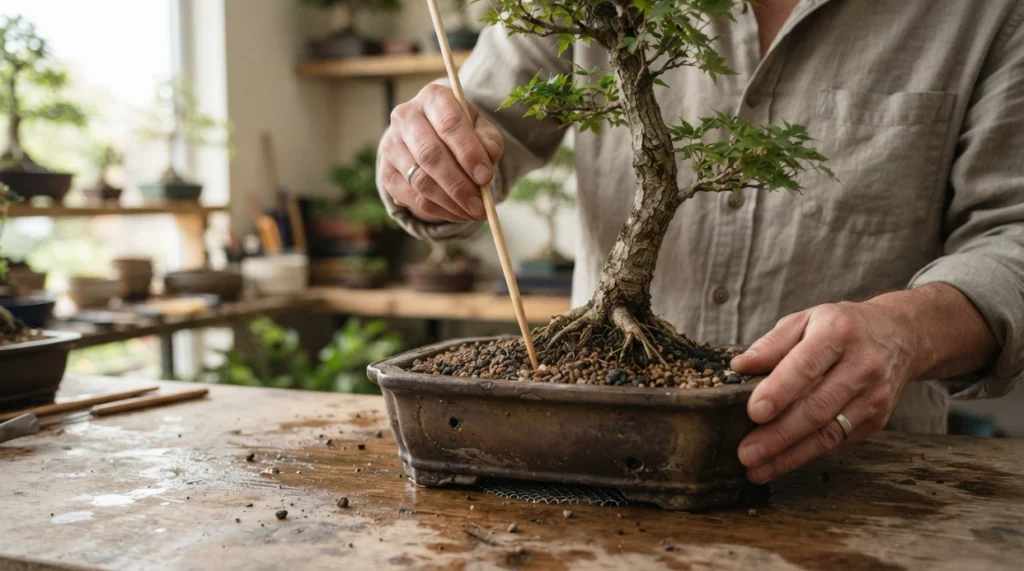
Start with the least invasive checks. Disturbing a weak root system unnecessarily can make an already stressed bonsai harder to recover.
Check the substrate first
Push a wooden chopstick gently into the root zone or inspect moisture just below the surface. The goal is to learn whether the interior remains saturated long after watering.
Then watch what happens during the next watering.
- Does water soak in evenly?
- Does it pool on the surface?
- Does it take a long time to leave the drainage holes?
- Does the center of the root ball stay wet for days?
- Has old organic soil broken down into dense, muddy particles?
Slow drainage does not prove disease. It does tell you that the roots may be getting less air than they need.
Inspect visible roots
Check drainage holes and exposed surface roots before removing the tree. Look for firmness, branching, and live fine roots.
If the tree continues declining and root disease seems likely, carefully slide the root mass from the pot when practical. Avoid tearing the roots apart just to satisfy curiosity.
Pro tip: Root cutting is irreversible. If the tree is valuable, badly weakened, or unfamiliar to you, ask an experienced grower or local bonsai club for hands-on help before removing substantial roots.
Use firmness as your main clue
Healthy living roots should have structural integrity. Fine roots may be pale, tan, or brown depending on species, age, moisture, and substrate.
Roots that collapse, smear, or shed their outer tissue deserve more concern. Compare them with firm roots from another part of the root ball whenever possible.
Is It Root Rot or Something Else?
Many bonsai problems produce the same canopy symptoms. Before treating root rot, compare moisture, roots, and recent care changes.
| Problem | Soil / Root Clue | Canopy Clue | Useful Check |
|---|---|---|---|
| Root rot | Persistently wet substrate; soft or declining feeder roots | Wilting, yellowing, weak growth, possible dieback | Check drainage, root firmness, and root loss |
| Drought stress | Root ball becomes dry; dead fine roots may feel brittle | Wilting, crisp leaves, leaf drop | Review recent drying and watering history |
| Fertilizer or salt injury | Root tips may be damaged; mineral deposits may appear | Brown tips or margins, decline after feeding | Check fertilizer timing and concentration |
| Seasonal leaf loss | Roots remain firm and substrate behaves normally | Expected color change and leaf drop in deciduous species | Confirm species and season |
| Environmental shock | Roots may look normal | Leaf drop after sudden light, heat, cold, or location change | Review changes during the previous days or weeks |
One mistake I avoid is treating a wet, wilting tree as though it needs more water. A damaged root system can leave foliage wilted even while the substrate is saturated.
UC Integrated Pest Management similarly notes that root rot is often linked with overwatering, poor drainage, and aging potting media that has lost aeration. Its container-plant root rot guidance is useful when comparing these symptoms.
What Causes Root Rot in Bonsai?
Root rot usually begins with an unhealthy root environment, a pathogen, or an interaction between both. Water itself is not poisonous to bonsai roots; the problem is prolonged saturation and loss of oxygen around them.
Compacted or poorly draining substrate
Bonsai need a balance of moisture retention and air space. Fine, broken-down organic material can gradually reduce both drainage and aeration.
A shallow pot makes substrate structure especially important. If drainage holes clog or the soil becomes dense, water can remain around the roots longer than expected.
Watering by schedule instead of need
A tree may need water daily during hot, windy weather and much less during cool, cloudy conditions. Species, pot size, root density, substrate, humidity, and season all change drying speed.
Checking the tree before watering is safer than following a fixed calendar.
Root-disease organisms
Several organisms can cause or contribute to root disease. Phytophthora and Pythium are water molds, while other true fungi can also damage roots.
That distinction matters because there is no universal fungicide for every form of root decline. Environmental correction remains essential even when a pathogen is involved.
Stress before the rot appeared
A tree weakened by drought, heat, severe root work, excess fertilizer, or poor light may become less able to recover from root damage. Sometimes the first problem happened weeks before the roots began decaying.
As of 2026, my practical approach remains simple: reconstruct the tree’s recent care history before blaming a single fungus. That often reveals the trigger faster than the leaf symptoms do.
What Should You Do if Your Bonsai Has Root Rot?
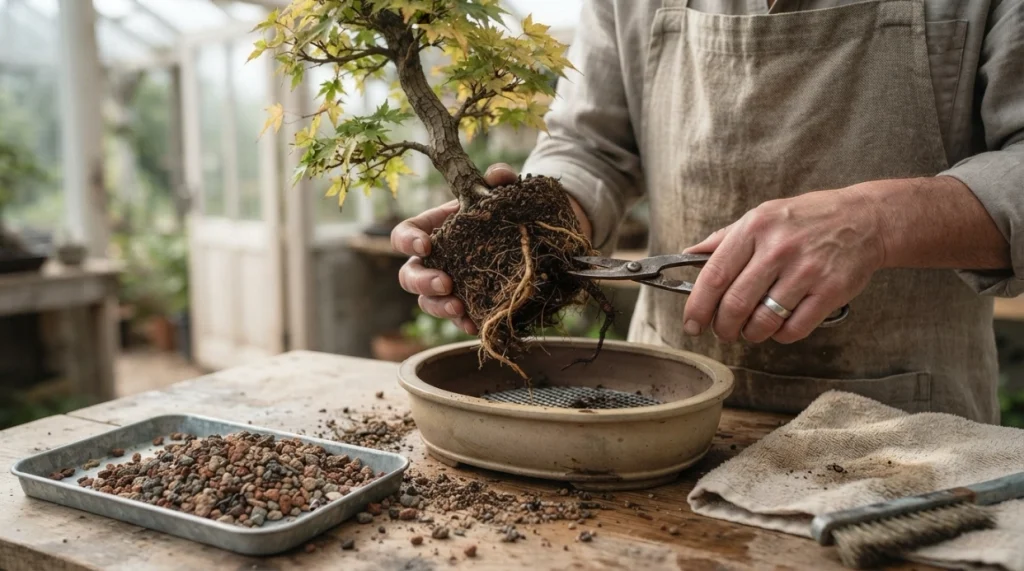
Correct the root-zone problem first. Do not automatically water more, fertilize heavily, or apply a random fungicide because the foliage looks weak.
- Stop automatic watering. Check the actual moisture in the root ball before adding more.
- Improve drainage. Make sure drainage holes are open and the pot is not sitting in standing water.
- Pause heavy fertilizing. A badly stressed root system does not need additional salt stress.
- Inspect the roots if decline continues. Focus on firmness, fine-root survival, and the extent of damaged tissue.
- Remove clearly dead tissue conservatively. Keep every firm, viable root you reasonably can.
- Use clean tools. Clean cutting tools before moving between healthy and diseased root tissue or different trees.
- Move to an appropriate draining substrate when root failure makes it necessary. Avoid leaving damaged roots in stagnant, airless soil.
Routine bonsai repotting is commonly timed around a species’ appropriate repotting season. Bonsai Empire’s bonsai repotting guide notes that early spring is a common repotting window for many species.
An emergency root problem is different from routine repotting. If the root system is actively failing, the risk of leaving it in unsuitable substrate must be weighed against the stress of out-of-season root work.
Pro tip: Do not aggressively bare-root or remove large amounts of living root from a weak bonsai unless you understand the species and its recovery needs. Get local expert help when the tree is valuable or the damage is extensive.
Should you use fungicide?
Not automatically. Fungicides cannot repair dead roots, and products differ in the organisms they control.
If you suspect a specific infectious root disease, identify the problem as closely as practical and follow a product label that covers both the target disease and plant use. Severe or recurring cases may justify professional diagnostic testing.
Section Takeaway: Save healthy roots first. Correct moisture and drainage, avoid unnecessary fertilizer, and use aggressive root work or disease treatments only when the evidence supports them.
How Can You Prevent Bonsai Root Rot?
Prevention comes down to keeping roots both moist and aerated. That balance is more important than trying to water a specific number of times each week.
- Use structured bonsai substrate: Choose particles that maintain useful air spaces while holding enough moisture for the species and climate.
- Keep drainage holes open: Water should be able to exit the container freely.
- Check moisture before watering: Learn how quickly each tree and pot dries.
- Adjust seasonally: Hot wind, summer growth, cool weather, and dormancy can produce different water demands.
- Repot when substrate structure declines: Old material that has broken down may hold water differently than it did when fresh.
- Avoid oversized moisture-retentive pots: The root system should not remain surrounded by stagnant wet substrate for prolonged periods.
- Keep tools and containers clean: Basic hygiene lowers the chance of carrying root pathogens from a sick plant to a healthy one.
One of the best habits is simply watching water move through the pot. A change from quick, even drainage to slow pooling tells me to investigate before the canopy begins showing severe symptoms.
Good substrate does not mean a bonsai can never be overwatered. It gives the root system better aeration and makes moisture easier to manage.
Frequently Asked Questions
Can a bonsai recover from root rot?
Yes, a bonsai can recover when enough healthy root tissue remains and the underlying cause is corrected. Recovery depends on the species, severity of root loss, season, and general tree strength. Severe rot that has destroyed most fine roots carries a much poorer outlook.
Are black bonsai roots always rotten?
No. Root color alone is not a reliable diagnosis. Older woody roots can be naturally dark, and soil components may stain root surfaces. Rot becomes more likely when dark roots are also soft, deteriorating, sloughing, or associated with persistent wetness and canopy decline.
What do healthy bonsai roots look like?
Healthy roots are primarily identified by firmness and functioning fine-root growth. Young feeder roots may look pale, cream, tan, or light brown, while older woody roots can be darker. Species, age, substrate, and moisture all influence appearance.
Does root rot make a bonsai wilt even when the soil is wet?
Yes. Damaged roots may lose the ability to move water effectively, so the foliage can wilt despite wet substrate. This is why automatically adding more water to a wilting bonsai can worsen a root-zone problem when the soil is already saturated.
Should I repot a bonsai immediately if I suspect root rot?
Not always. First check drainage, soil moisture, recent watering, and the severity of decline. Unnecessary root disturbance adds stress. However, severe root deterioration in stagnant substrate may require intervention even when the timing is not ideal.
Should I cut every brown root off my bonsai?
No. Brown does not automatically mean dead. Keep roots that remain firm and structurally sound. Remove only clearly dead or decayed tissue when root pruning is justified, and avoid sacrificing healthy roots simply because they are darker than expected.
Can overwatering cause bonsai root rot?
Persistent overwatering can create oxygen-poor root conditions and favor organisms associated with root disease. The real risk depends on drainage, substrate structure, temperature, species, pot size, and how quickly the root ball dries between waterings.
If you’re unsure whether your bonsai has root rot, do not diagnose it from one yellow leaf. Check the whole pattern: moisture, drainage, recent care, root firmness, fine-root survival, and the speed of the tree’s decline.
Catch the problem while healthy roots remain, and your options improve dramatically. When cutting roots would be risky, a local bonsai club or experienced grower can help you inspect the tree without causing unnecessary damage.
