Informal Upright Bonsai Style: How to Create It Step by Step

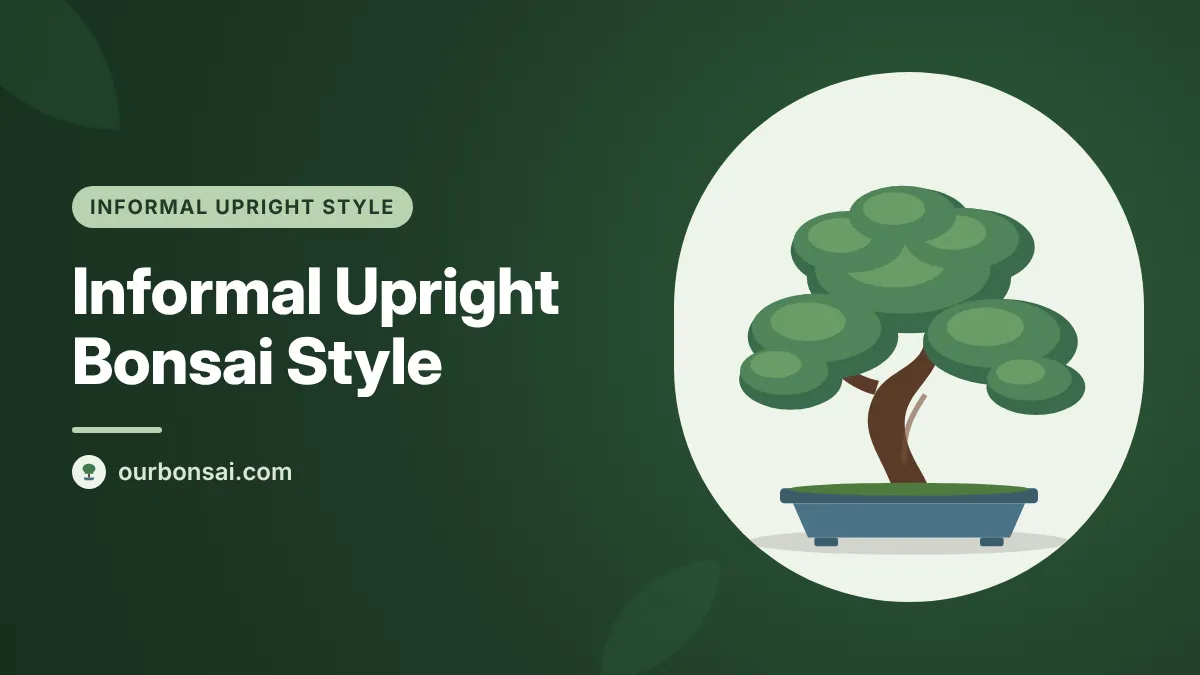
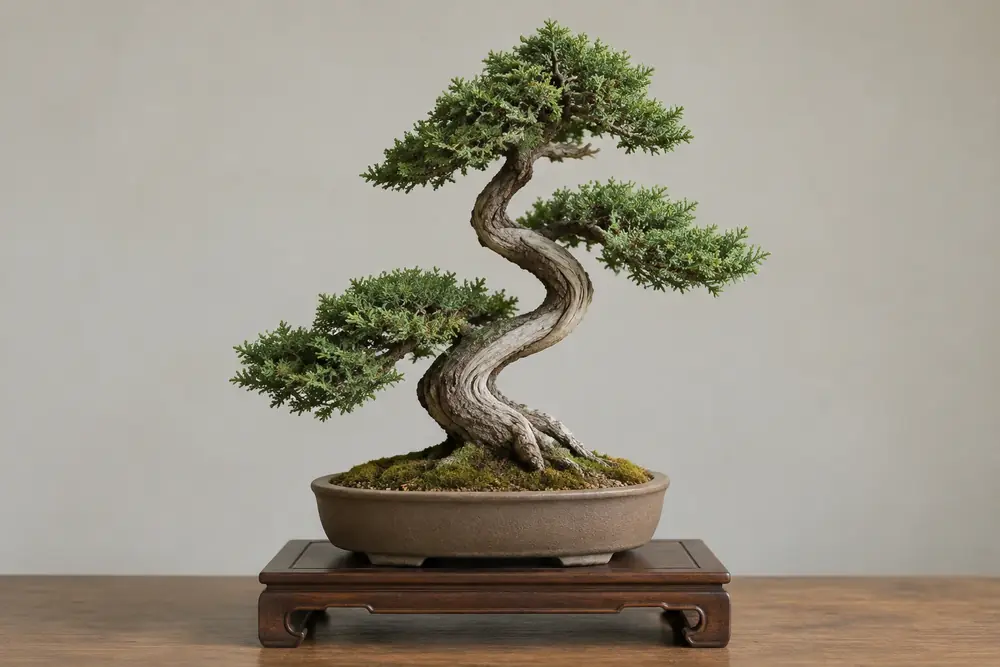
The informal upright bonsai style, or moyogi, is an upright tree with a curving trunk. The trunk moves from side to side (and ideally toward and away from the viewer) in gentle bends that get smaller toward the top, yet the apex ends up roughly above the base. Branches grow from the outside of each curve, the first and heaviest about a third of the way up the trunk. It is the most common bonsai style because almost every species suits it, from juniper and pine to maple, elm and ficus, and because natural irregularities in the material become part of the design rather than faults.
In this guide
How it differs from the formal upright
| Feature | Formal upright (chokkan) | Informal upright (moyogi) |
|---|---|---|
| Trunk line | Straight | Curving, S-shaped |
| Apex | Directly above base | Roughly above base, leaning slightly forward |
| Branch position | Spiral up a straight trunk | On the outside of each curve |
| Suitable material | Straight, tapered trunks only | Almost any upright tree |
| Forgiveness | Low; every flaw shows | High; flaws become character |
If you have a tree with a slight kink or bend that would ruin a formal upright, it may make a very good moyogi. Our overview of types of bonsai puts both styles in context.
The design rules
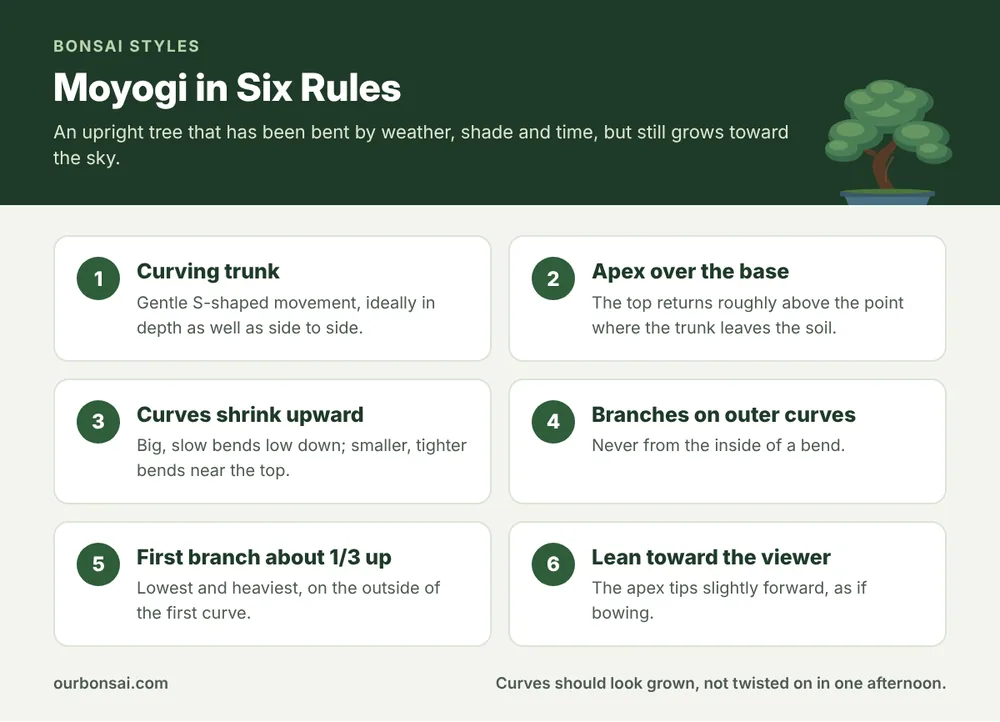
Think of a tree that grew upward but was nudged by shade, snow, or a neighboring tree along the way. Each time it bent, it corrected toward the light. That story gives the rules:
- Movement in three dimensions. A trunk that only curves left and right looks flat from the side. Add some movement toward and away from the viewer.
- Diminishing curves. The lowest bend is the largest. Each bend above it is shorter and tighter.
- Branches on the outside. A branch emerging from the inside of a bend looks crowded and unnatural. Choose or develop branches on the outer curve.
- A balanced apex. The top usually leans a little toward the front, which makes the tree feel as if it is greeting the viewer.
- No branch pointing straight at the viewer low on the trunk. Higher up, short front branches add depth.
Best species for the informal upright bonsai style
Nearly anything that grows upright. Common choices:
- Junipers. Flexible when young, and they hold wired curves well. See our ideas for juniper bonsai styles.
- Pines. Black, white and Scots pine are classic moyogi trees.
- Chinese elm and zelkova. Fine twigs and fast growth; easy to develop through pruning. Our Chinese elm bonsai care guide covers the basics.
- Maples. Trident and Japanese maple respond well to clip-and-grow shaping.
- Ficus, Fukien tea and jade. Popular indoor options. We have separate style guides for Fukien tea and jade.
Two ways to create the curves
Wire. The fastest method for conifers. Wrap the trunk in copper or aluminum wire at about 45 degrees, then bend it slowly into shape. Works best on young trunks no thicker than a finger or two. Thicker trunks may need raffia wrapping, guy wires or splitting techniques that are beyond a beginner’s first tree.
Clip and grow. Common for deciduous and tropical trees. Let a shoot grow, cut it back to a bud facing the direction you want, let that grow, cut again. Each cut changes direction slightly. It takes longer but produces natural-looking movement and taper together.
Many trees are made with a combination: wire for the trunk’s main curves while young, then clip and grow for branches and apex.
How to create an informal upright, step by step
- Pick a front. Rotate the tree and look for the angle where the trunk shows movement, the roots spread widely, and there is a strong branch on the outside of the first bend.
- Set the planting angle. Tilt the tree so the apex comes back over the base. A tree that leans permanently to one side becomes a slanting style instead.
- Wire or shape the trunk if it needs more movement. Make the lowest curve the biggest. Do it in late winter for deciduous trees and late autumn to winter for conifers.
- Choose the branches. First branch on the outside of the first bend, second branch on the outside of the next bend on the opposite side, then a back branch. Remove branches from the inside of curves.
- Wire branches slightly downward, with gentle movement of their own, and the tips turned up.
- Shape the apex so it leans slightly forward and is not too heavy.
- Let it grow. After styling, allow a full season of growth before cutting back hard again.
Wiring safely
- Use wire about one third the thickness of the branch or trunk.
- Anchor each wire on the trunk or another branch so it does not slip.
- Bend slowly, supporting the outside of the curve with your thumbs to prevent cracking.
- Check every 2 to 4 weeks during growth and remove wire before it bites into the bark.
Common mistakes
- Curves that are all the same size, which looks like a coiled spring instead of a tree.
- Curves only from side to side, leaving the tree flat in profile.
- Branches on the inside of bends.
- An apex that drifts away from the base, making the tree look unstable.
- Too many branches, hiding the trunk line. Leave gaps so the curves can be seen.
- Wire scars from forgetting to check wire in spring.
Frequently asked questions
Is the informal upright the best style for beginners?
For most people, yes. It suits nearly any upright tree and hides minor flaws. It is also a good way to learn branch selection and wiring.
How many curves should the trunk have?
There is no fixed number. Small trees often have two or three. Taller trees can have more, as long as they get smaller toward the top.
Can a ficus be styled as moyogi?
Yes. Ficus responds well to clip-and-grow, and its trunk can be bent with wire while young. Our ginseng ficus bonsai styles article discusses options for the thicker-rooted types.
What pot suits an informal upright?
Oval or rectangular pots in moderate depth. Deciduous and flowering trees can go in glazed pots; conifers usually look best in unglazed brown or gray.
Final thoughts
The informal upright works because it follows how real trees grow: upward, with detours. Build the movement in three dimensions, keep the curves decreasing toward the top and put branches on the outside of each bend. For more on the classical style vocabulary, see the Wikipedia article on bonsai aesthetics, and for inspiration, browse our bonsai gallery.