Slanting Bonsai Style: How to Create It Step by Step

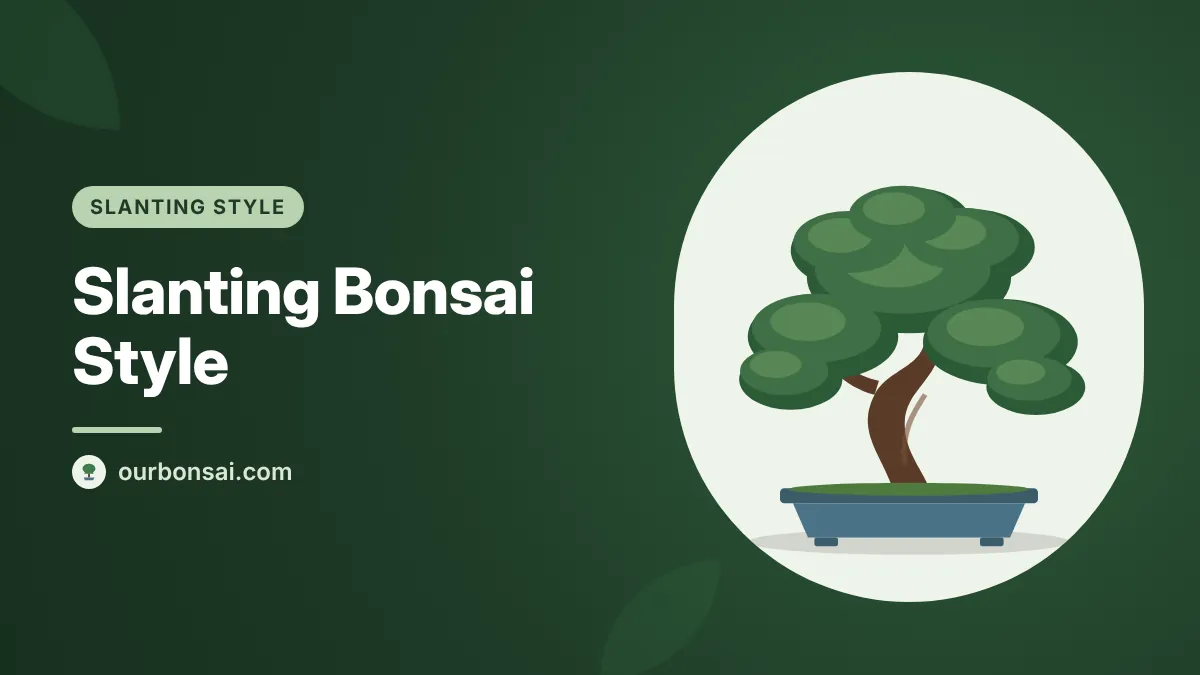
The slanting bonsai style, or shakan, is a tree whose trunk leans clearly to one side, usually at about 60 to 80 degrees to the soil surface, with the apex well outside the base rather than above it. To look stable rather than toppling, a slanting tree needs strong surface roots on the side opposite the lean (the “uphill” side) and usually a branch that reaches back against the lean as a counterweight. Branches grow on both sides of the trunk, which separates it from the windswept style. Most species work, especially juniper, pine, maple, elm and ficus, and the slant is usually set by changing the planting angle at repotting rather than by bending a thick trunk.
In this guide
What a slanting tree represents
In nature, trees lean for many reasons: a steady prevailing wind, shade from a larger neighbor, soil that slid on a slope, or a stream that undercut one side of the roots. Over years, the tree compensates. It grows thick roots on the side under tension, holding it upright, and its branches spread to balance the weight.
A good slanting bonsai tells that story. A bad one looks like a tree that has simply been tipped over in its pot.
Slanting, windswept or informal upright?
- Informal upright (moyogi): curved trunk, but the apex comes back over the base.
- Slanting (shakan): the whole tree leans; the apex stays out to one side. Branches on both sides.
- Windswept (fukinagashi): the tree leans and nearly all branches stream in one direction, as if blown. See our review of windswept juniper bonsai trees for an example.
- Semi-cascade: the trunk goes past horizontal and drops below the pot rim.
If your tree’s apex comes back over the base, call it an informal upright. If it leans past about 45 degrees to the soil, it starts to read as a cascade.
The slanting bonsai style, part by part
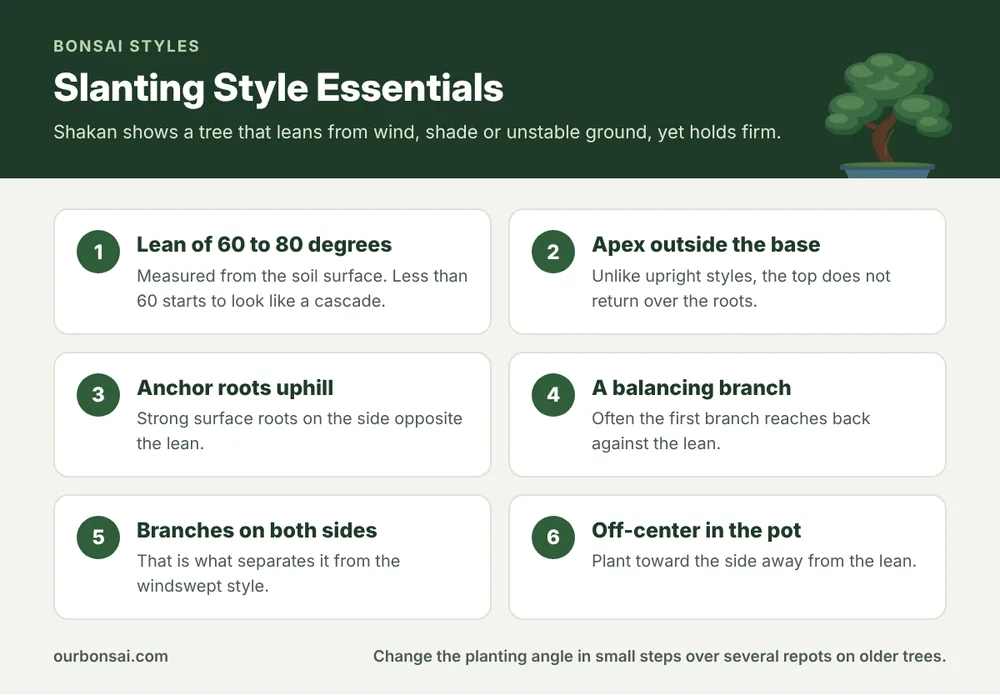
Angle. Between roughly 60 and 80 degrees to the soil is typical. A gentle lean of 80 degrees looks calm; 60 degrees looks dramatic. Measure from the soil surface, not from vertical.
Trunk. It can be straight or slightly curved. A trunk that leans one way and then curves back slightly near the top is natural and attractive.
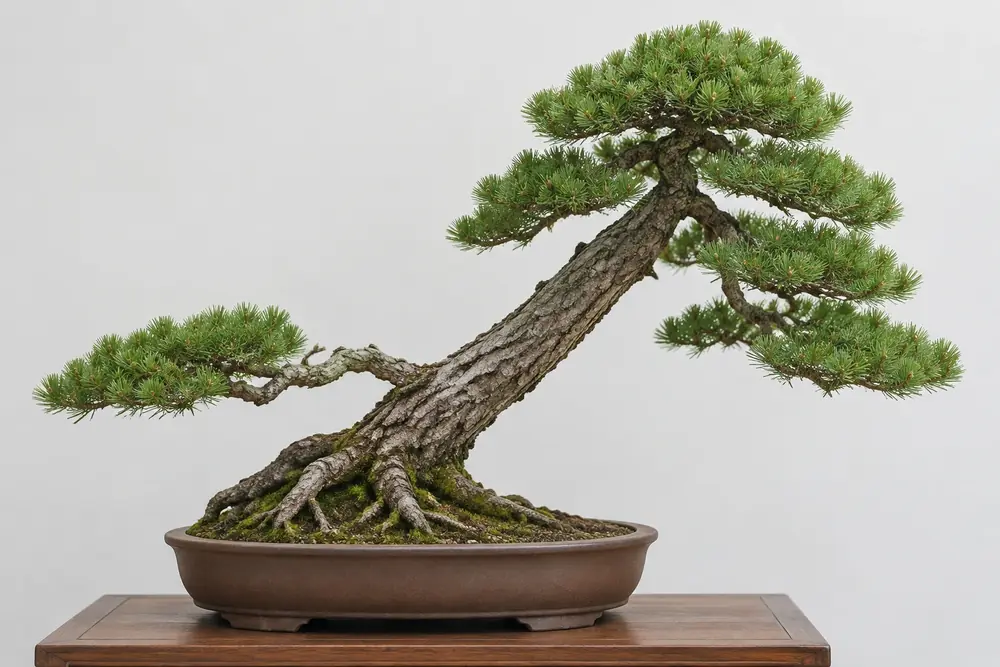
Roots. The roots on the uphill side should be the strongest on the tree, reaching out like anchors. Roots on the downhill side are shorter and tighter, as if compressed. Missing uphill roots is the most common reason a slanting tree looks wrong.
Branches. The first branch often grows against the lean, low on the trunk, balancing the visual weight. Other branches alternate along both sides and the back.
Apex. Usually small, and sometimes bent slightly back toward the vertical, as a tree corrects toward light.
Best species
Almost any upright tree can be slanted. The most common:
- Juniper and pine: the classic choice, especially for trees that already have some lean.
- Chinese elm and zelkova: easy to develop, good roots. See our Chinese elm bonsai care guide.
- Maple: strong roots that can be arranged on the uphill side.
- Boxwood and lemon cypress: compact trees that look good with a gentle slant; see our articles on boxwood bonsai styles and lemon cypress bonsai styles.
- Ficus: tolerates the root work needed to create a convincing base.
How to create a slanting bonsai, step by step
- Look for existing lean. Many nursery trees grow slightly crooked. Rotate the tree and find the view with the best natural lean and strong roots on the opposite side.
- Check the roots first. Brush away the top layer of soil. You want at least one or two good roots on the side away from the lean. If they are missing, choose a different front or a different style.
- Repot at the new angle. In spring, set the tree in the pot at the desired angle. Build a small mound of soil under the downhill side of the root ball and tie the tree in firmly with wire through the drainage holes. Our notes on bonsai repotting wire explain how to anchor it.
- Change angles gradually on older trees. A big change of 20 to 30 degrees in one go can leave roots in the air on one side and buried on the other. For established trees, tilt 10 to 15 degrees per repot.
- Select branches. Keep a strong, low branch reaching against the lean. Remove branches that grow straight down from the underside of the trunk.
- Wire branches into gently downward-sloping pads, tips raised.
- Shape the apex so it is small and turns slightly back toward vertical.
Building a convincing root base
Because roots carry so much of the effect, it is worth working on them over several repots:
- Encourage roots on the uphill side by leaving them longer when root pruning and spreading them outward.
- Trim roots on the downhill side shorter.
- Expose the top of the uphill roots slightly above soil level so they are visible.
- On deciduous trees, new roots can be encouraged by scoring the bark just below soil level on the uphill side.
Pot and placement
Shallow oval or rectangular pots suit most slanting trees. Place the tree off-center toward the uphill side, so the lean extends over the larger empty part of the pot. If the lean is strong, a slightly deeper pot adds visual weight and stability. The direction of the lean should not point straight out of a display alcove; it should lead the eye into the arrangement.
Common mistakes
- No anchoring roots on the uphill side, so the tree looks like it is falling.
- Apex drifting back over the base, which turns it into an informal upright.
- All branches on one side, which makes it a windswept tree, whether you meant it or not.
- A large, heavy apex at the far end of the lean, which looks top-heavy.
- Changing the angle too much at once on a mature tree.
Frequently asked questions
What angle should a slanting bonsai be?
Usually 60 to 80 degrees from the soil surface. Choose the angle that best shows the trunk and roots of your particular tree.
Can I slant a tree without repotting?
Not really. The angle is set by how the root ball sits in the pot, so it changes at repotting. Bending a young trunk with wire can add lean above the base.
Is the slanting style good for beginners?
Yes. It is one of the easier styles because many trees already lean slightly and the rules are simple. The root base is the part that takes time.
Which way should the tree lean?
Either direction. Choose the side that shows the best roots on the opposite side and fits where you will display the tree.
Final thoughts
A slanting bonsai is a tree that leans but holds its ground. Set the angle at repotting, make sure the uphill roots are strong and visible, and balance the lean with a branch that reaches back. For classical style terms, the Wikipedia article on bonsai aesthetics is a helpful reference, and our overview of types of bonsai shows where shakan fits among the other styles.