
What Do Spider Mites Look Like on Bonsai?

Quick Answer
Spider mites on bonsai usually look like tiny moving dots on the undersides of leaves or between fine needles. You may notice pale stippling, yellow or bronze foliage, and extremely fine webbing before you clearly see the mites themselves. The University of Minnesota Extension spider mite guide notes that two-spotted spider mites are around 1/50 inch long.
Signs to Look For
- Tiny moving dots: Adult mites are difficult to see without magnification.
- Fine stippling: Leaves develop many tiny pale, white, or yellow feeding spots.
- Bronzed foliage: Heavy feeding can make leaves or needles look dull, gray-green, yellow, or bronze.
- Silky webbing: Fine threads may form between leaves, needles, twigs, and branch forks.
- Underside colonies: Mites often concentrate beneath leaves where they are easy to miss.
Fast Confirmation Tip
- Hold white paper beneath suspicious foliage, tap the branch firmly, and watch for tiny dots that begin crawling across the paper.
If you’re asking what spider mites look like on bonsai, you’ve probably noticed strange speckles, dull foliage, or wispy threads on your tree. They’re easy to overlook because the mites themselves can be much smaller than the damage they create.
I’ve learned to inspect suspicious foliage before blaming watering, fertilizer, or seasonal stress. In this guide, I’ll show you what bonsai spider mites look like, how their damage develops, and how to confirm them quickly.
In This Guide
What Do Spider Mites Actually Look Like on Bonsai?
Spider mites are tiny plant-feeding arachnids related to spiders and ticks. To your naked eye, an adult usually looks more like a moving speck of dust than a recognizable creature.
The common two-spotted spider mite, Tetranychus urticae, is only around 1/50 inch long. Color varies with species, age, season, and feeding conditions.
Look for movement before color
Don’t rely on seeing bright red mites. Bonsai growers often expect every spider mite to look red, but many pest mites appear yellowish, greenish, orange, brown, or nearly translucent.
- Adults: Tiny oval bodies with eight legs.
- Young mites: Smaller and often lighter in color.
- Eggs: Minute, round, translucent to creamy spheres.
- Two-spotted mites: Adults may show dark patches on each side when magnified.
- Colonies: Usually appear as numerous moving specks rather than one obvious pest.
A 10× hand lens makes identification much easier. A phone camera with a good macro mode can also reveal movement that your eyes miss.
What does spider mite webbing look like?
Spider mite webbing is much finer than the strong, obvious web of a normal spider. Early infestations may produce almost no visible silk.
As populations increase, you’ll see thin strands across leaf undersides, needle clusters, branch crotches, or new shoots. Severe colonies can cover sections of foliage in a delicate veil.
Section Takeaway: Spider mites themselves look like tiny moving dots, so movement, feeding damage, and fine webbing are often more useful than color alone.
What Does Spider Mite Damage Look Like?
Spider mite damage usually appears as countless tiny pale dots called stippling. Stippling happens when mites pierce plant cells and feed from the foliage.
On broadleaf bonsai, the upper leaf surface may look dusty, faded, or finely freckled. Check directly beneath those damaged areas because mites often feed on the underside.
Early spider mite damage
- Scattered white or pale-yellow pinpoints on leaves
- A duller color than nearby healthy foliage
- Tiny mites beneath affected leaves
- Little or no visible webbing
- Subtle drying around heavily fed areas
Early damage can resemble watering stress or nutrient trouble. That’s why I don’t diagnose mites from yellow foliage alone.
Advanced spider mite damage
As feeding continues, pale stippling can merge into yellow, gray-green, bronze, or bleached-looking patches. Damaged foliage may dry, weaken, and eventually drop.
- Widespread bronzing or discoloration
- Dry or papery-looking foliage
- Premature leaf drop
- Fine webbing across foliage
- Visible colonies beneath leaves
- Loss of healthy color across entire shoots
Conifers such as juniper need careful inspection because individual feeding marks can be harder to recognize on scale-like or needle foliage. Watch for dull color, fine webbing, and mites collected by the paper test.
Section Takeaway: Pale stippling is often the first useful clue. Heavy webbing generally means the population has already become substantial.
How Can You Confirm Spider Mites on a Bonsai?
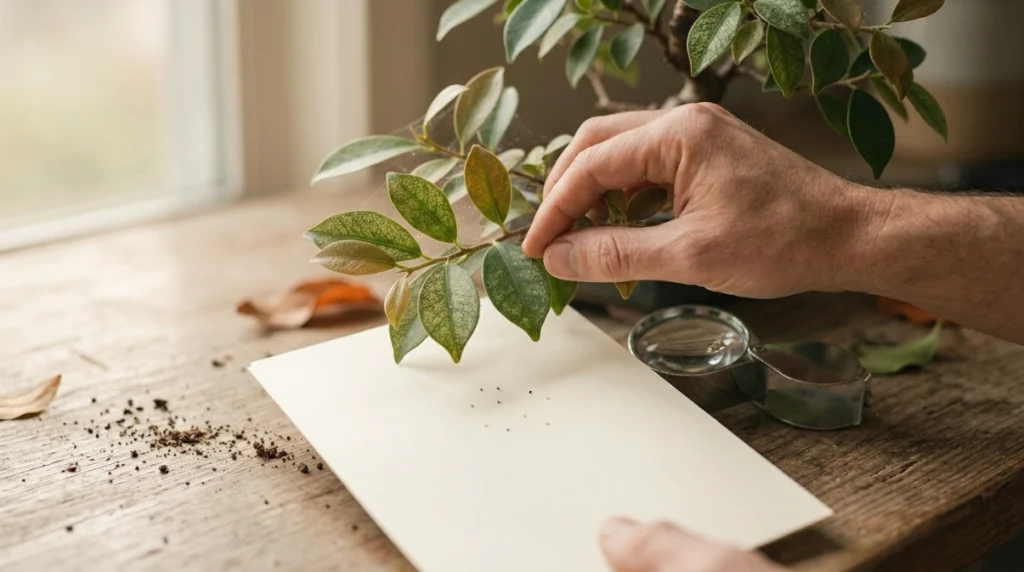
The easiest home confirmation method is the white paper test. It helps separate living mites from dust, soil particles, pollen, and dried plant debris.
Use the white paper test
- Place a clean sheet of white paper beneath a suspicious branch.
- Hold the paper close to the foliage.
- Tap or shake the branch several times.
- Wait a few seconds and study the fallen specks.
- Look for dots that begin crawling across the paper.
- Use a hand lens to examine anything suspicious.
The UC Statewide IPM Program’s spider mite guidance also recommends examining leaf undersides and using magnification because these pests are difficult to see unaided.
Inspect the underside of leaves
Turn several damaged leaves over rather than checking only one. Focus on foliage showing stippling or fading.
- Check along the main leaf vein.
- Examine areas near the petiole.
- Look where leaves touch each other.
- Inspect tender shoots and branch forks.
- Search inside dense foliage where pests stay protected.
On my own inspections, I treat one moving speck as a reason to check the whole canopy. Finding mites on several leaves is much stronger evidence than spotting an isolated web strand.
Section Takeaway: The best confirmation combines visible plant damage, underside inspection, magnification, and moving specks collected on white paper.
Spider Mites vs. Other Bonsai Problems
Not every web or yellow leaf means spider mites. Ordinary spiders, aphids, scale insects, thrips, watering problems, and other stresses can create confusing symptoms.
| Problem | What You May See | Best Clue |
|---|---|---|
| Spider mites | Tiny moving dots, stippling, bronzing, fine silk | Moving specks plus feeding damage |
| Normal spider | Stronger web strands or structured web | No widespread stippling or mite colonies |
| Aphids | Visible soft-bodied insects, distorted growth, sticky residue | Larger insects clustered on tender shoots |
| Scale | Small fixed bumps on leaves or stems | Bumps stay attached instead of crawling |
| Water stress | Wilting, browning, yellowing, dry foliage | No mites, colonies, or characteristic fine webbing |
Spider web or spider mite webbing?
A single strand between branches isn’t enough to diagnose spider mites. Small beneficial spiders regularly build webs around bonsai benches and tree canopies.
Mite webbing usually appears directly around damaged foliage and colonies. Combine the webbing with stippling and moving dots before making the call.
Section Takeaway: Don’t treat a bonsai merely because you found a web. Confirm the pest by looking for mites and their characteristic feeding pattern.
Where Should You Look for Spider Mites?
Start underneath foliage rather than on top. Spider mite colonies commonly develop in protected feeding areas where casual watering and visual inspections miss them.
- Broadleaf bonsai: Inspect leaf undersides and the areas beside major veins.
- Junipers: Look inside dense foliage pads and around fine branchlets.
- Ficus: Check beneath leaves showing pale speckling or dry edges.
- Indoor trees: Inspect plants near warm windows, heaters, or dry airflow.
- Outdoor trees: Pay closer attention during hot, dry periods.
Why hot, dry conditions matter
Some important spider mite species reproduce rapidly during warm, dry weather. A bonsai’s compact canopy can also provide protected feeding sites.
As of 2026, I still consider regular visual inspection more useful than waiting for obvious webbing. Webbing may be absent during an early infestation.
Check nearby plants too
If several bonsai share one bench, examine neighboring trees after confirming mites on one plant. You don’t need to assume every tree is infested, but nearby foliage deserves inspection.
Keep newly purchased or recently transported plants separate long enough to inspect them carefully. A simple quarantine area can prevent one overlooked pest problem from becoming a collection-wide issue.
Section Takeaway: Inspect protected leaf undersides, dense foliage, and neighboring trees first, especially during warm and dry conditions.
What Should You Do After Finding Spider Mites?
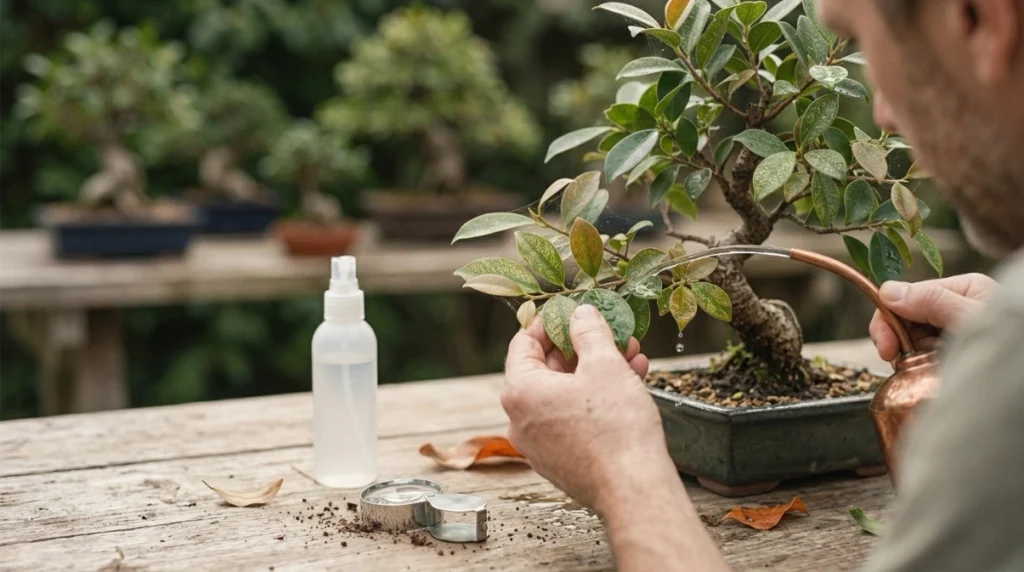
Once you’ve confirmed spider mites, isolate the affected bonsai from nearby plants when practical. Then decide on control based on the tree species, infestation level, and product label.
The goal isn’t only to remove visible adults. Eggs and immature stages can remain after the first treatment.
Start with a thorough inspection and rinse
For suitable species, a firm stream of water can physically remove many mites from foliage. Focus especially on leaf undersides while preventing unnecessary saturation of the bonsai soil.
Follow the tree’s normal watering needs rather than keeping the root ball constantly wet. Raising soil moisture to fight mites can create a separate root problem.
Use treatments labeled for mites
Spider mites are arachnids rather than insects, so don’t assume every general insecticide will control them. Read the label and verify that spider mites and your intended plant use are covered.
Bonsai Empire’s pest and disease overview also emphasizes identifying the pest before choosing a treatment. Correct identification reduces unnecessary spraying and helps you target the actual problem.
Insecticidal soaps and horticultural oils are common mite-management options on many plants. Tree sensitivity varies, so follow the product label and test cautiously when appropriate.
Recheck rather than assuming they’re gone
Inspect the bonsai again after treatment according to the product instructions. Repeat the white paper test and examine fresh growth for new stippling.
Old feeding damage won’t turn green again. Judge recovery by the absence of living mites and by healthier new foliage.
Section Takeaway: Confirm the pest first, isolate the tree, use an appropriate labeled control, and continue checking for living mites instead of judging success from old leaf damage.
Spider Mite FAQ
Can you see spider mites with the naked eye?
Yes, but they usually appear as tiny moving dots rather than clearly recognizable mites. A 10× hand lens or macro camera makes their oval bodies, legs, and color easier to see.
What color are spider mites on bonsai?
Color depends on the species and life stage. They may appear pale yellow, greenish, orange, reddish, brown, or translucent, so color alone isn’t reliable for identification.
Do spider mites always make webs?
No. Early infestations can exist without obvious webbing. Fine silk becomes easier to notice as mite populations increase, which is why stippling and the white paper test can reveal problems sooner.
What do spider mite eggs look like?
Spider mite eggs are extremely small, round, and often translucent or pale. They’re usually found around colonies on protected foliage and are much easier to recognize with magnification.
Can spider mites make bonsai leaves turn yellow?
Yes. Repeated feeding damages leaf cells and creates pale stippling that can progress into yellowing or bronzing. Yellow leaves alone aren’t proof, so check for mites before assuming they’re the cause.
Are webs on a juniper bonsai always spider mites?
No. Ordinary spiders can build webs in juniper foliage without harming the tree. Look for tiny moving mites, dull or stippled foliage, and fine webbing concentrated around feeding areas before diagnosing spider mites.
How often should I check a bonsai for spider mites?
Inspect routinely during active growth and increase checks during hot, dry weather or after bringing new plants into your growing area. A quick underside inspection and white paper test takes only a few minutes.
Final Takeaway
If you’re wondering what spider mites look like on bonsai, don’t wait for a clearly visible red bug. Look instead for tiny moving specks, pale stippling, bronzed foliage, underside colonies, and extremely fine webbing.
