Can Wet Bonsai Soil Cause Disease?

Quick Answer
Yes, wet bonsai soil can contribute to disease when it stays saturated long enough to reduce oxygen around the roots. Constantly wet, poorly drained substrate can weaken fine roots and create favorable conditions for root-rot organisms, so I focus on proper bonsai watering rather than keeping the pot continuously soaked.
Signs that wet soil may be becoming a problem
- Slow drying: The substrate remains wet much longer than expected for the weather and season.
- Poor drainage: Water sits on the surface or leaves the drainage holes unusually slowly.
- Yellow foliage: Leaves may yellow while the root zone remains wet.
- Wet-soil wilting: The tree wilts even though the substrate still contains plenty of moisture.
- Damaged roots: Affected roots may become dark, soft, limp, or deteriorated.
How to confirm the risk
- Check the soil below the surface, observe drainage, and look at several symptoms together rather than diagnosing disease from wet soil alone.
Wet bonsai soil isn’t automatically diseased soil. A freshly watered bonsai should be wet, and many healthy trees spend part of each watering cycle with moist roots.
The trouble starts when that moisture cannot drain or the soil stays saturated for too long. In this guide, I’ll show you where normal moisture ends and disease risk begins.
In This Guide
- Can Wet Bonsai Soil Actually Cause Disease?
- Why Does Constantly Wet Bonsai Soil Damage Roots?
- How Can You Tell If Wet Soil Is Causing Problems?
- What Should You Do If Your Bonsai Soil Stays Wet?
- How Do You Prevent Disease From Wet Bonsai Soil?
- Do Species and Seasons Change the Risk?
- Frequently Asked Questions
Can Wet Bonsai Soil Actually Cause Disease?
Yes, persistently wet bonsai soil can increase the chance of root disease. However, water itself doesn’t infect a bonsai.
The real problem is a root zone that remains saturated and poorly aerated. Those conditions stress roots and can favor certain disease-causing organisms.
Definition: Waterlogged bonsai soil is substrate in which excess water fills too much of the air space around the roots for an extended period, reducing the oxygen available to the root system.
Wet soil and root rot are not the same thing
A well-draining bonsai mix may become completely wet during watering and still remain healthy. Excess water should then move through the pot while air returns to the spaces between particles.
Root rot describes damaged and dying root tissue. Prolonged moisture, oxygen stress, injured roots, and pathogens can all play a role.
- Normal wetness: The tree has just been watered and excess water drains freely.
- Concerning wetness: The substrate stays saturated and airless for extended periods.
- Disease: Root tissue is being damaged, sometimes with pathogenic organisms involved.
Which organisms can attack wet roots?
Root diseases can involve organisms such as Pythium and Phytophthora. Other root-rot problems may involve Rhizoctonia or Fusarium.
Penn State describes Pythium root rot as a disease caused by fungus-like organisms that can attack root tips. Wet growing conditions can help these problems develop or spread.
Section Takeaway: Wet soil is a risk factor, not an automatic diagnosis. Persistent saturation becomes dangerous when it reduces root-zone oxygen and creates conditions that favor root damage or pathogens.
Why Does Constantly Wet Bonsai Soil Damage Roots?
Bonsai roots need both water and oxygen. A shallow container makes that balance especially important because the root system has little room to escape bad conditions.
Healthy substrate contains pore spaces between particles. After watering, some spaces hold moisture while others gradually refill with air.
Water can push air out of the root zone
When soil remains saturated, water occupies spaces that would normally contain air. Roots then receive less oxygen for normal cellular activity.
Fine feeder roots are especially important because they absorb water and nutrients. Once damaged, the tree can behave as though it is dry even while sitting in wet soil.
- Water uptake becomes less effective.
- Nutrient uptake can decline.
- Fine root growth may slow.
- Weak roots become less resilient to other stress.
- Root-rot organisms may gain favorable conditions.
Compacted soil makes the problem worse
Fine, broken-down substrate often loses the open structure that bonsai roots need. Water moves more slowly while less air reaches the center of the root ball.
Bonsai Empire’s soil guidance emphasizes drainage, water retention, and aeration as core qualities of a useful bonsai substrate. I consider all three together rather than trying to make soil simply “dry” or “wet.”
Drainage holes matter too
A good substrate cannot work properly if water has nowhere to go. Blocked holes, poorly fitted mesh, or a pot standing in water can keep the lower root zone wetter than expected.
Virginia Cooperative Extension notes that bonsai containers use large drainage holes because rapid drainage supports root health. Its bonsai cultivation guidance also recommends coarse, porous growing media.
Section Takeaway: The dangerous combination is prolonged moisture plus poor aeration. Good bonsai soil should retain enough moisture for the tree while still allowing excess water to leave and oxygen to return.
How Can You Tell If Wet Soil Is Causing Problems?
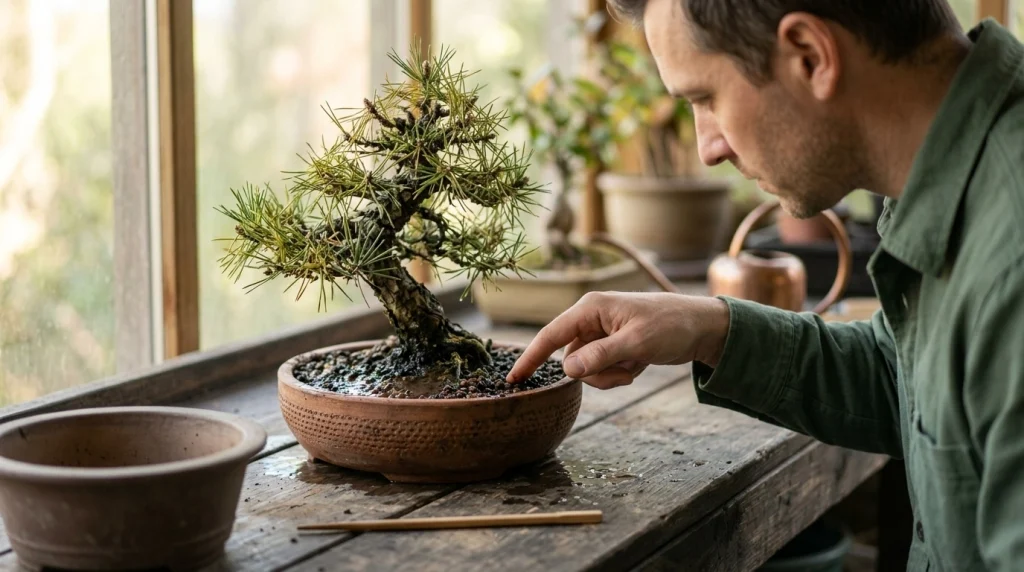
Start with the root zone, not the leaves. Yellowing foliage alone can come from many different stresses.
I become more suspicious when a declining tree also stays wet for unusually long periods. Several clues together are much more useful than one symptom.
| What to check | Normal moisture cycle | Possible wet-soil problem |
|---|---|---|
| Before watering | Upper substrate has begun to feel slightly dry | Soil is still wet from the previous watering |
| Drainage | Water passes through drainage holes freely | Water pools or drains unusually slowly |
| Foliage | Growth matches the normal species and season | Yellowing, weak growth, dieback, or wilting may appear |
| Root texture | Fine roots remain firm | Damaged areas may feel soft, limp, or deteriorated |
| Root color | Color varies by species and root age | Dark brown or black areas become more concerning when tissue is also soft |
Why can a bonsai wilt when the soil is wet?
A damaged root system may no longer absorb water efficiently. The foliage can therefore wilt even though plenty of water surrounds the roots.
This is why automatically adding more water to every wilted bonsai can make matters worse. Check the substrate first.
How deep should you check the moisture?
For a beginner, checking roughly 1 cm, or about 0.4 inch, below the surface gives more information than looking at surface color alone. It is still only one clue.
Pot weight, recent rain, temperature, wind, species, and drainage speed should influence your decision too. In my troubleshooting routine, I use several of these clues before reaching for the watering can.
Section Takeaway: Wet-soil disease is best identified through a pattern of symptoms. Slow drying, weak drainage, declining foliage, and damaged roots together are much more meaningful than wet soil by itself.
What Should You Do If Your Bonsai Soil Stays Wet?
First, stop watering automatically. Don’t swing to the opposite extreme and deliberately dry the bonsai until its roots become brittle.
Your immediate goal is to restore a sensible moisture cycle. Then identify why the pot remains wet.
- Check the substrate: Feel below the surface before adding water.
- Inspect drainage: Confirm that water can leave every drainage hole.
- Remove standing water: Don’t leave an ordinary bonsai pot soaking in a water-filled saucer.
- Review placement: Cool, shaded, still conditions can slow drying considerably.
- Inspect the soil structure: Compacted or broken-down material may need replacement at the correct repotting time.
- Examine roots if justified: Do this when symptoms and drainage problems strongly suggest root damage.
Should you repot immediately?
Not always. Repotting is stressful, and unnecessary root disturbance can make a weak tree harder to recover.
If the substrate has badly collapsed, drainage is severely restricted, or roots are clearly rotting, repotting may become necessary. Species and season should influence the timing.
Pro tip: Root pruning is irreversible. If you’re unsure how much damaged root tissue to remove, get help from an experienced grower or local bonsai club before making major cuts.
Do you need fungicide?
Don’t assume every wet-root problem needs a fungicide. Root death from oxygen deprivation and an active pathogen are not the same diagnosis.
The University of California’s guidance on Phytophthora root and crown rot stresses proper irrigation as a major preventive measure. If disease is severe or valuable specimens are involved, accurate pathogen diagnosis is more useful than guessing at a treatment.
Section Takeaway: Correct the growing conditions first. Check moisture, drainage, substrate structure, and root health before reaching for treatments or carrying out major root work.
How Do You Prevent Disease From Wet Bonsai Soil?
Prevention comes from managing the whole moisture system. Watering frequency alone is only one part of it.
I want a bonsai pot to become thoroughly watered, drain well, and then gradually approach the next watering point. I don’t want the root ball permanently saturated.
Water according to the tree, not the calendar
A rule such as “water every morning” sounds convenient but ignores changing conditions. The same bonsai can dry at dramatically different rates during hot wind and cool rain.
- Check moisture before watering.
- Water thoroughly when the tree needs it.
- Let excess water drain from the pot.
- Recheck more often during hot or windy weather.
- Expect slower drying during cool, humid, or low-light periods.
Use substrate that keeps its structure
Granular bonsai mixes are popular because particle spaces help maintain both drainage and aeration. Common components include akadama, pumice, and lava rock.
There isn’t one perfect ratio for every tree or climate. A grower in a rainy climate often needs different moisture retention than someone growing the same species in hot, dry conditions.
Keep the drainage path open
Check drainage holes during routine maintenance. Roots, fines, or displaced mesh can interfere with water movement.
- Use pots with functional drainage holes.
- Keep drainage screens secure without blocking flow.
- Avoid compacted layers of fine material.
- Don’t let the base of the pot remain submerged after watering.
As of 2026, I still consider observation more reliable than fixed watering schedules. The tree, pot, substrate, weather, and season should decide when you water.
Section Takeaway: Disease prevention is mostly about preserving a healthy moisture-and-air balance. Thorough watering is compatible with healthy bonsai as long as excess water drains and the substrate doesn’t remain waterlogged.
Do Species and Seasons Change the Risk?
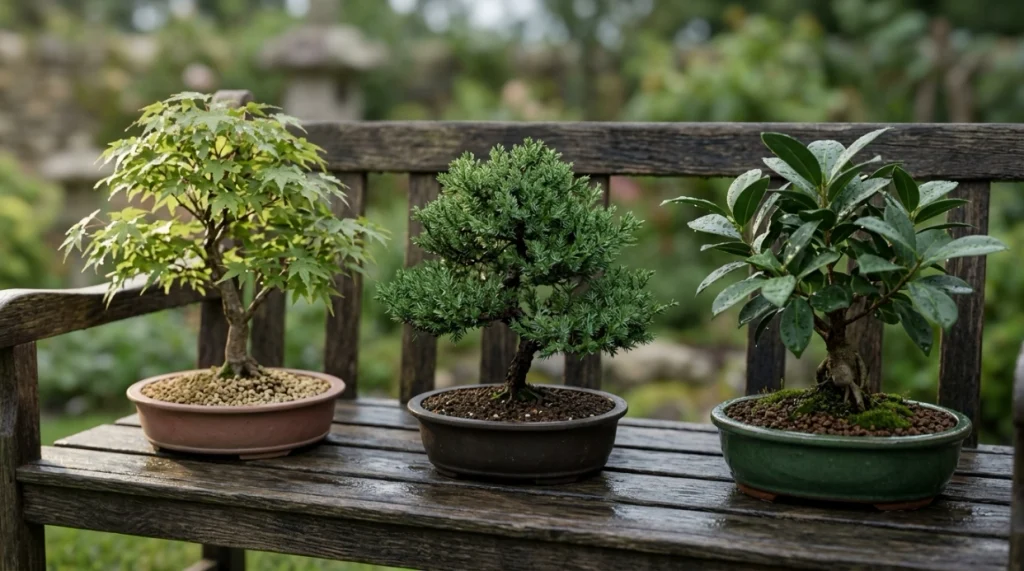
Yes. Different species use water at different rates, and the same tree’s demand changes through the year.
Pot size, foliage mass, temperature, sunlight, wind, humidity, and root condition also matter. That makes universal watering intervals unreliable.
Active growth usually increases water use
A leafy tree growing strongly in warm, bright weather can remove moisture from its pot quickly. Small bonsai pots may need particularly close monitoring under those conditions.
A tree using less water can remain moist longer. That often happens during cooler weather, reduced light, dormancy, or after foliage loss.
Species preferences don’t cancel the need for oxygen
Ficus, Japanese maple, azalea, pine, and juniper don’t share identical watering preferences. Their root systems still need an appropriate balance between moisture and aeration.
That distinction matters with moisture-loving species. “Don’t let it become bone dry” does not mean “keep it sitting in stagnant, airless soil.”
Rain can change your watering routine overnight
Outdoor bonsai may receive more water from several rainy days than from your watering can. During a wet spell, I check pots individually instead of watering simply because it is my normal watering time.
Shallow free-draining mixes may handle repeated rain well. Dense, compacted mixes can stay saturated much longer under the same weather.
Section Takeaway: The correct moisture level is dynamic. Match watering to the species, substrate, pot, season, and current weather instead of relying on a fixed number of days.
Frequently Asked Questions
Can one day of wet bonsai soil cause root rot?
Usually, normal wetness after thorough watering is not the same as root rot. Risk rises when the root zone remains saturated, poorly aerated, or otherwise stressful for an extended period, especially when susceptible pathogens are present.
Should bonsai soil be completely dry before watering?
No. Many bonsai should be watered after the substrate begins to dry rather than after the entire root ball becomes bone dry.
The exact point varies by species, season, pot, and soil mix. Check moisture instead of following a rigid schedule.
Can overwatering cause fungus in bonsai soil?
Constant moisture can create favorable conditions for several fungal or fungus-like root pathogens. However, visible fungus on the soil surface doesn’t automatically mean the roots have a serious disease.
Why is my bonsai wilting when the soil is still wet?
Root damage can reduce the tree’s ability to absorb water, so foliage may wilt despite wet substrate. Check drainage and root health before adding more water.
How do I know whether bonsai roots are rotten?
Rotten roots are often soft, deteriorated, and dark in affected areas. Root color alone isn’t enough because healthy appearance varies among species and with root age.
Can better bonsai soil prevent root rot?
A well-structured substrate can reduce risk by improving drainage and aeration. It cannot guarantee that disease will never occur, because pathogens, watering, temperature, root injuries, and tree health also matter.
Should I stop watering a bonsai with suspected root rot?
Stop unnecessary watering, but don’t intentionally dehydrate the tree. Check the substrate and water only when its condition and the species indicate that moisture is needed.
The Bottom Line
Wet bonsai soil can contribute to disease, but moisture itself isn’t the enemy. The bigger danger is soil that remains saturated, compacted, and short of oxygen.
Watch how quickly the pot drains and dries, then check the tree before every watering. That habit catches moisture problems much earlier than a fixed watering calendar.
If your bonsai is declining while the soil stays wet, investigate the root zone before assuming it needs more water. Healthy bonsai roots need moisture, drainage, and air working together.