
How to Treat Spider Mites on Bonsai Naturally

Quick Answer
To treat spider mites on bonsai naturally, isolate the tree, rinse the foliage, then apply a labeled insecticidal soap or horticultural oil if mites remain. The UC Integrated Pest Management spider mite guidance also recommends water sprays, insecticidal soaps, and oils while protecting natural predators.
Natural Treatment Steps
- 1. Isolate the bonsai: Move it away from other bonsai and houseplants immediately.
- 2. Confirm the mites: Inspect leaf undersides and use the white-paper test to find moving specks.
- 3. Rinse thoroughly: Spray both sides of the foliage with water, concentrating beneath the leaves.
- 4. Treat survivors: Use labeled insecticidal soap or horticultural oil, including neem-based oil where appropriate.
- 5. Recheck regularly: Eggs or missed mites can restart the infestation, so one treatment may not be enough.
- 6. Fix the conditions: Avoid drought stress, excessive dust, and poor growing conditions that favor damaging outbreaks.
Before You Spray
- Test soaps and oils on a small area first, and never spray a drought-stressed bonsai or apply oils during extreme heat.
If you’re searching for how to treat spider mites on bonsai naturally, early action matters more than using a harsh spray. These mites are tiny, reproduce quickly, and often hide beneath leaves or inside dense foliage.
I’ve found that the safest approach is also the most systematic. Confirm the pest first, reduce its population physically, and only then move to a low-impact treatment.
In This Guide
- How Do You Know Your Bonsai Has Spider Mites?
- What Is the Best Natural Treatment for Spider Mites on Bonsai?
- Which Natural Spider Mite Treatment Works Best?
- How Often Should You Repeat Spider Mite Treatment?
- How Do You Stop Spider Mites From Coming Back?
- When Is Natural Spider Mite Treatment Not Enough?
- Frequently Asked Questions
How Do You Know Your Bonsai Has Spider Mites?
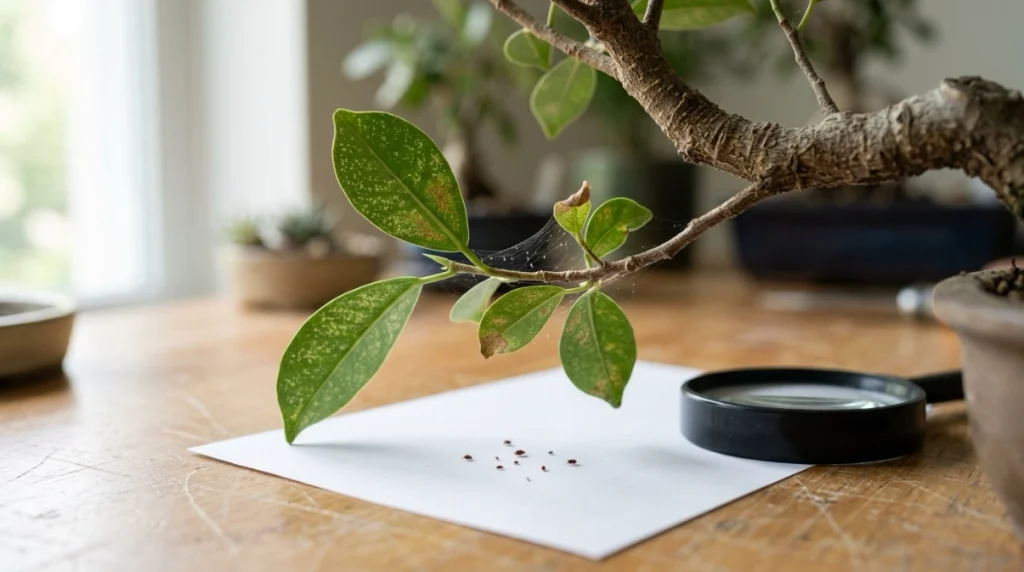
Spider mites usually cause fine pale stippling, yellowing, bronzing, drying leaves, and fine webbing. The mites themselves can look like tiny moving dots.
Definition: Spider mites are plant-feeding arachnids rather than true insects. Common pest species belong to the family Tetranychidae.
Adults can measure less than 1/20 inch long. A 10× hand lens makes inspection much easier.
Look Under the Leaves First
The underside of the foliage is my first inspection point. That’s where many spider mites feed, lay eggs, and remain hidden.
- Pale stippling: Hundreds of tiny light-colored feeding marks may develop across leaves.
- Bronzed foliage: Heavy feeding can change healthy green leaves to dull yellow or bronze.
- Fine webbing: Dense populations may create delicate silk around leaves and shoots.
- Dry leaves: Severe damage can make foliage brown, brittle, or prone to dropping.
- Moving specks: Tiny mites may become visible with magnification.
Try the White-Paper Test
Hold a clean sheet of white paper under a suspicious branch. Gently tap or shake the foliage above it.
Watch the paper for tiny moving specks. A hand lens can help you distinguish mites from dust or plant debris.
Do not diagnose mites from webbing alone. Ordinary spiders can also build webs around bonsai without damaging the tree.
I also compare damaged leaves with new growth. Fresh stippling tells me the problem is still active rather than old damage.
What Is the Best Natural Treatment for Spider Mites on Bonsai?
The best natural approach combines isolation, water, careful monitoring, and low-impact contact treatments. No single step should replace proper diagnosis.
1. Isolate the Bonsai
Move the affected bonsai away from other plants as soon as you confirm mites. Spider mites can spread within closely grouped plant collections.
Keep the quarantine location suitable for the species. Don’t move a sun-loving outdoor bonsai into a dark room simply to isolate it.
2. Wash the Foliage With Water
A firm water spray can physically knock many mites from foliage. Concentrate on the undersides of leaves and dense branch junctions.
- Protect loose bonsai soil from being washed out.
- Support delicate branches while rinsing.
- Reach the interior canopy, not only exposed leaves.
- Allow suitable airflow afterward.
Water is an excellent first population-reduction tool. It may not eliminate every mite or egg.
3. Use Labeled Insecticidal Soap if Needed
Commercial insecticidal soap contains potassium salts of fatty acids. It works through direct contact, so coverage matters.
The University of Minnesota Extension recommends insecticidal soaps and horticultural oils among common mite-management options.
Avoid assuming ordinary dishwashing liquid is equivalent. Homemade soap mixtures can injure leaves because their ingredients and concentrations vary.
4. Consider Horticultural or Neem-Based Oil
Horticultural oils can also suppress mites through direct contact. Some registered horticultural products use plant-derived oils, including neem seed oil.
Do not spray a water-stressed tree. UC IPM also cautions against applying soaps or oils when temperatures exceed 90°F, or about 32°C.
- Check the label: Confirm your plant and intended use are permitted.
- Test first: Treat a small section before covering valuable foliage.
- Cover thoroughly: Contact treatments must reach the mites.
- Avoid heat stress: Apply under appropriate label conditions.
Section Takeaway: Start with physical removal, then use the least disruptive labeled treatment that controls the remaining mites.
Which Natural Spider Mite Treatment Works Best?
No treatment is best in every situation. The right option depends on infestation size, bonsai species, growing conditions, and whether biological control is practical.
| Method | Best Use | How It Works | Main Limitation |
|---|---|---|---|
| Water spray | Early or light infestations | Physically removes mites | May not eliminate eggs or hidden mites |
| Insecticidal soap | Active mites on accessible foliage | Contact action against mites | Needs complete coverage and may need repetition |
| Horticultural oil | Persistent populations | Contact treatment that smothers mites | Can injure stressed or sensitive foliage if misused |
| Neem-based horticultural oil | Growers seeking a plant-derived oil option | Oil-based contact control | Product label and plant tolerance still matter |
| Predatory mites | Greenhouses or suitable controlled collections | Beneficial mites consume pest mites | Effectiveness depends on species and environment |
What About Predatory Mites?
Predatory mites can provide genuine biological control. Species such as Phytoseiulus persimilis feed on plant-feeding spider mites.
Colorado State University Extension notes that commercially produced predatory mites have been used successfully on interior plants. Temperature, humidity, and predator species influence their success.
They make the most sense in larger collections or controlled environments. For one windowsill bonsai, isolation and direct treatment are often simpler.
How Often Should You Repeat Spider Mite Treatment?
Continue monitoring after the first treatment because contact sprays may miss eggs and protected mites. Repeat any pesticide treatment only according to its product label.
Under favorable conditions, spider mites can complete their development quickly. This is why a tree that appears clear today can show fresh activity later.
Monitor Instead of Guessing
I prefer to base the next step on inspection rather than automatically spraying on a fixed schedule. That avoids unnecessary treatment on already stressed foliage.
- Inspect the undersides of leaves.
- Repeat the white-paper test.
- Look for fresh stippling.
- Check new shoots for damage.
- Watch for new webbing.
- Inspect nearby plants as well.
Old damaged leaves will not necessarily become green again. Judge recovery by the absence of live mites and the condition of newer foliage.
Keep the bonsai isolated while active mites remain. Clean fallen foliage and the surrounding surface during quarantine.
How Do You Stop Spider Mites From Coming Back?
Prevention starts with keeping the bonsai healthy and detecting small populations early. Hot, dry, dusty, and drought-stressed conditions can increase spider mite problems.
Avoid Drought Stress
Water according to the bonsai species, soil, season, and weather. Do not let a susceptible tree repeatedly become severely dehydrated.
This does not mean keeping the soil permanently wet. Bonsai roots still need oxygen, and chronic overwatering creates different problems.
Control Dust and Inspect Regularly
Dusty foliage and benches can favor mite outbreaks. Periodic cleaning also makes pests easier to notice.
- Check leaf undersides during routine watering.
- Use a 10× hand lens when symptoms look suspicious.
- Keep dead foliage off benches and soil surfaces.
- Inspect new bonsai before adding them to a collection.
- Keep infested plants separated during treatment.
- Avoid unnecessary broad-spectrum pesticide use.
Bonsai Empire’s pest and disease overview also emphasizes identifying bonsai pests correctly before deciding how to treat them.
Don’t Rely on Humidity Alone
Spider mite outbreaks are often associated with dry conditions, but simply misting a bonsai is not a complete treatment. Established mites can remain hidden beneath foliage despite occasional misting.
Never overwater the root system just to increase humidity. Treat the pest directly while maintaining species-appropriate care.
Section Takeaway: Prevention is mostly good culture plus regular inspection. Catching ten mites is far easier than treating thousands.
When Is Natural Spider Mite Treatment Not Enough?
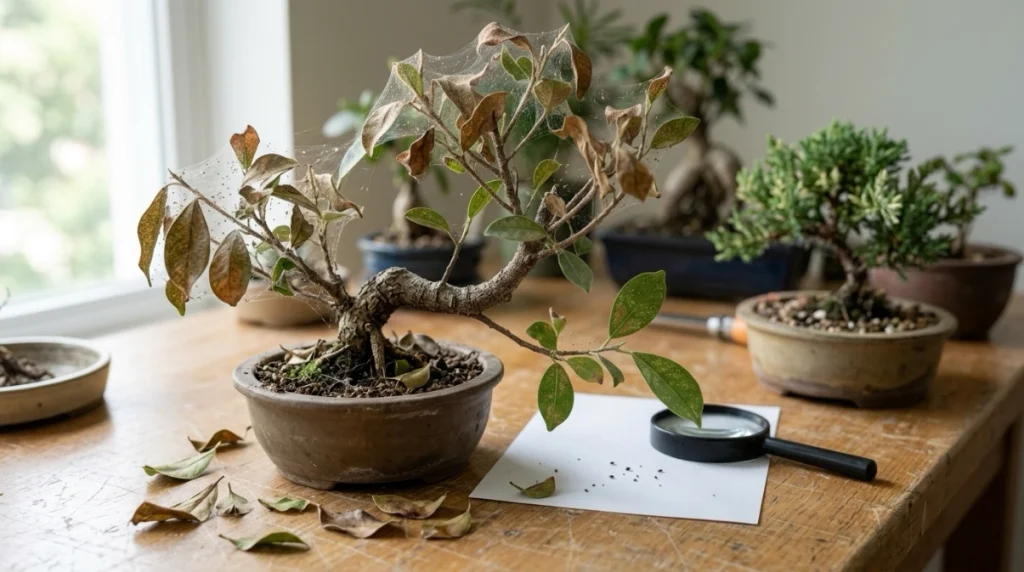
Natural methods work best when you catch the infestation early. A heavily damaged bonsai may require a labeled miticide or professional diagnosis.
Remember that spider mites are mites, not insects. A general insecticide may not control them and can sometimes kill beneficial predators.
Escalate Treatment When You See These Signs
- Rapid leaf decline: Large areas become yellow, bronze, brown, or dry.
- Heavy webbing: Webs cover shoots rather than appearing in isolated spots.
- Persistent live mites: Repeated inspections still show active populations.
- Major leaf drop: The bonsai is losing photosynthetic foliage quickly.
- Collection spread: Mites appear on several neighboring plants.
- Uncertain diagnosis: Symptoms continue despite mite-focused treatment.
A stressed tree may also have more than one problem. Watering trouble, root damage, excessive heat, and pests can occur together.
Do not automatically repot a bonsai because it has spider mites. Spider mites primarily inhabit and feed on above-ground plant tissue.
Pro tip: If severe decline makes you consider emergency root pruning or major structural pruning, consult an experienced grower or local bonsai club first. Irreversible work can further weaken a stressed tree.
Frequently Asked Questions
Can I wash spider mites off a bonsai with water?
Yes. A firm water spray can physically remove many spider mites, especially from leaf undersides. Water may substantially reduce a light infestation, but continue monitoring because hidden mites or eggs can remain.
Does neem oil kill spider mites on bonsai?
Some horticultural products containing neem-derived oil are labeled for mite control. Use only an appropriate labeled product, test foliage first, and follow all directions because plant sensitivity and formulations vary.
Can I use dish soap for spider mites on bonsai?
Commercial insecticidal soap is safer than improvising with household detergent. Dishwashing products vary in concentration and additives, so homemade mixtures can damage sensitive bonsai foliage.
Should I remove leaves damaged by spider mites?
Remove dead or severely damaged foliage when appropriate, but avoid unnecessary defoliation on a weak tree. Leaves with old cosmetic damage may still photosynthesize and support recovery.
Will increasing humidity get rid of spider mites?
Higher humidity may make conditions less favorable for some spider mites, but humidity alone is unreliable control. Use direct population reduction, careful monitoring, and appropriate treatment instead.
Can spider mites spread from one bonsai to another?
Yes. Nearby susceptible plants can become infested, especially in tightly grouped collections. Isolate the affected bonsai and inspect neighboring trees before returning it to the collection.
How do I know when the spider mites are gone?
Continue checking for moving mites, fresh webbing, and new stippling. Healthy new foliage and repeated inspections without active mites are better indicators than the appearance of previously damaged leaves.
The key to treating spider mites naturally is persistence, not stronger homemade sprays. Confirm the pest, reduce the population, protect the tree from stress, and keep checking until new damage stops.
As of 2026, water sprays, labeled insecticidal soaps, horticultural oils, and biological controls remain practical lower-impact options. Start early, and a small spider mite problem is much easier to manage.
