
Tiny White Bugs on Bonsai: Identification Guide

Quick Answer
Tiny white bugs on bonsai are most often mealybugs, whiteflies, scale insects, woolly aphids, or pale spider mites. White insects that jump from damp soil may instead be springtails, which usually cause little plant damage. The fastest way to narrow the problem is to compare movement, location, residue, and feeding damage with a reliable bonsai pest identification guide.
Fast Identification Clues
- Cotton-like wax: Mealybugs are a strong possibility, especially around leaf joints and branch forks.
- White insects flying: Adults that flutter upward when foliage moves usually point toward whiteflies.
- Fixed white bumps: Scale insects remain attached to leaves, twigs, needles, or bark.
- Fine webbing: Tiny moving specks plus stippled leaves suggest spider mites.
- Jumping on soil: Small white or gray organisms hopping after watering are often springtails.
- Sticky foliage: Honeydew can point toward mealybugs, aphids, whiteflies, or soft scale.
What to Do First
- Separate the affected bonsai from nearby plants and identify the pest before spraying anything.
Finding tiny white bugs on a bonsai can be confusing because several pests look alike from a distance. Color alone rarely gives me enough information to make a reliable identification.
I look at four clues first: where the organisms live, how they move, what residue they leave, and what damage appears on the tree. This guide walks through that process so you can respond without treating the wrong problem.
In This Guide
- What are tiny white bugs on bonsai most likely to be?
- How can you identify tiny white bugs by movement and location?
- What damage should you look for on your bonsai?
- How do you get rid of tiny white bugs safely?
- Why do tiny white bugs keep coming back?
- How can you prevent another infestation?
- FAQ about tiny white bugs on bonsai
What Are Tiny White Bugs on Bonsai Most Likely to Be?
Tiny white bugs on bonsai are not one specific pest. The description can include several insects, mites, and harmless soil organisms.
Definition: “Tiny white bugs on bonsai” is a visual description rather than a scientific pest category. Reliable identification depends on body shape, movement, feeding location, residue, and plant damage.
As of 2026, the same basic diagnostic rule still matters: identify first and treat second. A cottony insect on a branch joint needs a different response from a jumping organism living in damp substrate.
Mealybugs
Mealybugs are among the easiest white bonsai pests to recognize once you know their texture. They are soft-bodied sap feeders covered in white, waxy material that can resemble cotton or powder.
Look around leaf axils, branch crotches, young shoots, bark crevices, and the trunk base. Some species can also occur around roots.
- Appearance: White, oval insects with waxy or cotton-like material.
- Movement: Usually slow crawling rather than jumping or flying.
- Residue: Sticky honeydew may coat leaves and branches.
- Damage: Yellowing, weak growth, leaf drop, or distorted shoots can occur with heavier infestations.
The UC Integrated Pest Management mealybug guide also notes that these insects often gather in protected plant areas, which makes bonsai branch structure especially important to inspect closely.
Whiteflies
Whiteflies usually gather on leaf undersides. Adult insects resemble tiny pale moths and often flutter upward when a leafy branch is disturbed.
Adults are roughly 1/16 inch, or about 1.5 mm, long. Their immature stages remain attached to the underside of leaves and look much less like flying insects.
- Appearance: Tiny white winged adults with flatter immature stages underneath leaves.
- Movement: Adults readily fly when disturbed.
- Residue: Honeydew and sometimes black sooty mold.
- Damage: Yellowing, reduced vigor, distorted foliage, and premature leaf drop.
The University of Maryland Extension whitefly guide confirms that the fluttering response is one of the most useful identification clues.
Scale insects
White or cream scale can resemble tiny shells, spots, or pieces of wax attached to the bonsai. Mature scale insects often remain fixed in one position.
Some scale produces honeydew, while armored scale generally does not. That means the absence of sticky leaves does not automatically rule scale out.
Woolly aphids
Some aphids produce pale wax that creates a woolly or fluffy appearance. They may be mistaken for mealybugs unless you separate the wax and inspect the insect itself.
Aphids tend to concentrate around tender new growth where sap is readily available. Distorted young leaves and sticky honeydew strengthen the diagnosis.
Spider mites
Spider mites are mites rather than insects, and many are not bright white. Still, pale individuals, cast skins, and fine webbing can make an infestation look like white specks.
A strong clue is stippling, which appears as many tiny pale feeding marks across foliage. Severe infestations can eventually produce bronzing, drying, and leaf loss.
Springtails
If the organisms live on the soil surface and jump when disturbed, consider springtails before assuming your bonsai has a damaging foliage pest. Some springtail species are pale gray or white.
They thrive where moisture and organic matter are available. Most feed on fungi, algae, microorganisms, and decaying material rather than healthy bonsai tissue.
The University of Minnesota Extension springtail guide notes that springtails commonly occur in overly moist houseplant soil and rarely cause meaningful plant damage.
Section Takeaway: White color is only the starting clue. Movement, feeding location, wax, webbing, honeydew, and leaf damage tell you far more.
How Can You Identify Tiny White Bugs by Movement and Location?
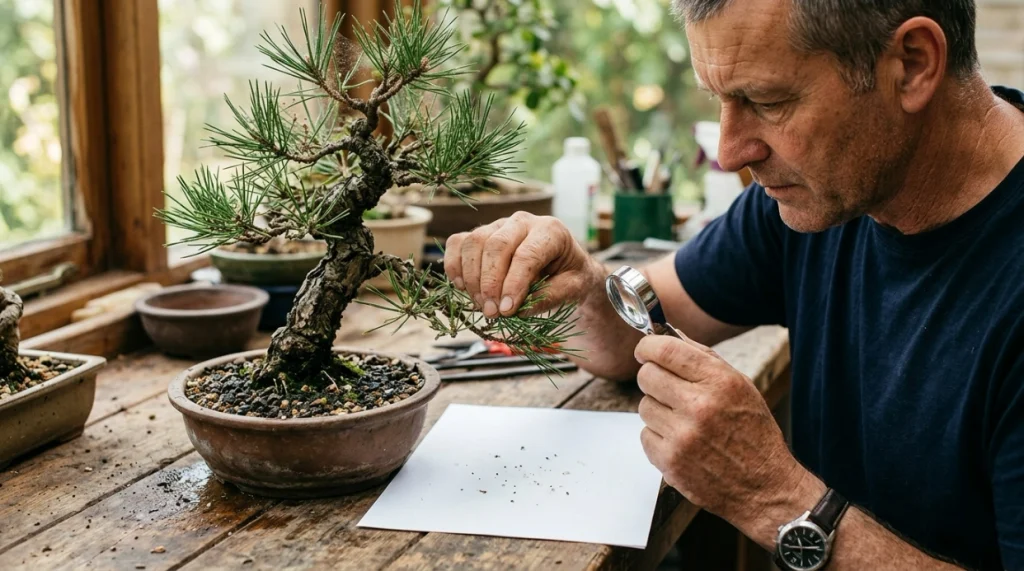
The quickest identification method is to watch what happens when you gently disturb the bonsai. Then inspect both foliage and substrate with bright light or a 10× hand lens.
My rule is simple: movement and location matter more than color. A white speck that flies is a very different problem from one that jumps from wet soil.
| What You See | Likely Cause | Where to Check | Best Confirmation Clue |
|---|---|---|---|
| Cottony white clusters | Mealybugs | Leaf joints, branch forks, bark cracks | Soft oval insect beneath white wax |
| Tiny white adults flutter upward | Whiteflies | Leaf undersides | Flying adults plus attached immature stages |
| Firm white or cream bumps | Scale | Leaves, needles, twigs, bark | Settled stages stay firmly attached |
| Fluffy wax around tender shoots | Woolly aphids | New shoots and soft growth | Aphid-shaped insect beneath wax |
| Tiny moving dots with webbing | Spider mites | Leaf undersides and branch junctions | Stippling plus fine webbing |
| Pale specks jumping from soil | Springtails | Moist substrate and drainage area | Jumping behavior after watering |
Try the white-paper test
Hold a clean sheet of white paper beneath suspicious foliage and gently tap the branch. Tiny mites may fall onto the paper and become easier to see as moving dots.
Fine webbing and pale stippling make spider mites more likely. The University of Minnesota Extension spider mite guide recommends this type of inspection alongside checking leaf undersides.
Inspect after watering
Check the substrate shortly after watering if the white organisms seem concentrated around the pot. Springtails often become easier to notice on the damp surface.
Do not assume everything moving in bonsai soil is attacking the tree. Healthy container ecosystems can contain small decomposers that are mostly harmless.
What Damage Should You Look For on Your Bonsai?
Pest damage can confirm an identification that body color alone cannot. Look at several leaves and branches rather than relying on one damaged spot.
- Sticky leaves: Honeydew points toward sap feeders such as mealybugs, aphids, whiteflies, or soft scale.
- Black surface coating: Sooty mold can grow on accumulated honeydew.
- Fine pale speckles: Stippling is strongly associated with mite feeding.
- Distorted new shoots: Aphids and other sap feeders often target tender growth.
- Yellowing leaves: Several sap-feeding pests can cause declining color and vigor.
- Fine webbing: Webbing around leaves or growing points makes spider mites a stronger suspect.
- No visible plant injury: Jumping organisms restricted to damp substrate may simply be springtails.
Also consider non-pest explanations. Mineral deposits from hard water, old spray residue, fungal growth, or natural bark features can resemble white insects from a distance.
Touching the material gently with a wooden toothpick can help. Residue usually behaves differently from a living insect or a scale covering.
How Do You Get Rid of Tiny White Bugs Safely?
Start with the least disruptive method that fits the confirmed pest. Bonsai have limited soil volume and carefully maintained foliage, so unnecessary treatments can create avoidable stress.
- Isolate the tree. Move it away from nearby bonsai, houseplants, and nursery material.
- Confirm the pest. Check movement, body shape, feeding location, honeydew, webbing, and damage.
- Remove what you can physically. Rinsing, wiping, or manually removing visible pests can reduce small populations.
- Choose a pest-specific treatment. Use only products labeled for the plant and target pest.
- Inspect repeatedly. Eggs or protected life stages may survive one cleanup.
- Check neighboring plants. Treating one tree will not solve a collection-wide infestation.
For mealybugs
Small aboveground infestations can often be reduced by physically removing visible insects. UC IPM also describes spot treatment using 70% or less isopropyl alcohol on a cotton swab for small houseplant infestations.
Test alcohol on a small area and wait one to two days before broader use. Tender bonsai foliage can react differently, so avoid treating the entire tree blindly.
For whiteflies
Focus on leaf undersides because eggs and immature insects stay there. A controlled rinse can remove some insects before further treatment.
Insecticidal soap or horticultural oil may be appropriate when the product label lists both the target pest and the type of plant. Thorough coverage matters because these materials work mainly through direct contact.
For scale insects
Small colonies can often be reduced by carefully removing reachable scale. Inspect protected interior branches because mature scale can blend into bark and twigs.
Young mobile stages, called crawlers, are generally easier to reach with contact treatments than established adults beneath protective coverings.
For spider mites
Rinsing foliage can physically reduce mites where the species tolerates it. Pay particular attention to leaf undersides.
If treatment becomes necessary, use a product labeled for mites and the plant involved. Avoid repeated broad-spectrum spraying without confirming the pest.
For springtails
Springtails normally do not justify pesticide treatment. A large population usually indicates persistently damp conditions and abundant organic material.
Adjust watering to the bonsai species rather than trying to make the root ball completely dry. A juniper, ficus, azalea, and maple do not share identical moisture requirements.
Important: Always read the pesticide label. Check plant restrictions, dilution, temperature limits, application intervals, protective equipment, and whether the product is intended for the pest you identified.
Section Takeaway: Isolation, correct identification, physical removal, and targeted treatment are safer than spraying every white speck you find.
Why Do Tiny White Bugs Keep Coming Back?
Recurring pests usually mean some insects or eggs survived, another plant remains infested, or the environment still favors the problem. One treatment rarely guarantees every life stage is gone.
- Hidden insects: Dense foliage, branch forks, bark cracks, and leaf axils protect small pests.
- Untreated life stages: Eggs and protected nymphs may survive the first cleanup.
- Nearby host plants: Houseplants or other bonsai can act as reservoirs.
- New arrivals: Recently purchased trees can introduce pests into a collection.
- Excess moisture: Persistently wet substrate encourages springtail populations.
- Warm, dry conditions: These conditions can favor spider mite activity on susceptible plants.
Do not respond to recurrence by automatically increasing pesticide strength. Go back to identification and determine what stage or source you missed.
How Can You Prevent Another Infestation?
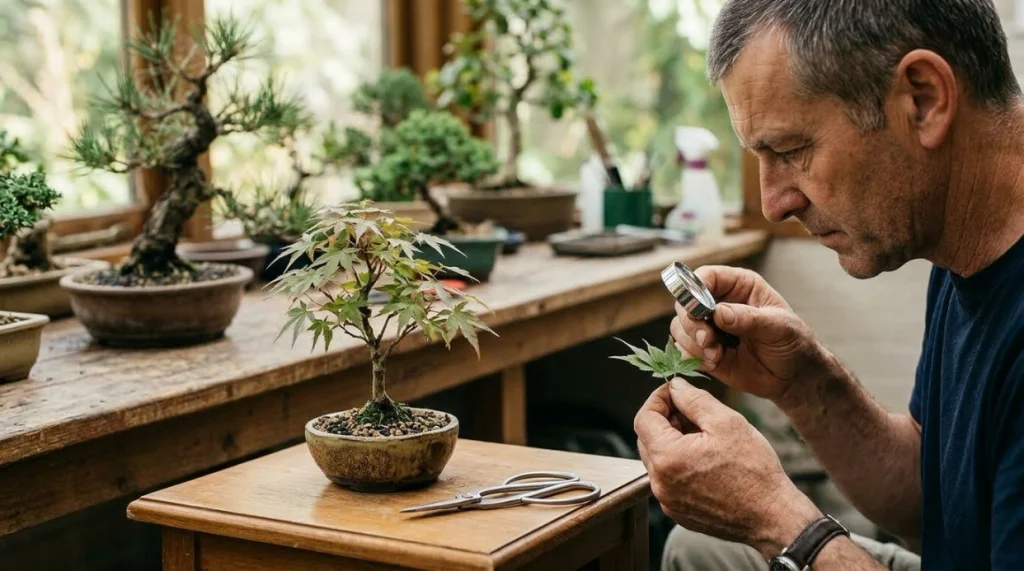
Prevention is mostly inspection and collection hygiene. Catching five insects early is easier than treating a colony hidden throughout a mature bonsai canopy.
- Inspect new trees: Check leaf undersides, shoots, bark, branch forks, soil surfaces, and drainage holes.
- Keep new plants separate: Observe new bonsai before placing them tightly among established trees.
- Check weekly: Use watering and routine maintenance as opportunities for pest inspection.
- Clean tools: Clean tools and work surfaces after handling visibly infested plants.
- Match care to species: Proper light, watering, drainage, and seasonal care help avoid unnecessary plant stress.
- Watch neighboring plants: Bonsai pests do not respect collection boundaries.
Look beneath the foliage rather than only at the display side. Many infestations begin where casual inspection misses them.
A 10× hand lens is especially useful for mites, crawlers, whitefly nymphs, and other pests that look like dust to the naked eye.
FAQ About Tiny White Bugs on Bonsai
What are the tiny white bugs crawling on my bonsai?
Slow-crawling white insects may be mealybugs, young scale crawlers, aphids, or other small pests. Look for cottony wax, sticky honeydew, body shape, and the exact location before deciding which pest is present.
What are the tiny white bugs flying off my bonsai?
White insects that flutter upward when you disturb foliage are commonly adult whiteflies. Turn several leaves over and look for eggs or flattened immature whiteflies attached to the undersides.
What are the tiny white bugs jumping in bonsai soil?
Jumping white or gray organisms in moist bonsai substrate are often springtails. They mainly feed on fungi and decaying organic material and usually cause little or no plant damage.
Are tiny white bugs harmful to bonsai?
Some are harmful and some are not. Mealybugs, whiteflies, scale, aphids, and spider mites can weaken bonsai through feeding, while springtails in the soil are usually harmless decomposers.
Can I spray insecticidal soap on my bonsai?
Insecticidal soap can control several soft-bodied pests, but suitability depends on the plant and product label. Confirm the pest, follow the label exactly, and test a small section when plant sensitivity is uncertain.
Why are my bonsai leaves sticky when I see white bugs?
Sticky foliage is usually honeydew, a sugary waste produced by pests such as mealybugs, aphids, whiteflies, and soft scale. Sooty mold may later grow on that residue and create a black surface coating.
Should I repot a bonsai because I found white bugs in the soil?
Not automatically. First identify the organisms, because springtails may need only moisture correction, while suspected root mealybugs require a different approach.
Pro tip: Avoid unnecessary root disturbance or out-of-season repotting just to investigate an unidentified soil organism. If root pests are suspected, ask an experienced grower or local bonsai club about safe timing for your species.
What Should You Do When You Find Tiny White Bugs?
Start by watching the bugs rather than spraying them. Check whether they fly, jump, crawl, remain fixed, produce wax, leave honeydew, or create webbing.
Then match those clues to the damage and location. Mealybugs, whiteflies, scale, aphids, mites, and springtails can all look pale, but they behave very differently.
Once you have a confident identification, isolate the bonsai and choose the least disruptive control that fits the pest. Keep inspecting the tree afterward because early follow-up is often what prevents a small problem from rebuilding.
