
Ants on Bonsai Trees: Why They Appear and What to Do

Quick Answer
Ants on bonsai trees usually appear because they have found food, especially the sugary honeydew produced by aphids, soft scale, mealybugs, or other sap-feeding pests. A few exploring ants are rarely an emergency, but a steady trail deserves inspection because aphids and their honeydew commonly attract ants.
What to check first
- New shoots: Look for clusters of small, soft-bodied aphids around buds and tender leaves.
- Sticky foliage: Honeydew on leaves or branches suggests a sap-feeding pest is present.
- Stem bumps: Brown, tan, or pale bumps can indicate soft scale.
- White patches: Cotton-like material around joints may indicate mealybugs.
- Potting mix: Ants repeatedly entering drainage holes may have established a nest in the container.
Best first move
- Identify and control the honeydew-producing pest first, then manage persistent ant trails around the pot or bonsai bench.
Ants on bonsai trees can be confusing because the ants themselves often aren’t the main problem. In day-to-day bonsai care, I treat persistent ant traffic as a clue first and an ant problem second.
The important job is finding out what they’re visiting. This guide covers aphids, scale, honeydew, nests in bonsai soil, safe control options, and ways to stop the problem from returning.
In This Guide
Why Do Ants Appear on Bonsai Trees?
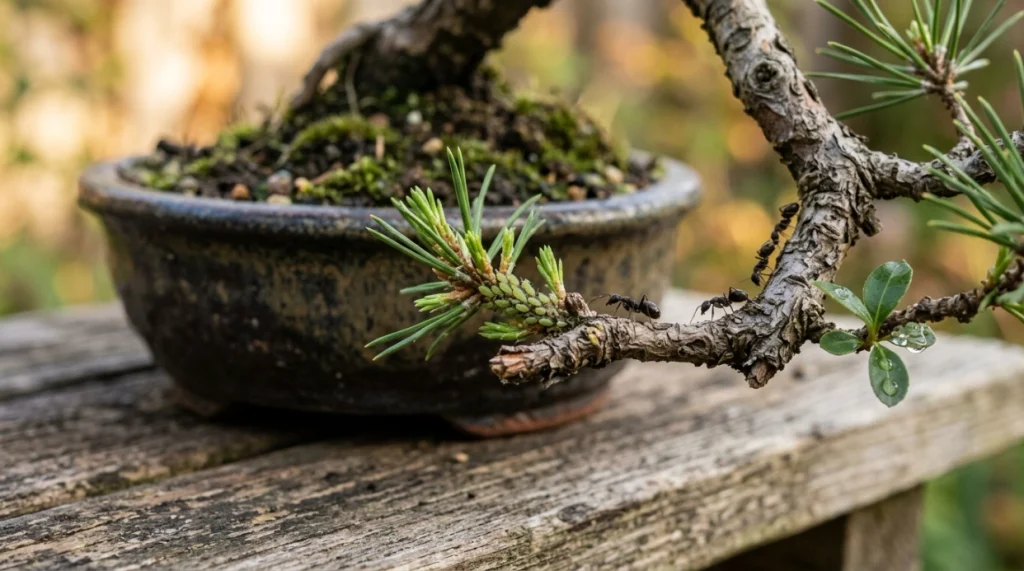
Ants usually visit a bonsai because the tree provides food, shelter, or a convenient route to another food source. Honeydew-producing insects are one of the first things worth checking.
Ant activity on bonsai is the repeated presence of worker ants on the trunk, branches, foliage, soil, or pot. It can indicate ordinary foraging, honeydew-producing pests, or a colony established in or near the container.
Aphids are a common reason
Aphids feed on plant sap and often gather on soft new growth. They produce a sugary waste called honeydew, which many ants readily collect.
Watch the ants rather than immediately spraying them. A trail that repeatedly ends at young shoots can lead you directly to a hidden aphid colony.
- Check buds: Aphids often gather around opening buds and tender shoots.
- Look under leaves: Colonies can hide on protected lower surfaces.
- Feel for stickiness: Honeydew can make leaves, branches, pots, and benches tacky.
- Notice white flakes: Pale shed aphid skins may remain near a colony.
- Inspect curled leaves: Sustained feeding can distort developing foliage.
Soft scale and mealybugs can also attract ants
Aphids aren’t the only insects that produce honeydew. Soft scale and mealybugs can create the same ant-attracting food source.
Scale can be easier to miss because it may resemble a small bump on a stem. University of Maryland Extension recommends watching ant activity as one clue when checking plants for scale insects.
- Soft scale: Look for rounded or flattened bumps on branches, stems, and leaf veins.
- Mealybugs: Look for white, waxy material around leaf joints and protected crevices.
- Sooty mold: Dark surface growth may appear where honeydew accumulates.
Ants may simply be foraging
One or two ants don’t prove that your bonsai has pests. Ant workers constantly search their surroundings for food and water.
Repeated activity is more informative. Tenants entering the same drainage hole or following the same trunk route deserve closer inspection.
Section Takeaway: Persistent ant trails are more important than an occasional ant. Follow the trail and check carefully for honeydew-producing insects before choosing a treatment.
Are Ants Harmful to a Bonsai Tree?
Most ants don’t directly eat healthy bonsai foliage or roots. The bigger concern is their relationship with sap-feeding pests and, in some cases, their nesting activity in the pot.
Ants can collect honeydew from aphids and other insects. They may also interfere with predators that naturally help reduce those pests.
Ants can protect aphid colonies
Beneficial insects such as lady beetles, lacewings, and parasitic wasps naturally attack aphids. Ants tending a colony may disrupt some of those predators.
That matters because removing aphids while ignoring heavy ant traffic can make biological control less effective. UC Integrated Pest Management recommends controlling ant access as part of aphid management on plants.
Ant nests can disturb bonsai soil
Some ant species naturally build nests in soil. A bonsai pot offers a small, protected space that may appeal to them, especially when conditions stay relatively dry.
Established colonies can move particles while making tunnels. In a shallow bonsai container, excessive excavation around fine roots is something I wouldn’t ignore.
| What you see | Likely explanation | What to inspect | First action |
|---|---|---|---|
| Ants concentrated on new shoots | Aphids or another honeydew pest | Buds, shoots, leaf undersides | Confirm and remove the pest |
| Ants visiting fixed bumps on stems | Possible soft scale | Branches, veins, trunk crevices | Identify the scale before treatment |
| Ants entering drainage holes | Possible nest in the pot | Soil surface, holes, pot underside | Check colony activity and soil condition |
| Sticky leaves plus black coating | Honeydew and possible sooty mold | Whole tree for sap-feeding pests | Control the honeydew source |
| Only one or two passing ants | Normal foraging may be occurring | Quick foliage and soil check | Monitor before treating |
Section Takeaway: Ants are often an indirect bonsai problem. Their presence matters most when they reveal sap-feeding pests or an active nest inside the container.
How Do You Find Out Why Ants Are on Your Bonsai?
Start with observation rather than pesticide. A five-minute inspection can often tell you whether the ants are visiting honeydew or living in the pot.
Step 1: Follow the ant trail
Watch several individual ants for a minute or two. Note whether they travel toward leaves, branch tips, the soil surface, or drainage holes.
The destination matters. Ants repeatedly climbing toward foliage suggest a food source above the soil.
Step 2: Inspect tender growth
- Look closely at new leaves and shoots.
- Turn leaves over and inspect their undersides.
- Check buds and leaf petioles.
- Use a 10× hand lens when insects are difficult to see.
- Look for curled leaves, white shed skins, or sticky residue.
Step 3: Inspect woody stems
If you don’t find aphids, look for scale. Check branch forks, leaf veins, fine twigs, and protected bark crevices.
A scale insect may look more like part of the branch than an insect. Avoid treating until you’re reasonably confident about what you’ve found.
Step 4: Check for honeydew and sooty mold
Honeydew is clear and sugary, so it often makes foliage look shiny before it feels sticky. Black sooty mold can later grow on the sugary residue.
The mold isn’t the underlying cause. University of Maryland Extension recommends finding and reducing the pest responsible for honeydew when managing honeydew and sooty mold.
Step 5: Check the container itself
Watch the drainage holes and edges of the pot. A steady flow of ants entering and leaving the substrate suggests more than casual foraging.
Also check under the pot and beneath the bench. The colony may be outside the bonsai container while workers simply use the tree as a food source.
Section Takeaway: Diagnose before treating. Ant location, sticky residue, pest appearance, and movement through the pot usually reveal what needs attention.
How Do You Get Rid of Ants on a Bonsai Safely?
The safest approach is to remove the ants’ food source first. Then manage persistent ant traffic without exposing a small bonsai unnecessarily to harsh chemicals.
For aphids, start with physical removal
A light aphid infestation can often be reduced with a controlled stream of water. Support delicate branches while rinsing so you don’t damage the tree.
Repeat the inspection afterward. Aphids hidden inside curled leaves or dense foliage can survive the first cleaning.
Use insecticidal soap or horticultural oil when needed
For persistent sap-feeding pests, consider a commercially prepared insecticidal soap or horticultural oil labeled for the plant and target pest. Follow the product label exactly.
- Cover the pest: Contact products work only where the spray reaches.
- Avoid heat stress: Don’t spray a drought-stressed tree or in unsuitable temperatures.
- Check sensitivity: Some species can react badly to oils or soaps.
- Protect flowers: Follow pollinator precautions on the label.
- Repeat only as directed: Don’t increase concentration to speed up control.
Avoid substituting household dish detergent for a labeled insecticidal soap. Household formulas contain ingredients that weren’t designed or tested for plant pest management.
Manage ants around the bench
If ants continue returning after the honeydew pest is controlled, find their route. Their colony may be under a paving stone, beside the bench, or elsewhere in nearby soil.
Many ant species nest in soil and forage for sugary foods, including honeydew, according to the University of Minnesota Extension ant guide.
- Remove obvious food sources around the growing area.
- Keep the bench reasonably clean.
- Interrupt physical routes from nearby plants when practical.
- Use enclosed ant bait stations only according to their labels.
- Keep pesticides away from the bonsai root zone unless the label specifically permits that use.
Don’t spray the tree just because you see ants
Random spraying can miss the real problem. It can also kill beneficial predators that would otherwise help control aphids and other pests.
As of 2026, an integrated approach still makes the most sense: identify, use physical controls first, preserve beneficial insects, and use labeled products only when needed.
Section Takeaway: Remove honeydew-producing pests first, then address the ant route or colony. Treating ants alone often leaves the reason they arrived untouched.
What Should You Do if Ants Are Nesting in the Bonsai Pot?
An active nest inside the pot needs more attention than ants simply walking across it. Confirm the nest before disturbing the roots.
Signs of a nest inside the pot
- Ants repeatedly enter and leave drainage holes.
- Workers disappear directly into the potting mix.
- Fine substrate collects around holes or the pot edge.
- Ant activity continues even after foliage pests are controlled.
- Ants rapidly emerge from the substrate when the pot is moved.
Check your watering and substrate
Some soil-nesting ants favor relatively dry sites. That doesn’t mean you should suddenly keep a bonsai waterlogged to discourage them.
Water according to the tree’s actual needs. If the mix has become excessively dry, hydrophobic, or compacted, correct the underlying care problem rather than flooding the pot repeatedly.
Should you repot because of ants?
Don’t automatically repot a healthy tree at the wrong time of year. Repotting can impose far more stress than a small ant colony.
If the substrate has broken down, drainage is poor, or the colony has substantially disturbed the mix, repotting may eventually be appropriate. Match the timing and root work to the bonsai species.
Pro tip: Root pruning and emergency repotting are irreversible. If the tree is weak, valuable, or outside its normal repotting season, consult an experienced grower or local bonsai club before disturbing the root ball.
Avoid pouring unverified chemicals into the soil
A shallow bonsai pot contains a concentrated root system. That makes careless soil treatments especially risky.
Never pour household cleaners, concentrated soap, boiling water, or an unlabeled pesticide solution through the pot. Use only products whose labels specifically allow the intended plant, site, and application method.
Section Takeaway: Confirm that ants are actually nesting in the container before disturbing the tree. Protect the root system and avoid emergency repotting unless the substrate or tree condition gives you another reason.
How Do You Stop Ants From Coming Back?
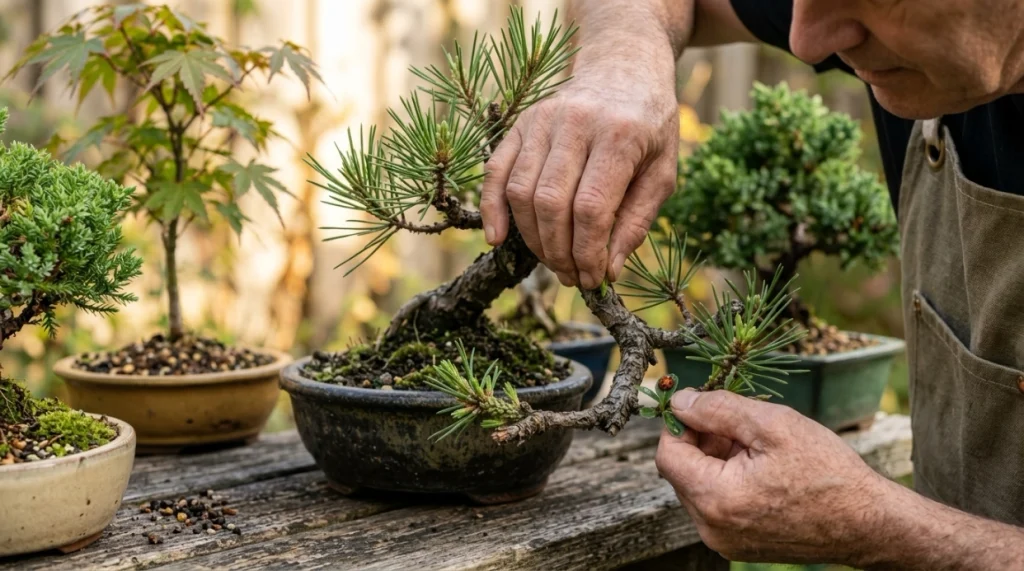
Prevention is mostly about removing the conditions that keep rewarding the ants. Regular pest inspection is more effective than repeatedly treating visible workers.
Inspect new growth every week during active growth
Tender shoots can change quickly in spring and early summer. Look closely while watering instead of waiting for curled leaves or a large colony.
- Check shoot tips.
- Look beneath young leaves.
- Inspect branch junctions.
- Watch for sticky surfaces.
- Follow any new ant trail.
Avoid excessively soft growth
Overfeeding can push lush, tender growth that is attractive to some sap-feeding insects. Fertilize according to species, season, development stage, and the tree’s health.
More fertilizer isn’t automatically better. Balanced growth is easier to inspect and manage.
Check nearby plants too
A clean bonsai can be recolonized from weeds, houseplants, garden plants, or neighboring bonsai. Winged aphids can move between host plants when conditions favor dispersal.
Inspect the entire growing area if the same problem keeps returning. Treating one bonsai while ignoring an infested plant beside it can create a cycle.
Encourage beneficial insects outdoors
Lady beetles, lacewing larvae, hoverfly larvae, and parasitoid wasps all help suppress aphids. Broad-spectrum insecticides can interfere with that natural control.
Use the least disruptive method that solves the problem. A small bonsai gives you an advantage because close inspection and manual removal are practical.
Section Takeaway: The best prevention routine is simple: inspect new growth, avoid unnecessary overfeeding, control honeydew pests early, and monitor nearby plants for reinfestation.
Frequently Asked Questions
Are ants on a bonsai always a sign of aphids?
No. Ants may simply be exploring, nesting nearby, or looking for another food source. However, repeated ant activity on foliage is a good reason to inspect for aphids, soft scale, mealybugs, and sticky honeydew.
Will ants kill my bonsai tree?
Ants usually aren’t direct bonsai killers. Problems are more likely when they support honeydew-producing pests or establish a large nest that disturbs the limited substrate inside a shallow bonsai container.
Why are ants crawling on the new growth?
Check the new shoots carefully for aphids. Aphids commonly feed on tender plant tissue and produce honeydew, giving ants a sugary food source that can keep them returning to the same shoots.
Why are ants going into my bonsai soil?
They may be exploring or nesting in the substrate. Watch for repeated entry through the soil or drainage holes, displaced particles, and persistent traffic even after any foliage pests have been removed.
Can I use insecticidal soap on a bonsai?
A labeled insecticidal soap may help control pests such as aphids when the bonsai species and application site are permitted by the label. Test cautiously, cover the target insects thoroughly, and avoid spraying stressed plants or using stronger concentrations than directed.
Should I use ant poison inside my bonsai pot?
Don’t place or pour an ant pesticide into bonsai soil unless its label specifically permits that plant and application method. When possible, locate the colony and use an appropriate enclosed bait away from the bonsai root zone.
Should I repot a bonsai that has ants?
Not automatically. Repot when the tree’s species, season, substrate condition, and root health justify it. An ant nest can add urgency, but unnecessary root disturbance at the wrong time may create a bigger problem than the ants.
The main takeaway: when you notice ants on a bonsai, don’t start by trying to kill every ant you see. Follow their trail, identify what they’re visiting, and fix that cause first.
Check tender shoots for aphids, stems for scale, protected joints for mealybugs, and the pot for nesting activity. That small inspection habit can catch several bonsai problems before they become serious.
