
Earwigs on Bonsai: Identification and Control

Quick Answer
Earwigs on bonsai are usually confirmed by their elongated brown bodies, rear pincers, nighttime activity, and irregular chewing on tender leaves or shoots. Before treating, inspect the tree after dark because UC Integrated Pest Management guidance on earwigs notes that they feed mainly at night and hide in cool, dark, moist places during the day.
What to do first
- Confirm the pest: Check the bonsai with a flashlight after dark instead of treating based on leaf holes alone.
- Check for damage: Look for ragged holes, chewed leaf margins, damaged buds, or feeding on soft new growth.
- Remove hiding sites: Clear fallen leaves, damp debris, unused pots, boards, and clutter around the bonsai bench.
- Use simple traps: Rolled cardboard, damp newspaper, or a shallow oil trap can help confirm and reduce earwig activity.
- Avoid automatic spraying: A few earwigs may eat other pests, so treatment is most useful when plant damage is continuing.
Important bonsai precaution
- Do not deliberately let a moisture-sensitive bonsai become dangerously dry just to make the area less attractive to earwigs.
Finding an earwig around a bonsai can look alarming, especially when those rear pincers are visible. The good news is that seeing one does not automatically mean your tree has a serious infestation.
I prefer to confirm nighttime feeding before changing a bonsai’s care routine. This guide covers identification, damage, trapping, control, and prevention without creating unnecessary stress for the tree.
In This Guide
How Do You Identify Earwigs on a Bonsai?
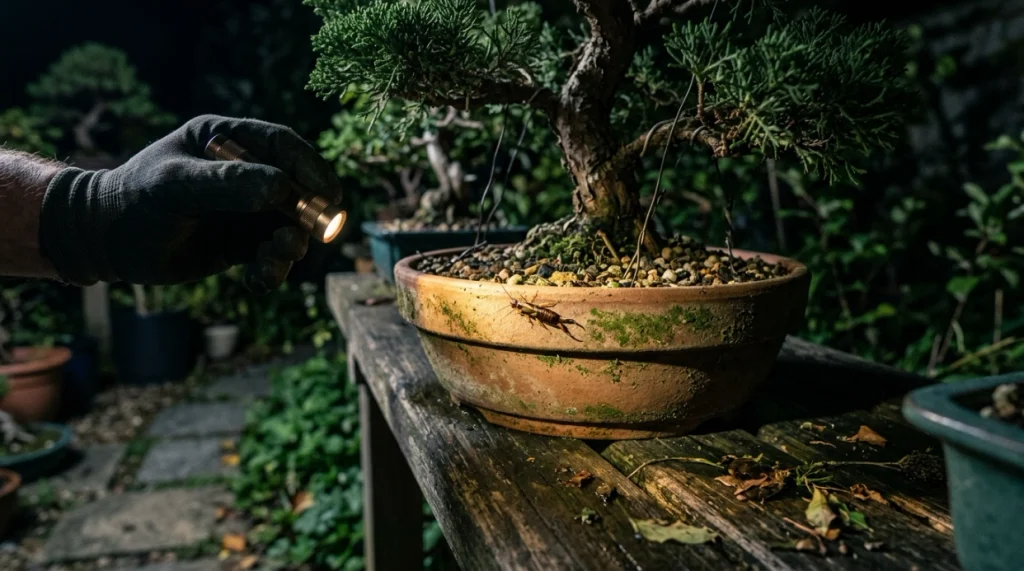
Earwigs are elongated insects with a distinctive pair of forceps-like appendages, called cerci, at the rear of the abdomen. European earwigs are usually brown to reddish brown and are commonly around 1/2 to 3/4 inch long as adults.
The pincers look intimidating, but they are mainly used for defense, mating, and handling prey. Their presence is the quickest visual clue that you are dealing with an earwig.
Look for nighttime activity
Earwigs are mainly nocturnal. During daylight, they prefer tight, dark, protected places with some moisture.
Inspect your bonsai about one or two hours after sunset. Use a flashlight and check both the tree and the area immediately around the pot.
- Young shoots: Look closely at soft new growth and buds.
- Leaf clusters: Check dense foliage where insects can remain shaded.
- Pot rim: Inspect the gap beneath the lip of the container.
- Beneath the pot: Earwigs may shelter under containers sitting on damp benches.
- Bench debris: Check fallen foliage, bark pieces, weeds, boards, and nearby clutter.
Utah State University describes the European earwig as a nocturnal omnivore that feeds on plant material, insects, fungi, and decaying organic matter. Its daytime habit of hiding in protected spaces explains why growers often see damage before seeing the insect itself.
You can review the Utah State University European earwig guide for additional identification details.
Earwig vs. other chewing pests
Leaf holes alone do not prove earwigs are responsible. Slugs, snails, caterpillars, beetles, and other insects may produce similar damage.
| Possible Pest | Typical Clue | Best Confirmation |
|---|---|---|
| Earwig | Irregular holes or chewed margins; no slime trail | Find brown insect with rear pincers at night |
| Slug or snail | Irregular chewing, often with shiny slime | Look for slime trails and nighttime activity |
| Caterpillar | Chewed foliage, pellets of frass, or webbing | Inspect foliage and branch junctions closely |
| Sap-feeding pest | Curling, stippling, sticky residue, or discoloration | Inspect leaf undersides and new shoots |
Section Takeaway: Confirm the insect itself whenever possible. Night inspection is far more reliable than identifying earwigs from leaf damage alone.
What Does Earwig Damage Look Like on Bonsai?
Earwigs can chew living plant tissue, especially softer material. On bonsai, the greatest concern is usually tender growth rather than old, hardened wood.
Possible signs include irregular holes, notched leaf edges, damaged buds, and chewing on emerging shoots. Young trees or recently developed foliage can show damage more clearly than mature, tougher leaves.
Not every earwig needs to be killed
Earwigs are omnivores. They may also consume aphids, mites, insect eggs, dead insects, and decomposing plant material.
That makes them different from a pest that feeds only on your bonsai. A low population without meaningful plant damage may not justify treatment.
UC IPM specifically describes earwigs as both potential plant pests and beneficial predators. Their guidance recommends management when damage becomes a problem rather than treating every individual insect.
When I would take action
I would move from simple monitoring to active control when fresh damage continues for several nights. Repeated feeding on buds or new shoots deserves more attention than one damaged old leaf.
- Several new leaves develop fresh holes overnight.
- Soft shoot tips are repeatedly chewed.
- Multiple earwigs appear around the same bonsai each night.
- Traps collect earwigs repeatedly.
- A small or weak tree is losing important foliage.
- Damage continues after other chewing pests have been ruled out.
For general bonsai troubleshooting, Bonsai Empire’s pest and disease guidance also emphasizes identifying the insect before selecting a treatment.
Why Are Earwigs Around My Bonsai?
Earwigs are attracted to shelter and favorable moisture conditions, not to the artistic form of the bonsai itself. A bonsai bench can unintentionally provide excellent daytime hiding places.
The issue is often the environment around the pot rather than the tree.
Common hiding places around bonsai
- Fallen leaves: Damp organic debris provides cover during daylight.
- Thick weeds: Dense growth keeps the area shaded and protected.
- Unused pots: Stacked containers create dark crevices.
- Wooden boards: Moist wood touching the ground can become shelter.
- Dense mulch: Organic mulch can hold moisture and provide hiding spaces.
- Damp bench surfaces: Constantly wet areas can remain attractive to moisture-seeking insects.
Does overwatering cause earwigs?
Overwatering does not create earwigs. However, consistently wet surroundings may provide the cool, protected conditions they prefer.
Do not respond by withholding water from a bonsai that needs it. Water according to species, substrate, season, pot size, temperature, and actual soil moisture.
A well-draining bonsai mix can stay appropriately moist without leaving the entire bench constantly saturated. The goal is healthy roots, not an artificially dry tree.
As of 2026, this remains an important distinction in bonsai pest management. Correct the habitat around the pot without turning pest control into a watering problem.
How Do You Get Rid of Earwigs on Bonsai?
The safest starting point is an integrated approach: confirm the insect, remove hiding places, trap adults, and monitor new damage. Chemical control usually comes later.
1. Clean the area around the bonsai
Remove fallen foliage, weeds, rotting organic matter, loose boards, and unused containers near the affected tree. Pay particular attention to damp material touching the bench or ground.
This does not require stripping decorative moss from every bonsai. Focus first on unnecessary hiding places around the growing area.
2. Use rolled cardboard or newspaper traps
Earwigs willingly enter narrow, sheltered spaces during daylight. Rolled corrugated cardboard, short tubes, or loosely rolled newspaper can work as simple monitoring traps.
- Place the trap near the affected bonsai in the evening.
- Leave it overnight.
- Check it the next morning.
- Shake trapped earwigs into a container of soapy water.
- Repeat while nighttime activity continues.
These traps are useful because they do two jobs. They confirm the pest and reduce the local population without spraying the bonsai.
3. Try a shallow oil trap
UC IPM describes low-sided containers containing vegetable oil with an attractive food odor as effective earwig traps. Place any liquid trap where pets and wildlife cannot reach it.
Do not set an open container where it can spill into a bonsai pot. Keep it beside the bench or near the suspected hiding area instead.
4. Hand-remove visible earwigs
A flashlight inspection can reveal individual earwigs feeding at night. Small numbers can be removed manually with tweezers, gloves, or a container.
This is practical when you have only one or two affected bonsai. It also avoids exposing beneficial insects to unnecessary pesticides.
5. Keep normal bonsai care stable
Do not suddenly repot, heavily prune, defoliate, fertilize, and spray the tree at the same time. Stacking several stressful interventions can make recovery harder.
Continue species-appropriate light and watering while you control the insects around it. Healthy bonsai care should remain the priority.
Pro tip: Major root pruning or emergency repotting is usually unnecessary for an earwig problem. If a valuable or weak bonsai appears to need irreversible root work, consult an experienced grower or local bonsai club first.
Section Takeaway: Sanitation plus trapping is the best first-line approach for most bonsai. It reduces earwig numbers without disrupting the tree’s normal growing conditions.
Should You Use Insecticide on Earwigs?
Consider insecticide only when confirmed earwig feeding remains unacceptable despite sanitation and trapping. Do not spray simply because you found one earwig beneath a pot.
UC IPM notes that insecticides are rarely required when habitat management and trapping work. Where treatment is necessary, product choice and label directions matter.
Check the label before treating a bonsai
A product labeled for earwigs is not automatically appropriate for every bonsai species or every growing situation. Confirm that the label allows use on the type of ornamental plant you are treating.
- Confirm earwigs are listed as a target pest.
- Confirm ornamental plants or the intended plant type are allowed.
- Follow the stated application rate exactly.
- Observe temperature and timing restrictions.
- Protect pollinators and other beneficial insects.
- Never exceed the label concentration.
Even when an active ingredient is commonly used for garden earwigs, the legal and safe use depends on the specific product label. Registration and approved uses can also differ by location.
Night or evening treatment may better match earwig activity when a label permits that timing. Always follow the product instructions rather than a generic online dosage.
How Do You Prevent Earwigs From Returning?
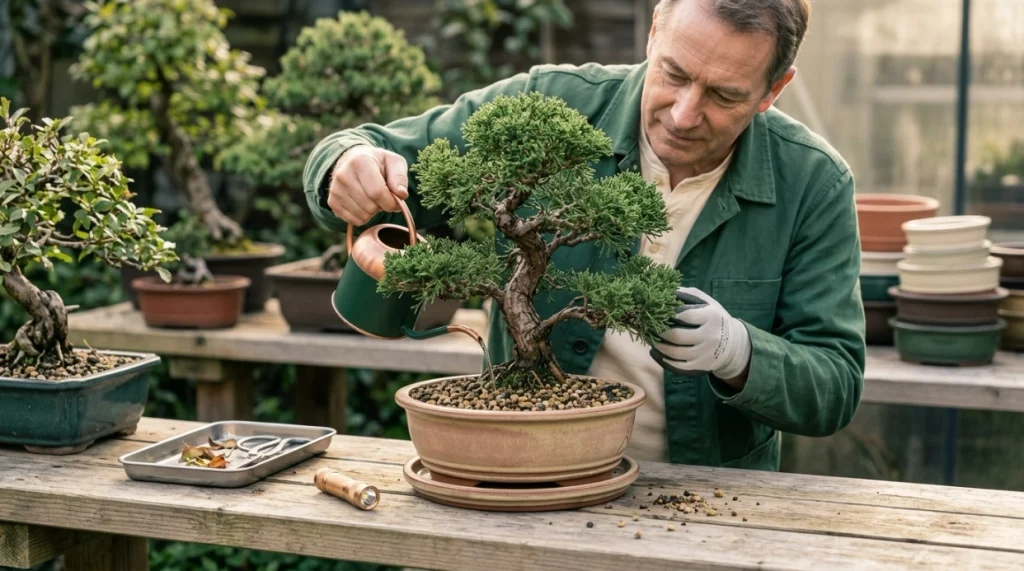
Prevention is mostly about removing easy shelter while keeping the bonsai healthy. A clean, well-managed growing area gives earwigs fewer protected places to congregate.
Use a simple prevention routine
- Inspect while watering: Look beneath leaves, around the pot rim, and under the container.
- Clear fallen debris: Do not let dead foliage remain wet beneath benches.
- Control weeds: Keep dense vegetation from touching the bonsai area.
- Improve drainage: Prevent standing water around benches and saucers.
- Move unused materials: Store boards, empty pots, and bags away from the growing area.
- Monitor at night: Recheck suspicious damage before treating.
Protect the tree instead of over-sanitizing it
Bonsai cultivation still requires correct moisture, suitable substrate, fertilizer, pruning, and seasonal care. The U.S. National Arboretum’s National Bonsai & Penjing Museum highlights the continual care required to maintain bonsai as living trees.
Do not remove every trace of moss, organic material, or natural life because one earwig appeared. Make changes that solve a confirmed problem while preserving the growing conditions your species needs.
That balance matters. Pest prevention should support tree health rather than compete with it.
Earwigs on Bonsai FAQ
Are earwigs harmful to bonsai trees?
Earwigs can damage bonsai by chewing tender leaves, buds, and shoots, but their presence does not always mean serious harm. They are omnivores and can also eat aphids and other small pests, so control is most justified when confirmed feeding is causing ongoing damage.
Why do I only see earwigs at night?
Earwigs are primarily nocturnal. They usually hide during daylight in dark, protected, moist spaces and emerge after dark to feed, which is why a nighttime flashlight inspection is one of the easiest ways to confirm them.
Can earwigs live in bonsai soil?
Earwigs may shelter around moist soil, beneath pots, and in protected crevices near containers. Their presence near the soil does not automatically mean the root system is infested or that the bonsai needs emergency repotting.
Should I repot a bonsai because of earwigs?
Usually not. Start with nighttime confirmation, sanitation, trapping, and monitoring unless the substrate or roots have a separate problem that already justifies repotting according to the tree’s species and season.
Will letting the bonsai soil dry kill earwigs?
Drier surroundings may reduce attractive hiding conditions, but deliberately dehydrating a bonsai is risky. Water according to the species and substrate while correcting excessive moisture, standing water, debris, and hiding places around the pot.
Can earwigs be beneficial around bonsai?
Yes. Earwigs are omnivorous and can prey on aphids, mites, insect eggs, and other small organisms while also consuming decaying material. A few earwigs without significant bonsai damage may not require control.
What is the easiest way to trap earwigs near bonsai?
Rolled corrugated cardboard or newspaper placed near the affected bonsai overnight is simple and inexpensive. Check it the following morning and dispose of captured insects, then repeat until activity and fresh damage decline.
The main takeaway: Do not treat leaf holes blindly. Confirm earwigs at night, remove their hiding places, use traps first, and reserve pesticides for persistent, damaging populations.
A few minutes of inspection each week can prevent a minor earwig problem from becoming serious. More importantly, it lets you protect your bonsai without disrupting the care routine that keeps the tree strong.
