Mold Growing on Bonsai Trunk: What to Do

Quick Answer
If you see mold growing on a bonsai trunk, first confirm that it is actually mold. White or fuzzy growth can develop when bark stays damp, but harmless lichen, algae, or moss on tree bark, mineral deposits, and scale insects can look surprisingly similar. Gently clean loose growth, improve airflow, and correct excess moisture before reaching for a fungicide.
What to Check First
- Check the texture: Soft, fuzzy material is more suspicious for surface fungal growth than a hard mineral crust.
- Inspect the bark: Healthy, firm bark is reassuring; soft, blackened, sunken, or peeling tissue needs closer attention.
- Check the soil: Soil that remains constantly wet can point to poor drainage or excessive watering.
- Look for insects: Scale, mealybugs, aphids, and their residues can be mistaken for fungal growth.
- Improve airflow: Crowded foliage and a constantly damp trunk create favorable surface conditions for unwanted growth.
Avoid This
- Do not automatically spray: Bleach, concentrated vinegar, peroxide, or an unneeded fungicide can injure bark without fixing the underlying cause.
Finding strange white, gray, green, or black growth on a bonsai trunk can be unsettling. I treat it as a clue rather than immediately calling it a disease.
In this guide, I’ll show you how I separate harmless trunk growth from real trouble, clean the bark safely, and reduce the chance of it returning.
In This Guide
Is the Growth on Your Bonsai Trunk Really Mold?
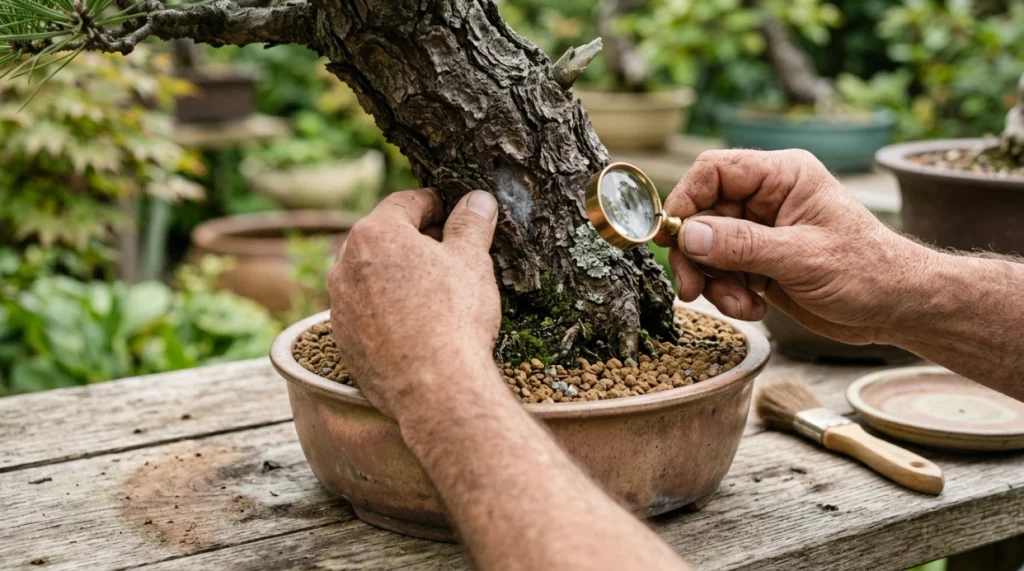
Not every fuzzy, pale, or green coating is mold. Identification matters because several harmless organisms and pests can resemble fungal growth.
I start by looking at color, texture, location, and whether the underlying bark remains firm.
Bonsai trunk mold usually means visible fungal growth developing on the bark surface or on dead organic material around it. That is different from a fungal infection actively damaging living trunk tissue.
Compare the most common look-alikes
| What You See | Possible Cause | Typical Clue | First Action |
|---|---|---|---|
| White or gray fuzz | Surface fungal growth | Often appears where conditions stay damp | Clean gently and review moisture |
| Green soft coating | Algae or moss | Common in damp, shaded conditions | Usually focus on growing conditions |
| Gray-green crusty patches | Lichen | Firmly attached and slow growing | Usually leave it alone |
| White hard crust | Mineral residue | Often associated with hard water | Review water source |
| Cottony or waxy spots | Scale or mealybugs | Individual insects or sticky honeydew may appear | Inspect for pests closely |
Harmless moss, algae, and lichens can use bark as a surface without feeding on the tree. Removing them aggressively can sometimes cause more damage than leaving them alone.
Also inspect for scale insects before diagnosing mold. The University of Maryland’s scale monitoring guidance notes that waxy covers and sooty mold associated with honeydew can make infestations confusing at first glance.
Section Takeaway: Identify the growth before treating it. Color alone is not enough to tell mold, lichen, minerals, and pests apart.
Why Does Mold Grow on a Bonsai Trunk?
Persistent moisture is one of the first things I investigate. The important question is why the trunk or surrounding organic material stays damp.
Surface fungal growth often develops when several conditions overlap.
- Constantly wet growing media: Dense soil can stay damp for long periods and keep the trunk base humid.
- Poor airflow: Closely packed trees, enclosed shelves, or stagnant indoor areas slow evaporation.
- Frequent misting: Repeatedly wetting the trunk can keep bark damp without providing useful root-zone watering.
- Organic debris: Dead moss, old leaves, decaying bark, or other material can support saprophytic fungi.
- Too much shade: Low light may slow surface drying and can be unsuitable for sun-loving bonsai species.
- Tree stress: Weak roots, unsuitable placement, pests, and poor soil can reduce overall vigor.
Overwatering is more complicated than watering too often
Overwatering usually means the root zone remains poorly aerated for too long. It does not simply mean you used a large amount of water at one watering.
A free-draining bonsai mix may need frequent watering in hot weather. Dense organic soil can remain wet much longer.
Bonsai Empire’s bonsai watering guidance recommends checking the soil rather than watering on a fixed calendar. I use the same principle when investigating recurring mold.
The goal is a healthy wet-to-drier cycle suited to the species, season, pot, substrate, and climate. You should not intentionally dehydrate the tree just to kill surface mold.
How Do You Remove Mold From a Bonsai Trunk Safely?
Start with the least aggressive method. Bonsai bark is part of the tree’s character, and rough cleaning can permanently scar it.
For superficial fuzzy growth on otherwise firm bark, I use a careful inspection-and-cleaning approach.
- Move the tree to good light. Examine the trunk, nebari, branches, soil surface, and drainage holes.
- Check for insects. Look for scale, mealybugs, aphids, webbing, sticky honeydew, and unusual bumps.
- Remove loose debris. Pick away dead leaves and decomposing material without disturbing healthy roots.
- Use a soft brush. Lightly loosen superficial growth with a clean, soft toothbrush or similar brush.
- Avoid soaking the bark. You do not need to repeatedly drench the trunk while cleaning it.
- Let the surface dry normally. Improve airflow while continuing species-appropriate watering at the roots.
- Watch for regrowth. Photograph the area so you can compare it after several days.
Do not scrape hard enough to remove living bark. Thin-barked species and young branches can be damaged quickly.
I also avoid automatically using bleach, concentrated vinegar, household disinfectants, or hydrogen peroxide on living bonsai bark. A treatment strong enough to kill organisms may also injure plant tissue.
Pro tip: If cleaning would require cutting bark, removing live wood, or exposing suspicious tissue, stop and ask an experienced grower, local bonsai club, or plant-disease specialist before making an irreversible cut.
How Do You Stop Mold From Coming Back?
Cleaning the visible growth is only half the job. Recurring mold usually tells me to investigate the environment around the tree.
Check drainage before changing your watering
Water should penetrate the root mass and leave through the drainage holes. Water sitting on the surface for long periods can indicate compacted substrate, blocked holes, or a root-bound tree.
Do not respond by withholding all water. Instead, learn how quickly your particular bonsai and soil mix dry under current conditions.
Increase airflow without creating harsh stress
Outdoor bonsai usually benefit from natural air movement when their species and climate permit it. Indoor tropical bonsai need suitable light and airflow without a cold or excessively drying draft.
- Give neighboring pots some space.
- Avoid keeping foliage pressed against walls or glass.
- Remove fallen organic debris.
- Stop routine trunk misting if it serves no species-specific purpose.
- Make sure the species is receiving appropriate light.
Keep the trunk base visible
Decorative moss can look attractive, but I don’t let a thick layer creep permanently over the lower trunk. Keeping the root flare visible also makes inspection easier.
The root flare is often called the nebari in bonsai. It describes the visible surface roots and base that help create the impression of an established tree.
Section Takeaway: Recurring surface growth is usually better handled by correcting moisture, airflow, debris, and placement than by repeatedly spraying the trunk.
When Is Trunk Mold a Serious Bonsai Problem?
Surface mold on firm bark is different from decaying or diseased wood. Pay closer attention when the tree itself shows signs of decline.
These warning signs justify a more cautious diagnosis:
- Soft or sunken bark: Living tissue may be damaged rather than merely coated.
- Blackened wet tissue: Persistent dark, soft areas deserve investigation.
- Rapidly expanding lesions: A spreading wound or canker is more concerning than superficial fuzz.
- Unpleasant odor: A rotten smell near the trunk base or roots can suggest decaying tissue.
- Branch dieback: Multiple weakening branches point to a broader health issue.
- Weak foliage: Yellowing, wilting, or sudden leaf loss can indicate root or vascular stress.
- Mushroom-like structures: Fruiting bodies emerging from wood deserve expert identification.
If you see white fungal sheets beneath loose bark, extensive soft wood, or obvious decay, do not treat the problem as ordinary surface mold. Some wood-decay and root-disease fungi affect tissues beneath the bark.
A photo is useful, but species, season, recent watering, repotting history, and root condition can change the diagnosis. For valuable specimens, I would rather get a qualified diagnosis than apply three different treatments and hide the original symptoms.
As of 2026, that conservative approach remains important because the word “mold” describes an appearance, not a specific disease. Correct identification should come before chemical control.
Should You Repot or Use Fungicide?
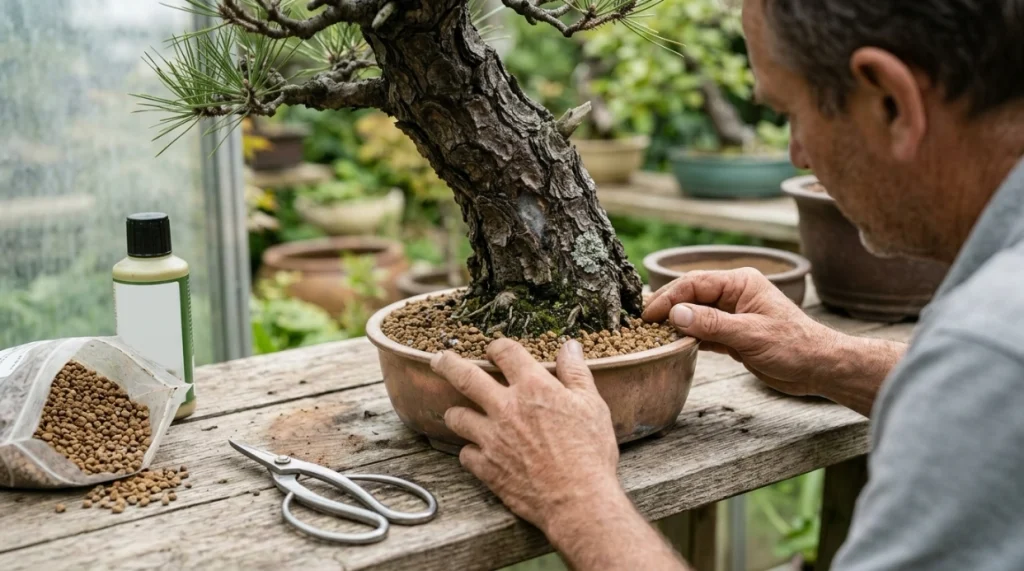
Usually, no immediate repotting or fungicide is needed for a small patch of superficial trunk growth on a healthy bonsai. Make those decisions based on the underlying problem.
Repot only when the root zone gives you a reason
Repotting makes more sense when soil has broken down, drainage is failing, roots are severely congested, or root disease is suspected. Trunk mold alone is not enough evidence.
Repotting also needs correct seasonal timing. Bonsai Empire’s repotting guide emphasizes evaluating the root system and timing the work according to the tree rather than treating repotting as a routine reaction.
Pro tip: Root pruning is irreversible. If your bonsai is already weak, avoid combining heavy root work with major pruning or other stressful procedures unless the situation clearly requires it.
Use fungicide only for an identified problem
A fungicide should match the disease, plant species, location, and product label. It should not be used simply because something white appeared on the trunk.
Many harmless trunk organisms do not need chemical treatment at all. Insect-related sooty mold also requires addressing the sap-feeding pest rather than treating the black coating as the primary problem.
If the condition continues spreading after moisture and airflow issues have been corrected, contact a local horticulture extension service, experienced bonsai grower, or plant diagnostic laboratory. Bring clear photographs and your recent care history.
Bonsai Trunk Mold FAQ
Is white mold on a bonsai trunk dangerous?
Not necessarily. White growth may be superficial fungus, mineral residue, or a pest-related deposit, so inspect it before treating it. It becomes more concerning when the bark is soft, damaged, blackened, sunken, or accompanied by declining foliage.
Can overwatering cause mold on a bonsai trunk?
Persistently wet conditions can encourage surface fungal growth and other moisture-related problems. However, the real issue may involve slow-draining soil, insufficient airflow, low light, or frequent trunk misting rather than watering frequency alone.
Should I remove moss growing up my bonsai trunk?
Moss growing on bark is generally not a parasitic disease, but thick growth can hold moisture against the surface and hide the trunk during inspection. I usually keep decorative moss mainly on the soil and gently control growth around the nebari.
Can I use vinegar to remove mold from bonsai bark?
I would not make vinegar my default treatment. Concentration, bark sensitivity, and contact with roots can create unnecessary risks, while correcting the environmental cause is usually more important for superficial growth.
Does mold mean my bonsai has root rot?
No. Surface mold does not prove root rot. Root problems become more likely when poor drainage, persistently saturated soil, weak growth, foul odors, or soft decaying roots appear alongside the trunk growth.
Should I stop watering until the mold disappears?
No. A bonsai still needs water according to its species and current conditions. Check the growing medium before watering and allow appropriate drainage rather than intentionally letting the entire root ball become dangerously dry.
Why does mold keep returning after I clean the trunk?
Repeated growth often means the favorable conditions are still present. Check airflow, soil drainage, light, wet moss, organic debris, trunk misting, pot placement, and whether the tree’s species is being grown in an appropriate environment.
Final Takeaway
Mold growing on a bonsai trunk deserves inspection, but it does not automatically mean your tree has a serious fungal disease. First decide whether you’re seeing fungus, moss, algae, lichen, mineral buildup, or a pest-related problem.
Clean superficial growth gently, then focus on drainage, airflow, light, and species-appropriate watering. If the bark itself is soft, damaged, spreading, or decaying, get a more specific diagnosis before cutting, repotting, or applying chemicals.
That slower diagnostic approach protects the tree and usually tells you far more than reaching immediately for a spray bottle.