
White Mold on Bonsai Soil: Is It Dangerous?

Quick Answer
White mold on bonsai soil is usually a harmless saprophytic fungus feeding on damp organic material rather than attacking the tree. However, repeated growth can warn that the surface stays too wet, drainage is slow, or airflow is poor. University Extension guidance on surface mold also notes that mold commonly develops on moist potting media.
What to check first
- Look at texture: Harmless surface fungi often appear as thin, fluffy, fuzzy, or web-like white growth.
- Check moisture: Soil that stays constantly damp gives fungi favorable growing conditions.
- Test drainage: Water should move through the bonsai substrate and leave through the drainage holes freely.
- Inspect the tree: Wilting, dieback, soft roots, or foul-smelling soil deserves more attention than surface fuzz alone.
- Check the residue: A hard, chalky white crust may be mineral or fertilizer salts rather than mold.
Safest first response
- Remove visible surface growth, clear dead organic debris, review watering, and improve airflow before reaching for fungicides.
Seeing white mold on bonsai soil can make a healthy tree look seriously diseased. In many cases, though, the fungus is living on dead organic matter rather than living bonsai roots.
I treat the growth as a clue first. In this 2026 guide, I’ll show you how to identify it, correct the conditions behind it, and recognize the signs that need a closer root inspection.
In This Guide
What Is White Mold on Bonsai Soil?
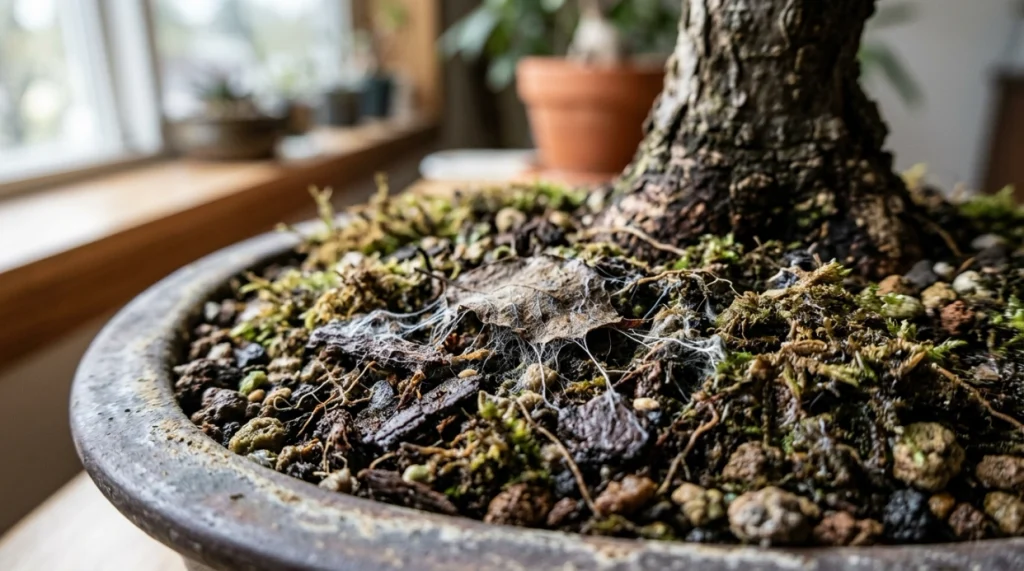
White mold on the soil surface is often fungal mycelium growing through damp organic material. Mycelium is the network of fine fungal threads that makes up the main body of many fungi.
Many of these organisms are saprophytic, or more precisely saprotrophic. That means they obtain nutrients by decomposing dead material rather than attacking healthy living tissue.
Definition: Surface soil mold is fungal growth colonizing organic material in or on the substrate. Its presence does not automatically mean the bonsai itself has a fungal disease.
Organic components such as pine bark, peat, dead moss, decomposing roots, and fallen leaves can provide food. Moist conditions then allow fungal threads to become visible.
I’ve seen this distinction matter most on bonsai with decorative moss or bark-rich mixes. The white fuzz may cover dead surface material while the tree above remains vigorous.
Could the white material be something other than mold?
Yes. Appearance matters because several unrelated problems can create white material around a bonsai pot.
- Mineral deposits: Usually crusty or chalky rather than fuzzy.
- Fertilizer salts: May form a pale crust around soil particles or the pot rim.
- Surface fungus: Often fluffy, thread-like, fuzzy, or webbed.
- Powdery mildew: Usually develops on living leaves or shoots rather than only on the substrate.
- Root disease: More concerning when paired with soft roots, poor growth, wilting, or decay.
A useful starting point is to ask where the white growth occurs. Fuzz limited to dead material on the soil surface is different from fungal growth spreading across damaged living tissue.
Is White Mold on Bonsai Soil Dangerous?
Surface mold by itself is usually not dangerous to an established bonsai. The growing conditions that encouraged it may be more important than the fungus.
Constant moisture can reduce air around the roots when the substrate is dense or deteriorated. Bonsai roots need a balance of moisture and oxygen.
That balance matters more in a shallow container. There is less substrate volume available to buffer watering mistakes.
- Small isolated patch: Usually a minor surface issue.
- Repeated mold after removal: Investigate watering and drying time.
- Mold with slow drainage: Examine substrate structure and drainage holes.
- Mold with declining foliage: Check roots and other possible causes.
- Mold on damaged trunk tissue: Treat it as a different diagnostic problem.
The Bonsai Empire soil guide emphasizes drainage, aeration, and moisture retention as core properties of bonsai substrate. Those same properties influence how long a soil surface remains damp.
Does white mold mean you overwatered?
Not necessarily. Overwatering is one possibility, but the useful question is how long the root zone remains wet.
A compacted mix may dry slowly even with reasonable watering. Cool temperatures, weak light, poor airflow, and a water-filled catch tray can also extend drying time.
That is why I don’t respond by simply skipping several waterings. I check the tree’s actual moisture needs first.
How Can You Tell Harmless Mold From Root Rot?
Look at the whole tree rather than diagnosing it from the soil surface alone. Surface mold and root rot can occur under similarly wet conditions, but they are not the same problem.
| Clue | Typical Surface Mold | Possible Root Trouble | Mineral/Salt Deposit |
|---|---|---|---|
| Texture | Fuzzy or thread-like | Roots may become soft or decayed | Hard or chalky |
| Location | Soil, bark, moss, debris | Root zone or lower stem | Surface and pot rim |
| Tree symptoms | Often none | Wilting, yellowing, weak growth, dieback | Often none unless salt levels become excessive |
| First response | Correct surface conditions | Investigate roots and drainage | Review water and fertilizer |
What does root trouble look like?
Root color varies between species, so color alone is unreliable. Texture, odor, function, and the condition of surrounding tissue provide stronger clues.
The Penn State Extension plant disease guidance describes root rot symptoms such as wilting and darkened, soft roots.
- Roots feel mushy instead of firm.
- Outer root tissue separates easily.
- The root ball smells sour or rotten.
- Water drains unusually slowly.
- The bonsai wilts while the substrate remains wet.
- New growth becomes progressively weaker.
Do not confuse harmless soil fungus with true white mold disease caused by organisms such as Sclerotinia. The University of Minnesota Extension white mold guide describes that disease as affecting plant tissues and causing symptoms such as wilt and stem damage.
Why Does White Mold Keep Coming Back?
Recurring mold means the fungus still has suitable moisture and food. Removing the visible fuzz without changing those conditions rarely solves the underlying issue.
1. The surface stays wet too long
Water according to the bonsai’s needs rather than a fixed calendar. A ficus indoors and a juniper outdoors can have completely different drying patterns.
2. Organic material is decomposing
Bark, peat, dead moss, old leaves, and other plant debris feed decomposer fungi. Removing loose dead material can reduce the visible growth.
3. Airflow is limited
Still air slows evaporation around the pot surface. Indoor bonsai crowded between other plants can remain damp longer.
4. The substrate has broken down
Old particles can crumble into fines and fill spaces that once contained air. Water movement becomes slower as the structure deteriorates.
5. Drainage is restricted
Blocked holes, accumulated fines, or standing runoff beneath the pot can keep the lower root zone wetter. Always check the physical drainage path.
- Remove standing water from trays or outer containers.
- Keep drainage holes unobstructed.
- Clear fallen leaves and dead moss.
- Check moisture before watering.
- Give indoor trees suitable airflow and light.
How Do You Remove White Mold From Bonsai Soil Safely?
Start with gentle cultural changes. There is usually no reason to pour harsh chemicals through healthy bonsai roots just because the soil surface looks fuzzy.
- Inspect the tree first. Look for wilting, dieback, soft roots, pests, or a sour smell.
- Remove loose surface mold. Lift away the fuzzy growth and heavily colonized dead debris without digging into healthy roots.
- Clear decomposing material. Remove dead leaves, excess decaying moss, and loose organic debris.
- Check drainage. Confirm water can leave every drainage hole freely.
- Adjust watering by need. Check moisture before adding more water instead of watering automatically.
- Improve growing conditions. Give the species appropriate light and airflow so the surface does not remain unnecessarily damp.
I prefer making one or two clear corrections and then watching the response. Changing watering, light, soil, fertilizer, and placement simultaneously makes diagnosis much harder.
Should you use hydrogen peroxide, vinegar, cinnamon, or fungicide?
I would not make homemade soil drenches the first response. Concentrated or poorly measured products can injure fine roots while leaving the moisture problem unchanged.
Fungicides also should not be used blindly. If a genuine disease is suspected, identify the problem and use only products labeled for the plant and disease involved.
When Should You Repot or Treat the Bonsai?
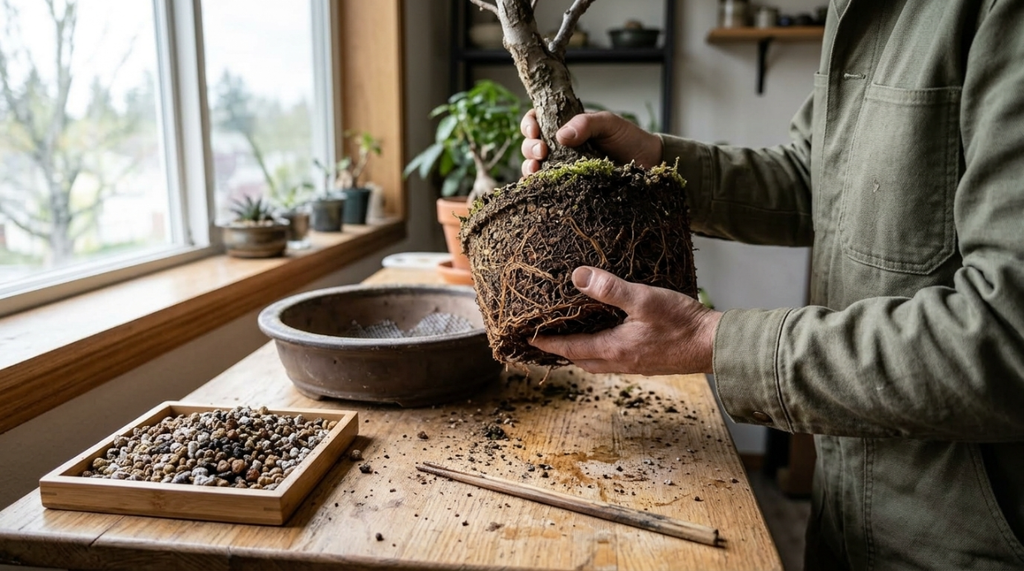
Do not repot solely because you found a small patch of white surface mold. Repotting disturbs roots and can add unnecessary stress.
Consider the substrate and root system instead. A repot becomes more reasonable when there is another clear reason to intervene.
- Drainage has deteriorated: Water sits on the surface or moves through unusually slowly.
- The substrate is collapsing: Formerly coarse particles have broken into dense fines.
- The tree is root-bound: Dense roots leave little room for functional substrate.
- Roots show decay: Significant portions are soft, damaged, or nonfunctional.
- The tree is already due: Its normal species-specific repotting window has arrived.
For many temperate bonsai, major repotting is normally timed around the beginning of active spring growth. Tropical species and unusual circumstances require different timing.
Pro tip: Root pruning is irreversible. If a valuable or severely weakened bonsai has extensive root decay, ask an experienced grower or local bonsai club for help before removing major roots.
Should you replace all the soil?
Usually not for harmless surface fungus alone. Replacing an entire root ball simply to remove visible mold can create more risk than the original problem.
If drainage and root health are good, correct the growing conditions instead. The goal is a healthy root environment, not a sterile pot.
White Mold on Bonsai Soil FAQ
Is white fuzzy mold on bonsai soil harmful?
Usually, white fuzzy growth limited to the substrate is a decomposer fungus feeding on organic material. It often causes little direct harm, but persistent growth can signal excessive moisture, poor airflow, compacted substrate, or slow drainage that deserves attention.
Can white mold kill a bonsai tree?
Ordinary saprophytic surface mold normally does not kill a healthy bonsai. A serious root disease or chronically waterlogged root zone can damage the tree, so check for wilting, weak growth, root decay, and drainage problems.
Should I remove white mold from bonsai soil?
Yes, you can gently remove visible fuzzy growth and dead organic debris. More importantly, determine why the surface remains favorable for mold and correct excessive moisture, blocked drainage, poor airflow, or decomposed substrate.
Does mold mean my bonsai is overwatered?
It can, but not always. Soil can remain damp because of low light, cool temperatures, dense organic material, poor airflow, blocked drainage, or standing runoff even when the watering frequency seems reasonable.
What is the difference between white mold and fertilizer salt?
Mold usually looks fuzzy, web-like, or thread-like. Fertilizer and hard-water deposits are generally dry, crystalline, powdery, or crusty and may also collect along the rim of the bonsai pot.
Should I use fungicide on white bonsai soil mold?
Not automatically. Surface saprophytic fungi often disappear when moisture and sanitation improve. Use a fungicide only when you have a reasonable disease diagnosis and a product whose label covers the relevant plant and disease.
Do I need to repot a bonsai with moldy soil?
A small amount of surface mold does not justify emergency repotting. Consider repotting when the substrate has broken down, drainage has failed, roots are unhealthy, or the tree is already due for repotting at an appropriate seasonal stage.
The main takeaway: white mold on bonsai soil is usually more useful as an environmental warning than as proof of disease. Check drainage, moisture, airflow, debris, and root health before taking aggressive action.
Keep the root zone healthy rather than trying to make it sterile. If the mold returns together with wilting, decay, or poor drainage, investigate the roots and substrate before the problem progresses.
