
Why Do My Bonsai Leaves Have White Spots?

Quick Answer
White spots on bonsai leaves usually come from powdery mildew, spider mite feeding, mealybugs, scale insects, mineral deposits, spray residue, or damaged leaf tissue. Before treating the tree, compare the spots with common bonsai pest and disease signs and inspect both sides of each affected leaf.
What the white spots may be telling you
- Powdery coating: White or gray flour-like patches suggest powdery mildew.
- Tiny pale dots: Fine stippling, especially underneath leaves, can indicate spider mites.
- Cottony clusters: Fuzzy white masses around leaf joints often point to mealybugs.
- Raised white bumps: Firm spots attached to stems or leaves may be scale insects.
- Chalky residue: Marks that wipe away cleanly may be hard-water or foliar-spray deposits.
- Bleached tissue: Pale spots that cannot be wiped away may come from sun, chemical, or other physical damage.
Check before you spray
- Use a damp cotton swab, a hand lens, and good natural light to determine whether the white material sits on the surface or is damage within the leaf.
White spots can look alarming because several unrelated bonsai problems produce almost the same symptom. The key is identifying what those spots actually are before reaching for a pesticide or fungicide.
My first diagnostic move is simple: I check whether the material wipes away, then inspect underneath the leaf with a hand lens. Those two checks often narrow the problem within minutes.
In This Guide
- What do white spots on bonsai leaves usually mean?
- Is white powder on bonsai leaves powdery mildew?
- Can spider mites, mealybugs, or scale cause white spots?
- Could hard water, spray residue, or sun scorch cause white marks?
- How do I diagnose white spots before treating?
- How should I treat and prevent white spots on bonsai?
- Frequently Asked Questions
What Do White Spots on Bonsai Leaves Usually Mean?
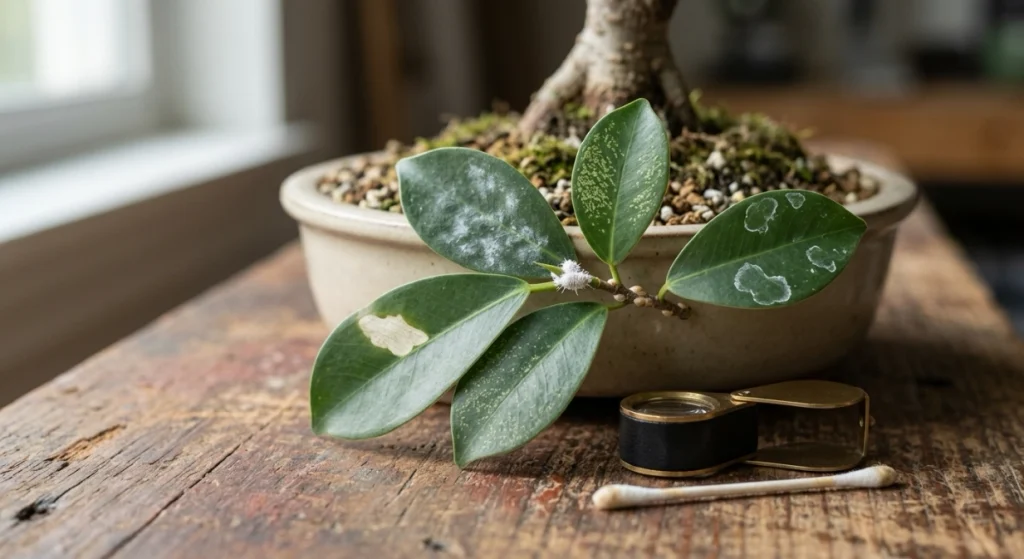
White spots are a visual symptom rather than a diagnosis. They can be living pests, fungal growth, dried minerals, chemical residue, or damaged leaf cells.
The appearance and location of each mark give you the strongest clues. Start by deciding whether the white material sits on top of the leaf or is part of the leaf itself.
White spotting on bonsai foliage means any localized pale, white, gray, waxy, powdery, or bleached area that differs from the tree’s normal leaf color. The term covers several unrelated problems, so treatment should never be based on color alone.
| What you see | Likely cause | Does it wipe off? | Extra clue |
|---|---|---|---|
| White flour-like patches | Powdery mildew | May rub partly away | Patches enlarge over time |
| Many tiny pale dots | Spider mite feeding | No | Check undersides for mites or webbing |
| Fuzzy white masses | Mealybugs | Can be physically removed | Often around leaf joints |
| Firm white or gray bumps | Scale insects | Usually needs scraping | May occur with sticky honeydew |
| Chalky rings or droplets | Mineral or spray residue | Usually yes | Matches dried water droplets |
| Flat bleached patches | Sun or chemical injury | No | Often follows an environmental change |
Do not rely on a single affected leaf. Examine several leaves, new shoots, branch junctions, and the surrounding foliage.
Is White Powder on Bonsai Leaves Powdery Mildew?
It can be. Powdery mildew commonly appears as white or gray powdery spots that gradually expand across the leaf surface.
The growth can begin as small circular patches before spreading. The affected foliage may later yellow, curl, distort, or weaken.
What does powdery mildew look like?
Powdery mildew usually resembles flour or fine dust sitting on plant tissue. It looks different from spider mite damage because the fungus creates visible surface growth.
- White to gray powdery patches
- Spots that enlarge or merge
- Growth on one or both leaf surfaces
- White coating on tender shoots in heavier cases
- Leaf distortion or yellowing as the problem advances
The UC Statewide IPM Program’s powdery mildew guidance also describes white powdery spots that can enlarge and cover plant tissue.
Why can a bonsai develop powdery mildew?
Poor airflow and susceptible foliage can encourage fungal problems. Crowded branches can also create a sheltered microclimate around leaves.
Do not assume that watering less is automatically the answer. A bonsai still needs appropriate root moisture even when fungal growth appears on its foliage.
- Increase air movement around the canopy.
- Avoid keeping susceptible foliage crowded against other plants.
- Remove severely affected fallen leaves from the growing area.
- Maintain appropriate light for the species.
- Avoid excessive nitrogen feeding that produces weak, lush growth.
If the disease keeps spreading, consider a fungicide specifically labeled for the plant and disease. Follow the label rather than improvising a stronger concentration.
Can Spider Mites, Mealybugs, or Scale Cause White Spots?
Yes. Several common bonsai pests create white material or pale feeding damage, but each produces a different pattern.
Spider mites cause tiny pale dots
Spider mites pierce leaf cells while feeding. The damaged cells create fine pale or whitish stippling that does not wipe away.
Heavy infestations can make an entire leaf look dull, gray, or faded. Fine webbing may appear once mite numbers increase.
- Check the undersides of leaves.
- Look closely at tender new growth.
- Search for fine webbing between leaves and shoots.
- Watch for bronzing, drying, or premature leaf drop.
A simple check is to hold white paper underneath a branch and tap the foliage gently. Tiny moving specks on the paper deserve closer inspection with a hand lens.
The University of Minnesota Extension recommends regular scouting and also describes using white paper when checking plants for spider mites.
Mealybugs look like white cotton
Mealybugs are sap-feeding insects covered with white wax. They often resemble small pieces of cotton tucked into protected parts of the bonsai.
- Leaf axils
- Branch junctions
- Young shoots
- Crevices in bark
- Areas where leaves overlap
Sticky honeydew may appear around a larger infestation. Ants or dark sooty mold can also accompany honeydew-producing pests.
The UC IPM mealybug guide describes these pests as wax-covered insects that often form white cottony clusters.
Scale can look like fixed white bumps
Some scale insects appear pale, gray, or whitish rather than brown. Unlike mildew, each spot often looks like an individual raised shell attached firmly to the plant.
Inspect stems as well as leaves. Scale often settles in areas where a quick top-down inspection misses it.
- Raised shell-like bumps
- Little or no movement from mature insects
- Sticky honeydew with some scale species
- Yellowing or weak foliage when populations become heavy
- Clusters along stems or leaf veins
The broader UC IPM houseplant pest guidance covers spider mites, mealybugs, scale insects, and the different damage patterns they create.
Section Takeaway: White pests are not interchangeable. Fine stippling suggests mites, cottony material suggests mealybugs, and attached raised bumps make scale more likely.
Could Hard Water, Spray Residue, or Sun Scorch Cause White Marks?
Yes. Not every white mark is alive or infectious, and unnecessary pesticide use can create a second problem.
Hard-water mineral deposits
Tap water can leave pale mineral residue after droplets evaporate. The marks often resemble rings, streaks, or chalky dots on smooth leaves.
Try wiping one mark with a clean damp cloth or cotton swab. If it disappears and healthy green tissue remains underneath, surface residue becomes more likely.
Foliar spray or fertilizer residue
Foliar products can dry into visible spots, especially when mixed too strongly or applied with mineral-rich water. A recent spray application is an important clue.
- Check when the product was applied.
- Compare spotted leaves with leaves that were shielded from the spray.
- Review the mixing directions.
- Look for matching residue on the pot or nearby surfaces.
Sun scorch and chemical injury
Sudden exposure to stronger sunlight can bleach sensitive foliage. Chemical injury can also create pale or whitish areas that are part of the leaf rather than something sitting on it.
These patches do not wipe away. They may later become tan, brown, crisp, or dry around the edges.
A common trigger is moving an indoor or shade-grown bonsai directly into intense afternoon sun. Gradual acclimation is safer for species that need brighter outdoor conditions.
How Do I Diagnose White Spots Before Treating?

Diagnose the pattern first. A five-minute inspection is safer than spraying several products and hoping one works.
- Move the bonsai into good light. Natural indirect light makes differences in texture easier to see.
- Check whether the mark wipes off. Use a damp cotton swab on one small area.
- Inspect underneath the leaves. Mites and other pests often hide there.
- Use a 10× hand lens if available. Look for moving mites, waxy insects, eggs, or attached scale.
- Check stems and leaf joints. Mealybugs and scale prefer protected areas.
- Look for secondary clues. Webbing, honeydew, ants, curling, yellowing, and leaf drop all matter.
- Review recent care changes. Note new sprays, harder sunlight, fertilizer, watering changes, or a recent move.
When should I isolate the bonsai?
Isolate it when insects, mites, spreading fungal growth, or an unidentified contagious problem seem possible. Separation protects nearby plants while you work out what is happening.
Keep the quarantined tree in suitable light and temperature. Do not place it in a dark corner that adds more stress.
What should I photograph?
Clear photographs help you compare changes and request expert identification. Take pictures before spraying or physically removing the suspicious material.
- One affected leaf close-up
- The underside of the same leaf
- An affected stem or branch junction
- The entire canopy
- The soil and pot if pests appear nearby
If identification remains uncertain, a local extension service, experienced bonsai grower, or bonsai club can help. The American Bonsai Society also provides educational resources and connections for bonsai enthusiasts.
How Should I Treat and Prevent White Spots on Bonsai?
Treatment should match the diagnosis. Avoid combining fungicides, insecticides, oils, soaps, fertilizer, pruning, and repotting simply because the tree looks unhealthy.
If it is powdery mildew
- Improve airflow around the foliage.
- Remove fallen infected material.
- Give the tree the correct light for its species.
- Avoid excessive nitrogen fertilization.
- Use a labeled fungicide when cultural control is not enough.
Do not remove most of a bonsai’s canopy just to eliminate every visible spot. Excessive pruning can leave an already stressed tree with much less foliage for recovery.
Pro tip: If removing live shoots would substantially change the tree’s structure, get advice from an experienced grower or local bonsai club before making irreversible cuts.
If it is spider mites
Isolate the tree and inspect nearby plants. A gentle water rinse can reduce exposed mite populations on species whose foliage tolerates it.
- Pay attention to leaf undersides.
- Remove heavily damaged individual leaves when sensible.
- Improve unsuitable hot, stagnant, dusty conditions.
- Use a product labeled for mites if treatment is necessary.
- Repeat inspections because eggs or immature mites may remain.
If it is mealybugs or scale
Small infestations can sometimes be reduced through careful physical removal. Check hidden crevices again after treatment because missed insects can rebuild the population.
- Remove visible insects carefully.
- Clean fallen debris and the pot area.
- Keep the affected bonsai separated.
- Consider insecticidal soap or horticultural oil only when labeled for the plant and pest.
- Test sensitive foliage on a small area first.
If it is mineral residue
Clean a small test area gently and observe the new foliage. If spotting repeatedly follows overhead watering, consider keeping unnecessary water droplets off the leaves.
Do not respond by watering the root ball less than the species needs. Leaf residue and soil moisture are separate issues.
If it is sun or spray injury
Stop the suspected stressor and protect the tree from another sudden exposure. Existing bleached tissue usually will not become green again, so judge recovery by healthy new growth.
- Acclimate foliage gradually to stronger sunlight.
- Follow pesticide and fertilizer labels exactly.
- Avoid applying unfamiliar sprays during extreme heat.
- Do not increase product concentration to make it work faster.
As of 2026, product registrations and pesticide labels can change. Always follow the current label for your location rather than relying on an old treatment recipe.
Section Takeaway: Identify first and treat second. The safest solution is usually the least disruptive method that directly addresses the confirmed cause.
Frequently Asked Questions
Are white spots on bonsai leaves always a fungus?
No. White spots can come from powdery mildew, spider mite feeding, mealybugs, scale, hard-water minerals, spray deposits, sun damage, or chemical injury. Inspect the texture and underside of affected leaves before deciding that a fungus is responsible.
Can I wipe white spots off my bonsai leaves?
You can gently test one small area with a damp cotton swab. Mineral and spray residues often wipe away, while mite stippling and sun damage remain inside the tissue. Powdery mildew may rub partly away but can return because the underlying fungal problem remains.
What are tiny white dots on my bonsai leaves?
Numerous pinprick-sized pale dots can be spider mite feeding damage, especially when the leaf surface itself feels clean. Inspect the underside with a hand lens and look for tiny moving mites, bronzing, drying foliage, or fine webbing.
What are the white fuzzy spots on my bonsai?
White fuzzy or cotton-like clusters often indicate mealybugs. Look around leaf axils, new shoots, branch junctions, and other sheltered areas. Sticky honeydew, ants, yellowing leaves, or black sooty mold can provide additional evidence of a sap-feeding pest.
Should I cut off leaves with white spots?
Not automatically. Removing a few heavily infected or infested leaves can sometimes reduce a localized problem, but aggressive defoliation can stress the bonsai. Identify the cause and consider the species, season, and tree vigor before removing substantial foliage.
Can hard water cause white spots on bonsai leaves?
Yes. Mineral-rich water can leave chalky marks when droplets dry on foliage. These deposits often wipe away with a damp cloth while the tissue underneath remains healthy. Repeated spotting after overhead watering is another useful clue that minerals are involved.
Final Takeaway: When your bonsai develops white spots, resist the urge to spray first and investigate later. Check whether the marks wipe away, inspect both sides of the leaves, look for pests or webbing, and review recent changes in light, water, and sprays.
Once you know whether you are dealing with mildew, mites, mealybugs, scale, residue, or damaged tissue, the correct response becomes much simpler. Keep inspecting the tree as new foliage develops, because healthy new growth is one of the clearest signs that your correction is working.
