Is My Brazilian Rain Tree Bonsai Dying? Signs and How to Save It

This post contains affiliate links. As an Amazon Associate, OurBonsai earns from qualifying purchases at no extra cost to you. Read our disclosure.
In this guide
- Signs your Brazilian rain tree bonsai is dying
- How to check if your rain tree is still alive
- 6 common reasons a Brazilian rain tree bonsai is dying
- How to save a dying Brazilian rain tree bonsai
- What recovery looks like
- How to keep your rain tree from dying again
- FAQ: brazilian rain tree bonsai dying
- Final thoughts
A brazilian rain tree bonsai dying is a common worry, because this species reacts dramatically to stress. Within days of a cold draft, a dry root ball or a move to a darker room, it can drop most of its leaflets and look half dead. The good news is that bare twigs are not always dead twigs. Rain trees often bud back from the branches and trunk once the cause is fixed, as long as the roots are still alive.
This guide shows you how to tell whether your tree is really dying or just stressed, the most common causes, and a step-by-step plan to save it.
Signs your Brazilian rain tree bonsai is dying
Some signs are just stress. Others point to real danger.
Stress, usually recoverable:
- Leaflets folding during the day
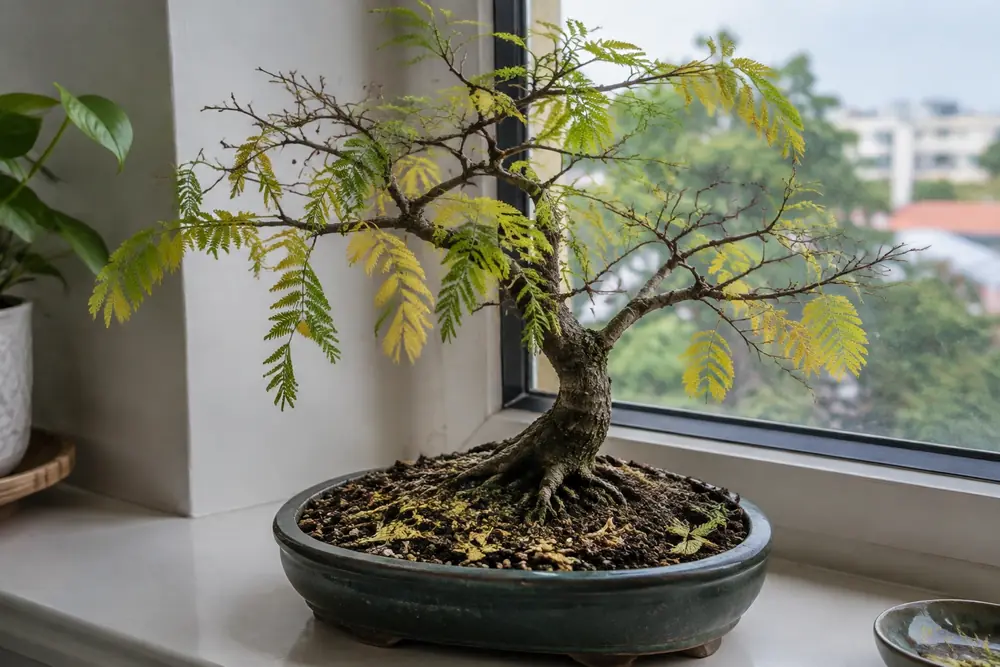
- Leaflets turning yellow and dropping
- A sudden leaf drop after a move, a cold night or a dry spell
- No new growth for several weeks in winter
Serious, act now:
- Twigs that are brown and dry all the way through when scratched
- Bark that wrinkles, peels or feels soft at the base of the trunk
- A sour or rotten smell from the soil
- Black, mushy roots that pull apart easily
- No green tissue anywhere under the bark
How to check if your rain tree is still alive
The scratch test
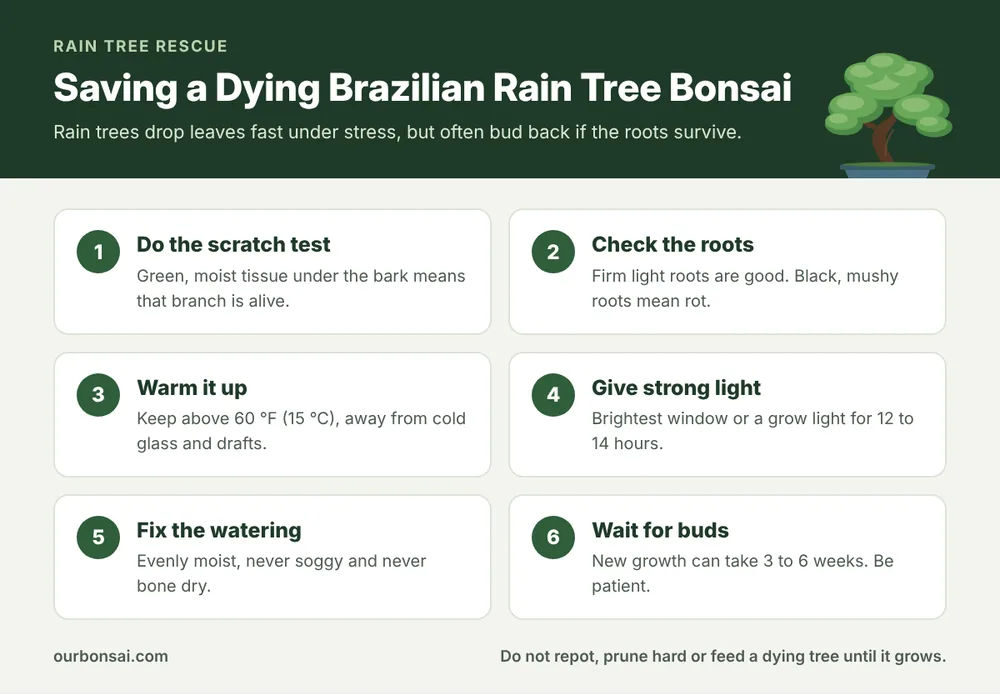
Use your fingernail or a small knife to scratch a tiny patch of bark on a twig. Bright green and moist underneath means the branch is alive. Brown and dry means that part is dead. Work from the tips toward the trunk until you find green. If the trunk is still green, the tree has a good chance of recovery.
The bend test
Live twigs bend. Dead twigs snap with a dry crack. Test a few thin twigs gently.
Check the roots
Slide the tree carefully out of the pot. Healthy roots are firm and light colored. Dead or rotting roots are dark, soft and may smell bad. If most roots are rotten, see our guide to root rot in bonsai before doing anything else.
6 common reasons a Brazilian rain tree bonsai is dying
1. Cold
The rain tree is a tropical from Brazil and dislikes temperatures below about 60 °F (15 °C). A night on a cold windowsill, a draft from a door, or a ride home in winter can cause sudden, heavy leaf drop. Extended cold damages roots and branches.
2. The soil dried out
This thirsty species drops leaflets quickly when the root ball dries out. Repeated drying kills fine roots, and the tree slowly declines. Our guide to watering indoor bonsai in winter explains how to keep the balance in the cold months.
3. Overwatering and root rot
Constantly wet soil, often in dense potting mix or a pot without drainage, suffocates the roots. Leaflets turn yellow and drop, and the tree weakens further every week.
4. Not enough light
Indoors, especially in winter, light levels are often far too low. The tree sheds leaves it cannot support and stops growing. Over months, it runs out of energy.
5. Pests
Spider mites, scale and mealybugs drain sap and weaken the tree, especially indoors in dry air. Look for fine webs, small brown bumps or white fluff. See our guides to spider mites and scale on bonsai trees.
6. Too much at once
Repotting, hard pruning and moving a tree all in the same month can push it over the edge. Each change on its own is fine, but together they leave the tree with too few roots and leaves to recover.
How to save a dying Brazilian rain tree bonsai
- Move it somewhere warm and bright. Above 60 °F (15 °C), ideally 65 to 80 °F (18 to 27 °C), right next to a bright window. Add a full spectrum LED grow light for 12 to 14 hours a day if natural light is weak. Our guide to the best indoor grow lights for bonsai helps you choose.
- Fix the watering. If the soil is dry, soak the pot for ten minutes and let it drain. If it is soggy, let it dry slightly and stop watering until the top layer is dry.
- Deal with root rot if present. Trim away black, mushy roots with clean scissors and repot into fresh, gritty soil. Our bonsai soil mix ratio guide shows how to build a fast-draining mix. This is the only case where you should repot a struggling tree.
- Raise humidity. Use a humidity tray and keep the tree away from heaters and vents.
- Treat pests. Rinse the foliage and treat with insecticidal soap or neem oil if you found pests.
- Cut off dead wood only. Once you are sure a twig is dead, cut it back to green tissue. Do not prune live growth.
- Do not fertilize yet. Weak roots cannot handle fertilizer. Wait until new leaves appear, then feed at half strength.
- Be patient. New buds can take three to six weeks to appear, sometimes longer in winter.
What recovery looks like
| Time after fixing the cause | What to expect |
|---|---|
| 1 to 2 weeks | Leaf drop slows or stops |
| 2 to 6 weeks | Small buds swell on branches and trunk |
| 6 to 10 weeks | New leaves open, often small at first |
| Next growing season | Normal growth returns, start light pruning |
During recovery, keep conditions stable. Do not move the tree around, and resist the urge to check the roots repeatedly.
How to keep your rain tree from dying again
- Keep it warm and away from drafts all year
- Give it the brightest spot you have, or a grow light in winter
- Water when the top of the soil is just starting to dry
- Use a gritty, fast-draining bonsai soil
- Feed through the growing season
- Inspect it for pests every couple of weeks
The rain tree belongs to the legume family, like acacias and mimosa. The Wikipedia page on Pithecellobium tortum explains more about its natural range in Brazil, which helps explain why it needs warmth and humidity.
FAQ: brazilian rain tree bonsai dying
Why did my rain tree drop all its leaves?
Usually cold, a dry root ball or a sudden drop in light. Check the scratch test. If the branches are green under the bark, it can recover.
Can a rain tree recover after losing all its leaves?
Yes, often. If the roots and trunk are alive, keep it warm and bright and wait for new buds over the next few weeks.
Should I repot a dying Brazilian rain tree bonsai?
Only if the roots are rotting or the soil is waterlogged. Otherwise, repotting adds stress. Wait until the tree is growing again.
How long does it take a rain tree to recover?
Usually three to ten weeks for new leaves, depending on temperature and light. Full recovery can take a whole growing season.
Final thoughts
A Brazilian rain tree bonsai dying is often a stressed tree, not a dead one. Use the scratch test, check the roots, then give it warmth, strong light, steady water and humidity. Avoid repotting, pruning and feeding until it grows again. For general rescue steps that work on any species, our main bonsai care guide covers the basics.