Best Soil for Olive Bonsai: Free-Draining Mix Recipes

This post contains affiliate links. As an Amazon Associate, OurBonsai earns from qualifying purchases at no extra cost to you. Read our disclosure.
In this guide
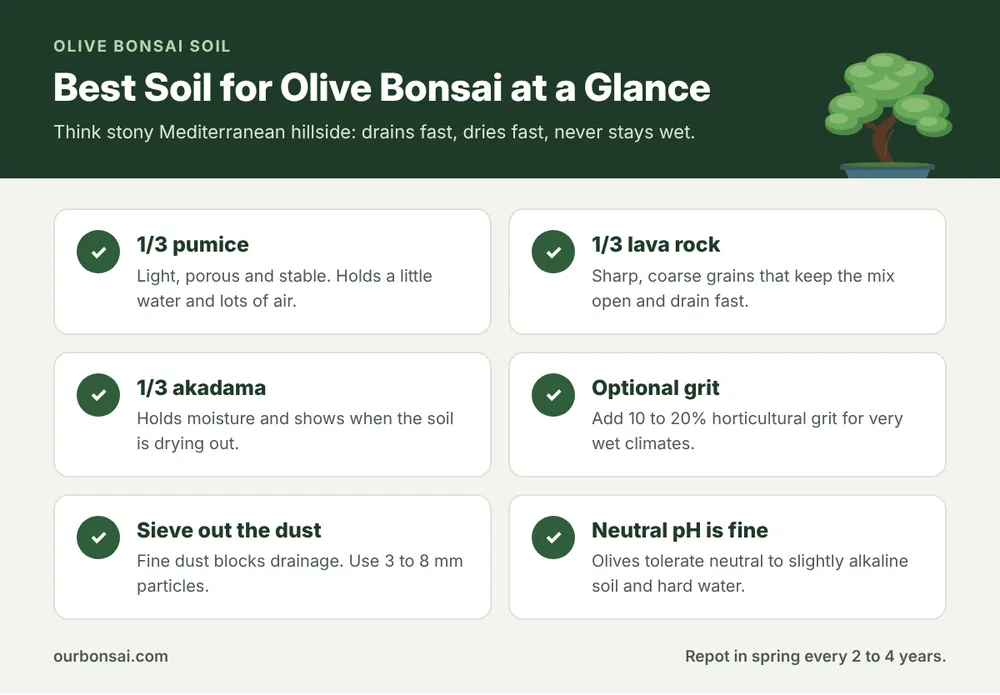
The best soil for olive bonsai is a gritty, fast-draining mix that dries out quickly between waterings. A reliable recipe is one third pumice, one third lava rock and one third akadama, sieved to remove dust. In wet climates or for very large trees, add some horticultural grit or increase the lava. Olives come from stony Mediterranean hillsides, and their roots rot quickly in soil that stays wet. Unlike azaleas or serissa, they are perfectly happy with neutral to slightly alkaline soil and hard tap water.
This guide explains why olive bonsai need such open soil, gives you a few tested recipes, and walks you through repotting.
Why olive bonsai need very free-draining soil
The European olive (Olea europaea) grows across the Mediterranean in thin, rocky soil under hot sun. Long dry summers and short wet winters shaped a tree that handles drought well but suffers when its roots sit in water. The Wikipedia article on the olive describes how well it copes with poor, chalky and stony ground.
In a bonsai pot, that means:
- Fast drainage is more important than water retention.
- Lots of air around the roots keeps them firm and white.
- Drying between waterings is normal and healthy.
- pH is not a worry. Olives tolerate neutral and slightly alkaline conditions.
Dense potting compost is the most common reason olive bonsai fail. It holds water for days, especially in cool, cloudy weather, and the fine roots rot. Our guide to bonsai soil vs regular soil explains why.
The best soil mixes for olive bonsai
| Mix | Recipe | Best for |
|---|---|---|
| Classic | 1/3 pumice, 1/3 lava rock, 1/3 akadama | Most olive bonsai in most climates |
| Extra drainage | 40% lava, 40% pumice, 20% akadama | Rainy climates, large pots |
| Dry climate | 40% akadama, 30% pumice, 30% lava | Hot, dry regions where pots dry very fast |
| Budget gritty | 50% pumice, 30% lava, 20% fine composted bark | When akadama is hard to get |
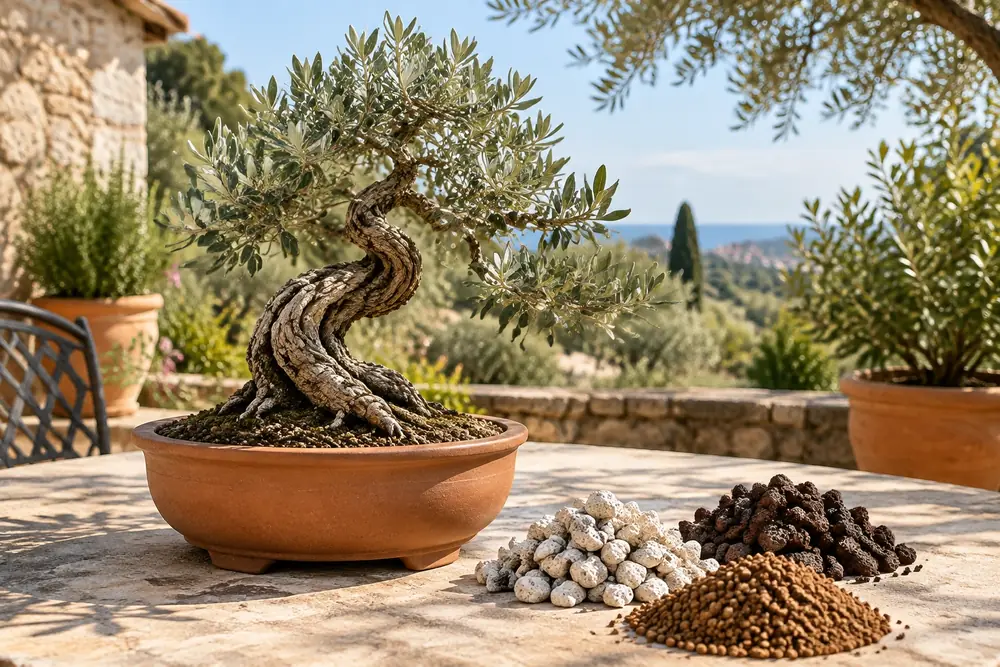
You can buy the ingredients separately, such as pumice for bonsai and lava rock bonsai soil, and blend your own. Our guide to the bonsai soil mix ratio explains what each component does.
What each ingredient does for an olive
- Pumice is light and full of tiny pores. It holds a little water and plenty of air, and does not break down.
- Lava rock is heavier and sharper. It keeps the mix open, adds weight so tall olives do not tip over, and drains very quickly.
- Akadama holds more water than the other two and changes color as it dries, which helps you judge watering. It slowly breaks down over a few years.
Can you use a pre-mixed bonsai soil?
Yes, if it is mostly inorganic. Many good pre-mixed soils are a blend of the same three ingredients. Sieve it before use to remove dust. If it contains a lot of peat or compost, mix in extra pumice or lava. Our Bonsai Jack gritty mix review covers a popular gritty option, and our premium bonsai soil review looks at another.
Particle size
Use particles of roughly 3 to 8 mm for medium and large olives, and 2 to 5 mm for small trees. Sieve out everything below 2 mm. Dust fills the gaps between particles and turns a free-draining mix into a dense one. A layer of slightly coarser particles at the bottom of the pot helps water run out quickly.
How to repot an olive bonsai step by step
Olives grow vigorously and can be repotted every two to four years. Young trees may need it every two years, older ones less often.
- Timing. Repot in spring, just as the buds begin to swell and night temperatures stay above about 10 °C (50 °F).
- Prepare the soil. Sieve and mix it. Prepare the pot with mesh over the drainage holes and tie-down wires.
- Remove the tree. Ease it out of the pot. Olive root balls can be dense, so use a root hook or chopstick around the edges.
- Comb out and trim. Tease out the outer roots and cut back long, thick roots. Olives tolerate root pruning well. Removing up to a third of the root mass is usually fine for a healthy tree.
- Position and tie in. Set the tree at the right angle and height, then secure it with wire through the drainage holes.
- Fill with soil. Work the mix in around the roots with a chopstick so there are no air pockets.
- Water thoroughly until water runs clear.
- Aftercare. Keep the tree out of strong wind and in partial sun for two weeks. Wait about four weeks before fertilizing.
For tools that make this easier, see our guide to the best bonsai repotting tools.
Pots for olive bonsai
The pot matters too. Olive bonsai look natural in unglazed or earthy glazed pots in brown, cream or terracotta tones. Make sure the pot has large drainage holes. Shallow pots dry faster, which suits olives well in cool climates. In hot climates, a slightly deeper pot gives a bit more buffer against drying out. Browse our guide to large deep bonsai pots if your olive needs more room.
Watering olive bonsai in gritty soil
Water thoroughly when the top 1 to 2 cm of soil is dry, then let it drain completely. In summer outdoors, that may be daily. In winter, it may be once a week or less. Olives tolerate a short dry spell much better than they tolerate soggy soil. Hard tap water is fine.
Common soil mistakes with olive bonsai
- Using regular potting soil. It stays wet and suffocates the roots.
- Too much organic matter. A little bark is fine, but peat-heavy mixes hold too much water.
- Not sieving. Dust makes even good ingredients drain poorly.
- Repotting in autumn or winter. Roots regrow slowly in cold soil. Spring is best.
- Skipping the drainage layer in deep pots. Water can collect at the bottom.
FAQ: best soil for olive bonsai
Can I use cactus soil for olive bonsai?
Cactus soil is closer to what olives need than regular potting soil, but most bagged cactus mixes are still too fine and peaty. Add plenty of pumice or lava before using it.
Do olive bonsai need acidic soil?
No. Olives are happy in neutral to slightly alkaline soil, and hard tap water is fine for them.
How often should I repot an olive bonsai?
Every two to four years in spring. Young, fast-growing trees need repotting more often than old, established ones.
Is akadama necessary for olive bonsai?
Not strictly. A mix of pumice, lava and a little fine bark also works well. Akadama simply makes it easier to see when the soil is drying.
What are the signs my olive bonsai soil is wrong?
Soil that stays dark and wet for several days, yellowing or dropping leaves, a sour smell and slow growth all point to a mix that holds too much water. Repot into a grittier blend in spring.
Final thoughts
The best soil for olive bonsai copies the stony ground olives grow in: gritty, airy and fast draining. A simple blend of pumice, lava and akadama, sieved and used in a pot with good drainage, keeps roots healthy and makes watering almost foolproof. Add regular sun and a spring repot every few years, and your olive will grow into a gnarled, characterful tree. For more trees that like the same conditions, see our guide to types of outdoor bonsai trees.