Best Soil for Bald Cypress Bonsai: Recipe and Ratios

This post contains affiliate links. As an Amazon Associate, OurBonsai earns from qualifying purchases at no extra cost to you. Read our disclosure.
In this guide
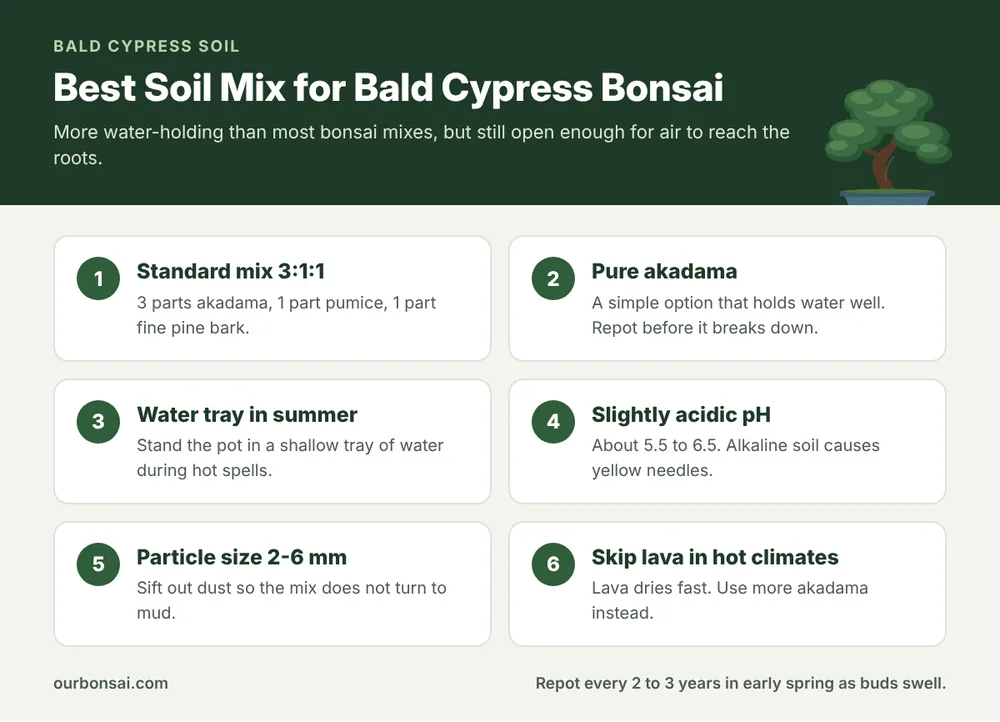
The best soil for bald cypress bonsai holds much more water than a typical bonsai mix, while still letting air reach the roots. A good starting point is three parts akadama, one part pumice and one part fine pine bark, sifted to remove dust. Bald cypress is a swamp tree in nature, so it tolerates and even enjoys wet roots, but in a small pot, soil that is both wet and airless still leads to weak roots. The right mix gives you the best of both.
Bald cypress (Taxodium distichum) is a deciduous conifer native to the swamps and river banks of the southeastern United States. In bonsai, it is famous for its wide, flared trunk base, soft needles that turn copper in autumn and its love of water. This guide gives you simple soil recipes, explains each ingredient and walks you through repotting.
What bald cypress roots need
In the wild, bald cypress grows in standing water and wet, often acidic soils. You can read about its natural habitat in the Clemson University bald cypress fact sheet. Its roots are adapted to low oxygen, which is why it can live in places that would rot most trees.
In a bonsai pot, though, conditions are different. The soil volume is tiny and the tree grows fast. To build fine, healthy roots, bald cypress needs:
- Plenty of water held in the soil. It dries out faster than you expect in summer and hates drying out.
- Some air space. Fine feeder roots need oxygen to grow, even in a water-loving species.
- Slightly acidic soil. Bald cypress develops yellow needles (chlorosis) in alkaline conditions.
Best soil for bald cypress bonsai: 3 recipes
Standard mix
- 3 parts akadama
- 1 part pumice
- 1 part fine pine bark
This is a reliable all-round mix. Akadama holds a lot of water and nutrients, pumice adds air and holds moisture inside its pores, and pine bark adds extra water retention and a little acidity.
Simple pure akadama
Many growers use pure akadama for bald cypress, sifted to 2 to 6 mm. It holds water well, is slightly acidic and lets fine roots grow easily. The drawback is that it breaks down into mud after two or three years, so do not leave it longer than that. The Wikipedia article on akadama explains how this Japanese clay behaves.
Cold climate or very wet summers mix
- 2 parts akadama
- 2 parts pumice
- 1 part fine pine bark
Where summers are cool or very rainy, a slightly more open mix avoids roots staying cold and wet for weeks.
What each ingredient does
| Ingredient | What it adds | Notes for bald cypress |
|---|---|---|
| Akadama | Water and nutrient holding, soft for roots | Main ingredient, slightly acidic |
| Pumice | Air pockets, holds water in its pores | Keeps the mix from compacting |
| Fine pine bark | Extra water retention, mild acidity | Use composted, 3 to 8 mm |
| Lava rock | Very open drainage | Use little or none in hot climates, dries fast |
| Kanuma | Acidic, very water retentive | Can replace some akadama if pH is a problem |
If you want to compare bagged soils, our reviews of Heron’s bonsai soil mix and Tinyroots premium bonsai soil cover two popular options. For more on adjusting ratios, see our bonsai soil mix ratio guide. If you prefer to buy akadama on its own, look for hard fired akadama, which lasts longer before breaking down.
The water tray trick in summer
Bald cypress is one of the few bonsai you can stand in water. In hot summers, many growers set the pot in a shallow tray filled with a couple of centimeters of water. The tree drinks freely, and you avoid the risk of a dry root ball on a hot afternoon.
A few rules:
- Use it in the growing season only, and stop in autumn as the tree slows down.
- Keep the water shallow, so the top half of the soil can still breathe.
- Change the water every few days to keep it fresh and avoid mosquitoes.
- Do not use this trick with a fresh repotting until new roots are growing.
Soil pH for bald cypress bonsai
Bald cypress prefers slightly acidic soil, around pH 5.5 to 6.5. In alkaline soil it struggles to take up iron and its needles turn yellow. An akadama-based mix sits in the right range. If your tap water is very hard, use rain water when possible, and consider swapping some akadama for kanuma, which is more acidic. Our kanuma bonsai soil review explains how it differs.
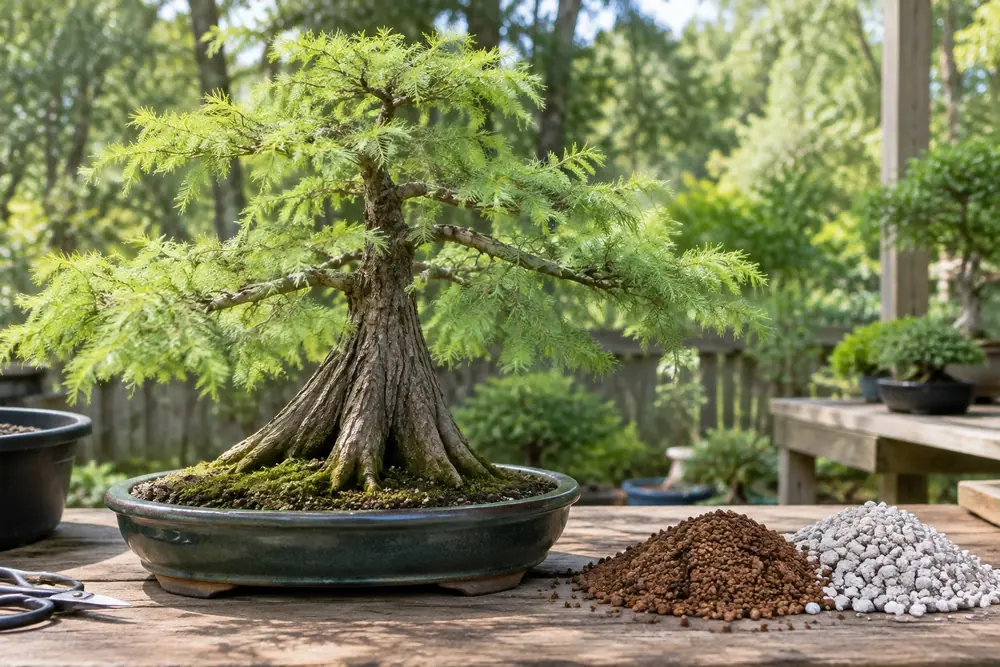
How to repot a bald cypress bonsai
Bald cypress grows vigorous roots and fills its pot quickly. Repot young trees every two years and older trees every three years, in early spring as the buds begin to swell.
- Water the tree the day before.
- Lift the tree from the pot and comb out the old soil around the edges and underneath with a root hook.
- Trim back thick, long roots, keeping as many fine roots as possible. Bald cypress tolerates fairly hard root pruning when healthy.
- Place a thin drainage layer of slightly larger particles, then fresh mix.
- Set the tree at the right angle, wire it in place through the drainage holes, and work the soil in with a chopstick so there are no air pockets.
- Water thoroughly until it runs clear.
- Keep the tree in light shade and sheltered from wind for two to three weeks. Do not use the water tray until new growth is strong.
Good tools make the job easier. See our guide to the best bonsai repotting tools.
Common soil mistakes with bald cypress
- Using a fast-draining mix designed for junipers or pines. It dries out too quickly for bald cypress in summer.
- Using regular potting soil. It turns into dense mud in a small pot and roots suffocate. Our comparison of bonsai soil vs regular soil explains why.
- Leaving akadama for too long. After a few years it breaks down and blocks drainage.
- Alkaline water and soil. Leads to yellow needles over time.
- Water tray all year. Constantly wet, cold soil in winter can rot dormant roots.
FAQ: best soil for bald cypress bonsai
Can bald cypress bonsai grow in regular potting soil?
It can survive for a while, but dense potting soil compacts in a small pot and starves roots of air. A gritty, water-retentive bonsai mix is much better.
Can I leave my bald cypress bonsai standing in water?
In summer, yes, in a shallow tray. Stop in autumn and winter, when the tree is dormant and uses little water.
How often should I repot a bald cypress bonsai?
Every two years for young trees and every three years for older ones, in early spring as buds swell.
Is akadama alone good for bald cypress?
Yes. Pure, sifted akadama works well. Just repot every two to three years before it breaks down.
Final thoughts
The best soil for bald cypress bonsai is more water-retentive than most bonsai mixes, built mainly on akadama with some pumice and pine bark, and kept slightly acidic. Combine it with a summer water tray and regular repotting, and this swamp-loving conifer will grow fast and healthy. To see how it compares with other deciduous species, browse our guide to deciduous bonsai tree types.