How Long Do Bonsai Trees Live? Lifespan by Species

How long do bonsai trees live? With good care, much longer than most people expect. A healthy bonsai can live as long as the same species growing in the ground. For many trees that means 50 to 100 years, and some of the oldest bonsai in the world are several hundred years old. Keeping a tree small in a pot does not shorten its life by itself.
In this guide
The catch is that most bonsai never reach old age. They die in their first few years because of watering mistakes, the wrong spot in the house, or missed repotting. So the real answer depends less on the tree and more on the care it gets. This guide covers typical lifespans by species, the oldest known bonsai, and what you can do to help your tree live for decades.
How long do bonsai trees live on average?
There is no single number, because “bonsai” is not a species. It is a way of growing almost any tree or shrub in a small pot. A bonsai juniper and a bonsai cherry are different plants with different natural lifespans.
As a rough rule:
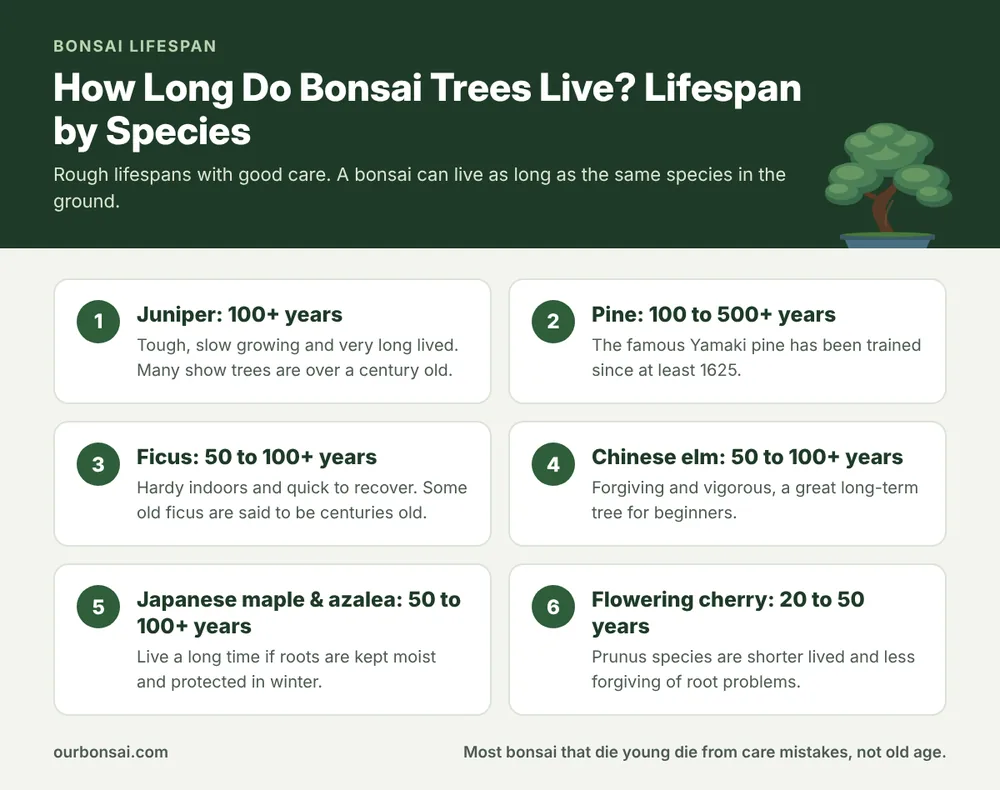
- Long-lived conifers such as junipers and pines can live for well over a century, and old specimens are passed down through families.
- Hardy broadleaf trees such as ficus, Chinese elm, Japanese maple, trident maple and azalea often live 50 to 100 years or more.
- Shorter-lived species such as flowering cherry and some fruit trees may live 20 to 50 years, even with good care.
In practice, a bonsai that makes it through its first five years with a careful owner has a very good chance of outliving that owner. That is part of the appeal. Many growers think of their trees as something they look after for a while and then pass on.
The oldest bonsai trees in the world
A few famous trees show how long a well cared for bonsai can last:
- The Yamaki pine. This Japanese white pine has been in training since at least 1625. It survived the atomic bombing of Hiroshima in 1945 just a few kilometers from the blast and was later given to the United States. The National Bonsai Foundation tells its story; it is on display at the National Bonsai & Penjing Museum in Washington, DC.
- Sandai-Shogun-no-Matsu. A Japanese white pine in the Imperial Palace collection in Tokyo, believed to be around 500 years old and once cared for by the third Tokugawa shogun.
- The Crespi ficus. A ficus at the Crespi Bonsai Museum in Italy is often described as being over 1,000 years old, although ages this high are hard to verify.
These trees did not survive by luck. Each one has been watered, repotted, pruned and protected by generations of growers. The history of bonsai is full of trees handed from teacher to student in exactly this way.
What decides how long your bonsai will live?
The species you choose
Some trees simply live longer than others. If you want a tree for life, junipers, pines, ficus and Chinese elm are safe choices. Our list of easy-care bonsai trees is a good place to start if you are buying your first one.
Indoor or outdoor placement
This is the biggest hidden killer. Many trees sold as “indoor bonsai” are actually outdoor trees, such as junipers, that need sun, wind and a cold winter rest. Kept on a shelf indoors, they slowly decline and usually die within a year or two. Check what your tree needs: our guides to outdoor bonsai trees and popular indoor bonsai trees will help you sort them out.
Watering
Too much water rots the roots, too little kills the fine root tips. Both happen often with new owners. Check the soil every day and water when the top layer starts to dry. The basics are covered in our bonsai care guide.
Soil and repotting
Over time, roots fill the pot and the soil breaks down into a dense mass that holds too much water and too little air. Repotting every two to five years, depending on the species and age, keeps the roots healthy. Older trees are repotted less often than young ones. See our tips on repotting bonsai for timing and steps.
Pests and diseases
Spider mites, scale and root rot can weaken a tree slowly before you notice. A quick look under the leaves each week catches most problems early. Our bonsai pests and diseases guide shows what to look for.
Does pruning a bonsai shorten its life?
No. Pruning, wiring and root pruning are stressful in the short term, but they do not shorten a healthy tree’s life when done at the right time of year. In some ways they help, because regular root pruning keeps the root system young and active. Problems only start when a weak tree is pruned hard, or when heavy work is done in the wrong season. If you are unsure, follow the rule of one major job per year and give the tree time to recover.
Why most bonsai die young
If bonsai can live for centuries, why do so many die in their first year? Here are the usual reasons:
| Problem | What happens | How to avoid it |
|---|---|---|
| Outdoor tree kept indoors | Slow decline, needles or leaves drop | Keep junipers, pines and maples outside |
| Watering on a fixed schedule | Root rot or dried-out roots | Check the soil daily instead |
| Poor, compacted soil | Roots suffocate | Use a fast-draining bonsai soil |
| Too little light | Weak, leggy growth | Bright window or grow light indoors |
| No winter protection | Frozen or dried roots | Shelter outdoor trees from hard frost |
When a tree does start to struggle, act quickly. Our guide to why bonsai branches die helps you find the cause before it spreads.
How to help your bonsai live a long life
- Choose a species that suits your home and climate.
- Learn whether it is an indoor or outdoor tree, and keep it where it belongs.
- Check the soil every day and water thoroughly when it starts to dry.
- Feed it during the growing season, and less or not at all in winter.
- Repot every few years into fresh bonsai soil.
- Prune and wire only when the tree is healthy and growing strongly.
- Inspect for pests regularly and treat early.
FAQ: how long do bonsai trees live
Can a bonsai tree live forever?
No tree lives forever, but a bonsai can live for hundreds of years with consistent care. Several trees in museum collections are over 300 years old.
Do bonsai trees live as long as normal trees?
Yes, a healthy bonsai can live as long as the same species in the ground, and sometimes longer, because it is protected from storms, drought and competition.
How long do indoor bonsai trees live?
True indoor species such as ficus, jade and Fukien tea can live for decades indoors with enough light. Outdoor species kept indoors usually only last a year or two.
How old is a typical bonsai when you buy it?
Most store-bought bonsai are 3 to 10 years old. Older, more developed trees cost much more because of the years of work that went into them.
Final thoughts
So, how long do bonsai trees live? As long as you keep them healthy. Pick a species that suits your space, keep outdoor trees outside, water by checking the soil, and repot on time. Do that, and your bonsai can be with you for decades, and maybe for the next generation too.