How to Prune Jade Bonsai: Step-by-Step Guide

This post contains affiliate links. As an Amazon Associate, OurBonsai earns from qualifying purchases at no extra cost to you. Read our disclosure.
In this guide
Knowing how to prune jade bonsai is the key to turning a top-heavy succulent into a convincing miniature tree. Jade (Crassula ovata) grows quickly in good light, and it branches exactly where you cut: snip a branch above a pair of leaves and two new shoots usually appear just below the cut. That makes jade one of the easiest bonsai to shape. The main differences from woody bonsai are that jade wood is soft and full of water, so you let cuts dry rather than sealing them, and you prune in the warm growing season, not in winter.
This guide covers when to prune, where to cut, how to pinch, how to handle big cuts, and what to do with the cuttings.
When to prune a jade bonsai
The best time is late spring through summer, when the jade is growing strongly and heals quickly. Light trimming and pinching can continue into early autumn. Avoid heavy pruning in winter, when a jade indoors grows slowly; cuts heal slower and new buds may not appear for months.
Also avoid pruning a jade that is dehydrated, recently repotted or recovering from rot. Wait until it is plump and growing.
Tools you need
- Sharp bonsai scissors for thin branches.
- A concave or knob cutter for thicker branches. Jade wood is soft, so even a basic one works well; our concave cutter review explains the benefits.
- Clean tools. Wipe blades with rubbing alcohol between trees to avoid spreading rot.
Our guide to the best bonsai pruning shears for beginners lists a few affordable options, or browse bonsai concave cutters.
How to prune jade bonsai step by step
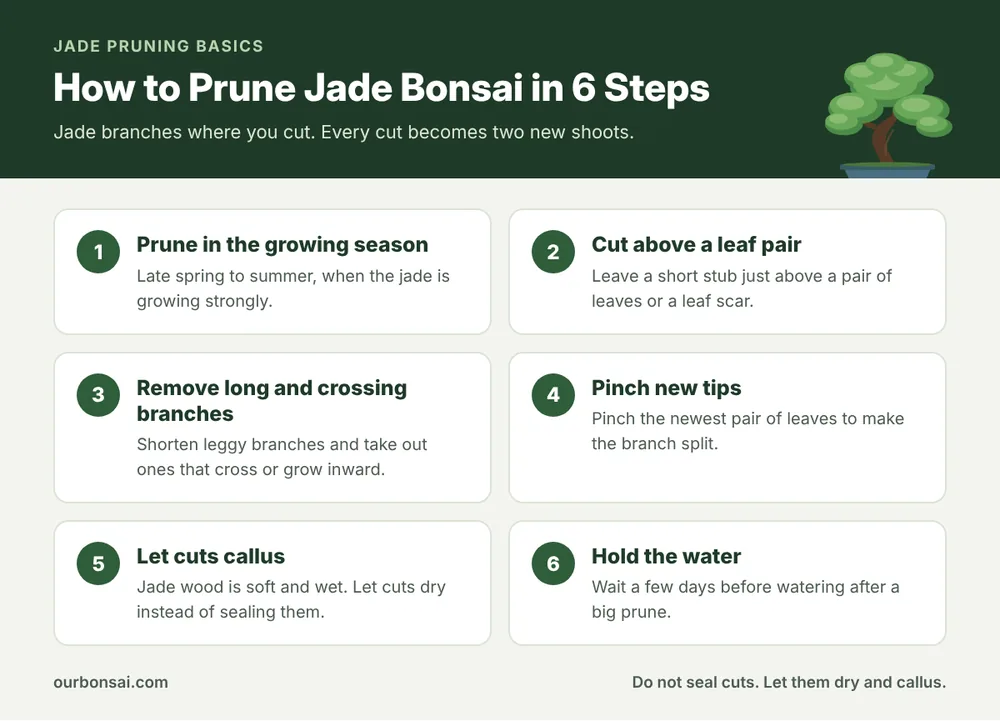
Step 1: Decide on the shape
Most jade bonsai look best as a broad, rounded tree with a thick trunk and a wide crown, much like an old tree in the African bush. Jade wood cannot be wired as easily as other species, so pruning does most of the shaping. Our guide to traditional jade bonsai styles shows the common forms.
Step 2: Remove problem branches
Start with branches that cross, grow straight toward the viewer, grow inward, or point straight down. Cut them back to the trunk or to a side branch.
Step 3: Shorten long branches
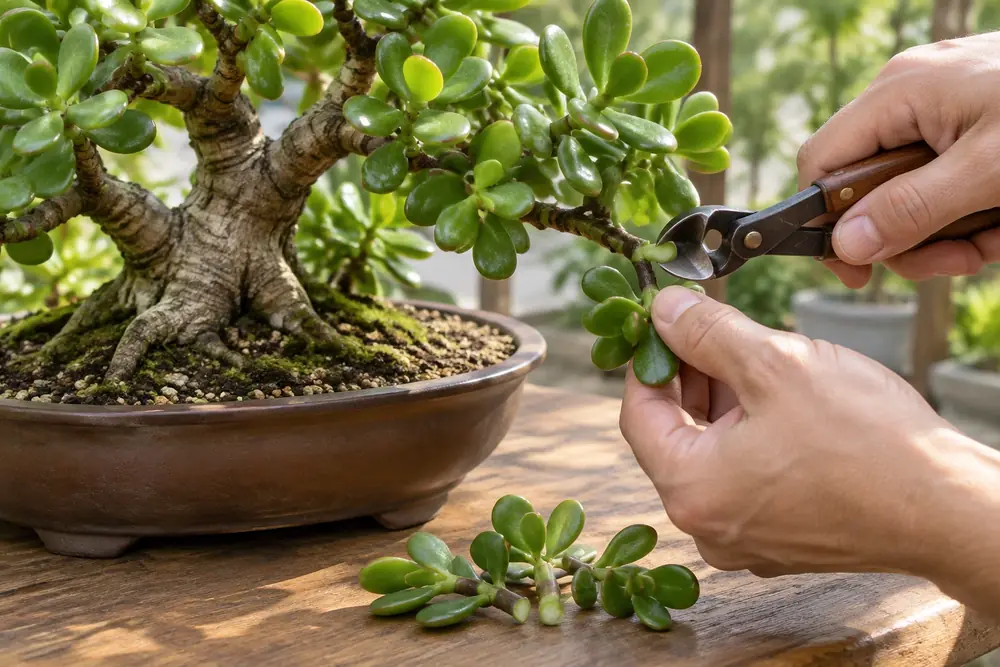
Cut leggy branches back to the length you want, cutting just above a pair of leaves or a leaf scar. New shoots will grow from the nodes just below the cut. Cutting back to a node with leaves gives the fastest regrowth.
Step 4: Pinch new growth
Once the main structure is set, maintain it by pinching. When a shoot has grown three or four pairs of new leaves, pinch out the tiny newest pair at the tip with your fingers. The branch usually splits into two, which builds the dense, bushy crown that makes a jade look mature.
Step 5: Let the cuts dry
Do not seal jade cuts with cut paste. Jade stems are full of water, and sealing can trap moisture and invite rot. Leave cuts open to dry and form a callus over a day or two. Large cuts will shrink and concave as they dry, which is normal.
Step 6: Aftercare
After a heavy prune, wait three to five days before watering so the cuts can callus. Keep the tree in bright light, but not in harsh afternoon sun for the first week.
Big cuts and trunk chops
Jade can take very hard pruning, which is handy if you have a tall, thin plant and want a short, thick bonsai. You can cut the trunk back to a low stub with only a few leaves; it will usually bud along the stem. Do this in early summer, let the cut dry fully, and keep watering light until new buds show. Cuts on thick trunks dry and shrink inward over several weeks, leaving a small hollow that heals over time.
Leaf pruning a jade bonsai
Jade leaves are naturally large for a bonsai. You can reduce their size in two ways:
- Remove the biggest leaves. Snap off the largest leaves on strong branches. The tree pushes new, smaller ones.
- Increase light. Jade grown in full sun grows smaller, tighter leaves, often with red edges. Jade in low light grows big, floppy leaves with long gaps between them.
Avoid stripping all the leaves at once. The leaves are the tree’s water store, and removing them all leaves it with no reserve.
Pruning dwarf jade (Portulacaria afra)
Many trees sold as “jade bonsai” are actually dwarf jade, or elephant bush (Portulacaria afra). It has much smaller round leaves on reddish-brown stems and is a different plant from the classic Crassula ovata. The pruning principles are the same: prune in the growing season, cut above a leaf node, and let cuts dry. The differences are:
- Dwarf jade grows even faster, so it needs pinching more often in summer.
- Its smaller leaves make it easier to get a fine, tree-like crown.
- Its branches are more flexible when young and can be wired gently with aluminum wire, as long as you check often and remove the wire before it marks the bark.
- It tends to drop lower branches in low light, so keep it in full sun if you can.
If you are not sure which jade you have, look at the leaves: thumb-sized, flat oval leaves mean Crassula; fingernail-sized round leaves on red stems mean Portulacaria. The Wikipedia page on Portulacaria afra has photos that make the difference easy to see.
What to do with jade cuttings
Almost every jade cutting will root. Let the cutting dry for a few days until the cut end calluses, then push it into dry, gritty soil and water lightly after a week. In a few weeks it will have roots. It is a cheap way to start your next bonsai. The Clemson Extension jade plant fact sheet describes the same simple propagation method.
Common jade pruning mistakes
- Pruning in winter when the tree is barely growing.
- Sealing cuts with paste and trapping moisture.
- Watering right after a big prune.
- Removing too many leaves at once, which takes away the tree’s water reserve.
- Using dirty tools and spreading rot between trees.
- Not giving enough light, so new growth is long and weak.
If your jade has soft stems or spotted leaves before you prune, check our guide to jade bonsai pests and diseases first.
FAQ: how to prune jade bonsai
Where do you cut a jade bonsai?
Just above a pair of leaves or a leaf scar. New shoots grow from the nodes directly below the cut.
Will a jade grow back after hard pruning?
Yes. Jade bud readily from bare stems in warm, bright conditions, even after a heavy trunk chop.
How often should I prune my jade bonsai?
Pinch tips throughout the growing season and do structural pruning once a year in late spring or summer.
Can I wire a jade bonsai?
Lightly, with care. The branches are brittle and the bark marks easily. Most shaping is done by pruning instead.
Final thoughts
Now you know how to prune jade bonsai: work in late spring or summer, cut above a leaf pair, pinch new tips to make branches split, and let cuts dry instead of sealing them. Jade responds fast, so you will see the results within weeks. For daily care beyond pruning, see our real jade bonsai tree indoor guide.