Do Bonsai Stay Small Forever? How Bonsai Trees Stay Tiny

Do bonsai stay small on their own? No. A bonsai is not a special dwarf species. It is an ordinary tree, the same species you might see growing in a park, kept small by the way it is grown. If you plant a bonsai juniper in the garden and stop trimming it, it will grow into a full-size juniper. The tiny size comes from a combination of a small pot, regular pruning of branches and roots, and ongoing care.
In this guide
- Are bonsai trees genetically small?
- How bonsai stay small: 5 techniques
- What happens if you stop pruning a bonsai?
- Do bonsai stay small without harming the tree?
- How big do bonsai trees get?
- How fast does a bonsai grow?
- How to keep your own bonsai small
- Common misconceptions
- FAQ: do bonsai stay small
- Final thoughts
That is good news, because it means you are in control. This article explains exactly how bonsai stay small, why the trees do not mind, what happens if you stop, and how long a bonsai can live at its miniature size.
Are bonsai trees genetically small?
Bonsai trees are not genetically small. Almost any woody tree or shrub can become a bonsai. A Japanese maple bonsai has the same genes as a Japanese maple that grows to 20 feet in the ground. The Wikipedia article on bonsai describes it as a growing technique, not a type of plant.
Some species are chosen for bonsai because they naturally have small leaves, short gaps between leaves or flexible branches. Dwarf cultivars of some trees, such as certain junipers, also grow more slowly. But even these would get much bigger in the ground. Our article on how bonsai trees grow in their miniature form explains the biology in more detail.
How bonsai stay small: 5 techniques
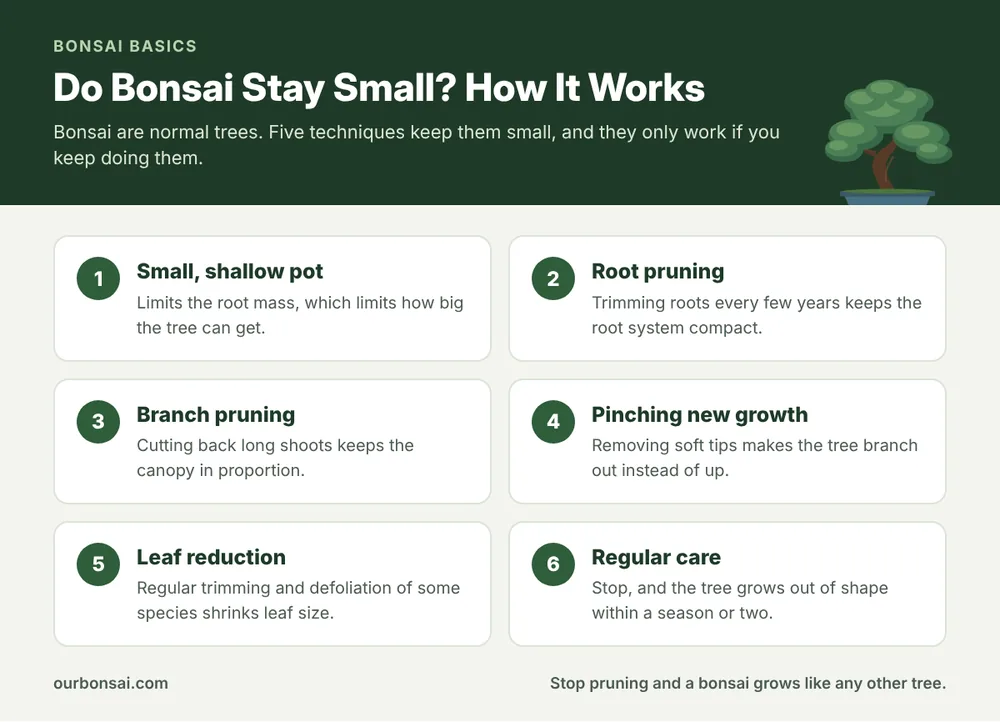
1. A small, shallow pot
A tree’s size above ground is closely linked to its root mass. A bonsai pot holds a fraction of the soil a tree would have in the ground, so the root system stays compact. That limits how much the tree can grow each year. The pot alone does not stop growth, but it slows it down a lot.
2. Root pruning
Every two to five years, depending on the species and age, a bonsai is taken out of its pot, and the longest and thickest roots are trimmed. Fresh soil is added and the tree goes back into the same pot or a similar one. This keeps the root system small and full of fine, efficient feeder roots, so the tree stays healthy in a small space.
3. Branch pruning
Without pruning, a tree puts most of its energy into growing up and out. Bonsai growers cut back long shoots to one or two leaves after they have grown a few. This keeps the outline compact and encourages the tree to branch closer to the trunk. Our guide on when to start pruning bonsai covers the timing.
4. Pinching new growth
Trees naturally favor their top and outer shoots, a habit known as apical dominance. Pinching off the soft tips of strong shoots removes that dominance and pushes energy into weaker shoots lower down. The result is a dense, small canopy instead of a few long whips.
5. Leaf reduction
On some species, such as maples and elms, repeated trimming and occasional partial or full defoliation make the tree produce smaller leaves. Smaller leaves keep the proportions of a miniature tree believable.
What happens if you stop pruning a bonsai?
If you stop pruning, the tree simply starts growing like a normal tree again. In one season, long shoots appear and the neat outline disappears. Over a few years, the tree becomes root-bound in its small pot, growth slows, and the tree may weaken because it cannot get enough water and nutrients.
If you plant it in the ground, it will grow much faster and eventually reach a size close to its natural form. Growers actually do this on purpose: putting a young tree in the ground or a large training pot for a few years is the fastest way to thicken the trunk before styling it as a bonsai.
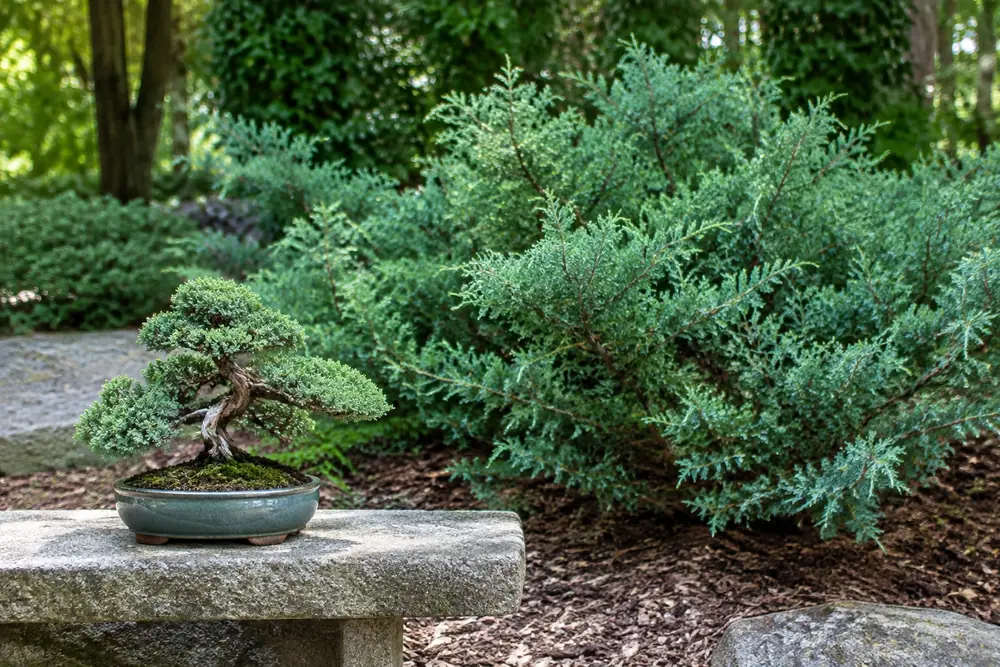
Do bonsai stay small without harming the tree?
Yes, when done well. Bonsai techniques work with the tree’s natural growth patterns. A healthy bonsai gets all the light, water, nutrients and air it needs. It is simply directed into a compact shape. Well-kept bonsai often live as long as, or longer than, the same species in the wild, because they are protected from competition, drought and pests. Some bonsai in Japanese collections are hundreds of years old.
The key is good care. A bonsai in poor soil, kept in a dark corner or watered irregularly will struggle, but that is a care problem, not a size problem. Our main bonsai care guide covers the basics that keep a small tree healthy.
How big do bonsai trees get?
Bonsai come in many traditional sizes, from tiny trees that fit in your palm to large trees that need two people to move:
| Size class | Approximate height |
|---|---|
| Mame (miniature) | Under 6 in (15 cm) |
| Shohin (small) | 6 to 10 in (15 to 25 cm) |
| Kifu / Chuhin (medium) | 10 to 18 in (25 to 45 cm) |
| Large | 18 to 40 in (45 to 100 cm) |
| Imperial | Over 40 in (100 cm) |
Your tree’s final size depends on the species, the pot and how you prune it. Larger bonsai are actually easier to keep healthy, because the bigger pot holds more water. If space is tight, our list of the best bonsai trees for small spaces suggests compact species.
How fast does a bonsai grow?
Growth speed depends on species, light and care. Fast species like ficus and Chinese elm can put on several inches of new shoots in a summer, which you then trim back. Slow growers like junipers and pines change more gradually. Our guide on how long it takes bonsai trees to grow gives realistic timelines.
How to keep your own bonsai small
If you own a bonsai and want it to keep its size and shape, a simple yearly routine is enough:
- Trim through the growing season. When a new shoot has grown four to six leaves, cut it back to one or two. Do this every few weeks from spring to late summer.
- Remove strong shoots at the top. The top of the tree grows fastest. Trim it harder than the lower branches so the tree stays balanced.
- Check the roots every spring. Gently lift the tree out of its pot. If roots circle the pot in a thick mat, it is time to root prune and repot.
- Keep the same pot size. Moving up to a bigger pot lets the tree grow larger. Return it to a pot of the same size after root pruning.
- Feed in moderation. Feeding keeps the tree healthy. Very heavy feeding of a tree you want to keep small just means more trimming.
This takes only a few minutes a month for most indoor and outdoor bonsai, and it keeps the tree compact and healthy for decades.
Common misconceptions
- “Bonsai are a special species.” They are normal trees grown with special techniques.
- “Bonsai are starved to keep them small.” Healthy bonsai are fed regularly during the growing season.
- “Bonsai are cruel to trees.” Done properly, they are healthy and long-lived.
- “Once shaped, a bonsai is finished.” Bonsai need ongoing pruning every year.
FAQ: do bonsai stay small
Do bonsai stay small if you plant them in the ground?
No. In the ground, roots spread freely and the tree grows much faster, eventually close to its natural size.
How do bonsai trees stay small without dying?
Through a balance of root pruning and branch pruning, plus good soil, light, water and feeding. The tree stays healthy, just compact.
Can you keep any tree small as a bonsai?
Most woody trees and shrubs can be grown as bonsai. Species with small leaves and flexible branches are easiest. Our guide to the best trees to make bonsai lists good options.
Do bonsai stay small forever?
Only as long as you keep pruning and repotting. Stop, and the tree starts growing out of shape within a season.
Final thoughts
So, do bonsai stay small by themselves? No. They stay small because you keep them small, with a shallow pot, root pruning, branch pruning and pinching. That is what makes bonsai an art: the tree stays healthy and vigorous, and you direct its growth into a miniature version of a mature tree.