How Often to Water Brazilian Rain Tree Bonsai (Indoor & Outdoor)


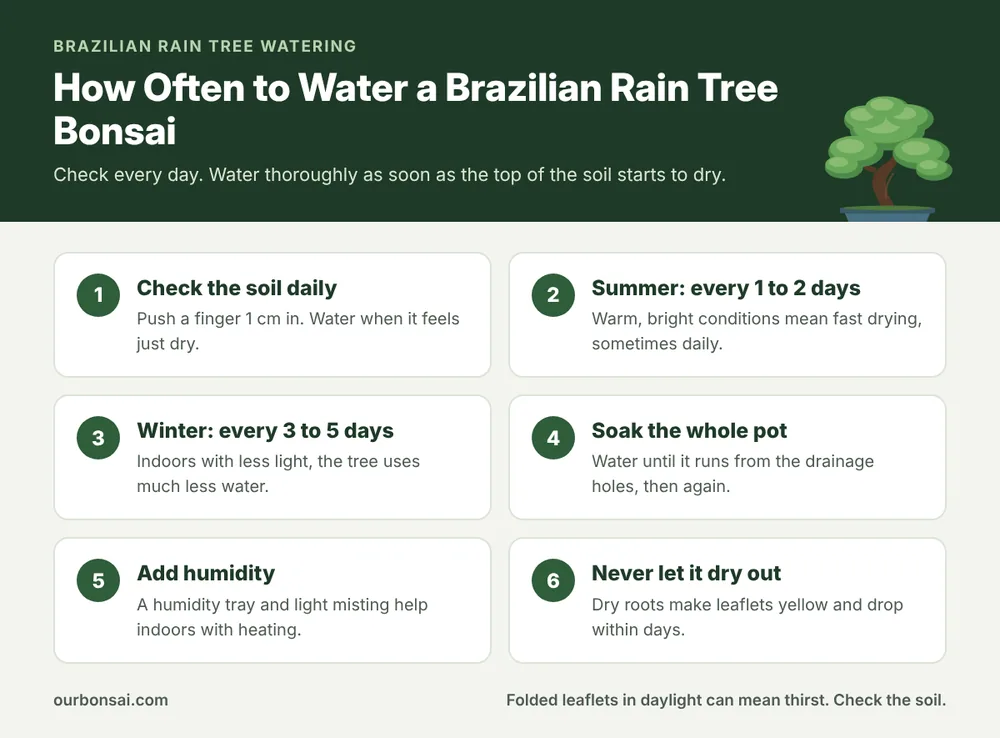
If you are wondering how often to water brazilian rain tree bonsai, the short answer is: check it every day and water as soon as the top of the soil starts to feel dry. In warm, bright summer conditions that usually means every one to two days, and in a small pot sometimes every day. In winter indoors, when growth slows and light is weaker, it may only need water every three to five days. The Brazilian rain tree is a thirsty tropical, and one of the most common reasons it drops leaflets is soil that dried out.
In this guide
- Why Brazilian rain tree bonsai need regular water
- How often to water brazilian rain tree bonsai by season
- How to tell when your rain tree needs water
- How to water a Brazilian rain tree bonsai
- Humidity: the other half of watering
- Signs of overwatering and underwatering
- Common watering mistakes
- FAQ: how often to water brazilian rain tree bonsai
- Final thoughts
The Brazilian rain tree (Pithecellobium tortum) comes from warm, humid parts of Brazil. Its fine compound leaves fold up at night and on dark days, which is how it got its name. That folding is normal, but leaflets that fold, yellow and fall during bright days are often a sign of watering problems. This guide explains how to get the rhythm right.
Why Brazilian rain tree bonsai need regular water
Rain trees grow fast and carry many small leaflets, each one losing water through the day. In a small bonsai pot, the root ball holds only a little moisture. On a warm day, a healthy tree can use most of that in a single afternoon.
Unlike some tropicals, such as jade or ficus, the rain tree has no thick leaves or stems to store water. When the roots dry out, it reacts quickly by dropping leaflets to save moisture. The tree usually survives, but repeated drying weakens it and slows growth.
At the same time, rain trees do not like soggy soil. Roots that sit in water lack oxygen and can rot. The goal is evenly moist soil that never dries completely and never stays wet for days.
How often to water brazilian rain tree bonsai by season
Use this table as a starting point. Always check the soil before watering, because pot size, soil mix and room temperature all change how fast the tree dries out.
| Season | Indoor (bright window) | Outdoor (warm months only) |
|---|---|---|
| Spring | Every 2 to 3 days | Every 1 to 2 days |
| Summer | Every 1 to 2 days | Daily, sometimes twice |
| Autumn | Every 2 to 4 days | Every 1 to 2 days, bring in below 60 °F |
| Winter | Every 3 to 5 days | Indoors only |
The rain tree is not frost hardy. Keep it above about 60 °F (15 °C). It can spend summer outdoors in warm climates, which it loves, but bring it inside before nights turn cool.
How to tell when your rain tree needs water
The finger test
Push a finger about 1 cm (half an inch) into the soil near the edge of the pot. If it feels just dry, water. If it still feels damp, check again later in the day.
The chopstick test
Push a wooden chopstick into the soil and leave it for ten minutes. If it comes out dark and damp, there is still water in the root zone. If it comes out dry and clean, water now.
Watch the leaflets
Healthy rain tree leaflets open in the morning and close at dusk. If they fold up during a bright day, droop, or feel soft, the tree is probably thirsty. Check the soil right away.
Use a meter if you prefer
A simple soil moisture meter takes the guesswork out of watering while you learn the rhythm. Push the probe into the root zone, not just the top layer.
How to water a Brazilian rain tree bonsai
- Use a watering can with a fine rose so you do not wash soil out of the pot. A Japanese watering can for bonsai is ideal.
- Water the whole soil surface slowly until water runs from the drainage holes.
- Wait a minute or two and water again so the soil absorbs it fully.
- Let the pot drain. Never leave it standing in a saucer full of water.
- If the soil has dried out badly and water runs straight off, set the pot in a basin of water for ten minutes, then let it drain.
Room-temperature water is best. Cold water straight from the tap can shock the roots of this warmth-loving tree, especially in winter.
Humidity: the other half of watering
Rain trees prefer humid air, which is hard to provide in a heated or air-conditioned home. Dry air makes leaflets crisp at the edges and increases water loss.
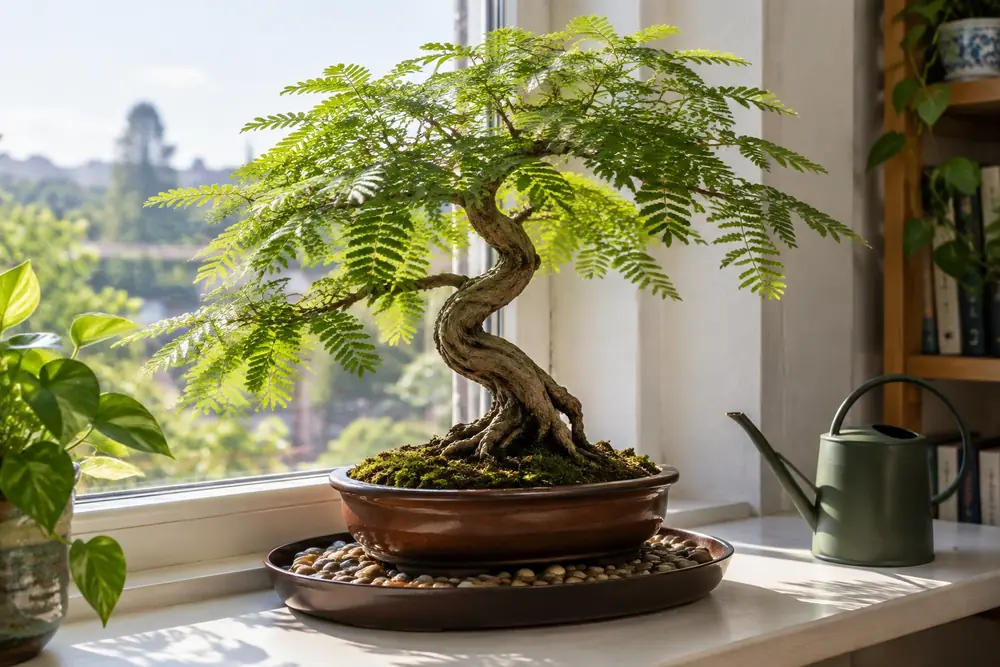
- Place the pot on a humidity tray filled with pebbles and water, keeping the pot above the water line.
- Group the tree with other plants to raise humidity locally.
- Mist the foliage lightly in the morning if the air is very dry. Misting does not replace watering the soil.
- Keep the tree away from heaters, radiators and air-conditioning vents.
Signs of overwatering and underwatering
| Sign | Likely cause | What to do |
|---|---|---|
| Leaflets folding and dropping on bright days, soil dry | Underwatering | Water more often, check daily |
| Crisp brown leaflet tips | Dry soil or very dry air | Water evenly, add humidity |
| Yellow leaflets, soil wet for days | Overwatering | Water less, check drainage |
| Sour smell, dark mushy roots | Root rot | Repot into fresh gritty soil |
| Sudden heavy drop after a cold draft | Cold stress | Move away from drafts, keep above 60 °F |
If the soil stays wet for a long time no matter what you do, the soil itself may be the problem. Our guide to the right bonsai soil mix ratio helps you build a faster-draining mix, and our article on root rot in bonsai covers what to do if roots are already damaged.
Common watering mistakes
- Watering on a schedule. “Every Monday and Thursday” will be wrong half the time. Check daily.
- Small sips. A splash of water only wets the top. Always water until it drains out.
- Letting it dry out completely. Rain trees drop leaflets quickly and take weeks to refill the canopy.
- Leaving water in the saucer. Roots sitting in water start to rot.
- Using cold water in winter. Let water reach room temperature first.
For more on general indoor watering in the cold months, see our guide to watering indoor bonsai in winter. The Wikipedia page on Pithecellobium tortum has more background on this species in the wild.
FAQ: how often to water brazilian rain tree bonsai
Should I water my Brazilian rain tree every day?
In summer, often yes, especially in a small pot in a bright spot. In winter, usually every few days. Always check the soil first.
Why do my rain tree’s leaves close during the day?
Closing at night and in dark, rainy weather is normal. Closing on a bright day often means the tree is thirsty or too cold.
Can I bottom water a Brazilian rain tree bonsai?
Yes, especially if the soil has dried out badly. Soak the pot for ten minutes, then let it drain fully. For routine watering, top watering flushes salts better.
Is misting enough for a rain tree?
No. Misting raises humidity briefly but does not water the roots. Always water the soil thoroughly.
Final thoughts
So, how often to water brazilian rain tree bonsai? Check every day, water thoroughly when the top of the soil is just starting to dry, and expect daily or every-other-day watering in summer and every few days in winter. Add humidity indoors, keep the tree warm and never let the root ball dry out completely. For other warm-climate species with similar needs, browse our guide to tropical bonsai species.