Bald Cypress Bonsai Winter Care: Dormancy and Protection

This post contains affiliate links. As an Amazon Associate, OurBonsai earns from qualifying purchases at no extra cost to you. Read our disclosure.
In this guide
- Why does a bald cypress bonsai lose its needles?
- How cold can a bald cypress bonsai handle?
- Bald cypress bonsai winter care checklist
- Where to keep a bald cypress bonsai in winter
- Watering a bald cypress bonsai in winter
- Fertilizer, pruning and repotting around winter
- Preparing a bald cypress bonsai for winter in autumn
- Bald cypress in very warm climates
- Common bald cypress winter mistakes
- Waking your bald cypress up in spring
- FAQ: bald cypress bonsai winter care
- Final thoughts
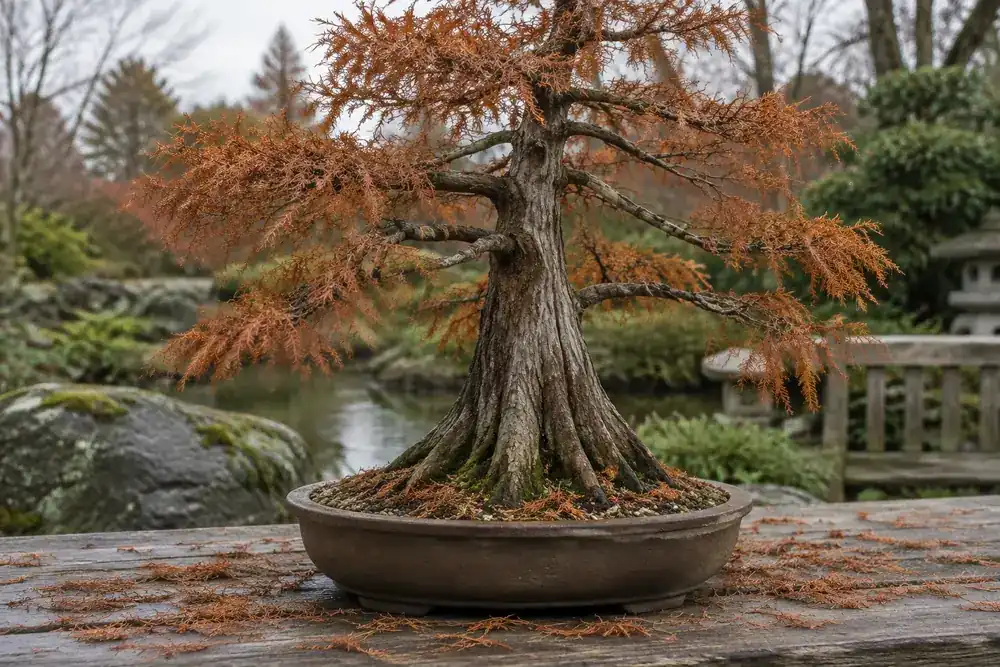
Bald cypress bonsai winter care is simpler than most people expect, once you know what is normal. Bald cypress (Taxodium distichum) is a deciduous conifer. Each autumn its soft needles turn rusty orange and fall, often taking small side twigs with them. Many first-time owners think the tree is dying. It is not. It is getting ready for its winter rest, and that rest is essential for a healthy tree.
This guide explains how cold a bald cypress bonsai can handle, where to keep it, how to water during dormancy and how to bring it back into growth in spring.
Why does a bald cypress bonsai lose its needles?
Unlike pines and junipers, bald cypress is one of the few conifers that is deciduous. In autumn, shorter days and cooler temperatures trigger the tree to drop its foliage. The needles grow on small deciduous twigs, so these branchlets drop too. This is a normal part of dormancy, the resting phase many temperate trees go through every winter.
You can tell normal autumn drop from a problem:
| Normal autumn drop | Possible problem |
|---|---|
| Happens in mid to late autumn | Happens in spring or summer |
| Needles turn evenly orange-brown | Needles brown in patches or at the tips only |
| Buds on main branches stay plump | Branches feel dry and brittle |
| Bark scratch shows green underneath | Bark scratch shows brown, dry wood |
If needles brown in summer, look at watering first. Our guide to bonsai leaves turning yellow or brown covers the common causes.
How cold can a bald cypress bonsai handle?
In the ground, bald cypress is hardy to about USDA zone 4 or 5, which means it shrugs off hard frost. In a bonsai pot the roots are far more exposed. As a guide:
- Down to about -5°C (23°F): No protection needed beyond shelter from wind.
- -5 to -10°C (23 to 14°F): Place the pot on the ground and mulch around it.
- Long spells below -10°C (14°F): Move it into an unheated shed, garage or cold frame, or bury the pot in the ground.
Check your local winter lows with the USDA plant hardiness map to see how much protection you need.
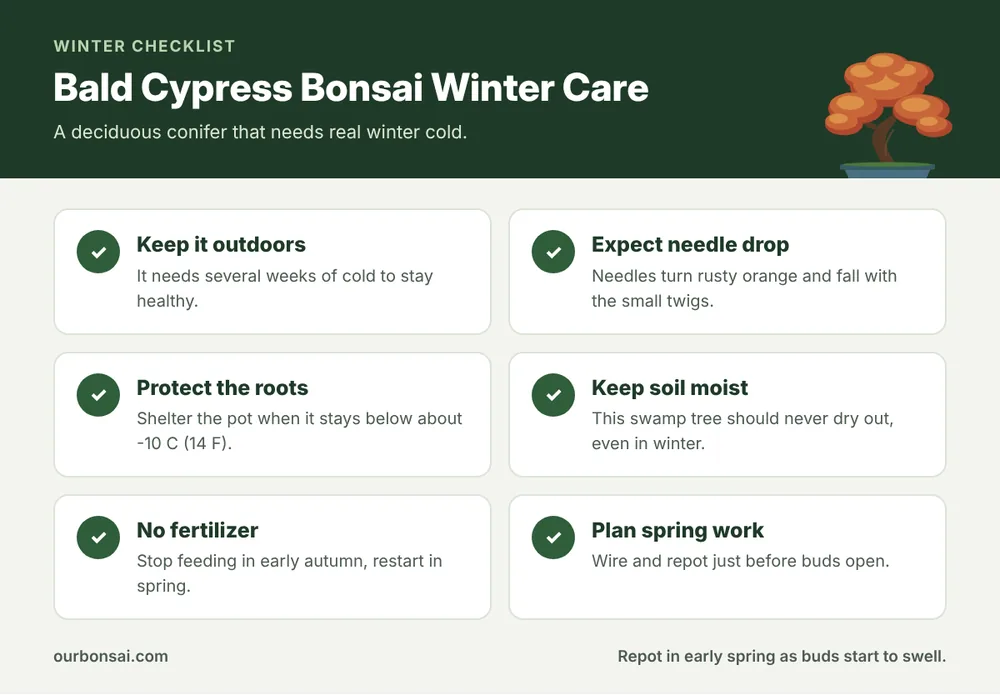
Bald cypress bonsai winter care checklist
Where to keep a bald cypress bonsai in winter
Outdoors is best. Bald cypress needs real cold to complete its dormancy. A tree kept indoors in a warm room will not rest properly and usually grows weak and leggy in spring, then declines. This is not an indoor tree; see our list of outdoor bonsai tree types for others that need the same treatment.
Good winter spots:
- On the ground in a sheltered corner of the garden.
- In a cold frame or unheated greenhouse.
- In an unheated garage or shed with a little light, kept just above freezing.
Because the tree has no leaves in winter, it does not need much light while fully dormant. A dim shed is fine for a few weeks. Move it back outside as soon as the hardest cold has passed.
Watering a bald cypress bonsai in winter
Bald cypress grows naturally in swamps and along riverbanks. It loves water in summer, and many growers even stand it in a shallow tray of water during hot months. In winter it needs much less, but the soil should never dry out.
- Check the soil every few days.
- Water when the surface is just starting to dry.
- Do not leave it sitting in a tray of water in freezing weather, since that turns into a block of ice.
- If the pot is frozen solid, wait for a thaw before watering.
Our guide on watering bonsai in summer explains the other half of the year, when this tree drinks a lot.
Fertilizer, pruning and repotting around winter
- Fertilizer: Stop feeding in early autumn. Restart once new foliage appears in spring.
- Pruning: Winter is a good time to see the branch structure clearly. You can remove dead twigs and plan the design, but leave major cuts until late winter or early spring, just before growth starts.
- Repotting: The best time is early spring, as buds begin to swell. Bald cypress develops thick roots quickly and appreciates a fresh, moisture-holding but well-draining mix. Our guide to bonsai soil mix ratios is a good starting point.
- Wiring: Late winter is ideal, before the buds open, because you can see every branch.
If you are still looking for a tree, our page on bald cypress bonsai for sale covers what to look for. You can also browse bald cypress bonsai trees on Amazon.
Preparing a bald cypress bonsai for winter in autumn
The weeks before winter set the tree up for a good rest. As the needles start to color, keep it outside in full sun so it receives the natural signals of shorter days and cooler nights. Moving it under cover too early confuses that process.
Use late summer and early autumn to build strength. A tree that was fed well during the growing season stores more energy in its roots and trunk, and that is what it lives on through winter and uses to push buds in spring. Stop fertilizer once the needles begin to change color, so the tree is not pushed into soft late growth that frost will damage.
This is also a good time to look for pests. Spider mites and bagworms can attack bald cypress in late summer. Remove any you find before the tree goes dormant, so they do not overwinter in the bark. Finally, check the drainage holes. A pot that drains slowly in autumn is much more likely to freeze into a solid block in winter.
Bald cypress in very warm climates
If you live where winters are mild, such as the US Gulf Coast or similar regions, your tree may only drop its needles late and go dormant for a short time. That is fine, as bald cypress is native to these areas. Just make sure it still gets the cool nights it would naturally experience, and keep it outdoors rather than in an air-conditioned room.
Common bald cypress winter mistakes
- Bringing it indoors because it looks dead. It is resting, not dying.
- Letting the soil dry out in a dry, windy cold spell.
- Leaving it on a high bench in a hard freeze, where the pot is exposed on all sides.
- Waking it too early by moving it into warmth in late winter, followed by frost damage to the soft new growth.
- Pruning off “dead” twigs before spring, when some of them are just dormant. Scratch the bark first.
Waking your bald cypress up in spring
In early spring, small green buds appear along the branches. This is the signal to:
- Move the tree back to full sun.
- Increase watering as the new foliage opens.
- Repot if needed, right at bud swell.
- Start feeding once the first needles have expanded.
Protect the fresh growth from late frosts by covering the tree or moving it under shelter for the night.
FAQ: bald cypress bonsai winter care
Is my bald cypress bonsai dead in winter?
Almost certainly not. Brown needles falling in autumn are normal. Scratch a small twig with your fingernail; green tissue underneath means it is alive.
Can I keep a bald cypress bonsai indoors in winter?
Not in a warm room. If you must bring it in, use an unheated garage or porch that stays cold but above freezing.
Do I need to water a bald cypress bonsai when it has no leaves?
Yes, but less. The roots are still alive and must not dry out. Check every few days.
When do bald cypress bonsai get new needles?
Usually in early to mid spring, a little later than many other deciduous trees.
Final thoughts
Good bald cypress bonsai winter care comes down to three things: let it go dormant outdoors, protect the roots from deep freezes, and keep the soil moist. Do that, and the bare branches you see in January will burst into soft, bright green needles in spring. For more about everyday care, read our complete bonsai care guide.