Azalea Bonsai Winter Care: How to Protect Your Tree

This post contains affiliate links. As an Amazon Associate, OurBonsai earns from qualifying purchases at no extra cost to you. Read our disclosure.
In this guide
- How cold can an azalea bonsai handle?
- Where to keep an azalea bonsai in winter
- Azalea bonsai winter care checklist
- Watering an azalea bonsai in winter
- Soil, fertilizer and pruning in winter
- Protecting an azalea bonsai from frost
- Getting your azalea ready for winter in autumn
- Waking your azalea bonsai up in spring
- Common azalea winter problems
- FAQ: azalea bonsai winter care
- Final thoughts
Good azalea bonsai winter care is mostly about balance. Azaleas, including the popular Satsuki varieties, are hardy outdoor shrubs that need a cool winter rest to flower well in spring. At the same time, their fine, shallow roots in a small bonsai pot are far more exposed to frost than the same plant growing in the ground. Get the balance right and your tree will reward you with a mass of flowers in late spring.
This guide covers how much cold azaleas can take, where to keep them, how to water in winter and what to do if you only have space indoors.
How cold can an azalea bonsai handle?
Satsuki azaleas (Rhododendron indicum and its hybrids) are generally hardy to about USDA zone 6 or 7 when planted in the ground. In a shallow pot, the roots are the weak point. As a rule of thumb:
| Temperature | What to do |
|---|---|
| Above 0°C (32°F) | Leave outside in a sheltered spot. |
| 0 to -5°C (32 to 23°F) | Light frost is fine for short spells. Keep out of wind. |
| Below -5°C (23°F) | Protect the pot and roots: ground, mulch, cold frame or unheated shed. |
| Long freezes below -10°C (14°F) | Move into an unheated garage or shed that stays just above freezing. |
The main danger is not the leaves; it is the root ball freezing solid for days and then thawing, again and again.
Where to keep an azalea bonsai in winter
Outdoors in mild climates
Move it off any high bench and onto the ground in a corner sheltered from wind, such as against a north- or east-facing wall. Some growers bury the pot up to its rim in a bed of mulch or bark. Our outdoor bonsai display ideas show a few practical layouts.
Cold frame, unheated greenhouse or shed
In colder areas, a cold frame or unheated greenhouse is ideal. An unheated garage or shed with a window also works. You want the space to stay roughly between 0 and 7°C (32 to 45°F). Too warm, and the tree may wake up early and push weak growth.
Indoors (only if you must)
Azaleas are not indoor trees, but some people keep them in apartments. If you do, choose the coolest bright room in the house, such as an unheated sunroom or a cool windowsill away from radiators. Our guide to Satsuki azalea bonsai indoor care covers the details.
Azalea bonsai winter care checklist
Watering an azalea bonsai in winter
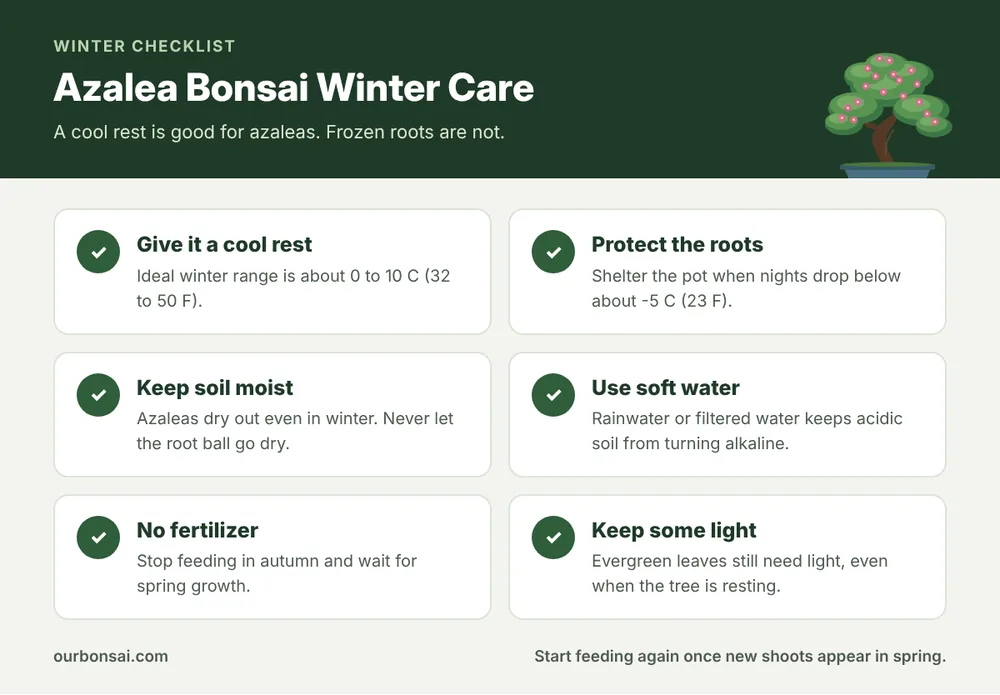
Azaleas hate drying out at any time of year. Their fine roots die quickly in dry soil, and the damage often only shows in spring. In winter, the tree drinks far less, so water less often but never let the soil go dry.
- Check every two or three days. Push a finger into the soil or use a chopstick.
- Water in the morning on mild days, so the pot is not soaking wet during a hard night frost.
- Do not water frozen soil. Wait until it thaws.
- Use soft water. Azaleas need acidic soil. Hard tap water slowly raises the pH. Rainwater is best.
If you keep the tree indoors, the heating dries the air and soil much faster. The tips in our guide to watering indoor bonsai in winter apply here too.
Soil, fertilizer and pruning in winter
- Soil: Azaleas grow best in kanuma, a soft acidic Japanese soil. If your tree is in kanuma, it holds moisture well through winter. See our top soil picks for azalea bonsai.
- Fertilizer: Stop feeding in early autumn. Restart after flowering, with an acidic fertilizer. Our azalea bonsai fertilizer picks list suitable options.
- Pruning: Do not prune in winter. Azaleas set next year’s flower buds in late summer, so winter pruning removes flowers. Prune right after flowering instead.
Protecting an azalea bonsai from frost
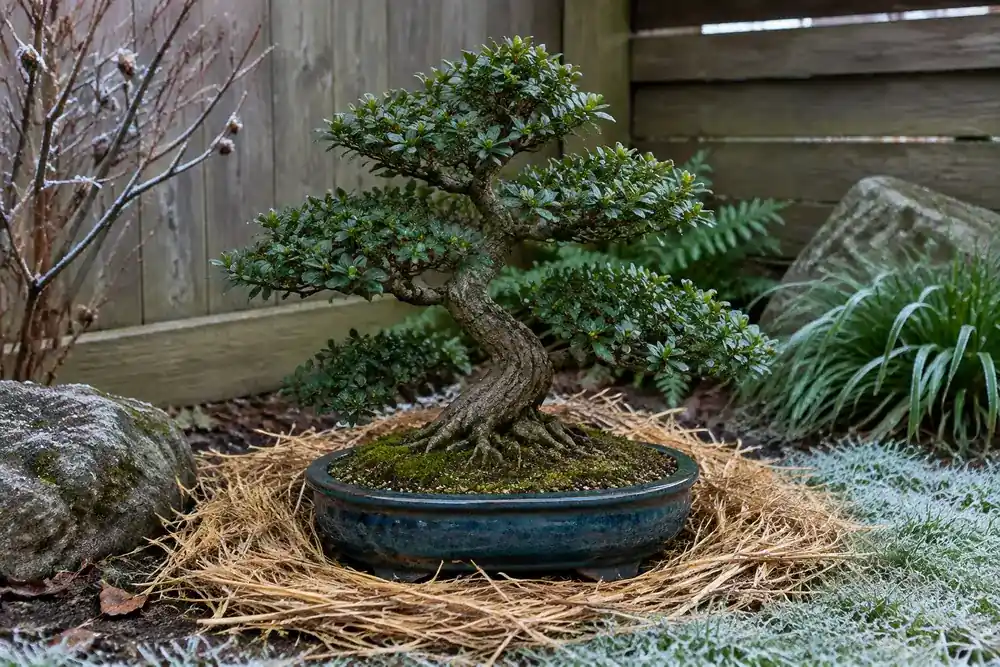
When a hard frost is forecast, a few simple steps help:
- Move the tree out of wind and onto the ground.
- Surround the pot with straw, bark mulch or bubble wrap. Frost protection fleece draped over the tree overnight gives extra protection.
- Keep the soil slightly moist; moist soil holds heat better than dry soil.
- Remove covers once the cold snap passes, so the tree gets light and air.
Mulch works the same way in a bonsai garden as in a vegetable bed: it insulates the roots and slows temperature swings. The RHS watering guidance is also worth reading for general cold-season watering habits.
Getting your azalea ready for winter in autumn
Good winter care actually starts in early autumn. A healthy, well-fed tree going into winter copes far better with cold than a stressed one.
- Feed through late summer. Regular feeding after flowering builds the energy reserves the tree uses through winter. Stop by early autumn so it can slow down.
- Check for pests. Spider mites and lace bugs are common on azaleas in late summer. Treat them before winter so they do not overwinter on the tree. Our guide to bonsai pests and diseases shows what to look for.
- Let it harden off. Leave the tree outside as nights cool. Gradual exposure to cold triggers the natural hardening process that protects its tissues.
- Plan your spot. Decide where the tree will go before the first hard frost arrives, so you are not rushing on a cold night.
Waking your azalea bonsai up in spring
As days lengthen, the tree starts to wake up. Flower buds swell and new leaf buds appear at the shoot tips. Move it back to its normal growing spot once nights stay above about -2°C (28°F). If it spent winter in a dark shed, give it a week in bright shade first, because leaves that sat in low light can scorch in sudden full sun. Water more often as growth speeds up, and wait until after flowering before repotting or hard pruning.
Common azalea winter problems
- Brown or curled leaves: Usually wind burn or dry roots. Shelter the tree and check watering.
- Leaf drop: Some older leaves yellow and drop in autumn and winter. That is normal for azaleas. Sudden heavy drop is not; see why bonsai lose leaves suddenly.
- Flower buds dropping: Often caused by the tree being too warm or too dry.
- Fungus or mold on the soil: Cool, wet, still air can encourage it. Improve air flow and water less often.
FAQ: azalea bonsai winter care
Do azalea bonsai lose their leaves in winter?
Most Satsuki azaleas are evergreen or semi-evergreen. They keep many leaves but drop some older ones. Some deciduous azaleas lose all their leaves.
Can I keep an azalea bonsai inside all winter?
You can, but it is not ideal. Without a cool rest the tree often flowers poorly. A cool, bright room is much better than a warm living room.
When should I bring my azalea bonsai back outside?
Once the worst frosts have passed and new buds start to swell, usually in early to mid spring. Reintroduce it to sun gradually over a week or two.
Final thoughts
Azalea bonsai winter care comes down to a cool rest, protected roots, steady moisture and soft water. Keep the tree outdoors as long as your climate allows, shelter it during hard frosts, and resist the urge to prune or feed. When spring arrives, you will be ready for the best part of growing azaleas: a tree covered in flowers. For year-round basics, see our bonsai care guide.