How to Remove Bonsai Wire Safely (Without Damaging Bark)

This post contains affiliate links. As an Amazon Associate, OurBonsai earns from qualifying purchases at no extra cost to you. Read our disclosure.
In this guide
- When should you remove bonsai wire?
- Tools you need to remove bonsai wire
- How to remove bonsai wire step by step
- Can you unwind bonsai wire instead of cutting it?
- What to do if wire has already cut in
- Removing guy wires and anchor wires
- How the tree recovers after wire removal
- Tips for easier wire removal next time
- FAQ: remove bonsai wire
- Final thoughts
Wiring shapes a bonsai, but the wire is only meant to stay on for a while. Knowing when and how to remove bonsai wire is just as important as putting it on. Leave it too long and it cuts into the bark, leaving scars that can take years to fade. Pull it off the wrong way and you can snap a branch you spent months shaping.
This guide shows you how to tell when the wire should come off, which tools to use, and how to remove it step by step without damaging your tree.
When should you remove bonsai wire?
There is no fixed date. Wire comes off when either of these happens:
- The branch holds its new position. Gently bend it a little; if it stays where you put it, the shape has set.
- The wire starts to bite. As the branch thickens, the wire tightens. When you see the bark swelling around the coils or the wire pressing in, it must come off, even if the branch has not fully set.
How long that takes depends on the tree and the season:
| Tree type | Typical time with wire | Check every |
|---|---|---|
| Fast tropical trees (ficus, Fukien tea) | 3 to 8 weeks in summer | 1 to 2 weeks |
| Deciduous trees (maple, elm) | 6 to 12 weeks in spring | 2 weeks |
| Junipers | 3 to 6 months | 2 to 4 weeks |
| Pines | 4 to 9 months | 3 to 4 weeks |
Spring and early summer are the danger months. Branches can thicken fast and wire that looked loose two weeks ago may already be cutting in. If you are unsure which gauge you used, our guide to bonsai wire sizes helps you identify it. Either way, set a reminder on your phone to check the tree.
Tools you need to remove bonsai wire
- Bonsai wire cutters. Their short, rounded jaws cut wire close to the bark without crushing it. They are the single most useful tool for this job. You can find bonsai wire cutters on Amazon or in most of the kits in our Japanese bonsai tool kit guide.
- Small pliers or jin pliers (optional) to ease out stubborn pieces.
- A small dish to collect the cut pieces so they do not end up in the soil.
Regular side cutters work on thin aluminum wire, but they often have pointed jaws that can nick the bark. Avoid scissors; they are not made for metal and will be ruined.
How to remove bonsai wire step by step
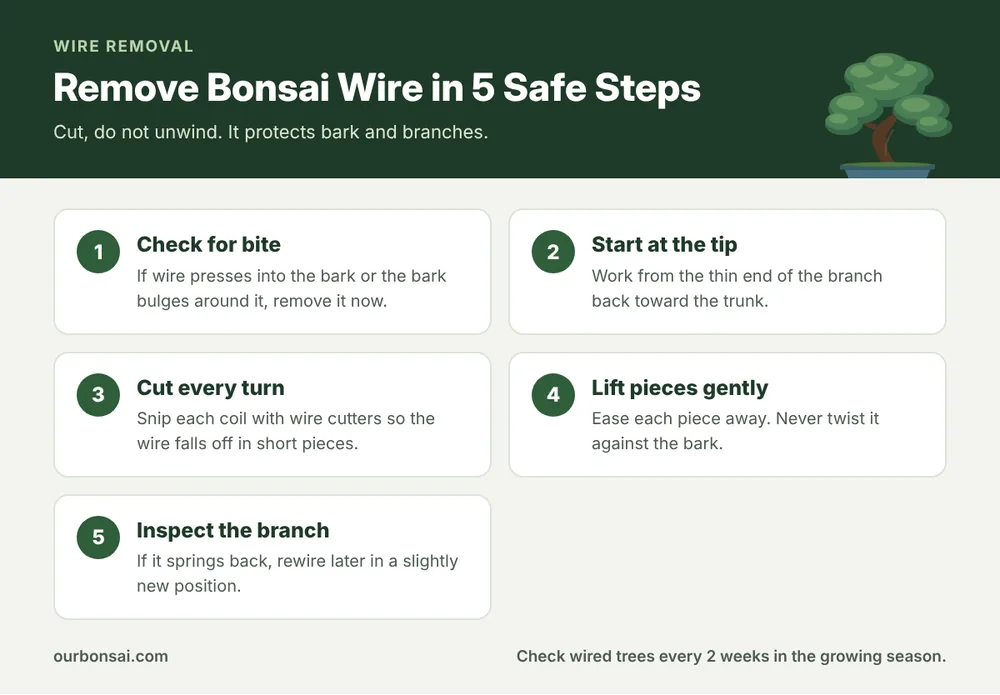
Step 1: Look for wire bite first
Go over the whole tree and find any coils that are pressing into the bark. Remove those first, then deal with the rest.
Step 2: Start at the tip of the branch
Work from the thin outer end of the branch back toward the trunk. This is the reverse of how the wire went on and keeps the branch supported as you go.
Step 3: Cut the wire at every turn
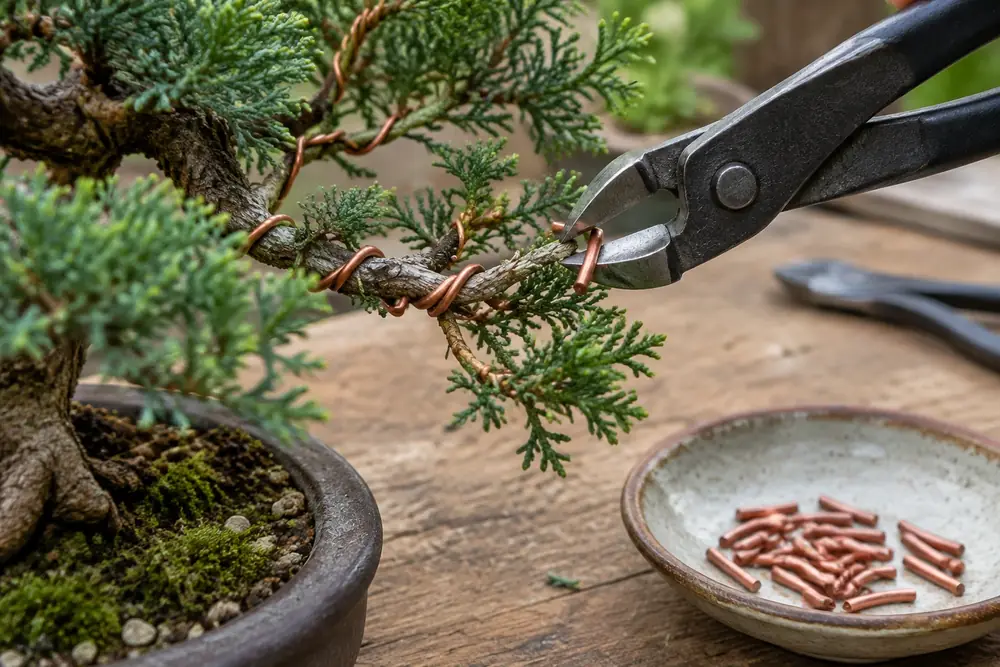
Place the cutter jaws across one coil, on the outside of the branch, and snip. Move to the next coil and snip again. The wire falls away in short C-shaped pieces. It feels slow, but it is the safest method.
Step 4: Ease the pieces away
Lift each piece out gently. If one is stuck in the bark, cut it into even smaller pieces and wiggle them out. Do not twist or drag wire along the branch.
Step 5: Check the branch
Once the wire is off, see whether the branch holds its shape. If it springs back a little, you can rewire it later in a slightly exaggerated position.
Can you unwind bonsai wire instead of cutting it?
On thin, flexible aluminum wire that is clearly loose, some experienced growers unwind it to reuse it. For beginners, cutting is safer. Unwinding means pulling the wire around and around the branch, which can:
- Tear bark where the wire has bitten in.
- Snap a branch that has just been set, because unwinding puts a twisting force on it.
- Break off buds, needles and small shoots caught under the coils.
Used wire is also work-hardened, especially copper, so it does not hold as well a second time. New wire is cheap compared with a broken branch.
What to do if wire has already cut in
A little bark marking heals quickly on fast-growing trees. Deeper scars need more care:
- Remove the wire immediately, cutting it into very small pieces.
- Do not dig out wire that has grown fully into the bark. Cut the visible parts away and leave the buried section. The tree will grow over it.
- Seal deep wounds on smooth-barked trees, such as maples, with cut paste. Our guide to a bonsai cut paste alternative explains options.
- Feed and water well so the tree grows strongly and covers the scar.
On junipers and pines, light wire scars often disappear within a season or two as the bark thickens. On maples and other smooth-barked trees they may stay visible much longer, which is why regular checking matters. The bonsai cultivation article on Wikipedia also notes that wire must be removed before it damages the bark.
Removing guy wires and anchor wires
Not all wire on a bonsai is wrapped around a branch. Guy wires pull a branch down from an anchor point on the pot or trunk, and tie-in wires hold the tree in its pot. These come off differently:
- Guy wires: Loosen the tension first by untwisting the tightening loop a little, then cut the wire at the anchor end. If you padded the branch with rubber tubing, check the bark under it for marks.
- Pot tie-in wires: Leave these in place until the next repotting, unless the tree is fully rooted and stable. They do not touch the bark if they were placed correctly over the roots.
- Anchor coils around the trunk: Treat them like branch wire. Cut each coil separately, as the trunk thickens slowly but steadily and old anchor coils are a common source of scars near the base.
How the tree recovers after wire removal
Once the wire is off, the branch can thicken freely again, and the tree often responds with a burst of growth in that area. Give it normal care: regular watering, feeding during the growing season and full light for outdoor species. This is also a good moment to step back and look at the overall design. Trim any shoots that have grown long while the wire was on, using sharp bonsai pruning shears, and decide whether any branch needs a second round of wiring.
If you see small wire marks, do not worry. On most species they fade as the bark grows. Avoid rewiring over exactly the same line; wrap the new wire at a slightly different angle so the old marks can heal.
Tips for easier wire removal next time
- Wrap the wire at about 45 degrees with a little space between coils, so it can be cut easily.
- Do not wire over leaves or buds.
- Wire fewer branches at a time on young, fast-growing trees.
- Keep notes or a photo of when each tree was wired.
- Learn to read your tree. Junipers, for example, often thicken in late spring, as our juniper bonsai styles guide explains.
FAQ: remove bonsai wire
How long should wire stay on a bonsai?
Anywhere from three weeks to nine months, depending on the species and season. Check every two weeks during growth and remove it as soon as it bites.
Can I reuse bonsai wire?
Aluminum wire that came off straight can be reused for small jobs, but cut pieces cannot. Copper hardens when bent and should not be reused.
Should I remove wire before repotting?
Not necessarily. Wire can stay on during repotting, but check it first. Repotting is a good time to remove any wire that is close to biting.
What if the branch moves back after removing the wire?
That is common on stiff or old branches. Rewire it, often in a slightly stronger bend, and leave it on a little longer next time.
Final thoughts
To remove bonsai wire safely, check often, start at the branch tip and cut the wire at every turn instead of unwinding it. A few minutes with a good pair of wire cutters protects months of styling work and keeps your tree’s bark smooth and healthy. For general maintenance between styling sessions, see our bonsai care guide.