How to Prune Juniper Bonsai: Step-by-Step Guide

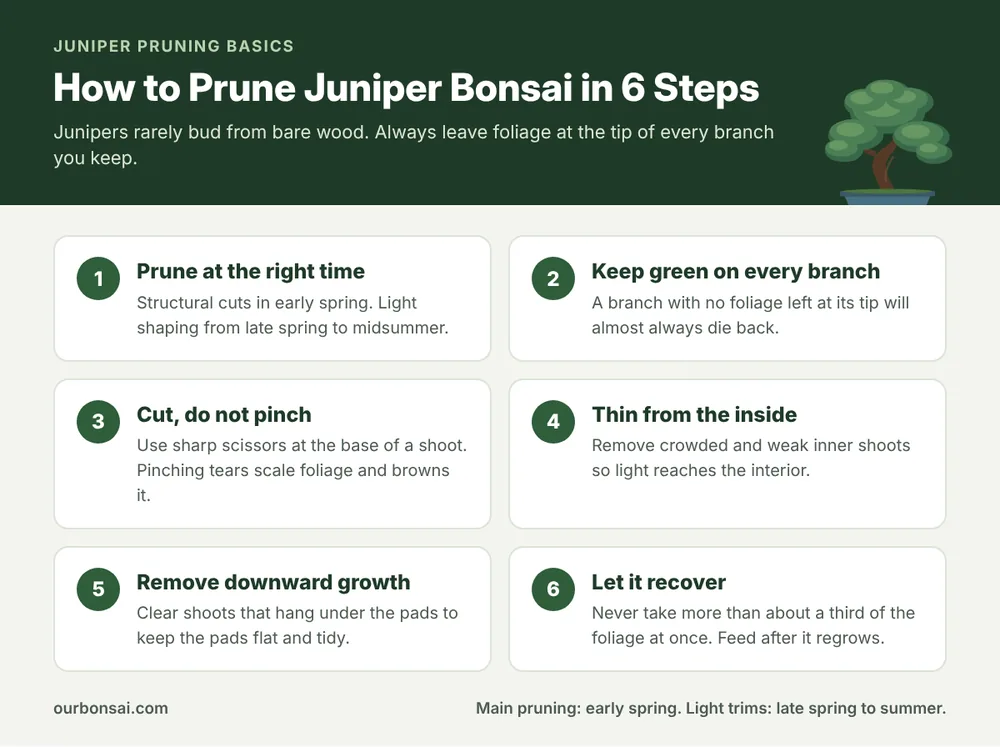
If you want to know how to prune juniper bonsai, start with one rule: never cut a juniper branch back to bare wood. Unlike maples, elms or ficus, junipers rarely push new buds from old, leafless wood. A branch that loses all of its green tips usually dies. Prune in early spring for structure and from late spring to midsummer for maintenance, cut with sharp scissors instead of pinching, thin out crowded growth, and never remove more than about a third of the foliage at once.
In this guide
That is the short version. Below you will find the timing, tools and step-by-step method that keep a juniper dense, healthy and looking like a real tree in miniature.
Why junipers need their own pruning approach
Most bonsai trees can be cut back hard and will push out a new set of buds. Junipers are different. Their energy flows to the foliage at the tips of the branches. Strong tips grow, while the inner foliage slowly weakens if it is shaded. Remove all the tips and the branch has nothing to feed it.
There are two kinds of juniper foliage you will see:
- Needle foliage (juvenile), sharp and prickly, common on Japanese garden juniper (Juniperus procumbens ‘Nana’) and on stressed trees.
- Scale foliage (adult), soft and flat, typical of Chinese juniper (Juniperus chinensis) varieties such as Shimpaku.
Both are pruned the same way: with scissors, shoot by shoot. For background on the species, see our juniper bonsai care guide.
When to prune juniper bonsai
| Type of pruning | Best time | Why |
|---|---|---|
| Structural (removing branches) | Late winter to early spring | Tree is about to grow and can heal quickly |
| Maintenance (shaping pads) | Late spring to midsummer | Strong growth replaces what you remove |
| Light thinning | Early autumn | Lets light in before winter |
| No pruning | Late autumn and winter | Tree is resting and cannot respond |
Prune only healthy, vigorous trees. A juniper that is weak, newly repotted or recovering from pests should be left to grow for a season first. Our guide on when to start pruning bonsai explains how to read a tree’s strength.
Tools you need
- Sharp bonsai scissors for individual shoots. Our beginner pruning shears guide compares good options.
- A concave cutter for removing whole branches flush with the trunk. These leave a hollow cut that heals flat.
- Wound sealant for any cut wider than a pencil.
- Tweezers for cleaning out dead inner foliage.
How to prune juniper bonsai step by step
Step 1: Look before you cut
Turn the tree slowly and find the front. Decide which branches build the design and which compete with them. Remove any dead or brown branches first, so you can see the real structure.
Step 2: Remove unwanted branches
Take off branches that grow straight up or straight down, branches that cross others, and one of any two branches that come from the same point on the trunk. Cut them with a concave cutter close to the trunk. Rather than cutting large branches off completely, many growers leave a stub and strip the bark to make a jin (deadwood), which suits junipers well.
Step 3: Thin the foliage pads
Inside each foliage pad, look for shoots that grow too strongly, crowd others or point the wrong way. Follow each one back to where it starts and cut it with scissors. Leave the weaker, shorter shoots, which make the pad dense and fine. Remove any shoots growing under the pad.
Step 4: Shorten long shoots, but keep green tips
Cut long shoots back to a side shoot that has healthy foliage. Every branch you keep must still have green growth at its end. If you are not sure, leave it longer and revisit next year.
Step 5: Clean the interior
Pull out dead, brown needles and weak inner shoots with tweezers. Better airflow and light inside the tree help prevent pests and keep inner growth alive. Our guide to juniper bonsai pests and diseases shows why a clean interior matters.
Step 6: Aftercare
Put the tree back in full sun, water normally and wait for strong regrowth before feeding. Once new growth is moving, resume fertilizing with a balanced or slightly nitrogen-rich feed. Our list of the best fertilizer for juniper bonsai has good options.
Pruning different juniper types
Not every juniper grows the same way, so adjust your approach a little.
- Procumbens ‘Nana’ (Japanese garden juniper). Grows vigorously with prickly needle foliage. It tolerates regular thinning in summer and builds dense pads quickly. Cut long runners back to a side shoot, and remove shoots that grow straight down from the pads.
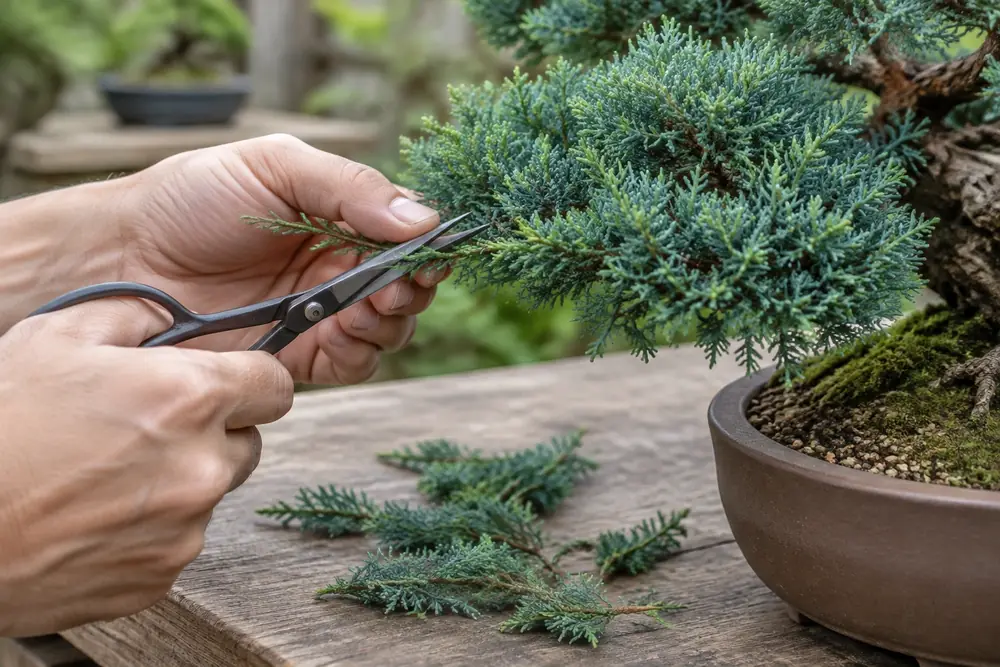
- Shimpaku and other Chinese junipers. Scale foliage that reacts badly to pinching. Let shoots extend a few centimeters, then cut the longest ones at their base with fine scissors. This style is slower but gives the finest foliage.
- Needle junipers (Juniperus rigida). Very sharp needles and strong apical growth. Thin the strong tips in early summer and keep the inner shoots so the branch does not become bare.
- Garden center nursery junipers. Often overgrown and leggy. Spend the first year only removing dead material and letting the tree gain strength, then start shaping.
How much is too much?
A useful check: after pruning, the tree should still look green and full from a few steps away. If you can see straight through large parts of the canopy, you have probably gone too far. Let it grow freely for the rest of the season and feed well.
Why you should not pinch juniper bonsai
Older books often say to pinch juniper tips with your fingers all season. Most professional growers now advise against it. Pinching tears the scale foliage, the torn ends turn brown, and repeated pinching weakens the tree because you keep removing the strongest growth. Cutting whole shoots at their base with scissors gives a cleaner result and keeps the foliage green.
Common mistakes when pruning junipers
- Cutting back to bare wood. The branch will almost always die. Always keep green at the tip.
- Giving it a haircut. Shearing the outside like a hedge cuts every tip in half and leaves brown ends everywhere.
- Pruning too much at once. Remove no more than about a third of the foliage in one session.
- Pruning a weak tree. Only strong, growing junipers respond well.
- Pruning and repotting together. Doing both in the same season is too much stress.
If brown patches appear after pruning, check our guide to Japanese juniper bonsai turning brown. For shaping ideas after pruning, see juniper bonsai styles for beginners. The Clemson Extension juniper factsheet is also a good reference on keeping junipers healthy.
FAQ: how to prune juniper bonsai
Can I cut a juniper bonsai back hard?
Only if every branch you keep still has healthy foliage at its tip. Junipers do not reliably bud from bare wood, so a hard cut back to leafless wood usually kills the branch.
How often should I prune my juniper bonsai?
One structural session in early spring and one or two light maintenance sessions in late spring and summer are enough for most trees.
Should I pinch or cut juniper foliage?
Cut. Use sharp scissors at the base of the shoot. Pinching tears the foliage and causes brown tips.
What do I do with large branches I remove?
You can cut them off flush with a concave cutter, or leave a stub and strip the bark to make a jin. Deadwood is a classic feature of juniper bonsai.
Final thoughts
Learning how to prune juniper bonsai comes down to respecting how the tree grows. Prune at the right time, use scissors rather than fingers, thin rather than shear, and always leave green on every branch. Follow those rules and your juniper will stay healthy and grow denser, more refined foliage pads every year.