Pruning Bonsai Summer Winter Guide: What to Cut and When

This post contains affiliate links. As an Amazon Associate, OurBonsai earns from qualifying purchases at no extra cost to you. Read our disclosure.
In this guide
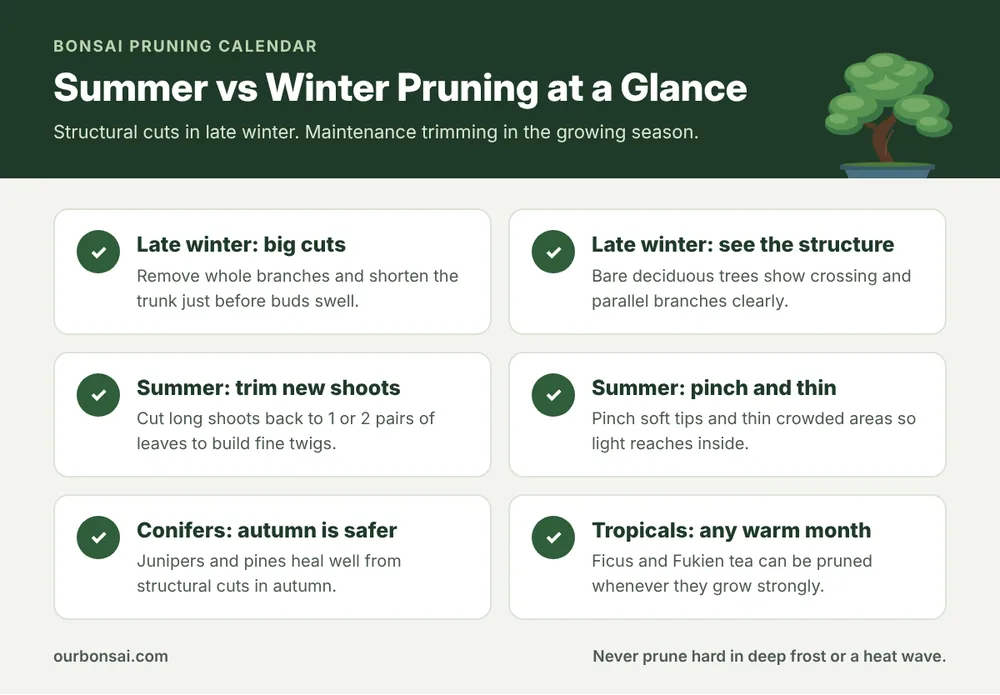
The question of pruning bonsai summer winter comes down to one idea: the two seasons do different jobs. Late winter, just before buds swell, is for structural pruning, which means removing whole branches and making big cuts that change the shape of the tree. Summer, while the tree is growing, is for maintenance pruning: trimming new shoots, pinching and thinning to keep the shape tight and the branches fine. Mix the two up and you either weaken the tree or lose a season of progress.
This guide explains why timing matters, what each season is best for, how it changes for deciduous, conifer and tropical bonsai, and the mistakes to avoid.
Why the season matters for pruning
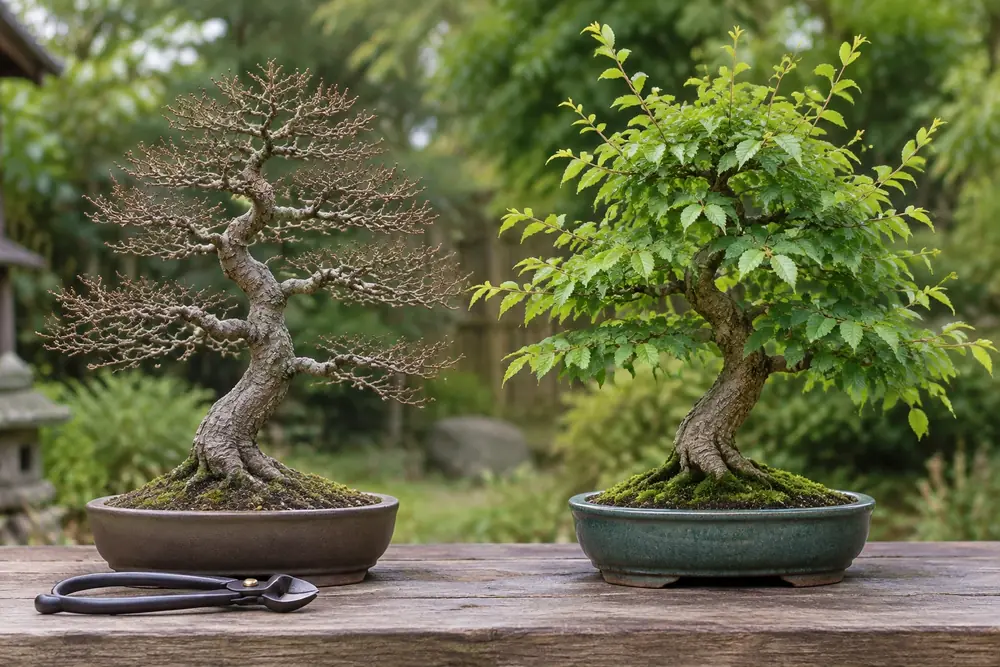
A tree stores energy in its roots and trunk over winter, then spends it on spring growth. When you cut a big branch in late winter, the tree has full reserves and is about to grow, so it heals the wound fast and pushes new buds near the cut. The bare branches also let you see exactly what you are removing.
Cut that same branch in midsummer and the tree loses leaves it is using to rebuild reserves, while the wound may bleed sap or dry out in the heat. On the other hand, summer is exactly when you want to trim new shoots, because that is when they are growing and when cutting them forces back-budding. The University of Minnesota Extension pruning guide explains the same principle for garden trees: dormant-season cuts give the strongest regrowth, summer cuts slow growth down.
Winter pruning: structural cuts
The best window is late winter to very early spring, once the worst frost has passed and just before the buds start to swell. This is the time to:
- Remove whole branches that cross, run parallel, or grow straight toward the viewer.
- Shorten the trunk or replace the apex with a lower branch.
- Cut back long, coarse branches to a better side branch.
- Remove bar branches (two branches coming from the same point on the trunk).
Use a concave cutter for branches close to the trunk, so the wound heals flat. Seal large cuts with cut paste; if you do not have it, our guide to the best bonsai cut paste alternatives covers safe options. For deciduous species, our article on when to prune deciduous bonsai gives a month-by-month view.
Avoid structural pruning in deep winter if your trees sit outside in hard frost. Fresh wounds can freeze and die back.
Summer pruning: maintenance and refinement
From late spring through summer, the job changes from shaping to refining:
- Trim new shoots. Let a shoot grow four to six leaves, then cut it back to one or two. This creates the dense twig network that makes a bonsai look mature.
- Pinch soft tips on trees such as Chinese elm and boxwood to keep them compact.
- Thin crowded areas so light reaches inner buds and they do not die off.
- Remove unwanted shoots on the trunk and in the crotches of branches.
- Partial leaf pruning on strong deciduous trees in early summer.
Summer pruning slows the tree slightly, which is what you want on a tree that is close to its finished shape. Avoid heavy cuts during heat waves; a tree under heat stress has no energy to spare. Our guide to watering bonsai in summer helps keep trees strong through the hot months.
How timing changes by tree type
| Tree type | Structural pruning | Maintenance pruning |
|---|---|---|
| Deciduous (maple, elm, hornbeam) | Late winter before bud break | Late spring to late summer |
| Conifers (juniper, pine) | Autumn to early winter | Spring and summer pinching |
| Tropical indoor (ficus, Fukien tea) | Any time it grows strongly, best in early summer | Year round when growing |
| Flowering (azalea, quince) | Right after flowering | Shortly after flowering, then stop |
Conifers are the main exception to the “big cuts in late winter” rule. Junipers and pines heal more reliably from heavy cuts in autumn, when sap flow is slower and there is less risk of bleeding resin. Flowering trees are pruned right after they bloom, because their buds for next year form during summer, and cutting later removes the flowers. Our when to start pruning bonsai guide covers how young trees fit into this.
A simple year-round pruning calendar
For a typical outdoor deciduous bonsai in a temperate climate, the year looks like this:
- Late winter (February to early March): structural pruning, branch removal, trunk chops. Wire while the tree is bare.
- Early spring (March to April): leave the tree alone while buds open. Repot if it is due, but do not combine repotting with heavy pruning.
- Late spring (May to June): first trim of the new shoots once they have four to six leaves. Partial defoliation on strong trees.
- Summer (July to August): keep trimming shoots back to one or two leaves every few weeks. Thin dense areas. No big cuts in heat waves.
- Autumn (September to November): stop trimming so the last shoots harden. Structural work on junipers and pines.
- Early winter (December to January): rest. Clean up dead twigs only.
Shift every step a few weeks earlier in a warm climate and later in a cold one. Tropical indoor trees ignore most of this and can be trimmed whenever they are actively growing, though a big cut still recovers fastest in early summer.
Can you do structural pruning in summer?
Sometimes, but only on very strong trees and only with a reason. Tropical ficus often respond well to a hard cut in early summer, because heat and light drive fast recovery. Healthy deciduous trees can lose a branch in early summer if it is badly placed, but you will get less back-budding than in late winter. For anything weak, newly repotted or in a hot climate, wait for the right season.
Common pruning timing mistakes
- Big cuts in autumn on deciduous trees. Wounds stay open over winter and can die back.
- Heavy pruning and repotting in the same season. Do one or the other, not both.
- Pruning a flowering tree in late summer and losing next spring’s blooms.
- Never trimming in summer, which leaves long, coarse shoots and thick branch tips.
- Pruning during a heat wave or deep frost.
If you are building your toolkit, a sharp concave cutter and fine scissors do most of the work; browse bonsai concave cutters or read our concave cutter review.
FAQ: pruning bonsai summer winter
Is it better to prune bonsai in summer or winter?
Both, for different jobs. Late winter for structural cuts, summer for trimming new shoots and keeping the shape.
Can I prune my bonsai in winter while it is dormant?
Yes for deciduous trees in late winter, just before buds swell. Avoid mid-winter cuts during hard frost if the tree is outdoors.
How much can I cut off in summer?
Trim new shoots back to one or two pairs of leaves. Avoid removing more than about a third of the foliage at once on a healthy tree.
When should I prune juniper bonsai?
Do structural work in autumn and pinch or trim the new growth in spring and summer.
Final thoughts
Pruning bonsai summer winter is not an either-or choice. Make the big, shape-changing cuts in late winter (autumn for conifers), and use summer for trimming and refining. Follow that rhythm and your tree will heal faster, back-bud more and look more mature every year. For everyday care in between, see our bonsai care guide.