Bonsai Defoliation and Leaf Pruning: When and How to Do It

This post contains affiliate links. As an Amazon Associate, OurBonsai earns from qualifying purchases at no extra cost to you. Read our disclosure.
In this guide
Bonsai defoliation is the practice of cutting off all or part of a tree’s leaves in early summer so it pushes out a second set of leaves. The new leaves come out smaller, the tree branches more, and light reaches the inner shoots. It is a powerful technique for refining deciduous bonsai such as maples and elms, but it is also stressful, so it only belongs on strong, healthy trees and never on a tree that is weak or recently repotted.
This guide explains what leaf pruning actually does, which trees can take it, the difference between full and partial defoliation, how to time it, how to cut, and how to look after the tree while it re-buds.
What bonsai defoliation does
A deciduous tree makes its first set of leaves in spring from energy stored in the trunk and roots. When you remove those leaves in early summer, the tree reacts by opening dormant buds and growing a fresh set. That second flush has a few useful effects:
- Smaller leaves. The second set usually comes out noticeably smaller, which keeps the tree in better proportion.
- More ramification. Several buds may open where only one grew before, so you get more fine twigs.
- Light inside the canopy. With the outer leaves gone for a few weeks, inner buds get sun and stay alive instead of withering.
- A clear view of the structure. A bare tree in summer is the perfect moment to see crossing branches and to wire.
The price is energy. The tree spends stored reserves on a second set of leaves, so a weak tree can decline badly. Defoliation is a refinement tool for trees that are already close to finished, not a way to grow a young tree bigger. For general background on how bonsai growers manage leaf size, see the Wikipedia article on bonsai cultivation and care.
Which trees tolerate bonsai defoliation?
| Tree | Defoliation | Notes |
|---|---|---|
| Trident maple | Full or partial | One of the most tolerant. Strong trees can be fully defoliated |
| Japanese maple | Partial, or full on very strong trees | Thin-leaf cultivars are more delicate |
| Chinese elm, zelkova | Full or partial | Re-buds quickly and evenly |
| Ficus | Full on healthy indoor trees | Best done in summer when growth is strongest |
| Hornbeam, beech | Partial only | Beech re-buds slowly. Cut half of each leaf instead |
| Ginkgo | Not recommended | Often fails to re-bud in the same season |
| Pines, junipers, conifers | Never | They cannot replace needles this way |
| Flowering trees (azalea, quince) | Avoid | You remove next year’s flowering energy |
If you are not sure what group your tree belongs to, our overview of deciduous bonsai tree types is a good starting point.
Full vs partial defoliation
Full defoliation removes every leaf on the tree. It gives the strongest effect on leaf size and ramification, but also the biggest stress. Use it only on vigorous trident maples, elms and ficus.
Partial defoliation is gentler and often smarter. There are three common ways to do it:
- Remove only the large leaves. Cut the biggest leaves and leave the small ones. This evens out leaf size across the tree.
- Defoliate only the strong areas. The top and outer branches of most trees grow hardest. Remove leaves there and leave the weaker lower and inner branches alone. This balances vigor, so the bottom branches catch up.
- Cut each leaf in half. On beech, hornbeam and some maples, trimming each leaf blade by half reduces shading without forcing a full second flush.
Beginners should start with partial defoliation. You get most of the benefit with a fraction of the risk.
When to do bonsai defoliation
The window is short: early summer, after the spring leaves have fully hardened, which is usually June in the Northern Hemisphere. The leaves should feel firm and leathery, not soft and pale. Doing it too early wastes the tree’s spring energy before it has recovered it; doing it too late (mid-August onward) leaves the new leaves too little time to harden before autumn.
Do not defoliate in the same year that you repot, after a heavy structural cut, or when the tree is still recovering from pests or a bad winter. If the spring growth was weak, skip it this year. And do not defoliate the same tree every year; every second or third year is plenty for most species. Our guide on when to prune deciduous bonsai shows how this fits into the yearly pruning calendar.
How to defoliate a bonsai step by step
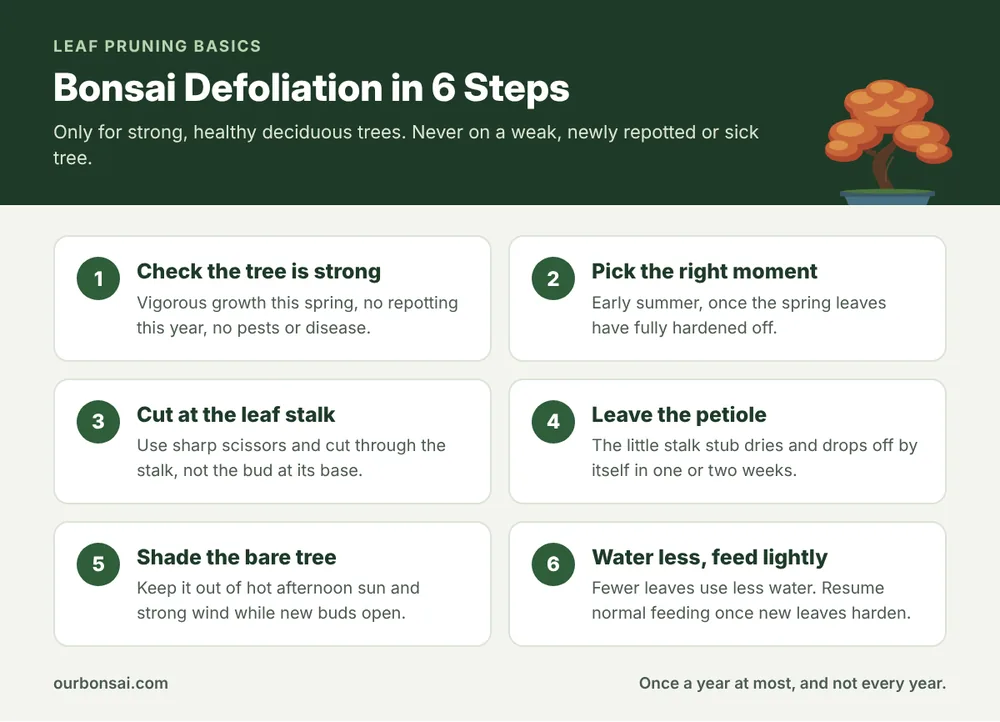
Step 1: Prepare the tree
Water the tree the day before so it is well hydrated. Feed it normally in the weeks before; a tree with good reserves re-buds faster.
Step 2: Get sharp scissors
Use fine-tipped leaf trimming scissors. Our guide to the best bonsai pruning shears for beginners covers a few good options, or browse bonsai leaf trimming scissors to compare.
Step 3: Cut through the leaf stalk
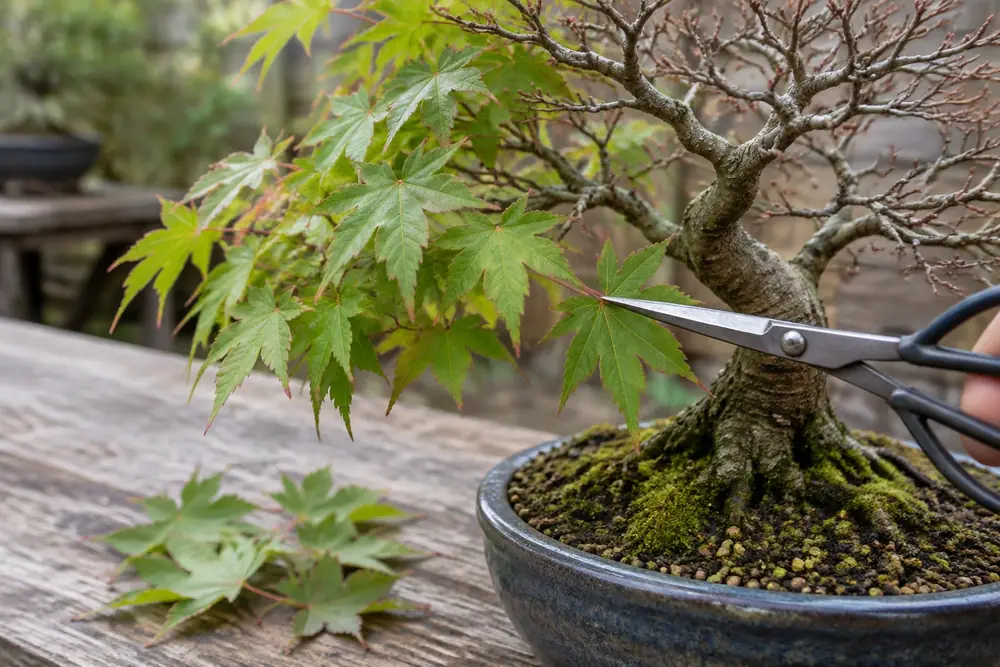
Cut each leaf at its stalk (the petiole), roughly in the middle. Do not pull leaves off by hand and do not cut right at the branch, because the dormant bud that will produce the new leaf sits at the base of the stalk and is easy to damage.
Step 4: Work from the top down
Start with the strongest areas, usually the apex and the outer tips. If you are doing partial defoliation, stop when the weaker lower branches still have their leaves.
Step 5: Prune and wire while it is bare
With the leaves gone, cut back long shoots to one or two pairs of buds, remove crossing branches and do any light wiring. This is the easiest time of year to see what you are doing.
Aftercare after defoliation
- Light shade. Bare branches and fresh buds scorch easily. Give the tree morning sun and afternoon shade for two to three weeks.
- Shelter from wind. New leaves are soft and tear easily.
- Water less. With fewer leaves, the tree uses far less water. Check the soil before each watering so the roots do not sit wet. Our guide to watering bonsai in summer explains how to judge it.
- Feed lightly. Pause strong feeding until the new leaves appear, then return to a balanced fertilizer.
- Be patient. New buds usually open within two to four weeks, depending on species and temperature.
Common bonsai defoliation mistakes
- Defoliating a weak tree, a newly repotted tree or a tree that has just been bought.
- Doing it every single year on the same tree.
- Cutting off the bud at the base of the leaf stalk.
- Defoliating too late in summer, so new leaves do not harden before autumn.
- Fully defoliating species that re-bud poorly, such as beech or ginkgo.
- Leaving the bare tree in full afternoon sun.
If a tree drops its leaves unexpectedly without you cutting them, that is a different problem. Our guide to bonsai losing leaves suddenly covers the usual causes.
FAQ: bonsai defoliation
Does defoliation hurt a bonsai?
It stresses the tree because it has to spend stored energy on new leaves. A strong tree recovers quickly and benefits. A weak tree can decline or lose branches.
How long does it take for leaves to grow back?
Usually two to four weeks for maples, elms and ficus in warm weather. Cooler weather or a weaker tree slows it down.
Can I defoliate an indoor ficus bonsai?
Yes, a healthy ficus that is growing strongly can be fully defoliated in summer. Keep it in bright light afterwards so it re-buds evenly.
Should I defoliate my bonsai every year?
No. Most growers defoliate a given tree every two or three years at most, and only when it is healthy and vigorous.
Final thoughts
Bonsai defoliation is a refinement technique, not a routine chore. Use it on strong deciduous trees in early summer, start with partial leaf pruning, cut at the leaf stalk, and give the tree shade and patience afterwards. Done well, it rewards you with smaller leaves and denser branching, and the basics of daily care in our bonsai care guide will carry the tree through the rest of the season.