
Why Is My Bonsai Losing Leaves Suddenly?

Seeing a bonsai suddenly drop leaves can be alarming, especially when the tree looked healthy only a few days earlier. Because bonsai grow in small containers with limited soil and root space, changes in water, temperature, light, pests, or root health can affect them quickly.
If you are asking, “Why is my bonsai losing leaves suddenly?”, do not assume the tree is dying. Leaf loss is a symptom rather than a diagnosis. Some causes are relatively easy to correct, while others—such as severe root rot or a heavy pest infestation—need faster attention.
This guide will help you identify the likely cause, inspect your bonsai safely, look for pests, and decide what to do next without making the tree more stressed.
Quick Answer
A bonsai may suddenly lose leaves because of overwatering, underwatering, a sudden change in light or temperature, root problems, pests, disease, or seasonal leaf drop. Check the soil moisture, recent environmental changes, leaf undersides, branches, and drainage before treating the tree. Avoid fertilizing or repotting until you understand the cause.
Is Sudden Leaf Loss Always a Serious Problem?
Not necessarily.
A few older leaves dropping from an otherwise healthy bonsai can be normal. Deciduous species naturally lose foliage as they enter dormancy, and some tropical bonsai may shed a limited number of leaves while adapting to a different environment.
Sudden heavy leaf loss deserves closer attention.
According to Penn State Extension’s guidance on diagnosing poor plant health, leaf drop can result from conditions including overwatering, root rot, low light, cold damage, excessive fertilizer, and environmental acclimation problems.
The important question is not simply how many leaves fell. Look at what happened immediately before the leaf loss and whether the remaining foliage, branches, soil, and roots show additional symptoms.
Common Reasons a Bonsai Suddenly Loses Leaves
1. The Bonsai Has Been Overwatered
Overwatering is one of the first things to investigate.
Bonsai need regular watering, but their roots also require oxygen. When the soil remains saturated for too long, air spaces fill with water and root function begins to decline.
Warning signs include:
- Soil remaining wet for unusually long periods
- Yellow leaves dropping while still soft
- Weak or limp foliage
- A sour or unpleasant smell from the soil
- Reduced new growth
- Water draining very slowly
- Dark, soft roots if root damage is severe
Do not simply stop watering for a fixed number of days. Instead, check the moisture level every day and water according to the tree’s actual needs.
Compact organic soil, blocked drainage holes, an oversized moisture-retaining potting mix, or poor airflow can make overwatering problems worse.
2. The Tree Became Too Dry
Underwatering can cause leaf loss surprisingly quickly because bonsai pots contain relatively little growing medium.
A tree sitting in strong sun or wind can dry much faster than a large landscape plant.
Look for:
- Dry soil throughout the pot
- Soil pulling away from the sides of the container
- Crisp or curled leaves
- Limp foliage followed by leaf drop
- Brittle young shoots
If the soil has become extremely dry, water thoroughly and make sure water actually penetrates the root ball. Very dry organic soil can sometimes repel water initially.
Do not compensate by leaving the bonsai standing permanently in a tray of water. That can turn a drought problem into a root problem.
3. Your Bonsai Experienced a Sudden Environmental Change
Bonsai do not always respond well to abrupt changes.
Moving a tree from bright outdoor conditions into a dim room, placing it beside an air conditioner, changing its growing location, or exposing a tropical bonsai to cold temperatures can trigger leaf drop.
This is especially common with some ficus bonsai.
The Missouri Botanical Garden’s guidance on weeping fig leaf drop notes that substantial changes in temperature or light, drafts, and both too much and too little water can cause foliage loss in Ficus benjamina.
Think about what changed during the previous one to three weeks.
Did you:
- Bring the bonsai indoors?
- Move it to another window?
- Place it near heating or cooling equipment?
- Experience unusually hot or cold weather?
- Purchase the tree recently?
- Transport it for several hours?
- Change its watering routine?
If so, environmental stress may be more likely than disease.
4. Pests Are Feeding on the Bonsai
Because this symptom can be caused by pests, inspect the tree carefully before assuming that watering is responsible.
Common bonsai pests include:
- Spider mites
- Scale insects
- Aphids
- Mealybugs
- Whiteflies
These pests feed on plant tissues or sap. A small population may produce only minor symptoms, but a serious infestation can weaken foliage enough to cause yellowing and premature leaf drop.
Signs of Spider Mites
Spider mites are extremely small and are easy to miss without close inspection.
Look for:
- Fine webbing between leaves or branches
- Tiny pale dots called stippling
- Yellow, gray, or bronze foliage
- Dry-looking leaves despite adequate watering
- Premature leaf drop
The University of Minnesota Extension’s spider mite guidance explains that severe mite feeding can make foliage appear bronzed or bleached and can eventually cause leaves to fall.
A useful test is to hold a sheet of white paper below a suspicious branch and gently tap the foliage. Tiny moving specks on the paper may indicate mites.
Signs of Scale, Aphids, or Mealybugs
Look carefully around branch junctions, young shoots, leaf undersides, and the base of leaves.
Possible signs include:
- Sticky residue called honeydew
- Black sooty mold growing on sticky foliage
- White cotton-like material
- Small brown or gray bumps attached to stems
- Clusters of tiny insects on young shoots
- Distorted new leaves
- Ant activity around the tree
Sudden Bonsai Leaf Loss: Warning Signs Checklist
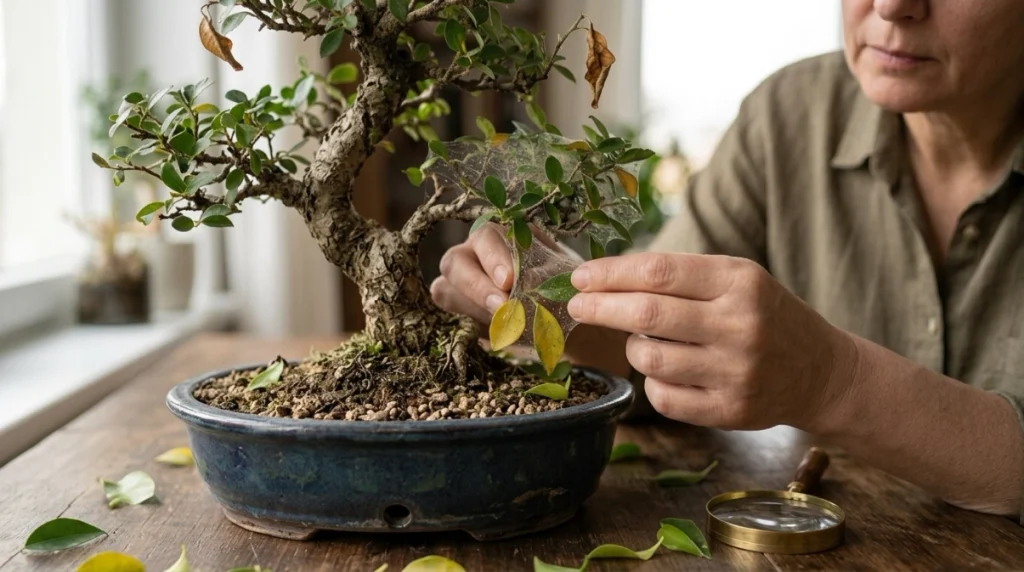
| What You See | Possible Cause | What to Check | First Action |
|---|---|---|---|
| Yellow, soft leaves and constantly wet soil | Overwatering/root stress | Drainage and soil moisture | Allow appropriate drying and improve drainage |
| Crisp leaves and very dry soil | Underwatering | Moisture throughout root ball | Water thoroughly |
| Leaf drop soon after moving the tree | Environmental shock | Light and temperature changes | Stabilize the growing location |
| Fine webbing and speckled foliage | Spider mites | Leaf undersides with magnifier | Isolate and identify infestation |
| Sticky foliage or small bumps | Scale/aphids/mealybugs | Stems and leaf joints | Isolate and treat confirmed pest |
| Yellowing plus weak growth in wet soil | Root rot | Drainage, odor, root condition | Reduce stress and investigate roots |
| Leaves fall after heavy feeding | Excess fertilizer/salt buildup | Recent fertilizer applications | Stop feeding temporarily |
| Healthy deciduous tree losing leaves in autumn | Seasonal dormancy | Species and season | Usually no treatment needed |
5. Root Rot May Be Developing
Root rot is more serious than ordinary temporary leaf drop.
Roots need both water and oxygen. When soil remains wet and poorly aerated, damaged roots may no longer supply the canopy properly.
This can result in:
- Yellowing foliage
- Wilting despite wet soil
- Sudden leaf drop
- Weak growth
- Branch dieback
- Dark or soft roots
- Unpleasant-smelling soil
Do not immediately perform a full repot on a badly stressed bonsai unless root failure makes it necessary. Major root work adds additional stress, especially outside the species’ normal repotting season.
For beginners, it is often safer to first check drainage, moisture, soil condition, and pest activity before disturbing the root system.
6. Too Much Fertilizer Can Cause Leaf Loss
When a bonsai looks weak, adding fertilizer may seem like an obvious solution. Sometimes it makes the situation worse.
Excess fertilizer can increase soluble salts around the roots and interfere with water uptake. A tree already stressed by damaged roots, drought, extreme heat, or pests may be especially vulnerable.
Possible clues include:
- Leaf tips turning brown
- Sudden yellowing
- Leaf drop following fertilization
- White mineral deposits on the soil or pot
- Weak roots
Do not fertilize a severely stressed bonsai simply to “give it energy.”
Wait until the primary problem is corrected and the tree shows signs of renewed growth.
7. The Tree May Not Be Receiving Enough Light
Light and watering are closely connected.
A bonsai moved from bright outdoor light to a darker indoor location uses water more slowly. If you continue watering at the previous rate, the soil may stay wet longer.
Tropical bonsai kept indoors can therefore develop both low-light stress and excessive soil moisture.
Conversely, suddenly moving a shade-acclimated tree into harsh direct sunlight can burn foliage.
Make lighting changes gradually whenever possible.
8. Temperature Stress Can Trigger Leaf Drop
Different bonsai species have very different temperature requirements.
A tropical ficus and a temperate Japanese maple should not be managed the same way.
Tropical bonsai may suffer when exposed to cold drafts or unexpectedly low temperatures. Temperate bonsai generally require a natural seasonal cycle and should not automatically be treated as permanent houseplants.
Before diagnosing the tree, identify the species.
Species suitability matters more than whether the plant was sold with an “indoor bonsai” label.
9. Some Leaf Loss Is Seasonal
Deciduous bonsai such as maples, elms, and hornbeams naturally shed their leaves as they enter dormancy.
That is very different from a tropical bonsai losing most of its foliage in the middle of active growth.
Some evergreen species also replace older foliage naturally, although the pattern differs from deciduous leaf drop.
Ask yourself:
- What species is the bonsai?
- Is it deciduous, tropical, or evergreen?
- What season is it?
- Are the branches and buds still healthy?
- Is the leaf loss happening uniformly or only on certain branches?
These questions can prevent unnecessary treatments.
How to Diagnose a Bonsai That Is Suddenly Losing Leaves
Avoid changing everything at once. Use a simple process.
Step 1: Identify the Bonsai Species
Determine whether you have a ficus, Chinese elm, juniper, maple, jade-type bonsai, or another species.
Species identification immediately narrows the list of possible problems.
Step 2: Check Soil Moisture
Feel below the surface rather than judging only by the top layer.
Determine whether the root area is:
- Very dry
- Slightly moist
- Consistently saturated
Also confirm that excess water can leave through the drainage holes.
Step 3: Review Recent Changes
Think back over the previous several weeks.
Consider changes in:
- Location
- Light
- Temperature
- Watering
- Fertilizer
- Repotting
- Pruning
- Weather
- Indoor heating or cooling
Step 4: Inspect for Pests
Use good lighting and, ideally, a 10× hand lens.
Check:
- Leaf tops
- Leaf undersides
- Branch forks
- Young shoots
- Bark
- Pot rim
- Soil surface
If you find pests, separate the affected bonsai from nearby plants immediately.
Step 5: Examine Branch Health
Healthy flexible twigs and viable buds are encouraging signs even when substantial foliage has fallen.
Do not repeatedly scratch healthy bark simply to check whether branches are alive. Unnecessary wounds create additional damage.
Step 6: Investigate the Roots Only When Necessary
If soil remains waterlogged, smells sour, growth is collapsing, or root rot is strongly suspected, a root assessment may be necessary.
A bonsai can also be wired securely into its pot, making casual removal risky.
If you are inexperienced with root work, this is a good point to ask a knowledgeable bonsai grower for help.
Expert Tip: When a bonsai suddenly loses leaves, change only what you can clearly identify as wrong. Simultaneously repotting, fertilizing, pruning, moving, and spraying the tree makes diagnosis harder and can compound the original stress.
What to Do If Pests Are Causing the Leaf Loss
First, confirm the pest.
For a light infestation, physical control may be enough to reduce the population. Depending on the species and pest, this can include removing heavily infested leaves or gently washing foliage.
More persistent infestations may require insecticidal soap, horticultural oil, or another labeled treatment appropriate for the plant and pest.
Never assume that stronger pesticide means better results.
The U.S. Environmental Protection Agency’s pesticide label guidance emphasizes following product directions for safe and effective use, including instructions related to application, storage, children, and pets.
When treating a bonsai:
- Identify the pest first.
- Confirm that the product is suitable for the plant and intended pest.
- Follow the label exactly.
- Avoid excessive application.
- Protect children and pets.
- Test sensitive foliage when appropriate.
- Repeat treatment only according to label instructions.
- Continue inspecting the bonsai afterward.
Some species are more sensitive to oils, soaps, or pesticide treatments than others, especially under high heat or strong sunlight.
Should You Repot a Bonsai That Is Losing Leaves?
Usually, not immediately.
Repotting is major work for a bonsai because roots are disturbed or pruned. A tree already suffering from environmental shock or a pest infestation may have less energy available for recovery.
Repotting becomes more reasonable when there is strong evidence of:
- Severe root rot
- Completely failed drainage
- Badly decomposed soil
- A serious root-zone problem that cannot be corrected otherwise
For an inexperienced grower, emergency repotting carries more risk than normal scheduled repotting.
Indoor vs Outdoor Bonsai Leaf Loss
Indoor and outdoor growing conditions create different diagnostic clues.
Indoor Tropical Bonsai
Common problems include:
- Insufficient light
- Heating vents
- Air-conditioning drafts
- Dry indoor air
- Spider mites
- Overwatering during slow winter growth
- Sudden relocation
Outdoor Bonsai
Common problems include:
- Extreme heat
- Strong drying winds
- Missed watering
- Frost injury
- Pest outbreaks
- Seasonal dormancy
- Poor drainage after prolonged rain
Never move an outdoor temperate bonsai permanently indoors just because it begins losing leaves in autumn. Natural dormancy is an important part of the life cycle of many temperate species.
Common Mistakes Bonsai Owners Should Avoid
- Watering according to a fixed calendar. Check the soil instead of automatically watering every day.
- Assuming every leaf drop problem is caused by pests. Environmental stress and root problems are extremely common.
- Spraying pesticide without identifying a pest. Unnecessary chemicals can damage foliage and complicate diagnosis.
- Fertilizing a severely stressed tree. Feeding does not correct rotten roots, mites, or incorrect light.
- Emergency repotting too quickly. Root work can further weaken an unstable bonsai.
- Changing multiple conditions simultaneously. You may never know what caused the problem.
- Ignoring species requirements. A juniper, ficus, maple, and jade-type bonsai have very different needs.
- Returning an infested tree to a collection too soon. Continue monitoring after treatment because pest populations can return.
When to Ask an Experienced Bonsai Grower or Arborist
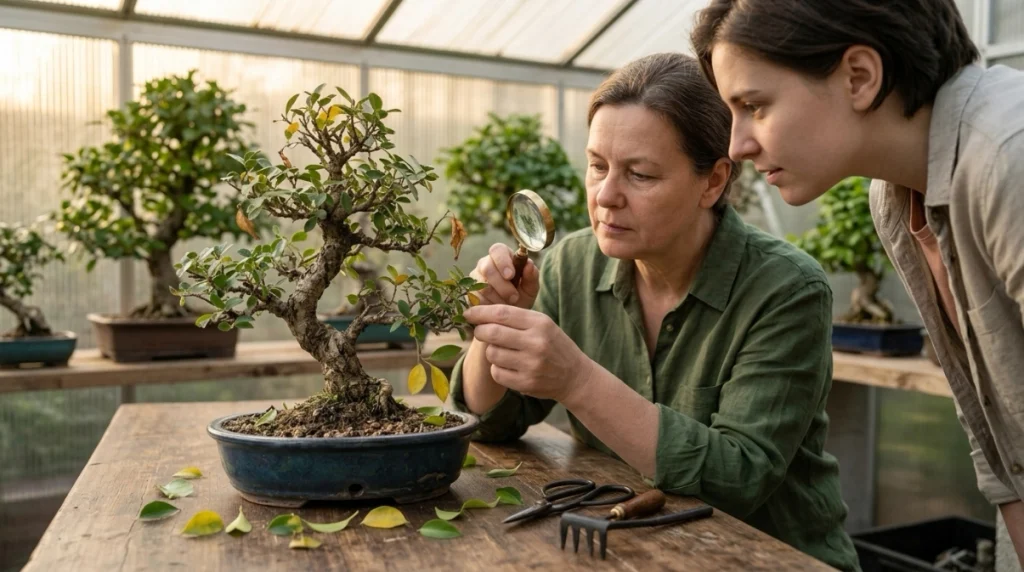
Some problems are difficult to diagnose from leaf symptoms alone.
Ask an experienced bonsai grower, local horticulture professional, plant diagnostic service, or qualified arborist when:
- Most foliage drops rapidly and the cause is unclear.
- Several branches begin dying.
- The trunk or major branches develop suspicious lesions.
- Roots appear black, soft, or severely decayed.
- The bonsai is valuable, old, or difficult to replace.
- You are unsure whether emergency root work is necessary.
- Pests keep returning despite correct treatment.
- Multiple trees develop the same symptoms.
- You cannot identify the bonsai species.
Professional or experienced help is especially worthwhile before major root pruning or structural work on a severely weakened tree.
FAQs
Why is my bonsai losing green leaves suddenly?
Green leaves can fall after abrupt changes in light, temperature, watering, or location. Some pests can also cause premature leaf loss. Review what changed recently and inspect the soil and foliage before treating the tree.
Can overwatering make a bonsai lose all its leaves?
Yes. Prolonged waterlogged conditions can damage roots and eventually cause extensive leaf loss. However, do not diagnose overwatering based on leaf loss alone. Check soil moisture, drainage, root-zone odor, and other symptoms.
Will my bonsai grow its leaves back?
Often it can if the branches, roots, and buds remain healthy and the original stress is corrected. Recovery time depends on the species, season, severity of damage, and cause of the leaf loss.
Should I fertilize a bonsai after it loses its leaves?
Usually not while the tree is severely stressed. Correct watering, light, temperature, pest, or root problems first. Resume appropriate feeding once the tree stabilizes and begins producing healthy new growth.
How can I tell if spider mites are causing bonsai leaf loss?
Look for fine webbing, pale stippling, yellow or bronze foliage, and tiny moving mites on the undersides of leaves. Tapping a branch over white paper can make small mites easier to notice.
Should I repot my bonsai if the leaves suddenly fall off?
Not automatically. Repotting adds stress and should generally be reserved for situations where there is strong evidence of root rot, failed drainage, decomposed soil, or another serious root-zone problem.
Is leaf loss normal after bringing a bonsai indoors?
It can be, particularly with some tropical species responding to reduced light, lower humidity, or a temperature change. However, heavy or continuing leaf loss should still prompt checks for improper watering, cold drafts, pests, and root problems.
Conclusion
If you are wondering “Why is my bonsai losing leaves suddenly?”, start with diagnosis rather than treatment. Check the species, soil moisture, drainage, recent environmental changes, temperature, light, and foliage for pests.
Overwatering, drought, environmental shock, root problems, excessive fertilizer, and pest infestations can all produce similar symptoms. That is why automatically watering more, fertilizing, repotting, or spraying pesticide can make matters worse.
Keep the tree’s environment stable, correct only confirmed problems, and watch for healthy buds or new growth. If severe leaf loss continues or root and branch health begin declining, get help from an experienced bonsai grower or plant professional before performing major work.
Your best next step is simple: inspect the bonsai carefully today, identify the most likely cause, and make the smallest corrective change needed to help the tree recover.
