Bonsai Care Cheat Sheet: Printable One-Page Guide


This post contains affiliate links. As an Amazon Associate, OurBonsai earns from qualifying purchases at no extra cost to you. Read our disclosure.
In this guide
- How to use this bonsai care cheat sheet
- Watering: the most important line on the sheet
- Light: put the tree where it can grow
- Feeding: little and often
- Pruning: keep the shape, keep it healthy
- Repotting: refresh the roots
- Wiring: shape, then remove
- Seasons and winter care
- Warning signs to watch for
- A simple daily, weekly and monthly routine
- Common mistakes the cheat sheet helps you avoid
- FAQ: bonsai care cheat sheet
- Final thoughts
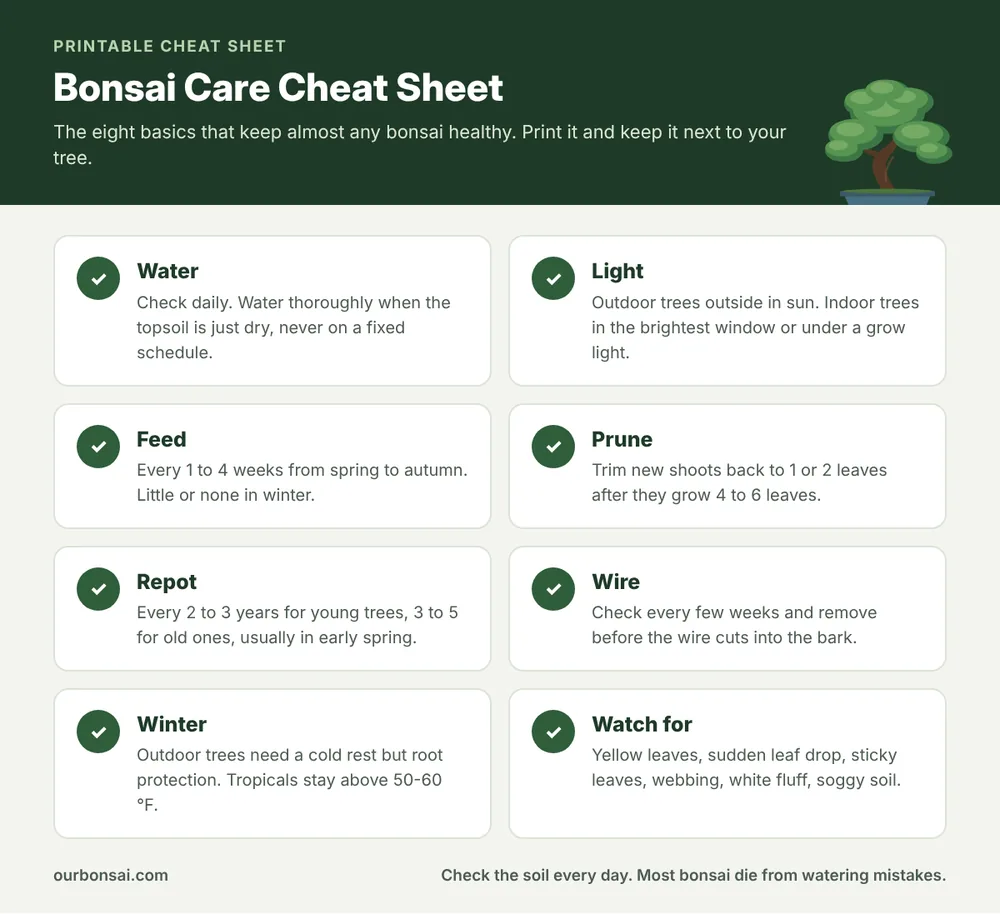
This bonsai care cheat sheet puts the essentials of keeping a bonsai alive and healthy on a single page. Bonsai care is not complicated, but it is easy to forget one basic, like checking the soil or protecting the roots in winter, and that is usually what kills a tree. Below you will find the printable sheet as an image, followed by a short explanation of each point so you know the reason behind every rule.
Print the infographic, pin it up near your tree and use the sections below when you need more detail. It works for the most common beginner trees, like Chinese elm, ficus, juniper, jade and Japanese maple. Where species differ, the sheet tells you what to check.
How to use this bonsai care cheat sheet
The cheat sheet is a reminder, not a rulebook. Every tree, pot and climate is a little different. Use the sheet to build habits: look at the tree and the soil every day, and adjust what you do to what you see. If you are completely new, our main bonsai care guide covers each topic in depth.
First, find out whether your tree is an indoor or outdoor species. This one fact changes most of the rules. Junipers, pines, maples and elms are outdoor trees that need seasons. Ficus, jade, schefflera and other tropicals can live indoors. If you are not sure what you have, our list of the most popular indoor bonsai trees and our guide to types of outdoor bonsai trees will help.
Watering: the most important line on the sheet
Check the soil every day. Push a finger about 1 cm into the soil. If it feels just dry, water. If it is still damp, wait. When you water, soak the whole pot until water runs out of the drainage holes, wait a minute and water again.
Never water on a fixed day of the week. Small pots can dry out in an afternoon in summer and stay damp for days in winter. A cheap soil moisture meter helps if you are unsure. In summer, read our guide to watering bonsai in summer.
Light: put the tree where it can grow
Outdoor species belong outside, in full sun or bright light with some afternoon shade in hot climates. Indoor species need the brightest spot you have, usually right next to a south or west facing window. A tree a few meters from the window is effectively in the dark. Our guide on how much light a bonsai tree needs explains how to judge it, and a LED grow light fills the gap in dark homes and winter.
Feeding: little and often
Bonsai soil holds very few nutrients, so feeding is not optional. Feed every one to four weeks from spring to early autumn, depending on the product. Liquid feeds are quick and easy. Slow-release pellets last longer. Stop or reduce feeding in winter for outdoor trees, and never feed a sick, dry or freshly repotted tree. Our article on bonsai fertilizer pellets or liquid helps you choose.
Pruning: keep the shape, keep it healthy
Let new shoots grow four to six leaves, then cut them back to one or two. This keeps the tree compact and makes it branch out. Bigger structural pruning is best done at the right time of year for each species. See when to start pruning bonsai for timing.
Repotting: refresh the roots
Young, fast-growing trees need repotting every two to three years, older trees every three to five years. Repot in early spring, just as the buds swell, for most species. Use a gritty, fast-draining bonsai soil, never regular potting soil. Our comparison of bonsai soil vs regular soil explains why.
Wiring: shape, then remove
Wire bends branches into position. Check wired trees every few weeks during the growing season. As soon as the wire starts to press into the bark, remove it by cutting, not unwinding. Leaving wire on too long leaves scars that take years to heal.
Seasons and winter care
| Season | Main jobs |
|---|---|
| Spring | Repot, start feeding, watch water needs rise |
| Summer | Water daily or more, trim shoots, give shade in heat waves |
| Autumn | Reduce feeding, prepare outdoor trees for winter |
| Winter | Protect roots of outdoor trees from hard frost, keep tropicals warm and bright |
Outdoor species need a cold rest in winter. Keeping a juniper or maple indoors all winter weakens it and often kills it. Protect the pot from deep frost by placing it on the ground in a sheltered spot. Tropical species should stay above about 50 to 60 °F (10 to 15 °C).
Warning signs to watch for
The last line of the cheat sheet lists early warning signs. Catching them early makes most problems easy to fix:
- Yellow leaves: often overwatering or hunger. See bonsai leaves turning yellow or brown.
- Sudden leaf drop: a change in light, temperature or watering. See why a bonsai loses leaves suddenly.
- Sticky leaves: sap-sucking insects like aphids or scale.
- Fine webbing: spider mites.
- White fluff: mealybugs.
- Soil that never dries: poor drainage and a risk of root rot.
For a broader overview of pests and diseases, the bonsai pests and diseases guide is a good starting point. If you want an outside reference, the Wikipedia article on bonsai cultivation and care gives a good overview of the traditional techniques behind each rule.
A simple daily, weekly and monthly routine
The cheat sheet becomes much easier to follow when you turn it into a routine. Here is a rhythm that works for most beginners:
Every day (1 minute): check the soil moisture and water if needed. Glance at the leaves for wilting, yellowing or anything new. In hot weather, check again in the late afternoon.
Every week (5 minutes): turn the tree a quarter turn if it grows toward the window, so all sides get light. Look under a few leaves for pests. Remove dead leaves from the soil surface, because they can harbor fungus and insects.
Every two to four weeks (growing season): feed the tree. Trim shoots that have grown long. Check any wire to make sure it is not cutting in.
Every spring: check whether the roots have filled the pot. If roots circle the inside of the pot or water runs straight through without soaking in, plan a repot. This is also the time to do bigger pruning on most species.
Every autumn: slow down feeding, and plan where your outdoor trees will spend the winter.
Writing these dates on a calendar, or setting a phone reminder, is the easiest way to make sure nothing gets missed during busy weeks.
Common mistakes the cheat sheet helps you avoid
- Watering every few days on a schedule instead of checking the soil
- Keeping an outdoor tree indoors as a houseplant
- Using regular potting soil that stays wet
- Forgetting to feed, then overfeeding a weak tree
- Leaving wire on until it scars the branches
- Repotting at the wrong time of year
FAQ: bonsai care cheat sheet
How often should I water my bonsai?
As often as the soil needs it. Check daily and water when the topsoil is just dry. That can be daily in summer and every few days in winter.
Can I print this bonsai care cheat sheet?
Yes. Open the infographic above, save it and print it on a standard sheet of paper. It is designed to be readable on a single page.
Does this cheat sheet work for indoor and outdoor bonsai?
Yes. The basics are the same. The main differences are light and winter care, which the sheet points out.
What is the most important bonsai care rule?
Watering correctly. More bonsai die from soil that was too dry or too wet than from any other cause.
Final thoughts
A bonsai care cheat sheet is not a substitute for watching your tree, but it keeps the basics in front of you every day. Water by checking, give the tree the right light, feed regularly, prune and repot at the right time and respect the seasons. Do those things consistently and your bonsai has every chance of living for decades.