How to Wire Bonsai Trees: Beginner Guide (Step by Step)


This post contains affiliate links. As an Amazon Associate, OurBonsai earns from qualifying purchases at no extra cost to you. Read our disclosure.
In this guide
Wiring is the technique that turns a bushy little tree into something that looks old and windswept. If you want to know how to wire bonsai, the basic idea is simple: you wrap a soft metal wire around the trunk or a branch, then gently bend it into a new position. The wire holds the shape while the branch thickens and sets, usually over a few months. Then you remove it.
Doing it well takes a little practice. Wire that is too thin will not hold, wire that is too tight will scar the bark, and a branch bent too fast can crack. This step-by-step guide walks you through choosing the wire, wrapping it correctly, bending safely and knowing when to take it off.
What you need to wire a bonsai
- Bonsai training wire in two or three sizes. Most beginners start with anodized aluminum bonsai wire in 1 mm, 2 mm and 3 mm.
- Wire cutters made for bonsai. They cut close to the bark without damaging it. Regular pliers crush the wire and can catch the bark. Our Japanese bonsai tool kit guide covers cutters worth buying.
- Small pliers (optional) to tighten the wire ends.
- Raffia or tape (optional) to protect thick branches before strong bends.
Aluminum or copper wire: which should you use?
| Wire | Best for | Pros | Cons |
|---|---|---|---|
| Anodized aluminum | Beginners, broadleaf trees such as ficus, elm, maple, azalea | Soft, easy to bend, reusable, hard to over-tighten | You need a thicker gauge to hold the same branch |
| Annealed copper | Conifers such as junipers and pines | Holds much better at a thinner gauge, looks discreet | Harder to apply, hardens once bent, easier to scar bark |
If you are new to wiring, start with aluminum on every tree. It is forgiving and you can practice on cheap nursery plants first. Our separate guide to bonsai wire sizes and uses explains gauges in more detail.
When is the best time to wire a bonsai?
- Deciduous trees (maples, elms): late winter to early spring before the buds open, when you can see the branch structure clearly. Some growers also wire after the spring flush has hardened.
- Conifers (junipers, pines): late autumn through winter, when growth has slowed and the branches are less likely to be damaged by fast thickening.
- Tropical indoor trees (ficus, Fukien tea): almost any time they are healthy and growing.
Avoid heavy wiring right after repotting or a hard pruning. Give a stressed tree time to recover first. If you are still deciding what to cut before you wire, read when to start pruning bonsai.
How to wire bonsai step by step
Step 1: Water the tree the day before
Well-watered branches are more flexible. Dry branches snap more easily. Do not wire right after a big watering, though, because wet soil makes the tree easy to rock in the pot.
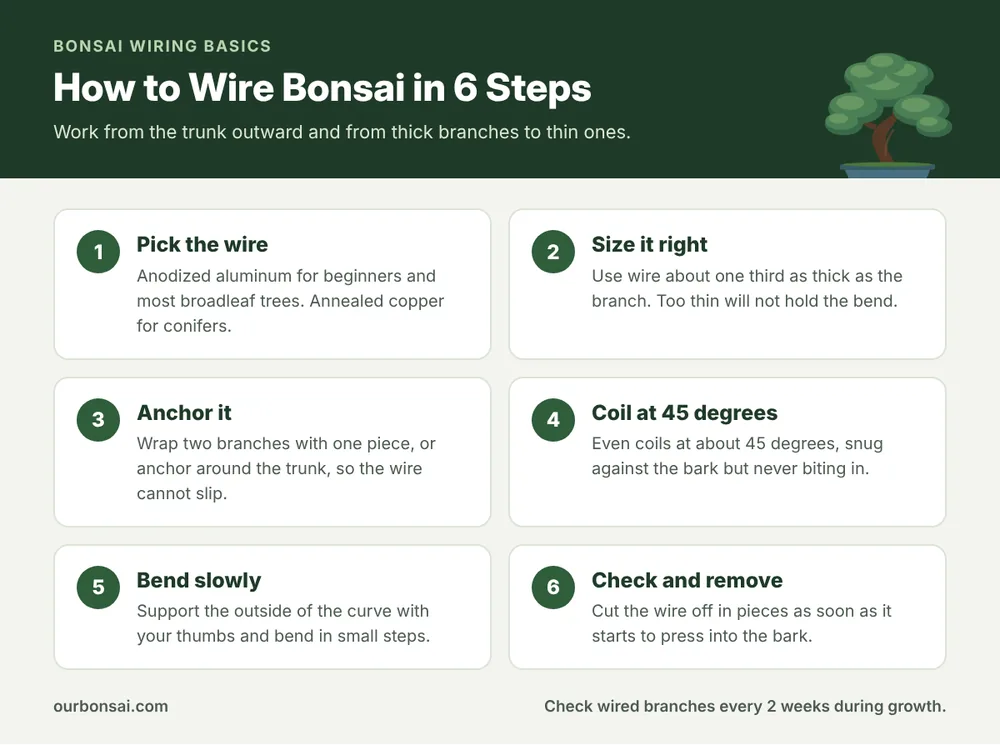
Step 2: Pick the right wire thickness
A good rule of thumb is that the wire should be about one third as thick as the branch you are bending. Test it by wrapping a short length and gently bending. If the branch springs back, go one size thicker. For a very stiff branch, you can use two wires side by side.
Step 3: Cut the wire to length
Cut a piece about one and a half times the length of the branch. It is easier to trim extra wire at the end than to run short halfway along a branch.
Step 4: Anchor the wire
A wire only holds a bend if it is anchored. The best way is to wire two branches of similar thickness with one piece. Start the wire around the trunk between them, then run one end out along each branch. When there is no second branch nearby, anchor the wire by wrapping it twice around the trunk before running it out along the branch.
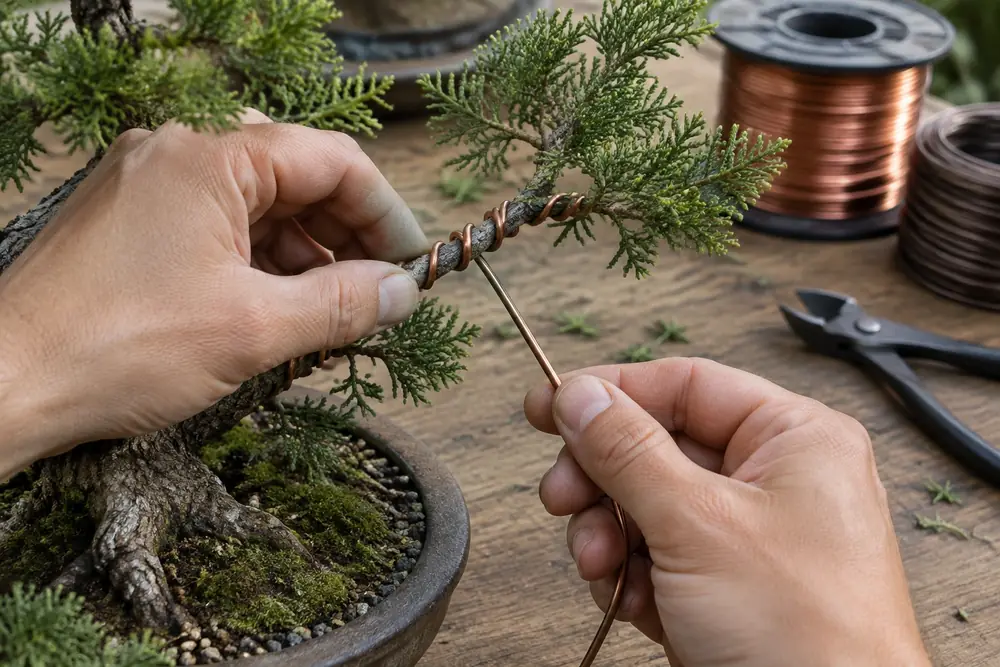
Step 5: Wrap at a 45 degree angle
Wrap the wire around the branch at about 45 degrees, working from the thick end toward the tip. Keep the coils evenly spaced and snug against the bark, but not tight. You should be able to slide a fingernail under the wire. Avoid trapping leaves or needles under the coils, and do not cross wires over each other.
Tip: if you plan to bend a branch down, the wire should pass under the branch on the outside of the bend, so it supports the curve and stops it cracking.
Step 6: Bend slowly
Hold the branch with both hands and place your thumbs on the outside of the curve you want to make. Bend gradually, a little at a time. Listen and feel for small cracking sounds; if you hear one, stop. For thick branches, wrap them with damp raffia first.
Step 7: Aftercare
Keep the tree out of strong afternoon sun and wind for a week or two, and do not fertilize heavily straight away. Normal watering continues as usual. The basics of daily care are in our bonsai care guide.
When to remove bonsai wire
Wire stays on until the branch holds its new position, which can take anywhere from a few weeks on fast-growing trees in summer to six months or more on slow conifers. Check every two weeks during the growing season. As soon as the wire starts to press into the bark, it has to come off, even if the branch has not fully set. You can always rewire it later.
To remove wire, cut it off in small pieces with wire cutters. Do not unwind it. Unwinding pulls on the bark and can snap the branch you just shaped. Marks left by wire that cut in too deep are called wire bite. On smooth-barked trees such as maples they can take years to heal, so it is worth checking often.
Common bonsai wiring mistakes
- Wire too thin so the branch springs back after a few days.
- Coils too close together (less than 45 degrees), which weakens the hold.
- Coils too far apart, which gives an uneven bend and can kink the branch.
- Wire too tight, cutting into the bark as the branch grows.
- No anchor, so the wire just slides around the branch.
- Leaving wire on too long, especially in spring and summer when branches thicken fast.
Which trees are easiest to wire for practice?
Junipers are the classic beginner tree for wiring because their branches are flexible and they recover well. See our juniper bonsai styles for beginners for ideas on shapes to aim for. Ficus and Chinese elm are also forgiving. Trees with brittle branches, such as azaleas, need very gentle bends. The wiring and shaping section of Wikipedia’s bonsai care article gives a good overview of how the technique developed.
FAQ: how to wire bonsai
How long do you leave wire on a bonsai?
Usually between a few weeks and six months, depending on the species and the season. Check every two weeks and remove the wire as soon as it starts to cut into the bark.
Can I use regular garden wire for bonsai?
It is not recommended. Steel garden wire is too stiff and often coated or galvanized, which can damage bark. Bonsai aluminum or copper wire is soft and made for the job.
Should beginners use aluminum or copper wire?
Aluminum. It is softer, cheaper, easier to adjust and harder to over-tighten. Move to copper later for conifers once you are comfortable.
Can you wire a bonsai in summer?
Yes for many trees, but branches thicken fast in summer, so the wire bites in sooner. Check wired trees every week in hot weather.
Final thoughts
Now you know how to wire bonsai: pick the right wire, size it to the branch, anchor it, wrap at 45 degrees, bend slowly, and cut it off before it bites. Practice on a cheap nursery plant first, and within a few sessions your coils will look neat and your bends will hold.