Best Outdoor Bonsai Display Ideas | Most Popular Bonsai Style


Quick answer: the best outdoor bonsai displays raise trees to about eye level on a bench, shelf or pedestal, give them the right amount of sun, leave space between pots for air, and set them against a plain background such as a fence or bamboo screen. For small spaces, use tiered stands or wall shelves. For large gardens, try a gravel bed with pedestals, a rock garden or a dedicated bonsai bench area.
In this guide
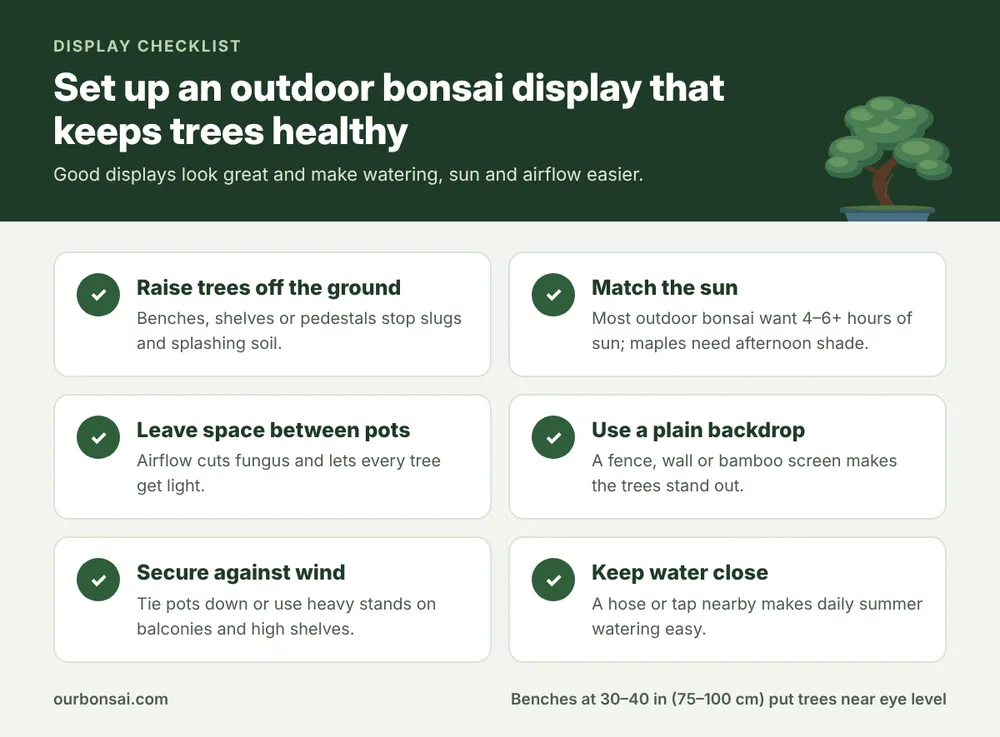
A good display is not just decoration. It keeps trees off the ground away from slugs and splashing soil, makes daily watering easier and lets you see each tree properly. Below are 15 practical ideas for small, large and DIY setups, plus where to place your bonsai and which style is most popular.
Outdoor bonsai display ideas for small spaces
Balconies, patios and small yards need displays that use height and keep pots secure.
1. Tiered display stand
A stepped stand holds several trees in a small footprint, with the tallest at the back so each tree gets light. Metal or treated wood lasts longest outdoors.
2. Wall-mounted shelves
Sturdy shelves on a sunny wall turn an empty surface into a display. Choose deep shelves (at least 10 in / 25 cm) and add a lip or tie-down point so pots cannot blow off.
3. Single pedestal or stone column
One good tree on a pedestal makes a strong focal point by a door or at the end of a path. A flat stone, a log round or a concrete block all work.
4. Railing planters and balcony shelves
On a balcony, use railing-mounted shelves rated for the weight of wet pots. Check the wind; high balconies dry trees out quickly.
5. Rolling plant trolley
A trolley lets you move trees into shade on hot days or under cover in winter. It is useful if your sun changes through the year.

Outdoor bonsai display ideas for large gardens
6. Classic bonsai benches
Long benches at about 30–40 in (75–100 cm) high are what most bonsai nurseries use. They are easy to water, easy to work at and keep trees clear of pests.
7. Gravel bed with pedestals
Lay gravel or crushed stone and set trees on posts or stone blocks of different heights. The gravel drains well, reduces weeds and looks calm and clean.
8. Rock garden setting
Place bonsai among rocks and low ground cover to suggest a mountain landscape. Keep the pots raised on flat stones so roots and drainage holes stay clear.
9. Display near a water feature
A small pond or fountain adds sound and humidity. Keep trees far enough away that pots do not sit in constant splashes.
10. Pergola, gazebo or shade structure
A pergola with shade cloth protects maples and azaleas from hot afternoon sun. Keep the sun lovers, such as junipers and pines, outside it.

DIY outdoor bonsai display ideas
11. Cinder block and plank bench
Stack concrete blocks and lay treated boards across them. It costs very little and is stable in wind.
12. Pallet shelf
A sanded, sealed wooden pallet can stand upright as a shelf for small trees. Check that it is heat-treated (marked HT), not chemically treated.
13. Bamboo screen backdrop
A roll of bamboo fencing behind a bench hides a busy background and gives a Japanese feel.
14. Log rounds and tree stumps
Thick log slices make natural pedestals. Seal the top and put a tile under the pot so the wood does not rot.
15. Turntable on the bench
A small turntable lets you rotate a tree for even sun and view it from every side while working. See our bonsai turntable review.
If you prefer a ready-made stand, compare options in our guide to the best outdoor bonsai plant stands.

How to display a bonsai tree outdoors
- Height: place trees at chest to eye level so you see the trunk and branch structure, not just the top.
- Spacing: leave a gap between trees so air can move and each tree gets light from several sides.
- Background: a plain wall, fence or screen helps the outline of each tree stand out.
- Grouping: group trees by need: sun lovers like juniper and pine together, shade lovers like maple together.
- Accents: a small companion plant or stone beside a tree is a traditional Japanese touch; keep it simple.
- Lighting: low solar or LED garden lights pointed up at a tree look great in the evening.
Where should I put my bonsai tree outside?
| Factor | What to aim for |
|---|---|
| Sun | Most outdoor bonsai need 4–6+ hours of direct sun; junipers and pines want more. Maples and azaleas prefer morning sun and afternoon shade. See how much light a bonsai needs. |
| Wind | Some airflow is good; strong wind dries pots fast and knocks trees over. Use a fence or hedge as a windbreak. |
| Water | Keep a tap or hose close. In hot weather small pots may need water once or twice a day: see watering bonsai in summer. |
| Height | Off the ground on a bench or stand, away from slugs, ants and soil splash. |
| Winter | Hardy trees still need root protection in pots. Move them to a sheltered spot, cold frame or unheated shed in hard frost. |
For a room-by-room and yard-by-yard guide, read the best place for a bonsai tree. If you are still choosing species that live outside, see our types of outdoor bonsai trees.

What is the most popular bonsai style?
The most popular bonsai style is informal upright (moyogi), with a trunk that curves gently as it rises and branches arranged in layers. It looks natural, suits most species and is the easiest style for beginners. Other common styles are formal upright (chokkan), slanting (shakan), cascade (kengai) and broom (hokidachi). Learn them step by step in bonsai styles for beginners, or read about the art’s background in the history of bonsai in Japan. For the classic style names, see bonsai on Wikipedia.
Frequently asked questions
How high should a bonsai bench be?
About 30–40 in (75–100 cm) works for most people. It puts trees near eye level when you stand and is comfortable for pruning and watering.
Can I put bonsai directly on the ground?
It is better not to. Pots on the ground attract slugs and ants, roots can grow out of the drainage holes into the soil, and trees are hard to see.
How do I stop bonsai from blowing over?
Tie the pot to the bench or shelf with wire or a strap through the drainage holes or around the pot, and use heavy, stable stands on balconies.
Should outdoor bonsai be covered in winter?
Hardy trees should stay outdoors for their winter rest, but protect the roots from hard frost by moving pots to a sheltered spot, mulching around them or using a cold frame.
Conclusion
The best outdoor bonsai display is one that works for the trees first: raised off the ground, with the right sun, good airflow and water close by. Start with a simple bench or tiered stand, add a plain background, and arrange trees by height and light needs. Then build on it with pedestals, gravel or a rock garden as your collection grows.