Best Soil for Brazilian Rain Tree Bonsai: Recipe and Ratios

This post contains affiliate links. As an Amazon Associate, OurBonsai earns from qualifying purchases at no extra cost to you. Read our disclosure.
In this guide
- What Brazilian rain tree roots need from soil
- Best soil for Brazilian rain tree bonsai: 3 recipes
- What each ingredient does
- Particle size and sifting
- Soil pH for Brazilian rain tree bonsai
- When and how to repot a Brazilian rain tree bonsai
- Common soil mistakes with Brazilian rain trees
- FAQ: best soil for Brazilian rain tree bonsai
- Final thoughts
The best soil for Brazilian rain tree bonsai is a gritty, fast-draining mix that still holds enough moisture to keep the roots evenly damp. In practice that means a blend of akadama, pumice and lava rock, roughly 2:1:1, with the dust sifted out. This tree drinks a lot of water and drops leaflets quickly if it dries out, but it also suffers in soggy soil. The right soil lets you water generously without drowning the roots.
The Brazilian rain tree (Pithecellobium tortum, also listed as Chloroleucon tortum) is a tropical legume from Brazil. It is popular as an indoor bonsai because of its fine, feathery leaves, twisting trunk and the way its leaves fold up at night or in dark, rainy weather. Below you will find simple soil recipes, what each ingredient does, and how to repot without stressing the tree.
What Brazilian rain tree roots need from soil
Rain tree roots are fine and fast growing. They need three things from the soil:
- Air. Roots need oxygen. Compact soil that stays wet leads to yellow leaves, leaf drop and root rot.
- Steady moisture. This species has a high water demand, especially in warm, bright conditions. If the soil dries out, the leaflets fold, yellow and fall within days.
- Free drainage. Excess water must run straight out of the pot so you can water deeply without flooding the roots.
Bonsai soil does all three by using small, porous particles. Water clings to and soaks into the particles, while the gaps between them stay open for air. You can read why this beats ordinary potting soil in our comparison of bonsai soil vs regular soil.
Best soil for Brazilian rain tree bonsai: 3 recipes
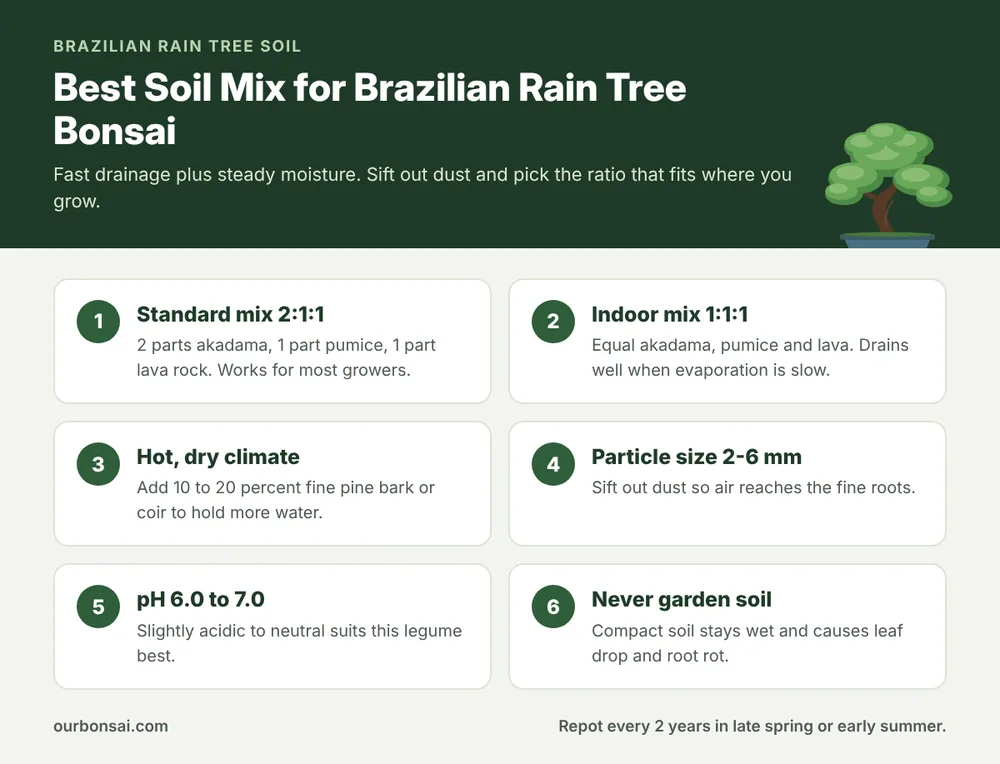
Standard mix (most growers)
- 2 parts akadama
- 1 part pumice
- 1 part lava rock
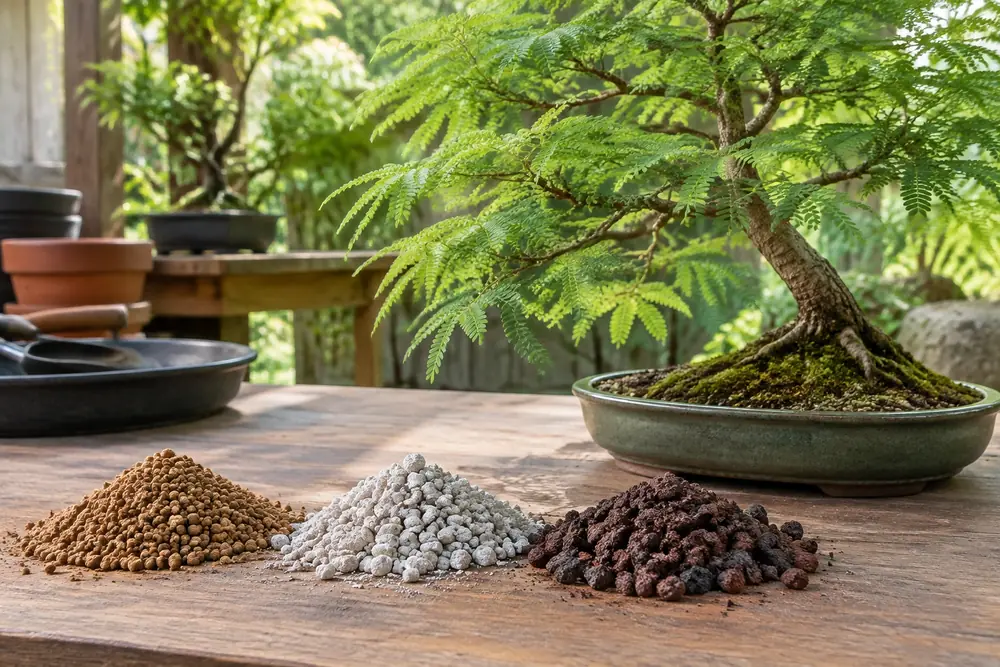
This is a classic, balanced mix. Akadama holds water and nutrients, pumice adds air and holds moisture, and lava rock keeps the structure open and helps roots branch. It suits a rain tree kept indoors in a bright window in summer or outdoors in warm months.
Indoor mix (slower drying)
- 1 part akadama
- 1 part pumice
- 1 part lava rock
Indoors, soil dries more slowly because there is less wind and sun. A slightly more open mix prevents the roots from staying wet too long, especially in winter when growth slows.
Hot, dry climate mix
- 2 parts akadama
- 1 part pumice
- 1 part lava rock
- 10 to 20 percent fine composted pine bark or coir
If your tree sits outdoors in strong sun or you cannot water more than once a day, a little organic material helps the soil hold more water between waterings.
What each ingredient does
| Ingredient | Role in the mix | Notes |
|---|---|---|
| Akadama | Holds water and nutrients, easy for fine roots | Breaks down over 2 to 3 years, so repot regularly |
| Pumice | Light, porous, holds water inside, adds air | Does not break down |
| Lava rock | Rough, open structure, very free draining | Encourages fine branching roots |
| Pine bark (optional) | Holds extra moisture, slightly acidic | Use small amounts only |
Akadama is a granular Japanese clay used in bonsai for centuries. The Wikipedia article on akadama explains how it is mined and why it is so popular. If you prefer a ready-made option, a pre-sifted akadama pumice lava bonsai soil mix saves you the work. Our reviews of premium bonsai soil and the Bonsai Jack gritty mix look at two popular blends, and our guide to bonsai soil mix ratios shows how to adjust a mix for any tree.
Particle size and sifting
Use particles roughly 2 to 6 mm across for small and medium trees. Always sift out the fine dust before use. Dust fills the gaps between particles and turns a good mix into a dense, wet one. A simple set of bonsai soil sieves does the job in a few minutes.
For shallow pots, use the smaller end of the range. For larger training pots, use slightly bigger particles in the bottom layer for drainage.
Soil pH for Brazilian rain tree bonsai
Rain trees grow well in slightly acidic to neutral soil, about pH 6.0 to 7.0. A standard akadama, pumice and lava mix sits right in this range. You do not need to adjust it unless your tap water is very hard. If white crust builds up on the soil and pot, flush the soil with rain water or filtered water now and then.
When and how to repot a Brazilian rain tree bonsai
Brazilian rain trees grow quickly and fill their pots with roots. Repot young trees every one to two years and older trees every two to three years. The best time is late spring or early summer, when temperatures are warm and the tree is growing strongly. As with other tropicals, our guide on the best time to repot tropical bonsai explains why warmth matters.
- Water the tree the day before so the roots are hydrated.
- Lift the tree and comb out the old soil from the outside of the root ball with a root hook or chopstick.
- Trim long and circling roots, removing no more than about a third of the root mass.
- Add a thin drainage layer of larger particles, then a layer of fresh mix.
- Set the tree, tie it in with wire through the drainage holes, and work the new soil in around the roots with a chopstick.
- Water thoroughly until the water runs clear.
- Keep the tree in warm, bright, indirect light for two to three weeks, and do not feed for about a month.
Keep the tree away from cold drafts after repotting. Rain trees dislike temperatures below about 60 °F (15 °C), and cold roots recover very slowly.
Common soil mistakes with Brazilian rain trees
- Using regular potting soil. It stays wet in the middle of the pot and leads to yellow leaves and root rot.
- Not sifting. Dust clogs the mix and blocks air.
- Too much organic matter. A little bark helps in hot climates, but a mostly organic mix stays soggy indoors.
- Never repotting. Akadama breaks down into mud over time and roots fill the pot, so water stops soaking in.
- Repotting in winter. Cold, slow-growing roots struggle to recover.
If your tree already shows leaf drop and the soil stays wet for days, check the roots for rot. Our guide to root rot in bonsai walks you through it.
FAQ: best soil for Brazilian rain tree bonsai
Can I use cactus soil for a Brazilian rain tree bonsai?
Cactus soil drains better than potting soil but often contains a lot of peat and fine sand. It is better than nothing as a short-term fix, but a gritty bonsai mix is far better.
Is akadama necessary for a rain tree?
No. A mix of pumice and lava with some fine bark also works. Akadama just makes watering more forgiving and helps fine roots develop.
How often should I repot my Brazilian rain tree bonsai?
Every one to two years for young, vigorous trees and every two to three years for mature ones, in late spring or early summer.
Does the soil affect leaf folding?
Indirectly. Leaflets fold at night and in low light naturally, but they also fold and drop when the roots are too dry or too wet. Good soil helps keep moisture even.
Final thoughts
The best soil for Brazilian rain tree bonsai is a sifted, gritty mix of akadama, pumice and lava rock, about 2:1:1, adjusted to be more open indoors or a little more water-retentive in hot climates. It lets you water this thirsty tropical deeply and often without risking root rot. For more on tropical species and their needs, see our overview of tropical bonsai species.