Bonsai for Beginners: How to Start Your First Tree

This post contains affiliate links. As an Amazon Associate, OurBonsai earns from qualifying purchases at no extra cost to you. Read our disclosure.
In this guide
Bonsai for beginners does not have to be hard. The art has a reputation for being difficult and mysterious, but keeping a first bonsai alive and healthy comes down to a few basic habits: choose a forgiving species, put it in the right place, water it correctly and feed it during the growing season. The shaping, wiring and styling can come later, once the tree is thriving.
This guide walks you through starting your first tree step by step, from picking a species to the first year of care. It is written for complete beginners, so there is no jargon you need to know in advance.
What is bonsai, really?
Bonsai is the practice of growing a normal tree or shrub in a small container and shaping it so it looks like a miniature version of a mature tree in nature. A bonsai is not a special dwarf species. It is the same tree you would find in a garden or forest, kept small by pruning and root work. The practice comes from Japan, with roots in Chinese penjing. The Wikipedia article on bonsai gives a good overview of its history, and our article on the history of bonsai trees in Japan goes deeper.
The most important thing to understand as a beginner is that a bonsai is a living tree with the same needs as its full-size relatives: light, water, air, nutrients and the right seasons.
Bonsai for beginners: choosing your first tree
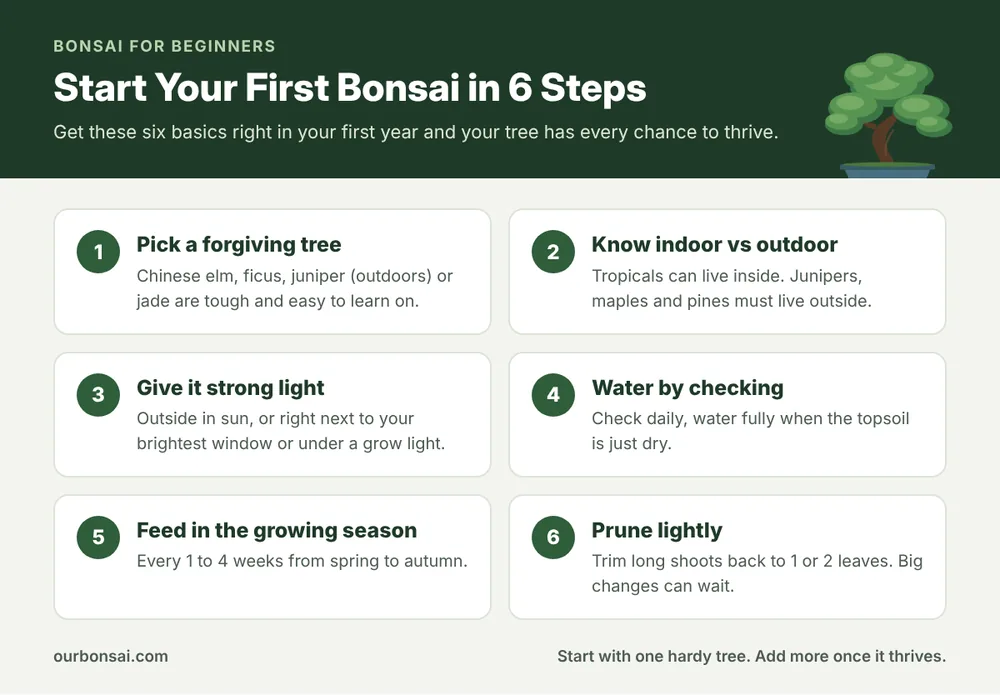
Pick a species that forgives mistakes. Good first trees are:
- Chinese elm: tough, fast to recover, can live indoors or outdoors in mild climates. See our Chinese elm bonsai care guide.
- Ficus: the classic indoor bonsai. Tolerates low humidity and some missed waterings.
- Juniper: very hardy, but must live outdoors. Never keep it indoors.
- Jade: a succulent that stores water in its leaves, ideal if you tend to forget watering.
- Dwarf schefflera: an easy indoor tropical that handles lower light better than most.
Our list of the best low maintenance bonsai trees for beginners compares these and a few more.
Nursery tree, pre-made bonsai or seeds?
For your first tree, buy a young pre-made bonsai or a nursery plant. Growing from seed takes years before you have anything to shape, and many beginners lose interest. Kits are fun as a side project, but start with a living tree you can care for right away.
Indoor or outdoor: the most important decision
Most bonsai are outdoor trees. Junipers, pines, maples, elms and azaleas need sun, fresh air and a cold winter rest. Indoors, they slowly decline and usually die. Only tropical and subtropical species, like ficus, jade, schefflera and Fukien tea, can live indoors all year.
So decide where your tree will live before you buy it. If you only have space indoors, choose a tropical species. Our guide to the best place for a bonsai tree explains how to pick the right spot in your home or garden.
The four basic care skills
1. Light
Bonsai need much more light than most houseplants. Outdoors, give them full sun or bright light with some afternoon shade in hot summers. Indoors, place them right next to your brightest window. If that is not enough, especially in winter, use a grow light. Our guide on how much light a bonsai tree needs explains how to judge it.
2. Watering
Never water on a fixed schedule. Check the soil every day by pushing a finger about 1 cm into it. When it feels just dry, water the whole pot until water runs from the drainage holes. Wait a minute and water again. This is the single most important skill in bonsai.
3. Soil
Bonsai grow in gritty, fast-draining soil, not ordinary potting soil. Good bonsai soil lets water through quickly while keeping air around the roots. Our comparison of bonsai soil vs regular soil explains why it matters. If your tree came in dense, muddy soil, plan to repot it into a proper mix in spring.
4. Feeding
Because bonsai soil holds few nutrients, regular feeding is essential. Feed every one to four weeks from spring to autumn with a bonsai fertilizer. A balanced liquid bonsai fertilizer is the simplest option for beginners. Reduce feeding in winter.
How to pick a healthy first bonsai
Whether you buy online or in a garden center, a few quick checks help you avoid a tree that is already in trouble:
- Leaves: they should be firm and evenly colored, without lots of yellow, brown or sticky spots. A few old inner leaves dropping is normal.
- Soil: it should not smell sour or look slimy. Avoid trees with rocks glued onto the soil surface, because the glue blocks water and air.
- Trunk: the tree should sit firmly in the pot and not wobble. A loose tree may have damaged roots.
- Pests: look under a few leaves and along the stems for webs, white fluff or small bumps.
- Label: check the species name so you know whether it is an indoor or outdoor tree.
When a new tree arrives, unpack it right away, water it if the soil is dry and put it in its permanent spot. Give it a few weeks to settle before doing any pruning or repotting.
Your first tools
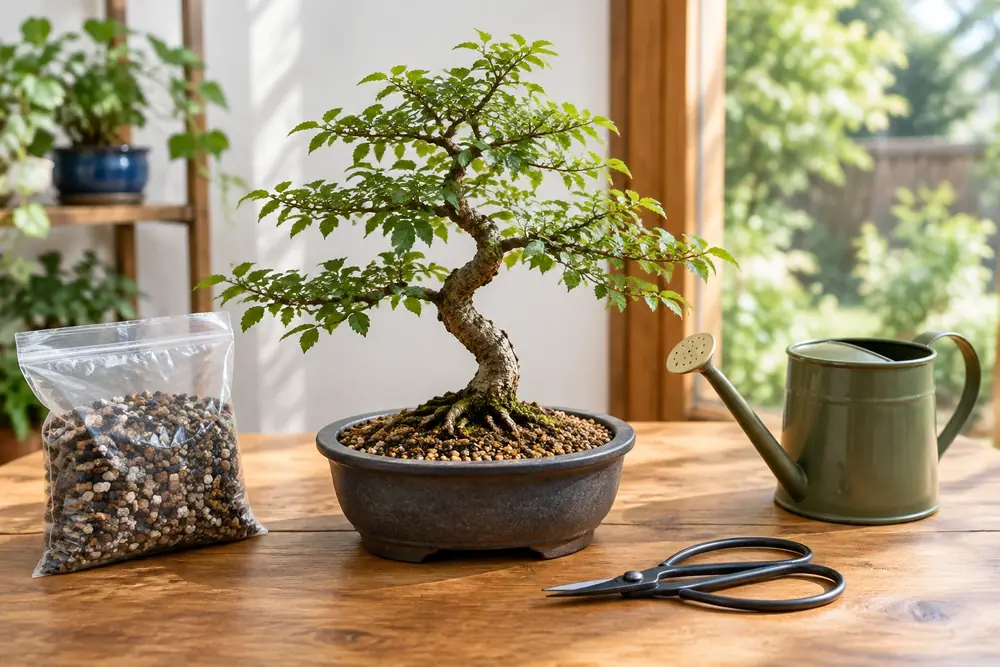
You need very little to start:
- A pair of sharp bonsai scissors
- A watering can with a fine rose
- A bag of bonsai soil for your first repotting
- A chopstick for checking soil moisture and working in new soil
Concave cutters, wire and root hooks can come later. Our guide on what tools are needed for a bonsai garden covers what to add as you progress, and our best bonsai pruning shears for beginners picks are a good first purchase.
Your first year: a simple plan
| Time | What to do |
|---|---|
| First weeks | Find the right spot, learn the watering rhythm, do not repot or prune hard |
| Spring | Repot into bonsai soil if needed, start feeding |
| Summer | Water daily if needed, trim long shoots back to 1 or 2 leaves |
| Autumn | Reduce feeding, prepare outdoor trees for winter |
| Winter | Protect outdoor tree roots from deep frost, keep indoor trees bright |
The goal of your first year is a healthy, growing tree, not a finished masterpiece. Once you see strong new growth, you can start to learn styling and wiring.
Common beginner mistakes
- Keeping an outdoor species indoors
- Watering on a schedule instead of checking the soil
- Putting the tree in a dark corner as decoration
- Never feeding the tree
- Repotting, pruning and wiring all at once
- Leaving glued rocks on the soil surface of a store-bought tree
FAQ: bonsai for beginners
What is the easiest bonsai for beginners?
Chinese elm and ficus are the easiest for most people. Jade is great if you tend to underwater. Juniper is easy if you can keep it outdoors.
How much time does a bonsai take each day?
A minute or two to check the soil and water. Pruning and other work happens a few times a year and takes minutes.
Can a beginner keep a bonsai indoors?
Yes, if it is a tropical species like ficus, jade or schefflera, and it gets plenty of light near a window or under a grow light.
When should I start shaping my first bonsai?
Once it is healthy and growing well, usually after a few months. Start with light pruning, then try wiring in your second year.
Final thoughts
Bonsai for beginners is really about learning to care for a tree in a pot. Choose a forgiving species, put it in the right place, water by checking the soil, use good bonsai soil and feed it through the growing season. Get those basics right and you will have a healthy tree ready for styling. For the full care routine, see our main bonsai care guide.