Bonsai Wire Bite: How to Prevent and Fix Wire Scars

This post contains affiliate links. As an Amazon Associate, OurBonsai earns from qualifying purchases at no extra cost to you. Read our disclosure.
In this guide
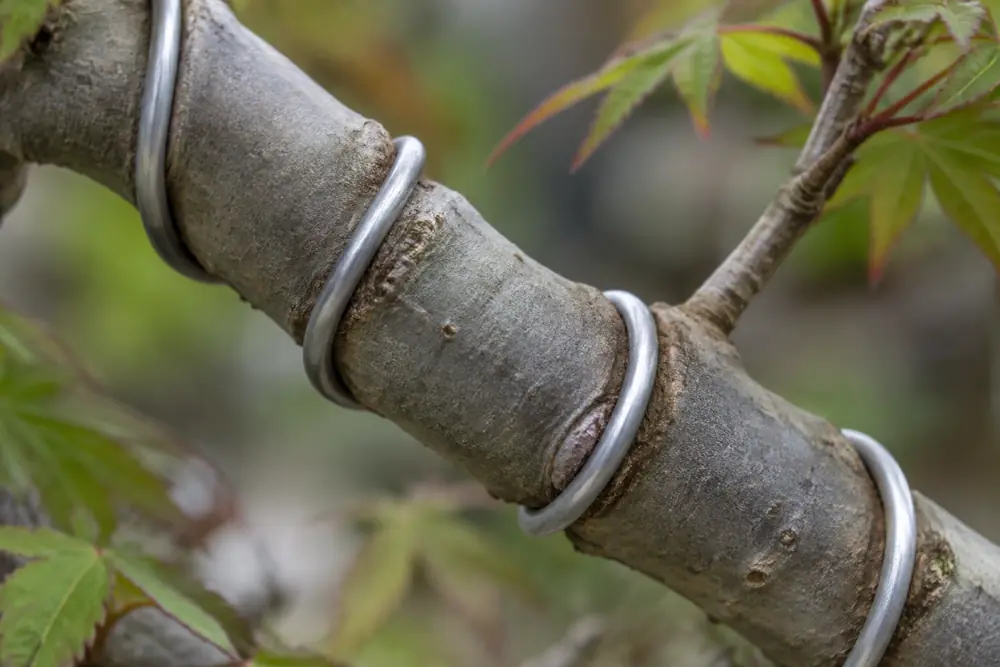
Bonsai wire bite is what happens when training wire stays on a branch too long. As the branch grows thicker, the wire does not stretch, so it starts to press into the bark and eventually cuts into the living tissue underneath. The result is a spiral groove or raised scar that follows the coils. Light marks fade quickly, but deep bites can stay visible for years, especially on smooth-barked trees such as maples.
The good news: wire bite is completely preventable, and even when it happens, most branches heal. This guide explains why it happens, how to spot it early, and what to do once a branch has been marked.
What causes bonsai wire bite?
A branch grows in thickness through a thin layer of living tissue just under the bark, called the cambium. When a wire is wrapped around the branch, that layer keeps expanding while the wire stays the same size. At first the wire just sits snugly. Then it presses in, and the bark bulges around each coil. Left longer, the bark grows over the wire.
Several things make it happen faster:
- Wiring at the start of the growing season. Many trees thicken most in late spring and early summer.
- Fast-growing species. Ficus, Chinese elm, trident maple and other vigorous trees can mark within a few weeks.
- Heavy feeding and full sun. Great for growth, but growth means thickening.
- Wire wrapped too tightly from the start.
- Forgetting about it. The most common cause of all.
How to spot wire bite early
Look closely at each wired branch every couple of weeks. Early warning signs:
| Stage | What you see | What to do |
|---|---|---|
| Snug | Wire touches bark, no marks | Fine, check again in 1 to 2 weeks |
| Early bite | Faint lines when you lift a coil, slight bulge | Remove wire within days |
| Clear bite | Bark swells around coils, visible groove | Remove wire now |
| Deep bite | Bark growing over the wire | Cut out visible wire, leave buried parts |
On junipers and pines, light wire marks are often accepted as part of the process, because their rough bark hides them quickly. On maples, beech and other smooth-barked trees, even a light groove can show for years, so these need closer checking.
How to fix bonsai wire bite
1. Remove the wire carefully
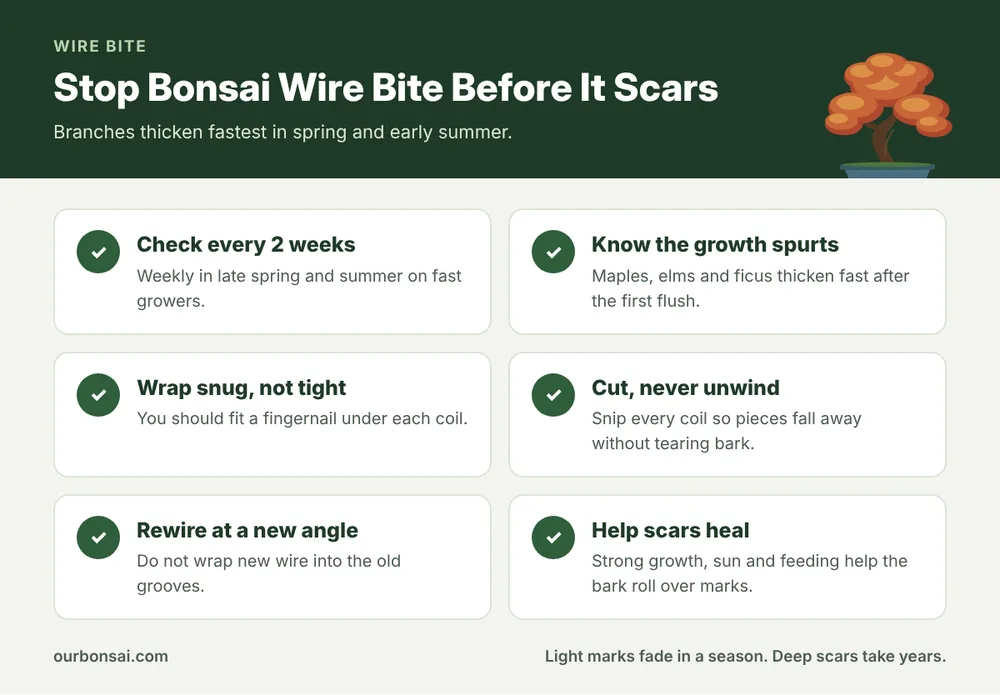
Cut the wire off at every coil with proper wire cutters. Do not unwind it, because that drags the wire through the groove and tears the bark. Our step-by-step guide on bonsai wire sizes and uses also explains why the right gauge matters. A pair of dedicated bonsai wire cutters makes this much easier than regular pliers.
2. Leave deeply buried wire alone
If the bark has grown right over a section of wire, cut away everything you can reach and leave the buried part. Digging it out creates a larger wound than the one you are trying to fix. The tree will grow over it.
3. Seal deep wounds on smooth-barked trees
Where the bite has opened the bark, a thin layer of cut paste helps keep the wound moist and encourages the edges to callus and roll over. Our guide to a bonsai cut paste alternative explains which products work.
4. Let the branch grow freely
Scars heal fastest when the branch thickens. For a season, let that branch grow without pruning it back hard. Give the tree plenty of light and regular fertilizer during the growing season so it can lay down new wood over the marks.
Can bonsai wire bite be a good thing?
Some experienced growers deliberately let wire bite in a little on pines and junipers. A slight bite can help a stubborn branch hold its new position, and on rough bark the marks soon disappear. Some even use spiral scars on old deadwood-style trees as character.
For beginners, though, it is best to avoid it. You lose control of how deep the scar gets, and on deciduous trees a scar is simply a flaw in the design. Remember that one of the goals of bonsai is a natural-looking trunk and branches; the Wikipedia article on bonsai aesthetics and care describes how wiring should be removed before it marks the tree.
How long do wire scars take to heal?
It depends on the tree and the depth of the bite:
- Light marks on fast-growing trees: Often gone in one growing season.
- Moderate grooves on maples and elms: Two to four years.
- Deep spiral scars: May never fully disappear, but become less obvious as the branch thickens.
Trees that grow in thickness quickly, such as tropical ficus, hide scars fastest. Slow conifers keep them longest, but their textured bark makes them less visible.
How to prevent bonsai wire bite
- Check on a schedule. Every two weeks in the growing season, every week in early summer. A phone reminder works well.
- Wrap at 45 degrees with even spacing, snug but not tight.
- Use the right gauge. Wire about one third the thickness of the branch. Thin wire wrapped tightly bites faster.
- Wire at the right time. Wiring deciduous trees in late winter means they will hold the shape by the time growth speeds up, but you must check them often in spring. See when to prune deciduous bonsai for timing that also suits wiring.
- Rewire rather than leave it on. If a branch is not set but the wire is close to biting, remove it and rewire in a slightly different line.
- Use raffia or tape on thick branches before heavy bends, to spread the pressure.
Trees most prone to wire bite
- Trident and Japanese maples
- Chinese elm and Zelkova
- Ficus species
- Fukien tea
- Azaleas (brittle and scar easily)
If you grow a Japanese maple, the smooth bark shows every mark. Our guide to Japanese maple bonsai covers how to style them gently.
A simple wiring log to avoid wire bite
The easiest way to beat wire bite is to stop relying on memory. Keep a short log for every tree you wire, either in a notebook or a note on your phone:
- Date wired and which branches.
- Wire type and gauge, for example 2 mm aluminum on the first left branch.
- Next check date, two weeks later in spring and summer, three to four weeks in autumn and winter.
- A photo taken on the day of wiring. Comparing it with the tree a month later shows how much the branches have thickened.
Experienced growers also learn to read the season. After the first spring flush has hardened, many deciduous trees go through a strong thickening phase. Junipers often thicken in late spring and again in early autumn. Tropical trees indoors under lights grow almost year round, so they need checking all the time. Once you see the pattern on your own trees, you will know exactly when to look more closely.
Finally, think about how much wire one tree really needs. A beginner who wires every branch at once creates a huge job when it all needs removing on the same weekend. Wiring a few main branches at a time is easier to manage and spreads the checking out. That approach is kinder to the tree too, since it gets a chance to recover between styling sessions.
FAQ: bonsai wire bite
Will wire bite kill a branch?
Rarely, but it can if the wire cuts all the way around and chokes the branch for a long time. Remove the wire as soon as you see it, and most branches recover.
Should I fill wire scars with anything?
No filler is needed. On deep wounds, a thin layer of cut paste is enough. The tree heals the scar itself by growing new wood around it.
Is copper or aluminum wire more likely to bite?
Copper holds more firmly and is often left on conifers longer, so it can mark more deeply if forgotten. Aluminum is softer, but it still bites just as fast on a thickening branch.
Can I rewire a branch that has wire bite?
Yes, once the wire is removed. Wrap new wire at a different angle so it does not sit in the old groove.
Final thoughts
Bonsai wire bite is one of the most common beginner mistakes, and one of the easiest to avoid. Check your wired trees often, know when your species thickens fastest, and cut wire off at the first sign of pressure. Light marks heal quickly, deep ones take patience, but with good care almost every branch recovers. For everyday care between styling sessions, see our bonsai care guide and our pick of the best bonsai tools.