Best Soil for Jade Bonsai: Mix Recipe and Ratios

This post contains affiliate links. As an Amazon Associate, OurBonsai earns from qualifying purchases at no extra cost to you. Read our disclosure.
In this guide
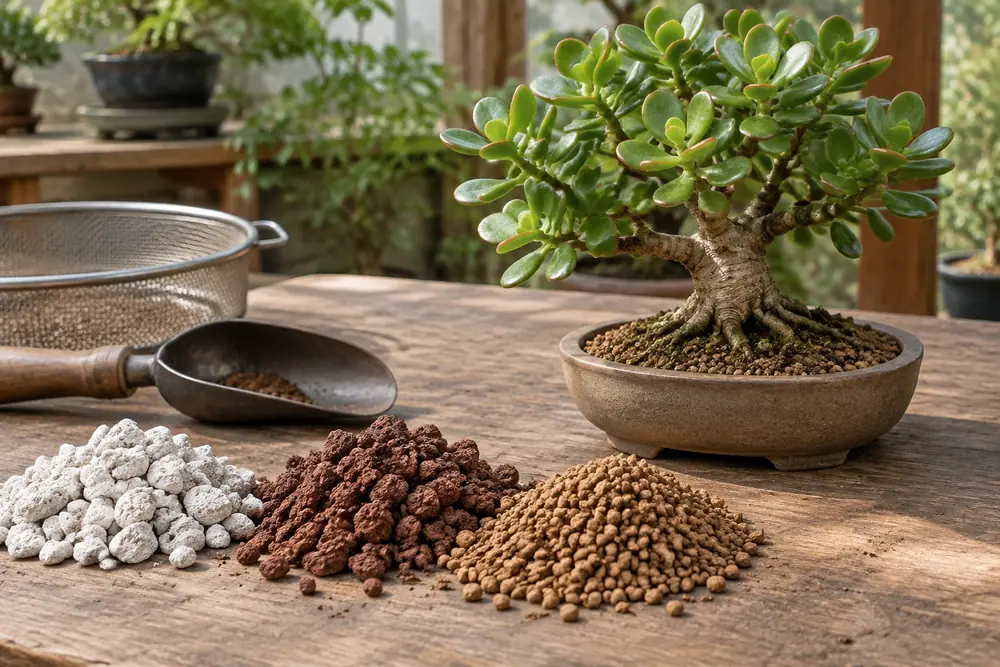
The best soil for jade bonsai is a fast-draining, mostly mineral mix that lets water run straight through and dries out within a few days. A simple and reliable recipe is equal parts pumice, lava rock and akadama, sieved to remove dust. Jade (Crassula ovata) is a succulent that stores water in its thick leaves and stems. It handles drought easily but rots quickly when its roots sit in wet soil, so the soil’s job is to drain fast and give the roots plenty of air.
This guide explains what jade roots need, gives three easy soil recipes, lists what to avoid, and shows how to repot a jade bonsai into its new mix.
Why jade bonsai need special soil
Most bonsai soils are designed to hold some water between waterings. Jade needs less than that. As a succulent from dry parts of South Africa, it is adapted to soak up water fast after rain and then go dry for long periods. The Wikipedia page on Crassula ovata describes its natural habitat on rocky hillsides, which is exactly the kind of fast-draining ground you are trying to copy in a pot.
In dense soil, three things go wrong:
- Root rot. Roots sitting in wet soil lose oxygen and turn black and mushy.
- Soft, wrinkled leaves. Ironically, a jade with rotting roots looks thirsty, because dead roots cannot take up water.
- Leaf drop and stem rot. Rot can spread from the roots into the trunk.
Our guide to root rot in bonsai shows how to spot and treat it. The right soil prevents most of it.
What makes a good jade bonsai soil
| Property | Why it matters for jade |
|---|---|
| Fast drainage | Water should run out of the pot within seconds |
| Lots of air space | Roots need oxygen between waterings |
| Low water retention | Soil should dry out within 3 to 7 days |
| Stable particles | Mineral grit does not break down and compact like peat |
| Particle size 3 to 6 mm | Large enough for air, small enough for fine roots |
The best soil components for jade bonsai
- Pumice. Light, porous volcanic rock that holds a little water inside each grain while draining freely. The best single ingredient for jade.
- Lava rock. Rough, heavy and very free-draining. Adds stability and air space.
- Akadama. Japanese baked clay granules that hold water and nutrients. Use less of it for jade than for other bonsai.
- Perlite. Cheap and widely available. Fine as a substitute for pumice, though it floats to the top when watered.
- Calcined clay (cat litter or oil absorbent). A budget alternative to akadama; it must be the non-clumping, baked type. Our article on the best cat litter for bonsai soil explains which kinds work.
- Cactus soil. Fine as a small part of a mix, but too fine and peaty on its own.
3 best soil mixes for jade bonsai
Recipe 1: Classic gritty mix
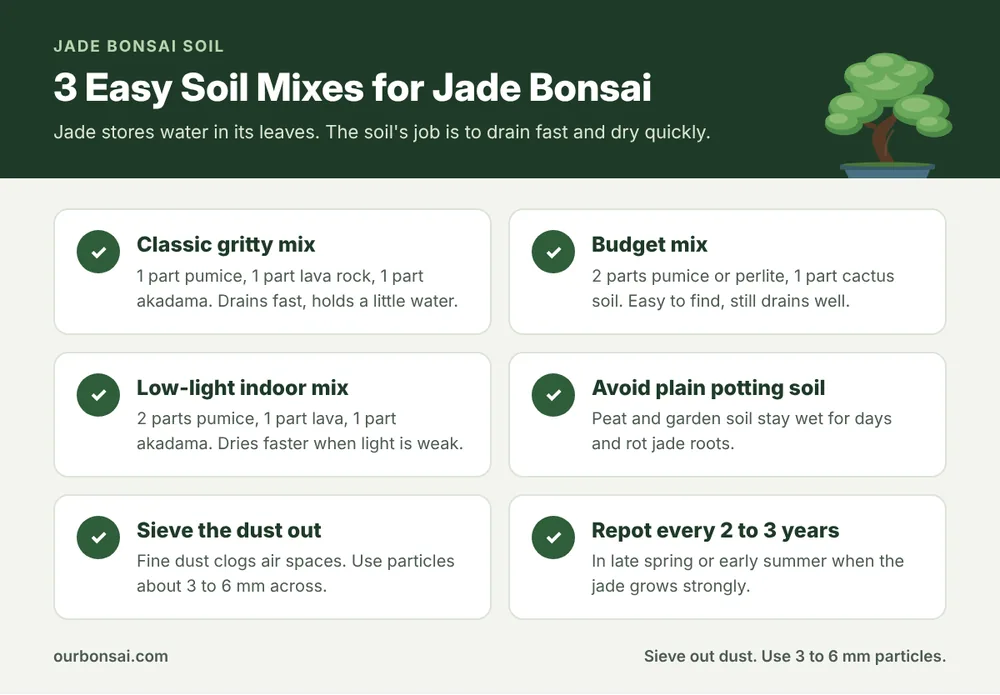
1 part pumice, 1 part lava rock, 1 part akadama. This is the mix most bonsai growers use for jade. It drains instantly, dries within a few days in good light, and the akadama turns pale as it dries, which shows you when to water.
Recipe 2: Budget mix
2 parts pumice or perlite, 1 part store-bought cactus soil. Easy to find in any garden center. It holds a bit more water than the classic mix, so water a little less often.
Recipe 3: Low-light indoor mix
2 parts pumice, 1 part lava, 1 part akadama. Indoors in winter, a jade uses very little water. Extra pumice and lava help the pot dry out faster so the roots are never wet for long.
If you would rather buy a ready-made mix, look for a succulent bonsai soil that is mostly grit. Our Bonsai Jack succulent soil review covers one popular option, and our general bonsai soil mix ratio guide explains how to adjust ratios for other trees.
How the right soil changes watering
Once your jade is in a gritty mix, the watering rhythm changes. Water thoroughly until water pours from the drainage holes, then let the soil dry almost completely before the next watering. In a bright window in summer that may be every five to seven days; in winter it may be every two to three weeks. The akadama in the classic mix turns from dark brown to pale tan as it dries, and that color change is your signal.
The leaves also help. Plump, firm leaves mean the tree has enough water stored. Slightly soft or wrinkled leaves on a tree in dry soil mean it is time to water. Wrinkled leaves on a tree in wet soil mean the roots are in trouble, and you should check them. The Clemson Cooperative Extension jade plant fact sheet gives the same advice: let the soil dry between waterings and water less in winter.
Soils to avoid for jade bonsai
- Regular potting soil. Peat-based, holds water for days, compacts over time. See bonsai soil vs regular soil for why.
- Garden soil. Heavy, poorly drained and may carry pests.
- Pure cactus soil. Better than potting soil but still fine and peaty.
- Moisture-control mixes. Designed to hold water, which is the opposite of what jade needs.
- Unsieved grit. Dust fills the gaps between particles and slows drainage.
How to repot a jade bonsai into new soil
- Pick the right time. Late spring or early summer, when the jade is growing strongly.
- Let the old soil dry out for a few days so the root ball comes out easily.
- Remove the tree and comb out the roots. Shake off old soil and trim any long or dead roots. Our guide to the best bonsai repotting tools covers what you need.
- Add the new mix. Put a layer in the pot, set the tree, tie it in and fill around the roots with a chopstick.
- Wait before watering. Unlike most bonsai, jade should not be watered right after repotting. Wait about a week so any damaged roots can callus over, then water normally.
FAQ: best soil for jade bonsai
Can I use cactus soil for jade bonsai?
Yes, but mix it with at least the same amount of pumice or perlite. On its own, cactus soil is often too fine and holds too much water for a bonsai pot.
Does jade bonsai need akadama?
No. Akadama helps by showing when the soil is dry and holding a little water, but a mix of pumice and lava works very well on its own.
How often should I repot a jade bonsai?
Every two to three years for young trees and every three to five years for older ones, in late spring or early summer.
What pot is best for jade bonsai soil?
An unglazed or glazed bonsai pot with large drainage holes. Shallow pots dry faster, which suits jade.
Final thoughts
The best soil for jade bonsai is one that drains fast and dries quickly: equal parts pumice, lava and akadama is a proven recipe, and pumice with a little cactus soil works on a budget. Get the soil right and you remove the main risk to a jade bonsai, root rot. For styling ideas once it is growing well, see traditional jade bonsai styles.