How to Care for Bonsai Gift Trees: A Simple Starter Guide

This post contains affiliate links. As an Amazon Associate, OurBonsai earns from qualifying purchases at no extra cost to you. Read our disclosure.
In this guide
- Step 1: find out what tree you have
- Step 2: unwrap it properly
- Step 3: put it in the right place
- How to care for bonsai gift trees: watering
- Step 4: give it time to settle
- Step 5: start a simple routine
- Pets and gift bonsai
- What you might want to buy (and what you do not need)
- Mistakes that kill most gift bonsai
- FAQ: care for bonsai gift
- Final thoughts
If you have just received one, learning how to care for bonsai gift trees starts with one simple fact: a bonsai is a real, living tree that needs light, water and the right season, not a decoration for a dark shelf. Most gift bonsai die in their first year, not because they are difficult, but because they are treated like ornaments. Get a few basics right in the first weeks and your tree can live for decades.
This guide walks you through the first steps: finding out what species you have, choosing the right spot, watering correctly and avoiding the mistakes that kill most gift trees.
Step 1: find out what tree you have
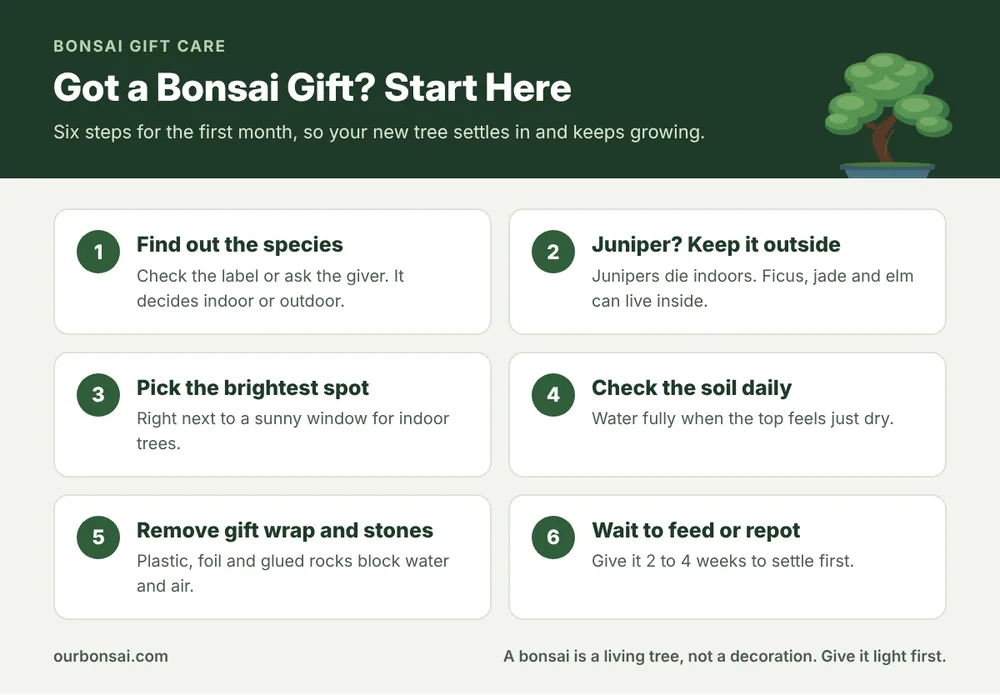
Look for a label on the pot or in the packaging, or ask the person who gave it to you. The species decides almost everything about its care, above all whether it lives indoors or outdoors. The most common gift bonsai are:
| Gift bonsai | Indoor or outdoor? | Notes |
|---|---|---|
| Ficus (Ginseng or Golden Gate) | Indoor | The easiest indoor bonsai |
| Juniper | Outdoor only | Dies indoors within months |
| Jade | Indoor | Stores water, hates soggy soil |
| Chinese elm | Indoor or outdoor | Forgiving and fast growing |
| Fukien tea | Indoor | Likes warmth and humidity |
| Dwarf schefflera | Indoor | Tolerates lower light |
| Azalea | Outdoor | Flowers, needs acidic soil |
Our list of the most popular indoor bonsai trees has photos that help you identify common species. If you received a juniper, our Japanese juniper bonsai care guide explains how to keep it outside.
Step 2: unwrap it properly
Gift bonsai often come with foil, plastic wrap, ribbons or decorative sleeves around the pot. Remove all of it. Wrapping traps water and blocks drainage, which can rot the roots in a week.
Look at the soil surface. Many shop bonsai have small stones glued onto the soil. The glue layer stops water from soaking in and air from reaching the roots. If you can, gently break it away. If it is stuck fast, plan to remove it when you repot in spring. Some trees also come in a pot with no drainage hole, which needs fixing at the first repotting.
Step 3: put it in the right place
Indoor species
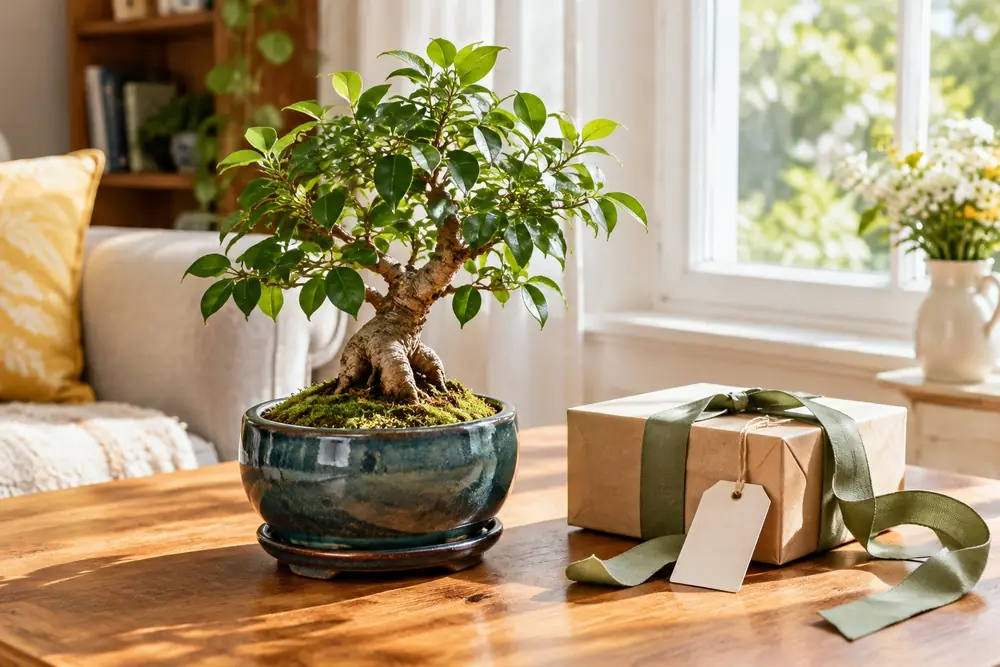
Place the tree right next to your brightest window, ideally south or west facing. Bonsai need far more light than most houseplants. A spot on a coffee table in the middle of the room is too dark, even if it looks bright to you. Avoid heaters, radiators and air-conditioning vents. Our guide on how to take care of a bonsai tree inside covers indoor placement in detail.
Outdoor species
Junipers, azaleas, maples and pines must live outside, in sun or bright light, sheltered from strong wind. They need a cold winter rest. If you received one in winter, keep it in a cool, bright, frost-protected spot like an unheated porch, then move it outside. Our guide to the best place for a bonsai tree explains how to choose.
How to care for bonsai gift trees: watering
Watering is where most gift trees go wrong. Never water on a fixed schedule and never give small sips.
- Check the soil every day by pushing a finger about 1 cm into it.
- When it feels just dry, water slowly over the whole surface until water runs out of the drainage holes.
- Wait a minute and water again.
- Let it drain fully. Do not leave the pot standing in water.
If the soil is still damp, do not water. Indoors in winter, a tree may need water every few days. Outdoors in summer, it may need water every day. Our guide to watering indoor bonsai in winter explains the seasonal changes. A simple bonsai watering can with a fine rose makes thorough watering easy.
Step 4: give it time to settle
Gift trees have usually come from a greenhouse, then a store or warehouse, then your home. That is a lot of change. Expect some leaf drop in the first weeks, especially with ficus. Keep conditions stable:
- Do not move it around the house
- Do not repot it right away
- Do not prune it hard
- Do not fertilize for two to four weeks
If you have other houseplants, keep the new tree a short distance away for a couple of weeks and check it for pests. Our guide on how long to quarantine a new bonsai explains why.
Step 5: start a simple routine
Once your tree has settled, a simple routine keeps it healthy:
- Daily: check the soil and water when needed.
- Every 2 to 4 weeks (spring to autumn): feed with a bonsai fertilizer.
- When shoots grow long: trim them back to one or two leaves.
- Every 2 to 3 years, in spring: repot into fresh bonsai soil.
Our main bonsai care guide covers each of these tasks in detail.
Pets and gift bonsai
Some popular bonsai, including ficus, jade and schefflera, can upset cats and dogs if chewed. Keep the tree out of reach of curious pets. Our article on whether bonsai trees are poisonous to cats and dogs lists the common species, and the ASPCA toxic and non-toxic plants list lets you check any plant by name.
What you might want to buy (and what you do not need)
Most gift bonsai come with just the tree and pot. You can keep it healthy with almost nothing extra, but a few inexpensive items make care easier:
- A watering can with a fine rose for thorough, gentle watering.
- A humidity tray for indoor tropicals in dry, heated rooms.
- A small pair of bonsai scissors for trimming long shoots later on.
- A bag of bonsai soil for the first repotting in spring.
- A grow light if your home has no bright window, especially in winter.
You do not need leaf shine, plant food sticks, decorative figurines on the soil, or a bigger decorative pot without drainage. Many of these actually harm the tree. Spend your effort on light and watering first.
Mistakes that kill most gift bonsai
- Keeping a juniper indoors
- Leaving it in a dark spot as decoration
- Watering a little every day, or once a week regardless of the soil
- Leaving the gift wrap on the pot
- Repotting, pruning and fertilizing in the first week
- Placing it on a sunny windowsill above a radiator
FAQ: care for bonsai gift
How often should I water a bonsai gift?
Check the soil daily and water thoroughly whenever the top feels just dry. There is no fixed number of days.
Can I keep my gift bonsai on my desk?
Only if your desk is right next to a bright window, and only for indoor species. Most offices are too dark without a grow light.
Why is my new gift bonsai losing leaves?
It is adjusting to lower light and a new environment. Some drop is normal. Give it the brightest spot you have and steady watering.
When should I repot a gift bonsai?
In the next suitable season, usually spring, not in the first weeks. Repot sooner only if the soil is waterlogged and the roots smell sour.
Final thoughts
To care for bonsai gift trees well, treat them like the living trees they are. Identify the species, keep junipers and other outdoor trees outside, give indoor trees the brightest window, and water by checking the soil. Let the tree settle before you prune, feed or repot. Do that, and your gift can grow with you for many years. If you are thinking of giving one yourself, our guide to the best bonsai gifts has beginner-friendly ideas.