Brazilian Rain Tree Bonsai Winter Care: Warmth, Light, Humidity


This post contains affiliate links. As an Amazon Associate, OurBonsai earns from qualifying purchases at no extra cost to you. Read our disclosure.
In this guide
- How cold can a Brazilian rain tree bonsai handle?
- Brazilian rain tree bonsai winter care checklist
- Light: the most important winter factor
- Humidity in heated rooms
- Watering a Brazilian rain tree in winter
- Why is my Brazilian rain tree dropping leaves in winter?
- Fertilizer, pruning and repotting in winter
- Pests to watch for indoors
- Summer outdoors, winter indoors
- Setting up a winter corner for tropical bonsai
- Common Brazilian rain tree winter mistakes
- FAQ: Brazilian rain tree bonsai winter care
- Final thoughts
Brazilian rain tree bonsai winter care is mostly about recreating a little piece of the tropics in your home. The Brazilian rain tree (Pithecellobium tortum, also listed as Chloroleucon tortum) comes from warm, humid regions of Brazil. It has delicate, feathery leaves that fold up at night and in low light, and it reacts quickly to cold, dark or dry conditions by dropping leaflets. With warmth, strong light and good humidity, though, it stays lush all winter.
This guide covers the minimum temperature, the light it needs, how to manage humidity and watering, and how to deal with leaf drop.
How cold can a Brazilian rain tree bonsai handle?
This is a true tropical tree with no frost tolerance.
| Temperature | Effect | Action |
|---|---|---|
| 18 to 30°C (64 to 86°F) | Happy and growing | Ideal range |
| 12 to 18°C (54 to 64°F) | Growth slows, some leaf drop | Acceptable for short periods |
| Below 12°C (54°F) | Heavy leaf drop, stress | Move somewhere warmer |
| Near freezing | Severe damage or death | Never allow |
If you keep the tree outside in summer, bring it inside before nights fall below about 15°C (59°F). In most temperate climates that means early autumn.
Brazilian rain tree bonsai winter care checklist
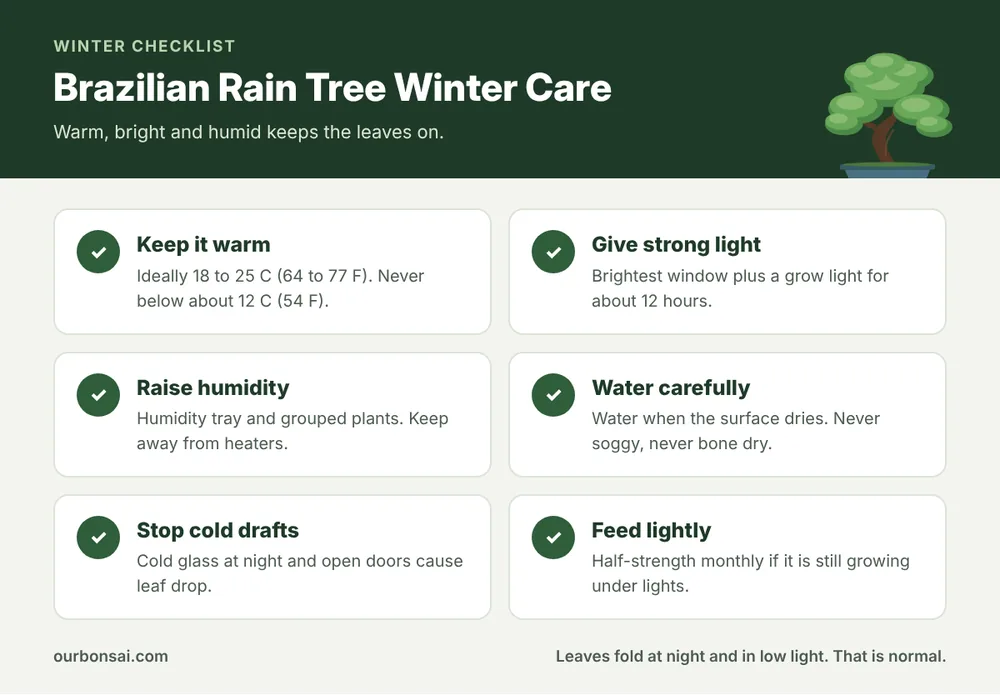
Light: the most important winter factor
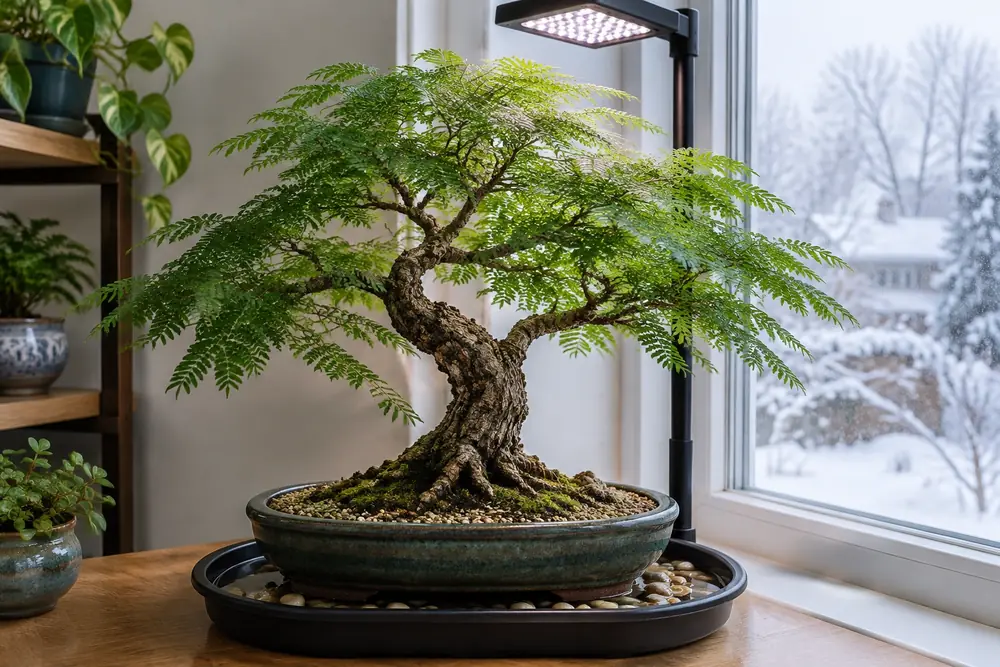
In winter, the short days and weak sun are the biggest challenge. Brazilian rain trees need a lot of light to hold their leaves.
- Place it in the brightest window you have, ideally south-facing in the northern hemisphere.
- Keep it close to the glass, but not touching cold glass at night.
- Add a full-spectrum LED grow light for about 12 hours a day. This makes the biggest single difference. Our guide to the best grow lights for bonsai covers good options and setup.
A useful sign: the leaves fold up when light is too low. If your tree’s leaves stay folded for much of the day, it needs more light. Our guide on how much light a bonsai tree needs explains how to measure it.
Humidity in heated rooms
Central heating can drop indoor humidity below 30%, far lower than this tree is used to. Dry air causes crispy leaflets and leaf drop.
- Use a humidity tray: a shallow tray of pebbles and water under the pot, with the pot sitting above the water line.
- Group it with other plants.
- Run a small room humidifier nearby if your air is very dry.
- Keep it away from radiators, heat vents and fireplaces.
Misting can help for a short time but is not enough on its own.
Watering a Brazilian rain tree in winter
Growth slows in winter, so the tree uses less water. At the same time, warm indoor air can dry a small pot quickly. Do not water on a fixed schedule.
- Water thoroughly when the top layer of soil is dry.
- Let excess water drain away; never leave the pot sitting in water.
- Use room-temperature water. Cold water shocks tropical roots.
Our guide to watering indoor bonsai in winter covers the general principles.
Why is my Brazilian rain tree dropping leaves in winter?
Some leaflet drop in winter is common, especially after moving the tree indoors. Typical causes:
- Low light. The most common cause. Add a grow light.
- Cold. Temperatures below about 15°C (59°F), or cold drafts from windows and doors.
- Dry air. Low humidity from heating.
- Overwatering. Soggy soil in a cool room can lead to root problems.
- Underwatering. Small pots near heaters can dry out in a day.
If the branches are flexible and green under the bark, the tree will usually grow new leaves once conditions improve. Our guide on why a bonsai loses leaves suddenly goes deeper into diagnosis.
Fertilizer, pruning and repotting in winter
- Fertilizer: If the tree keeps growing under lights, feed with a half-strength balanced fertilizer about once a month. If it has slowed down a lot, stop feeding until spring.
- Pruning: Light trimming is fine. Save heavier pruning for spring and summer, when the tree recovers fastest.
- Repotting: Wait until late spring or early summer, when it is warm and the tree is growing strongly.
Pests to watch for indoors
Warm, dry indoor air in winter is ideal for spider mites, and mealybugs and scale are also common on tropical bonsai. Check under the leaves and along the stems every week. Our guide to spider mites on bonsai trees explains how to spot and treat them.
Summer outdoors, winter indoors
Many growers in temperate climates keep their Brazilian rain tree outside from late spring to early autumn. The extra light and humidity outdoors give it a big boost. When you bring it back in, expect some leaf drop as it adjusts. Make the move before nights get cold, and inspect it for pests before it comes inside.
If you are looking for more tropical options, see our guide to tropical bonsai species. You can also browse Brazilian rain tree bonsai on Amazon.
Setting up a winter corner for tropical bonsai
If you keep several tropical trees, a dedicated winter corner makes care much easier. A simple setup needs:
- A sturdy shelf or table near your brightest window.
- One or two LED grow lights on a timer, set to about 12 hours a day, hung 20 to 40 cm above the trees.
- Large humidity trays under all the pots, refilled once or twice a week.
- A small clip-on fan on low, running for a few hours a day. Gentle air movement reduces fungus and pests and makes the branches stronger.
- A thermometer and hygrometer so you can see when the room gets too cold or too dry.
Brazilian rain tree, ficus, Fukien tea and other tropical species all enjoy the same conditions, so they can share the space. Our list of popular indoor bonsai trees includes several good companions.
Common Brazilian rain tree winter mistakes
- Keeping it in a dim corner far from a window.
- Leaving it on a windowsill where cold glass chills it overnight.
- Placing it next to a radiator.
- Watering with cold tap water.
- Panicking at folded leaves at night, which is completely normal behavior.
FAQ: Brazilian rain tree bonsai winter care
Why do Brazilian rain tree leaves close at night?
It is a natural response called nyctinasty. The leaflets fold up in darkness and open again in light. Leaves that stay folded during the day suggest the tree needs more light.
Can a Brazilian rain tree survive winter on a windowsill?
Yes, if the window is bright, the room is warm and the tree is not chilled by cold glass at night. A grow light helps a lot.
Should I fertilize my rain tree in winter?
Only if it is actively growing under lights. Then use half-strength fertilizer once a month.
How do I know if my rain tree is dead?
Scratch a twig. Green underneath means alive. Dry, brown wood throughout the tree, plus no buds after several weeks of good care, is a bad sign. The species page for Pithecellobium tortum has more about its native range.
Final thoughts
Successful Brazilian rain tree bonsai winter care means warmth above 15°C, as much light as you can give, a humidity tray and careful watering. Expect a little leaf drop when the tree comes indoors, and do not worry about leaves folding at night. Keep conditions stable, and your tree will carry its fine, feathery canopy right through to spring. For more about indoor care, see how to take care of a bonsai tree indoors.