Best Soil for Trident Maple Bonsai: Mixes and Ratios

This post contains affiliate links. As an Amazon Associate, OurBonsai earns from qualifying purchases at no extra cost to you. Read our disclosure.
In this guide
- What trident maple roots need
- The best soil for trident maple bonsai: the classic mix
- Recommended ratios by situation
- Particle size and sieving
- Alternatives if you cannot get akadama
- When to repot a trident maple
- Soil and watering go together
- How to mix and use trident maple soil step by step
- Common soil mistakes with trident maples
- FAQ: best soil for trident maple bonsai
- Final thoughts
Choosing the best soil for trident maple bonsai makes the rest of the care much easier. Trident maple (Acer buergerianum) is a vigorous, thirsty tree that builds roots quickly, thickens fast and loves water in summer. It needs a soil that drains freely, holds enough moisture to get through hot days and keeps plenty of air around the roots. The classic answer is an akadama-based mix, but there are good alternatives too.
This guide explains what trident maples need from their soil, the ratios most growers use, how to adjust for your climate and stage of development, and when to replace the soil.
What trident maple roots need
Trident maples come from eastern China and Japan, where they grow along rivers and in moist lowland areas. In a pot they:
- Use a lot of water in summer, often needing water once or twice a day.
- Grow roots very quickly, filling a pot in one or two seasons.
- Respond well to root pruning by producing dense, fine roots, which is what you want for a good nebari (surface root spread).
- Prefer slightly acidic to neutral soil, roughly pH 5.5 to 7.
A good soil therefore has to balance two jobs: drain quickly so roots never sit in water, and hold enough water in the particles themselves that the tree does not dry out between waterings.
The best soil for trident maple bonsai: the classic mix
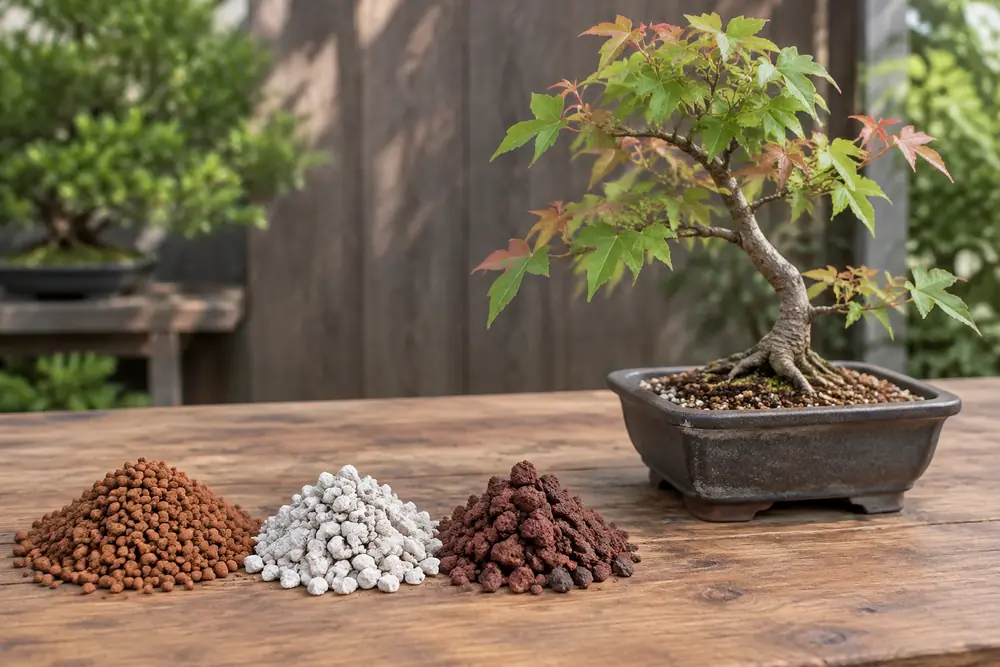
Akadama
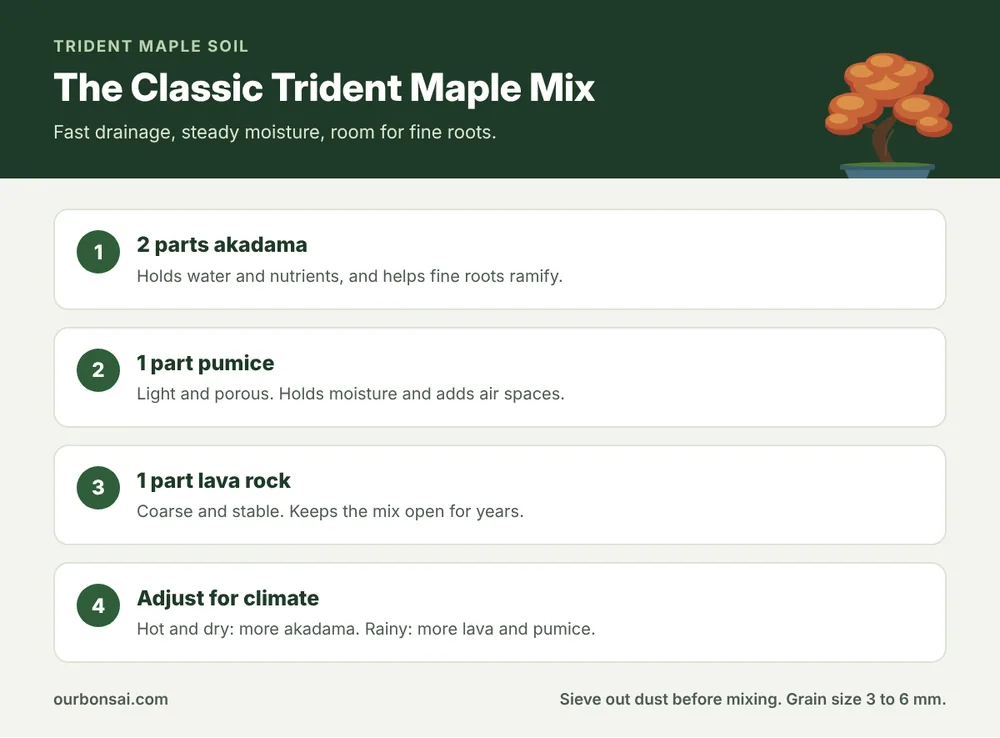
Akadama is a granular Japanese clay that holds water and nutrients well and gradually breaks down. It is the base of most trident maple mixes because fine roots grow into and around the granules, which helps build a dense root system. You can read more about it in the Wikipedia article on akadama.
Pumice
Pumice is light volcanic rock full of tiny pores. It holds moisture inside, but the spaces between particles stay open for air. It does not break down.
Lava rock
Lava rock is heavier and coarser. It adds structure, improves drainage and keeps the mix open for years.
Recommended ratios by situation
| Situation | Akadama | Pumice | Lava | Notes |
|---|---|---|---|---|
| Standard mix | 2 | 1 | 1 | Good all-round choice |
| Hot, dry summers | 3 | 1 | 1 | More water holding |
| Wet, rainy climate | 1 | 1 | 1 | Faster drainage |
| Young tree in a training pot | 1 | 1 | 1 + some bark | Faster growth, cheaper |
| Refined tree in a small pot | 2 to 3 | 1 | 1 | Finer grain, 2 to 4 mm |
These are starting points. Watch how quickly your pots dry and adjust at the next repotting. Our general guide to bonsai soil mix ratios explains how to fine-tune any mix.
Particle size and sieving
Particle size matters as much as the ingredients. For most trident maples, aim for granules between about 3 and 6 mm. Use slightly smaller grains (2 to 4 mm) in small, shallow pots, and slightly larger (4 to 8 mm) for big trees in deep training pots.
Always sieve out dust before mixing. Fine dust fills the gaps between particles, slows drainage and can lead to root rot. A set of bonsai soil sieves is a small investment that improves every mix you make.
Alternatives if you cannot get akadama
Akadama can be hard to find or expensive in some countries. Trident maples grow well in other mixes:
- Pumice and lava only (1:1): Very free-draining. Water more often in summer.
- Calcined clay products such as certain kitty litters or soil conditioners work as a stand-in for akadama. Our guide to cat litter for bonsai soil explains which types are safe.
- Ready-made bonsai mixes: Many commercial blends work well for maples. See our roundup of the best bonsai soil for options.
- Kanuma: Mainly used for azaleas because it is acidic. It can be mixed in a little, but it is not ideal as a trident base. Read our kanuma soil review for details.
Avoid ordinary garden soil or bagged potting compost on its own. It packs down, holds too much water and suffocates roots in a shallow pot. Our comparison of bonsai soil vs regular soil explains why.
When to repot a trident maple
Because trident maples root so fast, young trees often need repotting every one to two years, and mature trees every two to three years. The best time is early spring, just as the buds swell and before the leaves open. Signs it is time:
- Water runs off the surface or drains very slowly.
- Roots circle the inside of the pot or push out of the drainage holes.
- The tree dries out much faster than it used to.
Tridents tolerate heavy root pruning well when healthy, which is one reason they are popular for developing wide, flaring nebari. If you are shopping for a tree, our Brussel’s trident maple bonsai review looks at one widely available option.
Soil and watering go together
Even the best soil fails if the watering does not match it. With an akadama-based mix:
- Water thoroughly until water runs from the drainage holes.
- Water again when the top layer has dried, not before.
- In hot summers, check twice a day. Trident maples can scorch quickly if they dry out.
Akadama changes color when wet (darker) and dry (lighter), which makes it easy to see when the tree needs water.
How to mix and use trident maple soil step by step
- Sieve each component separately and discard the dust. Keep the very coarse pieces for a drainage layer.
- Measure by volume with a cup or scoop, using the ratio that suits your climate.
- Mix dry in a bucket or on a tray until the colors are evenly spread.
- Add a drainage layer of coarse particles at the bottom of the pot, about one grain deep.
- Settle the tree on a small mound of mix, spread the roots outward, then fill around them.
- Work the soil in with a chopstick so there are no air pockets, without pressing it down hard.
- Water thoroughly until the water runs clear from the drainage holes.
After repotting, keep the tree in bright shade and out of wind for two or three weeks, and wait about a month before feeding. Good tools help with this job; our list of bonsai repotting tools covers root hooks, scissors and soil scoops.
Common soil mistakes with trident maples
- Using unsieved soil full of dust.
- Mixing in too much organic matter in a small pot, which stays soggy.
- Leaving a tree in old, broken-down akadama for many years.
- Using very coarse, fast-draining soil in a hot climate without increasing watering.
- Packing the soil down hard when repotting instead of working it in with a chopstick.
FAQ: best soil for trident maple bonsai
Is akadama necessary for trident maple?
No, but it helps. Pumice and lava mixes, calcined clays and good commercial blends all grow healthy trident maples.
Can I use regular potting soil for a trident maple?
Not on its own in a bonsai pot. It holds too much water and compacts. A little can be mixed into a coarse mix for young trees in large training pots.
What pH does trident maple soil need?
Slightly acidic to neutral, about 5.5 to 7. Akadama-based mixes fall in this range naturally.
How often should I change the soil?
Every one to three years at repotting, depending on age and vigor. Replace it sooner if it has broken down and drains slowly.
Final thoughts
The best soil for trident maple bonsai is a free-draining, moisture-holding mix, most often two parts akadama to one part each of pumice and lava rock, sieved to remove dust. Adjust the ratio for your climate, repot every few years in early spring, and match your watering to the mix. With healthy roots in good soil, a trident maple rewards you with fast growth, fine branching and brilliant autumn color. For broader care tips, see our bonsai care guide.