
Black Fungus on Bonsai Leaves: Causes and Treatment

Quick Answer
Black fungus on bonsai leaves is often sooty mold growing on sticky honeydew from aphids, scale insects, or similar sap-feeding pests. If the black material will not wipe away and forms dead spots inside the leaf, fungal or bacterial leaf disease becomes more likely. The University of Maryland’s sooty mold guidance explains this important difference.
Signs to check first
- Wipeable black coating: Usually points toward sooty mold growing on honeydew.
- Sticky leaves: Check closely for aphids, soft scale, mealybugs, or whiteflies.
- Expanding black spots: Fungal or bacterial leaf disease becomes more likely.
- Constantly wet soil: Root stress and poor drainage may be contributing to the decline.
- Wet, crowded foliage: Long leaf-wetness periods can favor several foliar diseases.
Best first move
- Isolate the bonsai, inspect for pests, test whether the black coating wipes away, and correct excess moisture before spraying anything.
Black fungus on bonsai leaves looks frightening, but the black color alone is not a diagnosis. I first determine whether I am seeing surface mold, dead leaf tissue, insect residue, or moisture-related damage.
That distinction prevents unnecessary spraying. It also helps me fix the underlying problem instead of repeatedly cleaning the leaves.
In This Guide
- What Is the Black Fungus on Bonsai Leaves?
- How Can You Identify What Is Causing the Black Leaves?
- What Causes Black Fungus and Black Spots on Bonsai?
- How Do You Treat Black Fungus on Bonsai Leaves?
- How Can You Stop Black Fungus From Returning?
- When Does a Bonsai Need Fungicide or Expert Help?
- Frequently Asked Questions
What Is the Black Fungus on Bonsai Leaves?
What growers call “black fungus” is commonly one of two different problems. It may be sooty mold, or it may be dark tissue caused by a leaf disease.
Sooty mold is dark fungal growth that develops on sugary honeydew deposited on plant surfaces by sap-feeding insects. It sits on the surface rather than directly infecting healthy leaf tissue.
This distinction matters. Treating sooty mold with fungicide while leaving scale insects on the tree usually misses the real cause.
Sooty mold usually sits on the leaf surface
Sooty mold can look like charcoal dust or a dirty black film. Heavy growth may cover leaves, shoots, branches, or even the pot below the canopy.
Try rubbing a small affected area with a damp cotton pad. Some surface mold may loosen while the green leaf tissue remains underneath.
- Sticky residue: Honeydew often makes affected leaves feel tacky.
- Ant activity: Ants may visit honeydew-producing insects.
- Fixed bumps: Brown or tan bumps can indicate scale insects.
- Clusters on new growth: Small soft insects may be aphids.
- Black film on green tissue: This strongly supports sooty mold.
True leaf disease damages the tissue
Fungal leaf spots usually form lesions within the leaf. They may begin tan or brown before becoming dark brown or black.
The University of Maryland’s fungal leaf spot guidance notes that lesions can enlarge, merge, and cause leaf drop in severe cases.
- Spots enlarge: Lesions become wider over several days.
- Tissue stays damaged: The black area cannot be wiped away.
- Similar lesions repeat: Multiple leaves develop comparable symptoms.
- Leaves drop early: Serious infections may accelerate defoliation.
Section Takeaway: A removable black coating suggests sooty mold, while permanent black lesions suggest damaged or diseased leaf tissue.
How Can You Identify What Is Causing the Black Leaves?
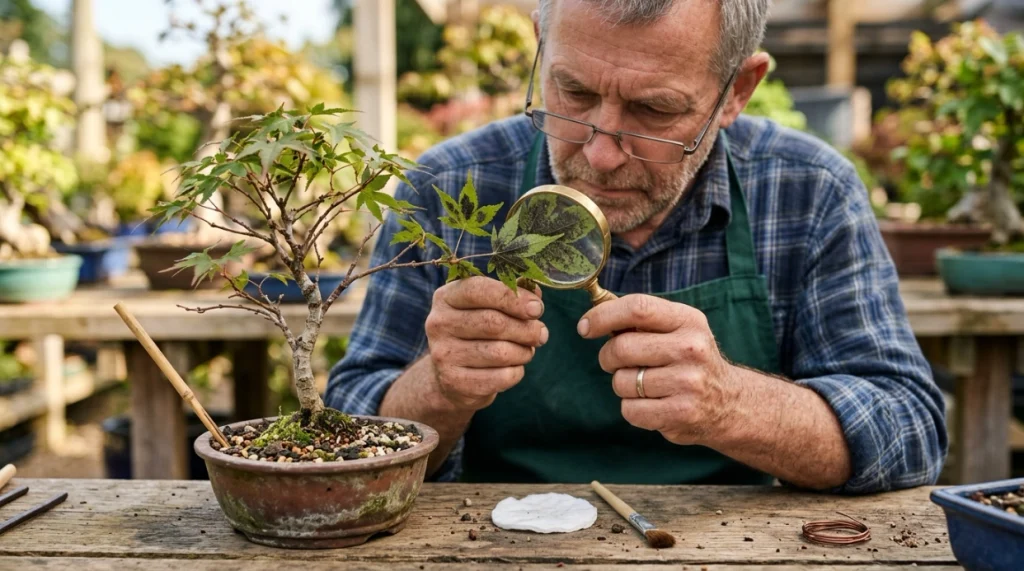
Start with the pattern, not the color. I examine several affected leaves under strong light before choosing any treatment.
A 10× hand lens is useful for spotting scale crawlers, mites, aphids, fungal structures, and tiny changes in leaf tissue. Check healthy leaves too.
| What You See | Likely Explanation | What to Check Next |
|---|---|---|
| Black film that partly wipes away | Sooty mold | Sticky honeydew, aphids, scale, mealybugs |
| Round or irregular black lesions | Possible fungal leaf spot | Spread pattern, wet foliage, fallen leaves |
| Water-soaked dark spots | Possible bacterial disease | Soft tissue, yellow halos, shoot dieback |
| Blackened tips or margins | Environmental or root stress | Heat, cold, fertilizer, watering history |
| Decline with constantly wet soil | Root stress or drainage problem | Drainage holes, soil structure, root-zone smell |
Inspect the entire bonsai
Do not examine only the worst leaf. The location of symptoms often tells me more than their color.
- Look at the upper and lower surfaces of at least five leaves.
- Inspect new shoots and leaf joints for aphids or mealybugs.
- Check twigs and branches for fixed scale-like bumps.
- Feel leaves for sticky honeydew.
- Check whether the soil remains saturated for several days.
- Review recent fertilizer, pesticide, oil, and location changes.
The Bonsai Empire pest and disease guide also recommends identifying the problem before choosing a control product.
Section Takeaway: Diagnose several symptoms together. Black color by itself cannot identify a bonsai disease.
What Causes Black Fungus and Black Spots on Bonsai?
Several unrelated problems can create dark foliage. Sooty mold is especially common when sticky honeydew and sap-feeding pests are present.
1. Aphids and scale insects
Aphids and many soft scale insects feed on plant sap and release honeydew. Sooty mold fungi can then colonize this sugary material.
The result may look like a fungal infection of the bonsai itself. In reality, controlling the insects is usually the important step.
2. Long periods of leaf wetness
Many foliar diseases become easier to establish when leaves remain wet. Dense foliage and weak airflow can extend drying time.
- Repeated overhead watering
- Crowded bonsai benches
- Humid sheltered corners
- Watering late in the day
- Dead leaves trapped inside the canopy
3. Poor drainage and root stress
Bonsai roots need both moisture and oxygen. Constant saturation can damage roots and weaken the tree’s ability to support healthy foliage.
This does not mean every black leaf comes from overwatering. Check drainage and moisture before changing your routine.
4. Fungal or bacterial leaf disease
True disease becomes more suspicious when similar lesions keep appearing. Spreading spots, halos, blighting, or shoot dieback deserve close attention.
5. Environmental injury
Cold, strong heat, sudden sun exposure, excessive fertilizer, or a poorly timed spray can darken foliage. These injuries may resemble disease.
Recent history is valuable here. Damage starting soon after a major care change may point toward environmental stress.
Section Takeaway: Sooty mold, leaf disease, root stress, and environmental damage can all look black, but they need different treatments.
How Do You Treat Black Fungus on Bonsai Leaves?
Treatment depends on the diagnosis. I avoid applying several products at once because that can add stress and hide the original problem.
Step 1: Isolate the bonsai
Move the affected tree away from other bonsai if pests or contagious disease are possible. Keep its light and temperature suitable for the species.
Step 2: Remove badly damaged material
Remove completely dead or heavily diseased leaves when practical. Collect fallen leaves from the soil surface and dispose of them away from the growing area.
Pro tip: Avoid aggressive branch pruning while the tree is already stressed. Ask an experienced grower or local bonsai club before making irreversible cuts on valuable material.
Step 3: Treat the source of sooty mold
If honeydew-producing pests are present, deal with them first. Sooty mold usually declines after its food source disappears.
The UC Integrated Pest Management sooty mold guide recommends controlling the sap-feeding insects responsible for honeydew.
- Aphids: Gently dislodge manageable colonies with water where the species tolerates it.
- Scale: Remove reachable insects carefully and monitor for young crawlers.
- Heavy infestations: Consider insecticidal soap or horticultural oil labeled for the plant.
- Product safety: Follow the current label exactly and test sensitive foliage first.
Step 4: Clean remaining surface mold gently
Once pests are controlled, gently wiping broad, sturdy leaves can improve their appearance. Do not scrub delicate foliage or damage the cuticle.
Old black residue may remain temporarily. New clean growth is a better recovery signal than perfect-looking old leaves.
Step 5: Correct moisture and airflow
Water according to the root zone rather than a fixed calendar. The soil should drain freely while still meeting the species’ moisture needs.
- Keep drainage holes open.
- Avoid leaving the pot standing in water.
- Give foliage room for gentle air movement.
- Water early enough for wet leaves to dry.
- Avoid repeatedly soaking foliage when disease is active.
Section Takeaway: Remove the cause before chasing the black appearance. Pest control, sanitation, and better growing conditions solve many cases without unnecessary fungicide.
How Can You Stop Black Fungus From Returning?
Prevention starts with routine inspection. I prefer catching three scale insects today rather than finding an entire sticky canopy next month.
Check the bonsai every week during active growth
Look under leaves and around branch junctions. Tender new growth deserves extra attention because many pests concentrate there.
- Check for sticky surfaces.
- Watch for ants repeatedly climbing the tree.
- Inspect for fixed scale-like bumps.
- Look for aphid clusters around soft shoots.
- Monitor existing spots for expansion.
Keep watering species-appropriate
A bonsai should not be watered simply because yesterday’s schedule says so. Check the substrate and respond to actual moisture conditions.
Small pots can dry quickly in wind and heat. The same pot may remain damp much longer during cool, humid weather.
Maintain clean growing conditions
Remove dead foliage from the pot and bench. Clean tools between questionable or diseased trees.
- Do not crowd canopies tightly together.
- Quarantine suspicious new plants.
- Avoid excessive nitrogen that produces weak, pest-prone growth.
- Inspect nearby plants when honeydew pests appear.
As of 2026, the most dependable approach remains integrated management. Correct identification and good culture come before routine chemical spraying.
Section Takeaway: Regular inspection, clean growing areas, good drainage, and fast pest detection make black fungal problems much less likely to return.
When Does a Bonsai Need Fungicide or Expert Help?
Do not assume every black mark needs fungicide. Fungicides cannot reverse tissue that is already dead.
A labeled product may be appropriate when a fungal disease has been identified and cultural changes are not enough. The exact choice depends on the tree species and disease.
Seek additional help when symptoms keep spreading
- New lesions continue appearing despite improved conditions.
- The bonsai loses a large portion of its foliage.
- Young shoots begin dying back.
- Branches develop sunken or discolored lesions.
- The soil stays wet while the tree continues wilting.
- Roots or the trunk base develop soft, decaying tissue.
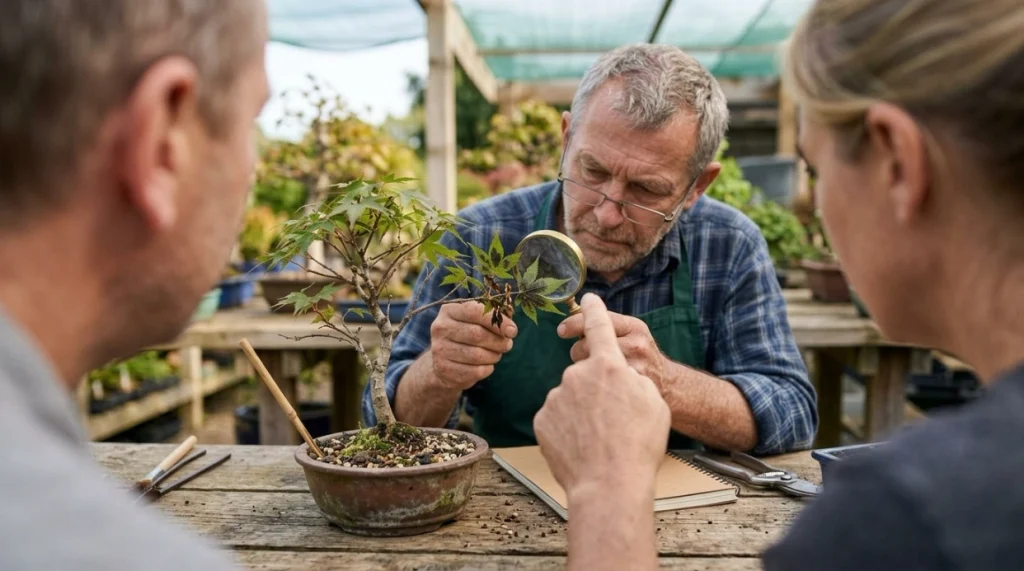
A local extension plant-diagnostic service, experienced bonsai grower, or bonsai club can help with difficult cases. Species identification and clear photographs improve diagnosis.
Bring information about watering, soil, light, fertilizer, weather, and recent treatments. Those details often reveal what the leaves alone cannot.
Frequently Asked Questions
Can black fungus kill a bonsai tree?
Sooty mold itself usually grows on surface honeydew rather than invading living tissue. However, a severe pest infestation can weaken a bonsai, and a heavy coating can interfere with light reaching the leaves.
Does black fungus mean I am overwatering my bonsai?
Not necessarily. Constantly wet conditions can encourage root stress and some diseases, but a black surface coating may instead come from honeydew-producing insects.
Should I remove every leaf with black fungus?
No. Remove severely damaged or clearly diseased leaves when useful, but avoid stripping a weak bonsai unnecessarily.
If the coating is sooty mold on otherwise living foliage, controlling the pest matters more than removing every affected leaf.
Can I wash sooty mold off bonsai leaves?
You can gently clean sturdy leaves after controlling the honeydew-producing pest. Avoid hard scrubbing, harsh detergents, or repeated handling of delicate foliage.
Will neem oil cure black fungus?
Neem-based or horticultural oils may help manage certain pests when the product is labeled for them. They should not be treated as a universal cure for every black leaf symptom.
How can I tell sooty mold from fungal leaf spot?
Sooty mold usually forms a dark surface film associated with sticky honeydew. Fungal leaf spots develop within damaged tissue and cannot simply be wiped from the leaf.
Should I repot a bonsai with black leaves?
Do not repot solely because foliage is black. Consider root-zone intervention only when evidence points toward serious drainage or root problems and the tree’s condition justifies the added stress.
Black fungus on bonsai leaves becomes much easier to manage once you stop treating “black” as one disease. First determine whether you have sooty mold, true leaf lesions, pest damage, or environmental stress.
Start with observation, sanitation, airflow, and correct watering. Then use a targeted treatment only when the evidence supports it.
