
How to Treat Powdery Mildew on Bonsai

Quick Answer
To treat powdery mildew on bonsai, isolate the tree, confirm the white coating is fungal growth, improve light and airflow, and remove badly infected foliage without over-defoliating a weak tree. For an active mild infection, use a fungicide labeled for powdery mildew and the tree species, following established powdery mildew management guidance.
What to do first
- Isolate the bonsai: Move it away from susceptible trees while you diagnose the problem.
- Check the coating: Powdery mildew usually forms spreading white-to-gray powdery patches on leaves and young shoots.
- Increase airflow: Give foliage more space and ventilation instead of keeping the tree in a stagnant corner.
- Improve light: Move the bonsai toward the appropriate brighter position for its species without suddenly scorching shade-grown foliage.
- Treat early: Horticultural oils or neem-based products can help with mild infections when their labels permit use on your plant.
- Protect new growth: Continue monitoring because fresh leaves can become infected even after older patches are controlled.
Important spray precaution
- Never combine oil and sulfur treatments closely together. Follow the product label and avoid spraying stressed or overheated bonsai.
I know how alarming powdery mildew looks on a small bonsai canopy. A few pale spots can seem minor one morning, then become a dusty white coating across tender growth.
The good news is that early infections are usually manageable. The key is identifying the problem correctly and treating the tree without creating a second stress problem.
In This Guide
How Do You Know a Bonsai Has Powdery Mildew?
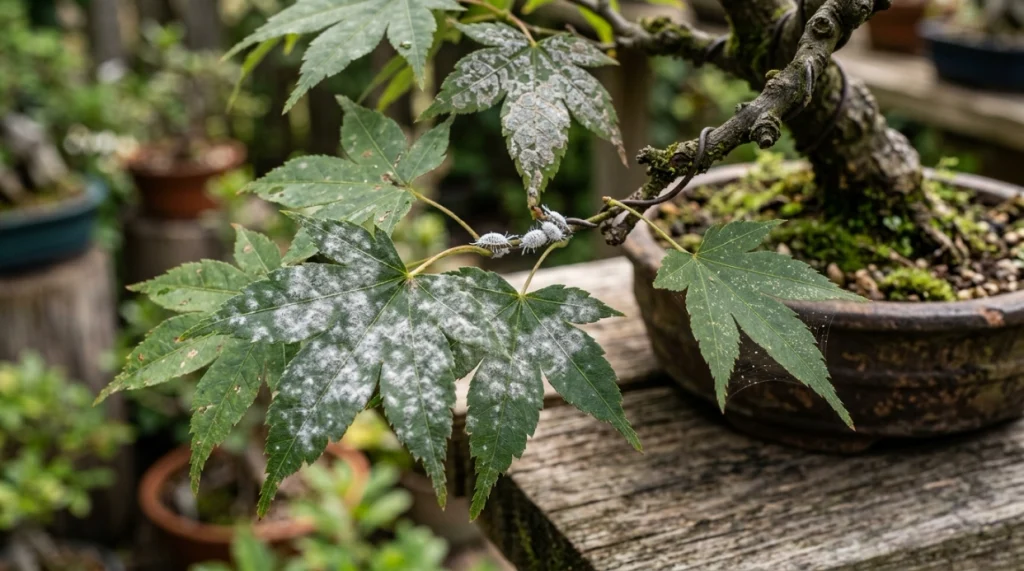
Powdery mildew is a group of fungal diseases that creates white-to-gray fungal growth on living plant tissue. It commonly appears as powdery patches on leaves, young stems, shoots, or buds.
The coating often resembles flour or talcum powder. As infection develops, separate spots can merge into larger patches.
- Early infection: Small circular or irregular pale patches appear on foliage.
- Developing infection: Patches spread and become more obviously white or gray.
- Heavy infection: Leaves may curl, distort, yellow, brown, or drop prematurely.
- Tender growth: Young shoots can show stronger symptoms than older, hardened foliage.
I don’t automatically reach for a fungicide when I see something white. Bonsai leaves also collect mineral deposits, dust, insect wax, and residue from previous sprays.
Powdery mildew vs. other white material on bonsai
| Problem | Typical appearance | Useful clue |
|---|---|---|
| Powdery mildew | White or gray powdery patches | Patches expand across living foliage and shoots |
| Mealybugs | Cottony white clusters | Look closely for individual insects around nodes and leaf joints |
| Hard-water residue | Chalky spots or dried rings | Usually follows repeated overhead watering or misting |
| Spider mites | Fine webbing with pale leaf stippling | Check leaf undersides with a magnifying lens |
The University of Minnesota Extension describes white-to-gray powdery spots and mats as classic symptoms on woody plants. Identification matters because insect problems require different treatment.
Why Does Powdery Mildew Develop on Bonsai?
Powdery mildew often develops when a susceptible plant meets favorable temperature, humidity, shade, and airflow conditions. Unlike many fungal diseases, it doesn’t require a continuously wet leaf surface.
That detail catches many bonsai growers by surprise. A tree can develop mildew even when you’ve carefully avoided leaving its foliage wet overnight.
Common conditions that encourage an outbreak
- Weak air circulation: Crowded benches, walls, fences, and enclosed balconies can trap humid air around foliage.
- Too much shade: Low-light areas can favor disease while slowing foliage drying and reducing plant vigor.
- Moderate temperatures: Powdery mildew often performs well during mild conditions rather than extreme heat.
- Tender growth: Soft new leaves and shoots can be especially susceptible.
- Excess nitrogen: Heavy feeding can produce lush, soft growth that is easier for some mildew species to infect.
- Susceptible species: Risk differs widely between plant genera, species, and cultivars.
UC Integrated Pest Management notes that many powdery mildews favor moderate temperatures around 60–80°F, or about 16–27°C. Shade can also encourage disease development.
On my benches, my practical rule is simple: don’t diagnose mildew as a watering failure alone. I look at the whole microclimate around the foliage.
The American Bonsai Society is also worth keeping in your reference list for broader species-care education and access to local bonsai communities.
How Do You Treat Powdery Mildew on Bonsai?
Start with cultural control, then use an appropriate labeled fungicide when the infection warrants it. Bonsai need extra caution because a small canopy and shallow root system can become stressed quickly.
- Separate the tree. Give the affected bonsai its own well-ventilated space while you monitor nearby susceptible plants.
- Confirm the diagnosis. Check upper and lower leaf surfaces, shoots, nodes, and nearby foliage before choosing a treatment.
- Improve airflow. Increase spacing around the canopy and remove nearby objects that trap stagnant air.
- Correct the light level. Give the species its normal healthy light exposure without suddenly moving tender foliage into scorching sun.
- Remove badly affected material. Prune individual infected leaves or shoots when doing so won’t strip an already weak tree.
- Use a labeled treatment if needed. Horticultural oils, neem-based products, potassium bicarbonate products, sulfur, or other registered fungicides may be options depending on the plant and infection stage.
- Monitor new leaves. Fresh growth tells you more about control than old leaves that remain cosmetically marked.
Don’t try to make every infected leaf visually perfect. Damaged tissue won’t necessarily regain its original appearance after the fungus is controlled.
Your goal is healthy, clean new growth. That is a much better indicator of recovery.
Pro tip: Removing live branches or heavily defoliating a bonsai is irreversible. If the tree is weak, valuable, or recently repotted, consult an experienced grower or local bonsai club before aggressive pruning.
Should you isolate an infected bonsai?
Temporary separation is sensible when several susceptible bonsai sit close together. Powdery mildew produces spores that can move through air currents.
Isolation doesn’t mean putting the tree into a dark room. Keep it in conditions appropriate for its species, with improved ventilation.
Section Takeaway: Treat the tree and its environment together. Spraying without correcting poor airflow, shade, or excessive soft growth can leave the conditions that helped the outbreak develop.
Which Powdery Mildew Treatments Work Best?
The right product depends on whether you’re preventing infection or controlling an existing mild outbreak. Always confirm that the label permits use on your plant and in your growing situation.
| Treatment | Best role | Important caution |
|---|---|---|
| Horticultural oil | Mild to moderate active infections when labeled | Avoid heat-stressed or drought-stressed trees and follow sulfur separation instructions |
| Neem oil | Can provide eradicant and protective activity on labeled plants | Test sensitive foliage and follow the exact dilution on the label |
| Sulfur | Primarily preventive protection | Keep it separated from oil applications and avoid unsuitable temperatures |
| Potassium bicarbonate | Preventive use with some activity against existing mildew | Use a properly formulated product labeled for the plant |
| Other registered fungicides | Persistent or high-risk infections | Product labels, local regulations, and species sensitivity govern use |
Can you use neem oil on powdery mildew?
Neem-based horticultural products can be useful against mild to moderate powdery mildew when their labels specify that use. Coverage matters because many contact treatments must reach the affected surfaces.
Don’t assume stronger is better. Over-concentrated oil can damage foliage, especially during hot weather or when a bonsai is water-stressed.
Can you use sulfur after neem or horticultural oil?
Don’t closely alternate sulfur and oil products. UC IPM specifically warns against applying oils within two weeks of sulfur because plant injury can result.
The required interval can be longer for sensitive plants. The product label should always override a generic spray schedule.
What about homemade baking soda sprays?
I prefer a registered potassium bicarbonate product over improvised sodium bicarbonate mixtures. A bonsai pot contains little soil volume, so unnecessary salt accumulation is something I avoid.
Home remedies can also vary wildly in concentration. A labeled formulation provides clearer directions for dilution, repeat use, and plant safety.
How Do You Keep Powdery Mildew From Returning?
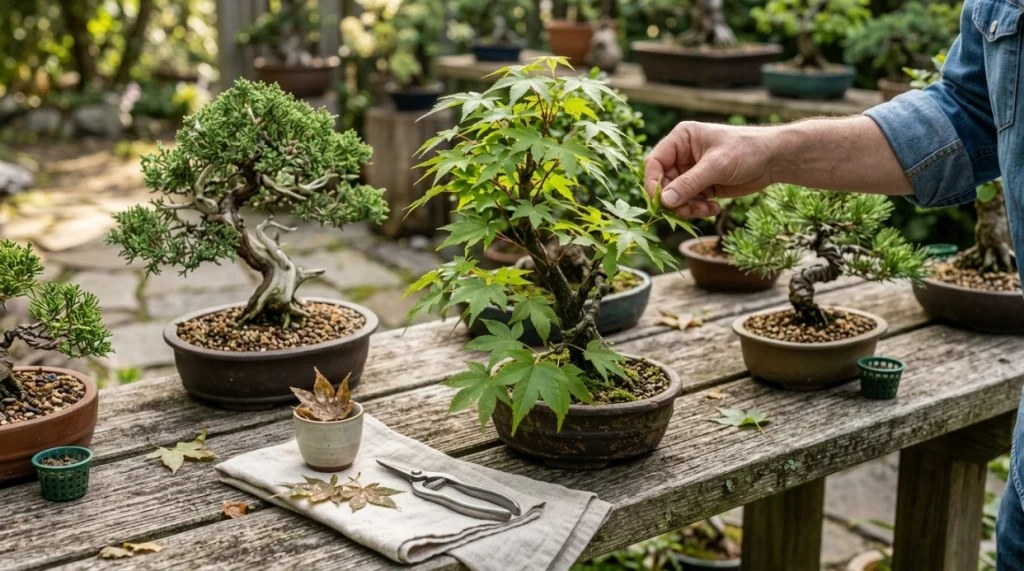
Prevention is mainly about creating conditions that favor the bonsai rather than the fungus. Good light, spacing, balanced feeding, and regular inspection make the biggest practical difference.
- Space trees properly: Don’t let neighboring canopies form one dense mass.
- Use appropriate sunlight: Give each species the light exposure it needs.
- Avoid excessive nitrogen: Don’t force constant soft, lush growth with unnecessary fertilizer.
- Inspect new shoots: Tender foliage can reveal recurrence before an entire canopy becomes coated.
- Clean tools: Keep pruning equipment clean when working among diseased and healthy plants.
- Remove problem foliage: Dispose of severely infected material instead of leaving it around the bench.
- Review the location: A recurring infection can signal a persistent airflow or shade problem.
Should you change your watering routine?
Keep watering according to the needs of the roots and substrate. Don’t deliberately keep a bonsai dry because you’ve seen mildew on its foliage.
Powdery mildew differs from many fungal diseases because free water isn’t required for infection. Root stress from underwatering can make recovery harder.
If you wet foliage, choose timing that allows sensible drying before night. Avoid turning routine misting into a substitute for proper humidity and species-specific watering.
When is a bonsai recovering?
Watch the new growth. Clean expanding leaves with normal color and shape are a stronger recovery sign than stains remaining on old foliage.
- New leaves open without fresh powdery colonies.
- Shoots extend normally rather than becoming distorted.
- Leaf yellowing and premature drop slow down.
- The tree maintains normal water use and vigor.
As of 2026, prevention through suitable growing conditions remains a core recommendation in university extension guidance. Fungicides are tools, but they work best as part of good plant care rather than as the entire strategy.
For broader examples of long-term bonsai horticulture, the National Bonsai & Penjing Museum maintains one of the most important public bonsai collections in the United States.
Section Takeaway: Judge recovery by healthy new foliage, not by whether every old mark disappears. Then correct the growing conditions that made repeated infection easier.
Frequently Asked Questions
Will powdery mildew kill a bonsai tree?
Powdery mildew is often more damaging to appearance than to the survival of an otherwise healthy woody plant. Heavy or repeated infections can still weaken growth, reduce photosynthetic leaf area, distort shoots, and stress a small bonsai, so persistent cases shouldn’t be ignored.
Is powdery mildew contagious between bonsai trees?
Powdery mildew spores can spread by air, but individual powdery mildew fungi often have limited host ranges. An infected bonsai can threaten compatible hosts nearby without necessarily infecting every species in your collection.
Should I remove every infected leaf?
No. Removing a few heavily infected leaves can help, but stripping most foliage from a weak tree can create greater stress than the disease itself. Balance sanitation with the bonsai’s species, strength, season, and remaining leaf mass.
Can I use neem oil on an indoor bonsai?
Possibly, if the specific neem product is labeled for the plant and growing situation. Provide ventilation, protect surfaces, follow the stated dilution, and test sensitive foliage first rather than assuming every indoor bonsai tolerates oil equally well.
How often should I spray a bonsai for powdery mildew?
Use the interval stated on your fungicide label. Don’t invent a weekly schedule or spray more frequently for faster results, because repeat intervals vary by active ingredient, formulation, plant species, weather, and whether the product is preventive or eradicant.
Does powdery mildew mean I am overwatering my bonsai?
Not necessarily. Powdery mildew can infect foliage without standing water on the leaves. Look instead at susceptibility, airflow, shade, humidity, temperature, soft growth, and overall growing conditions while continuing to water the root system according to its needs.
Can powdery mildew come back after treatment?
Yes. New infections can develop while favorable conditions remain, especially on susceptible tender growth. Continue checking new leaves after treatment and improve airflow, light, spacing, and feeding practices to reduce repeated outbreaks.
If you’re dealing with powdery mildew now, start by confirming the diagnosis and improving the bonsai’s growing conditions today. Treat early when necessary, follow every fungicide label carefully, and let clean new growth guide your next step.
