Rust Disease on Bonsai Trees: Identification and Control

Quick Answer
Rust disease on bonsai usually appears as yellow, orange, reddish, or rusty-brown spots and spore-producing patches on leaves. On junipers, certain rust fungi can instead cause swollen twigs, woody galls, branch dieback, and orange gelatinous growth during wet weather. Compare suspicious symptoms with a reliable university rust disease guide before treating the tree.
Signs to check first
- Orange spores: Powdery or raised orange, yellow, or rusty areas strongly suggest a rust fungus.
- Leaf spotting: Pale yellow spots may develop before darker rust-colored spores become obvious.
- Juniper galls: Rounded galls or swollen twigs can appear before orange gelatinous spore horns develop.
- Branch decline: Severe infections on junipers can slow growth and cause affected twigs to die back.
- Wet-weather flare: Rust symptoms and spore release often become more noticeable during moist conditions.
What to do now
- Isolate the bonsai, remove clearly infected disposable foliage where appropriate, improve airflow, keep foliage drier, and confirm the disease before using any fungicide.
Rust disease on bonsai trees can look dramatic, especially when orange spores appear almost overnight. The challenge is that sun scorch, mites, old foliage, nutrient stress, and other fungal diseases can create surprisingly similar discoloration.
I prefer to diagnose the pattern before reaching for a spray. This guide explains what rust looks like, which bonsai are vulnerable, how to separate it from lookalikes, and how to control it without putting an already stressed tree through unnecessary treatment.
In This Guide
- What Does Rust Disease Look Like on a Bonsai Tree?
- Which Bonsai Species Can Get Rust Disease?
- How Can You Confirm Rust Before Treating?
- How Do You Control Rust Disease on Bonsai Trees?
- When Should You Use Fungicide for Bonsai Rust?
- How Do You Prevent Rust From Coming Back?
- Frequently Asked Questions About Bonsai Rust
What Does Rust Disease Look Like on a Bonsai Tree?
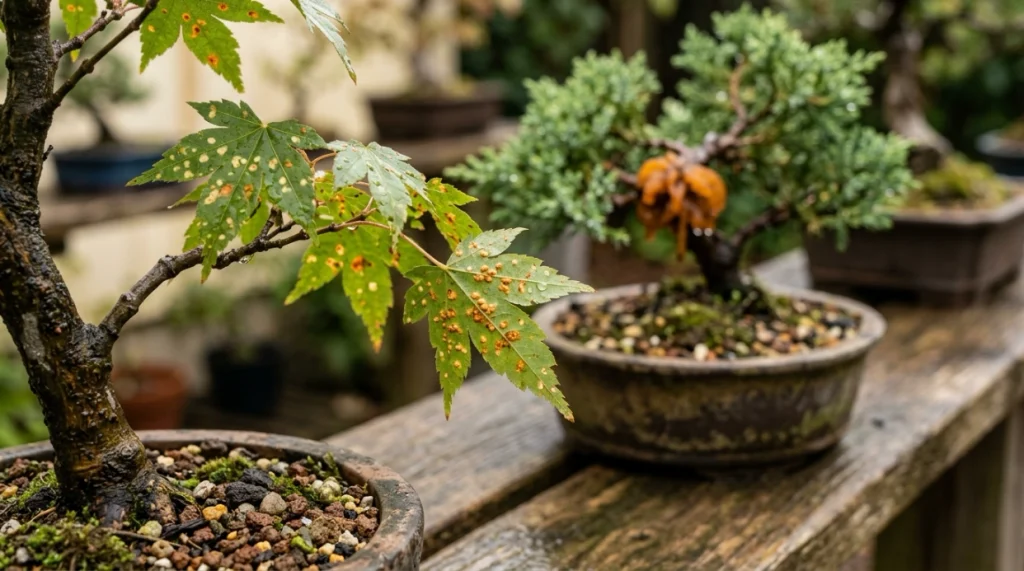
Rust is a fungal plant disease caused by specialized rust fungi that produce conspicuous spores. Depending on the fungus and host, those spores may appear yellow, orange, reddish-brown, or cinnamon colored.
The word “rust” describes the appearance, not ordinary oxidation. Your bonsai’s symptoms come from living fungal infection rather than anything involving metal or mineral rust.
Typical rust symptoms on leaves
On broadleaf bonsai, the first visible change may be small pale or yellowish spots. These often become stronger orange or brown areas as the fungus develops.
- Upper leaf surface: Look for yellow, pale green, orange, or reddish spots.
- Leaf underside: Check for raised pustules, dusty spores, or small projections beneath matching spots.
- Advanced infection: Affected leaves can yellow, dry around lesions, or drop prematurely.
- Repeated pattern: Similar lesions appearing across several leaves are more suspicious than one damaged leaf.
One simple field check is to examine a mature lesion closely. Some active rust pustules release colored powder that can transfer when gently touched, although not every rust species produces an obvious smudge.
Rust looks different on juniper bonsai
Juniper rust deserves special attention because the main infection may sit in woody tissue rather than appearing as classic leaf pustules. Species of Gymnosporangium can form swellings or galls on juniper twigs.
During wet spring weather, mature galls can produce striking orange gelatinous spore structures. Penn State Extension describes this cycle in its guide to cedar-apple and related rust diseases.
- Cedar-apple rust: Often produces rounded woody galls.
- Cedar-hawthorn rust: Can create less obvious swollen areas on twigs.
- Cedar-quince rust: May cause elongated branch swelling and dieback.
- Japanese apple rust: Can also infect susceptible junipers and Malus hosts.
Which Bonsai Species Can Get Rust Disease?
Rust is not one single fungus that attacks every bonsai. Different rust fungi have specific host ranges, so identifying the tree species is an important diagnostic step.
Juniper bonsai deserve particular attention because several Gymnosporangium rusts use junipers as one stage of their life cycle. Apples, crabapples, hawthorns, quince, pears, serviceberries, and related trees may act as alternate hosts for certain species.
Why alternate hosts matter
Some rust fungi need two different plant hosts to complete their life cycle. Spores produced on one host infect the other rather than simply reinfecting the same tree immediately.
This matters if your bonsai benches sit close to susceptible landscape plants. A juniper bonsai beside an ornamental crabapple may experience a different disease risk than the same bonsai in a garden without compatible alternate hosts.
| Bonsai or Host Type | Possible Rust Sign | Useful Clue |
|---|---|---|
| Juniper | Twig swelling, galls, orange gelatinous structures | Inspect branches, not just foliage |
| Apple or crabapple | Yellow-orange leaf spots | Check leaf undersides as lesions mature |
| Hawthorn | Orange-yellow leaf lesions | Nearby junipers may be relevant |
| Pear or quince relatives | Rust-colored spotting or fruit/twig symptoms | Exact symptoms depend on rust species |
Bonsai Empire also notes rust as an important concern on some junipers. Its juniper bonsai care guide points out that susceptibility varies between species and cultivars.
How Can You Confirm Rust Before Treating?
Do not diagnose rust from brown foliage alone. I look for a combination of color, lesion shape, location, season, host species, and visible spore structures.
Begin with good light and inspect both sides of every suspicious leaf. On junipers, follow affected foliage back along the twig and look for swelling, cracked bark, or gall-like growth.
Rust versus common lookalikes
| Problem | Typical Appearance | Main Difference From Rust |
|---|---|---|
| Rust disease | Yellow, orange, red-brown spots, pustules, spores, or juniper galls | Often produces distinctive colored fungal structures |
| Spider mites | Fine pale stippling, dull foliage, sometimes webbing | No orange fungal pustules or woody rust galls |
| Sun scorch | Dry tan or brown exposed leaf tissue | Damage follows exposure rather than producing spores |
| Juniper twig blight | Browning and death at shoot tips | Usually lacks characteristic rust galls and orange gelatinous horns |
| Normal old foliage | Older shaded needles or leaves yellow and drop | No expanding lesions or spore structures |
Take clear photographs before removing anything. Capture the whole tree, affected branch, upper leaf surface, underside, and any gall or swelling.
If symptoms remain unclear, a local plant diagnostic laboratory or experienced bonsai grower can prevent an expensive mistake. The American Bonsai Society also maintains resources for connecting growers with the wider bonsai community.
How Do You Control Rust Disease on Bonsai Trees?
Control starts by reducing sources of spores and protecting healthy tissue. The exact response depends on whether rust is confined to removable leaves or established inside a woody juniper branch.
- Separate the affected bonsai. Move it away from susceptible trees while you investigate the problem.
- Remove disposable infected material. Pick off badly infected deciduous leaves when doing so will not excessively weaken the tree.
- Inspect woody tissue. On junipers, check branches carefully for galls, swelling, cracked bark, and localized dieback.
- Clean your tools. Sanitize pruning tools between trees and after removing diseased material.
- Dispose of infected debris. Do not leave infected leaves or pruned galls beneath the bench.
- Improve airflow. Space trees so foliage dries faster after rain or watering.
- Water the soil. Avoid repeatedly wetting foliage late in the day when a fungal problem is active.
For juniper rust galls, pruning may remove localized infection before spore structures develop. Cut well into healthy tissue when the design and health of the tree allow it.
Pro tip: Removing a major bonsai branch is irreversible and can change the entire design. If a gall sits close to the trunk or an important primary branch, consult an experienced grower or local bonsai club before cutting.
Severe juniper infections are harder to manage because the fungus can persist in woody tissue. Removing one visible structure does not always mean the remaining tree is disease-free.
When Should You Use Fungicide for Bonsai Rust?
Fungicides work best when matched to the exact disease and applied at the correct stage. They should not be treated as a universal rescue for every orange or brown bonsai leaf.
Many fungicides protect uninfected tissue more effectively than they cure established infections. Once a permanent rust infection is established inside a juniper branch, spraying the outside cannot simply reverse damaged woody tissue.
- Confirm the host: Make sure the product is labeled for the plant species or ornamental category.
- Confirm the disease: Look for rust on the label rather than assuming a general fungicide covers it.
- Check timing: Preventive treatments may need to coincide with the infection period.
- Follow the label: Never increase concentration or shorten intervals beyond labeled directions.
- Protect bonsai foliage: Test cautiously when the species is sensitive to sprays or oils.
As of 2026, product registrations and approved uses still vary by country and region. Your local extension service or plant clinic is the safest place to confirm an appropriate product and treatment window.
I also avoid combining several treatments at once. A stressed bonsai gives you little room to tell whether decline comes from the disease, chemical injury, excessive watering, or the treatment itself.
How Do You Prevent Rust From Coming Back?
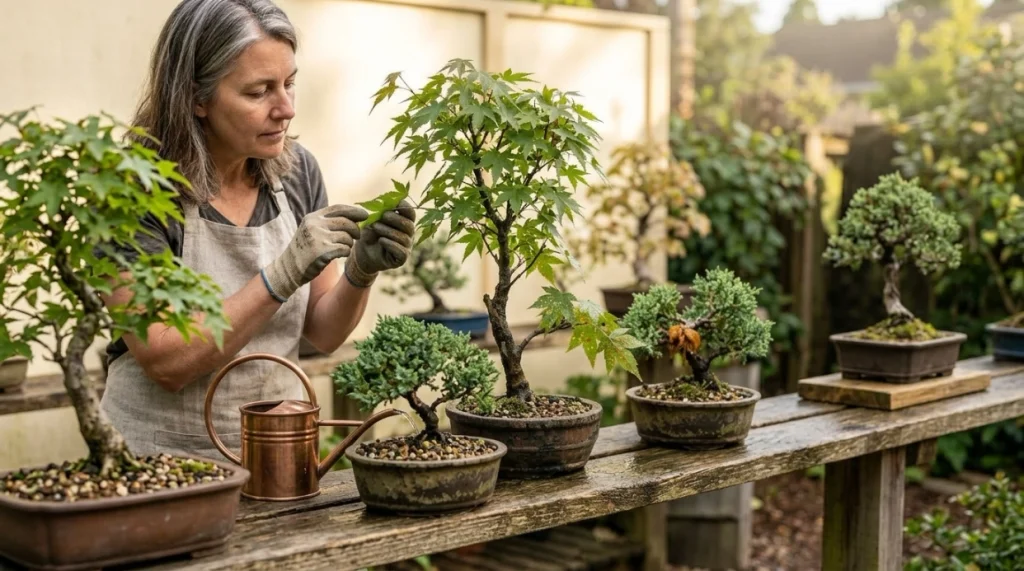
Rust prevention is mostly about limiting infection opportunities and catching symptoms early. You cannot control the weather, but you can control spacing, watering habits, sanitation, and host placement.
Keep foliage from staying wet unnecessarily
Rain is unavoidable on outdoor bonsai, and outdoor trees should not be sheltered simply to keep every leaf dry. The goal is to avoid creating extra hours of leaf wetness through poor watering habits.
Water the root zone thoroughly when the tree needs it. When possible, do this early enough for accidentally wet foliage to dry before prolonged nighttime humidity.
Create better airflow around the canopy
Crowded benches hold humid air around leaves and branches. Give trees enough space for natural air movement, especially during warm, rainy periods.
- Inspect weekly: Check leaf undersides, branch junctions, and old pruning sites.
- Remove fallen debris: Do not let diseased leaves accumulate around pots.
- Quarantine new trees: Observe recent purchases before placing them among an established collection.
- Know nearby hosts: Note apples, crabapples, hawthorns, pears, quince, and junipers around the growing area.
- Maintain vigor: Proper light, drainage, watering, and feeding help avoid unnecessary stress.
University of Maryland Extension recommends early inspection, better air circulation, and watering practices that allow foliage to dry. Those simple cultural controls are useful beyond rust because they reduce conditions that favor several foliar diseases.
One habit has proved especially useful on a bonsai bench: inspect the tree before grooming it. When you routinely turn the pot and examine the back branches, you often find suspicious lesions long before they dominate the canopy.
Frequently Asked Questions About Bonsai Rust
Can rust disease kill a bonsai tree?
It can seriously weaken a bonsai when infection is severe, repeated, or associated with branch dieback. Many foliar rust infections are manageable, but woody rust diseases on susceptible junipers can be harder to eliminate and may permanently damage important branches.
Should I remove every leaf with a rust spot?
Remove heavily infected leaves when the tree has enough healthy foliage to tolerate the loss. Avoid stripping a weak bonsai bare, because severe defoliation creates another source of stress and reduces the tree’s ability to photosynthesize.
Can rust spread from one bonsai to another?
Rust spores can spread, but host compatibility matters. Some rust fungi infect one host repeatedly, while others require two different host types to complete their life cycle, so nearby trees are not automatically equally susceptible.
Does orange color always mean rust?
No. Old foliage, nutrient problems, mites, sun damage, and other diseases can produce yellow, bronze, orange, or brown discoloration. Rust becomes more likely when you also find repeating lesions, raised pustules, colored spores, galls, or characteristic seasonal patterns.
Can I cure juniper rust with fungicide?
A fungicide may help protect susceptible tissue when correctly labeled and timed, but it should not be viewed as a guaranteed cure for established woody infection. Infected juniper branches may need pruning, and severe cases require careful evaluation.
Should I repot a bonsai that has rust?
Not automatically. Rust is usually a foliage or woody-tissue disease, so disturbing healthy roots may add unnecessary stress. Repot only when the root system or substrate has a separate problem, or when normal species-specific repotting timing makes it appropriate.
How long should I isolate a bonsai with suspected rust?
Keep it separated while active symptoms are developing and until you understand the diagnosis and disease cycle. Continue checking nearby compatible hosts because visible spots can appear after the original infection occurred.
The key takeaway is simple: orange spots alone do not prove rust, but orange spores, repeating lesions, or juniper galls deserve immediate attention. Confirm the pattern first, remove infection sources where practical, improve growing conditions, and use fungicides only when the disease and label support them.
Early diagnosis gives you the best chance of protecting both the infected bonsai and the rest of your collection. Make leaf and branch inspection part of normal watering and grooming, rather than waiting until a problem becomes obvious from across the bench.
