Mushy Bonsai Roots: Causes and Treatment

Quick Answer
Mushy bonsai roots usually mean root tissue has died and begun to decay, often after the root zone stayed wet and poorly aerated for too long. Check several roots before acting because healthy root color varies between species, and use established bonsai care guidance when deciding whether emergency root work is justified.
Signs that point toward damaged roots
- Soft texture: Damaged roots feel limp, weak, or mushy instead of firm.
- Dark tissue: Badly deteriorated roots often become brown or black inside.
- Outer layer slips: Severe decay may cause the soft outer tissue to pull away easily.
- Wet-soil wilting: The tree wilts even though the root ball remains damp.
- Poor drainage: Water remains in the substrate much longer than expected.
What to do first
- Stop watering by calendar and check moisture deeper in the pot before watering again.
- Make sure drainage holes are open before disturbing the roots.
- If decay is confirmed, remove only clearly dead tissue and move the tree into a more aerated substrate when repotting is necessary.
Mushy roots are one of the more alarming things you can find when checking a bonsai. They deserve attention, but they don’t automatically mean the entire tree is lost.
I look at texture, drainage, moisture, foliage, and the amount of healthy root tissue together. That gives a much better diagnosis than root color alone.
In This Guide
What do mushy bonsai roots mean?
Mushy bonsai roots mean that some root tissue has lost its normal firmness and is deteriorating. In many cases, prolonged saturation and poor oxygen movement around the roots are major contributing factors.
Definition: Root rot is a general term for deterioration of a plant’s root system, often involving disease organisms that take advantage of stressful, wet root conditions.
Healthy bonsai roots need both moisture and oxygen. A shallow pot does not protect a tree from waterlogging if the substrate has compacted or remains saturated.
Are brown bonsai roots always rotten?
No. Root color alone is an unreliable test because species, root age, soil particles, and staining can all change how roots look.
I rely more heavily on firmness. A root that is tan or brown but still strong may be alive, while a dark root that collapses between your fingers deserves closer inspection.
- Healthy roots: Firm and structurally intact.
- Fine growing roots: Often lighter near active tips.
- Questionable roots: Darker but still firm enough to resist gentle pressure.
- Decayed roots: Soft, limp, hollow, slimy, or easily stripped.
Why does the foliage wilt if the soil is wet?
A damaged root system cannot move water efficiently even when plenty of moisture surrounds it. That creates the confusing combination of wet soil and a wilting tree.
Yellow leaves, weak growth, or dieback can appear too. Those symptoms are not specific enough to diagnose root rot without checking the root zone.
What causes bonsai roots to become mushy?
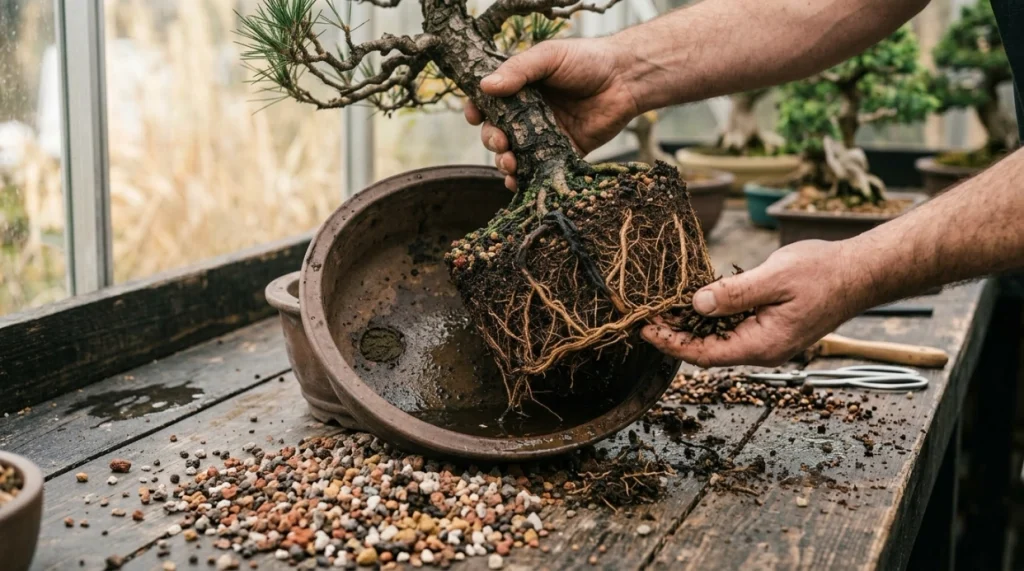
The most common pattern is not simply “too much water.” The deeper problem is a root zone that stays wet long enough to lose the air space healthy roots require.
1. Watering again before the substrate needs it
Watering on a fixed daily schedule can keep moisture levels too high. Bonsai should instead be checked individually because weather, species, pot size, and substrate all affect drying speed.
Cool or cloudy weather often slows water use. A watering routine that worked during hot weather may suddenly become excessive.
2. Compacted or moisture-heavy substrate
Fine organic material can settle and reduce the air spaces between particles. Water then drains slowly while oxygen movement through the root ball declines.
Granular bonsai substrates are designed to maintain structure. Common components include akadama, pumice, lava rock, fired clay, and other stable particles.
3. Blocked drainage holes
Roots, broken-down soil, mesh, or debris can obstruct a pot’s drainage openings. Water may then remain trapped in the lowest part of the container.
- Check that water exits freely after irrigation.
- Inspect drainage holes when runoff becomes unusually slow.
- Do not assume a pot drains well just because it has holes.
4. Root-rot pathogens
Several fungi and fungi-like organisms can attack weakened root systems. University horticulture resources describe groups such as Phytophthora, Pythium, Rhizoctonia, and Fusarium among recognized root-rot causes.
The University of Wisconsin horticulture resources are useful for understanding why soft brown roots and wet-soil wilting deserve closer investigation.
5. Seasonal stress and poor species care
A tree using little water will keep its substrate wet longer. Temperature, dormancy, indoor conditions, light, and species all change how quickly moisture leaves the pot.
That is why the same soil and watering routine may work for one tree but fail for another.
Section Takeaway: Mushy roots usually develop when poor drainage, excess moisture, root stress, and decay overlap. Fixing only the watering schedule may not solve a compacted substrate or blocked drainage problem.
How can you tell healthy roots from rotting roots?
Inspect several roots instead of judging the whole tree from one strand. Healthy and damaged roots can exist in the same root ball.
| Feature | Healthy or viable root | Dry or stressed root | Decaying root |
|---|---|---|---|
| Texture | Firm and intact | Dry, brittle, or shriveled | Soft, limp, or mushy |
| Color | White, cream, tan, or brown depending on species and age | Often dull or darkened | Often dark brown or black internally |
| Outer tissue | Stays attached | May be thin or dehydrated | May slide or peel away |
| Root-zone condition | Moist with visible air space | Excessively dry | Often persistently wet and poorly aerated |
Check the smell, but don’t rely on it
Severely decaying roots can develop an unpleasant or sour smell. However, the absence of odor does not prove that the roots are healthy.
Look at drainage before removing the tree
Pour water through the pot and observe how quickly it exits. Slow drainage or water pooling on the surface suggests that substrate structure deserves attention.
As of 2026, I still consider physical root inspection the strongest home-grower confirmation. Leaf yellowing by itself has too many possible causes.
How do you treat mushy bonsai roots?
Treatment should protect every healthy root that remains. Aggressive root pruning can turn a manageable problem into a severe recovery challenge.
Step 1: Stop automatic watering
Do not keep adding water because the foliage looks weak. First check whether the root ball is already wet below the surface.
Water again when the species and substrate indicate that moisture is needed. Avoid deliberately drying a moisture-loving tree to an extreme.
Step 2: Check drainage and pot condition
Confirm that each drainage hole is open. Remove any external blockage without disturbing the root ball unnecessarily.
If the soil is compacted into a dense mass, drainage correction alone may not be enough. Repotting may eventually be required.
Step 3: Inspect the roots carefully
Slide the tree from the container only when inspection is justified. Support the trunk and root ball instead of pulling the tree by its branches.
- Keep firm roots whenever possible.
- Identify sections that are unmistakably soft or decomposing.
- Work slowly around living feeder roots.
- Avoid removing healthy roots just because they are dark.
Pro tip: Root cutting is irreversible. If the tree is valuable, severely weakened, or an unfamiliar species, ask an experienced grower or local bonsai club for hands-on guidance before making major cuts.
Step 4: Remove clearly dead tissue when necessary
Use a clean, sharp tool to trim roots that are completely soft, hollow, or decomposed. Disinfect tools before moving to another tree.
The goal is not to produce a perfectly clean-looking root ball. Preserve the largest possible amount of functioning root tissue.
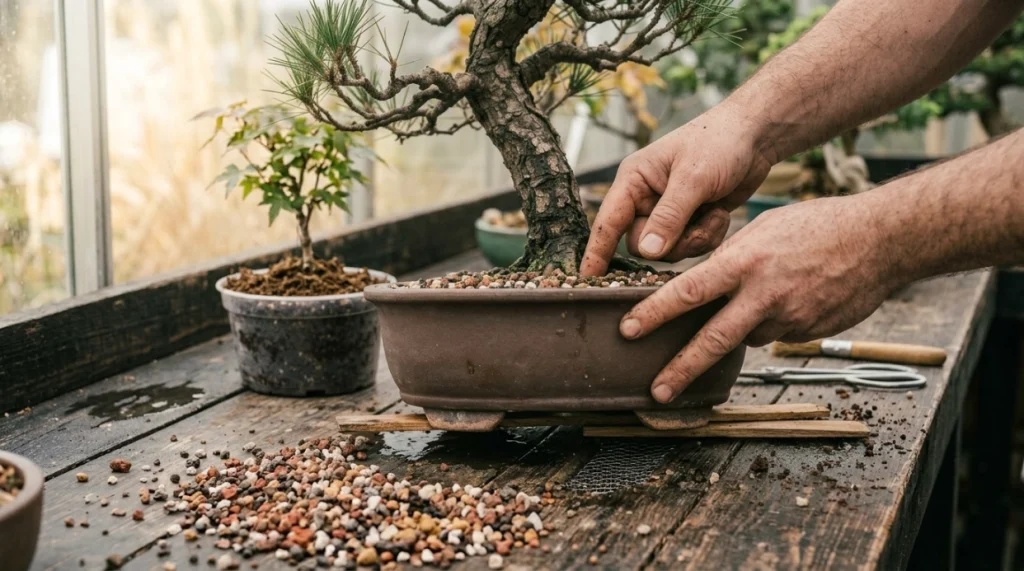
Step 5: Repot into an aerated substrate
A good bonsai substrate balances water retention with fast drainage and oxygen movement. The correct mix varies with species, climate, container depth, and your watering habits.
For many trees, akadama, pumice, and lava-based mixes provide a useful starting point. Local growers often substitute other stable granular materials when those components are unavailable.
Normal repotting is commonly timed around a species’ appropriate repotting season. Bonsai education groups such as the American Bonsai Society can also help growers locate experienced local clubs.
Step 6: Reduce stress during recovery
Give the tree conditions appropriate for its species rather than automatically placing it indoors or in deep shade. Outdoor bonsai species generally still need outdoor growing conditions.
- Avoid heavy fertilizer immediately after major root damage.
- Postpone wiring, defoliation, and major styling.
- Protect the tree from extreme heat or drying wind while roots recover.
- Keep monitoring moisture rather than returning to a fixed watering schedule.
Should you use fungicide?
I don’t treat fungicide as the first answer to every mushy root. Different pathogens require different management, and some root problems begin mainly with poor drainage rather than an identifiable disease.
If disease is strongly suspected, use only a product labeled for the plant and target problem. Follow the label exactly or seek a professional diagnosis.
Section Takeaway: Save healthy roots, correct the wet conditions that caused the problem, and repot only as aggressively as the situation requires. Recovery depends more on restoring a functional root environment than on removing every discolored root.
How do you prevent mushy roots from returning?
Prevention starts with controlling the balance between water and air. Good bonsai soil makes that balance easier to manage.
Water according to the tree, not the calendar
Check moisture daily when conditions are hot or changeable. That does not mean the tree must be watered every day.
Feel the substrate, check below the surface, and learn how quickly each pot dries. Small bonsai can change much faster than larger containers.
Protect soil structure
Replace badly compacted substrate during the correct repotting window. Particle size should suit the tree, pot, climate, and stage of development.
- Use stable particles that maintain air spaces.
- Avoid dense garden soil in shallow bonsai pots.
- Keep drainage openings functional.
- Adjust moisture retention for local heat and humidity.
Inspect newly purchased bonsai
Mass-market bonsai sometimes arrive in dense, moisture-retentive soil. Watch how quickly water penetrates and drains before deciding on a long-term watering routine.
I also isolate newly acquired trees for a period when practical. That makes pest and disease problems easier to notice before they affect the rest of a collection.
Frequently asked questions
Can a bonsai recover from mushy roots?
Yes, recovery is possible if enough healthy roots and living tissue remain. Correct the wet conditions, preserve viable roots, reduce additional stress, and watch for stable buds or new growth rather than expecting an immediate response.
Should I cut off every brown bonsai root?
No. Brown does not automatically mean dead. Keep roots that remain firm and structurally sound, and remove only tissue that is clearly soft, hollow, decomposing, or otherwise dead.
Should I repot a bonsai immediately if I find root rot?
Not every suspicious root requires an emergency repot. Severe active decay in saturated substrate may justify intervention, but mild problems can sometimes be stabilized until the normal repotting window.
Can overwatering cause mushy roots?
Repeated watering can contribute when it keeps the root zone saturated and low in oxygen. Drainage, substrate structure, temperature, light, species, and water use all influence whether frequent watering becomes harmful.
Do mushy roots always smell bad?
No. Advanced decay may produce an unpleasant smell, but odor is not required for root damage to exist. Root texture, moisture conditions, drainage, and the tree’s overall condition are more useful together.
Can I fertilize a bonsai after trimming rotten roots?
A heavily stressed tree usually benefits more from stable growing conditions than aggressive feeding. Wait for signs that the root system and new growth are functioning again before returning to the normal fertilizer program for that species.
How long does recovery from root damage take?
There is no fixed recovery time. Species, season, remaining root mass, temperature, light, and the severity of damage determine whether improvement appears within weeks or takes an entire growing period.
Final takeaway
Mushy bonsai roots are a warning that part of the root system is failing, but early intervention can make a major difference. Confirm the problem by checking texture and drainage before reaching for pruning tools.
Preserve every firm root you can, improve aeration, and stop watering by habit. Then give the tree stable species-appropriate care while it rebuilds its root system.
