
Why Is My Bonsai Soil Staying Wet?

Quick Answer
Bonsai soil usually stays wet because the mix drains too slowly, the drainage holes are blocked, the root mass is compacted, or the tree is using less water than expected. Before watering again, check below the surface and compare your setup with the drainage and aeration principles in this bonsai soil guide.
Common reasons bonsai soil stays wet
- Dense soil: Fine or broken-down particles leave too little air around the roots.
- Blocked drainage: Roots, compacted soil, or debris can slow water leaving the pot.
- Too much watering: Watering by schedule can keep an already moist root ball saturated.
- Cool conditions: Lower temperatures and weak light usually reduce water use.
- Oversized pot: A large volume of wet substrate can dry much slower than the roots need.
- Poor root health: Damaged roots may absorb less water, leaving the substrate wet longer.
What should you do first?
- Pause automatic watering, check moisture below the surface, confirm the drainage holes are open, and avoid emergency repotting unless the root system truly needs intervention.
Bonsai soil that stays wet for too long deserves attention, but it doesn’t automatically mean your tree has root rot. I first look at the entire growing setup before disturbing the roots.
Pot size, soil structure, weather, light, species, and season all affect drying speed. Here’s how I work through the problem without creating extra stress for the tree.
In This Guide
Why Does Bonsai Soil Stay Wet for So Long?
Bonsai soil stays wet when water enters the pot faster than evaporation, drainage, and root uptake can remove it. The cause may be the soil itself, but it can also come from your environment or watering routine.
Definition: Bonsai soil drainage is the ability of excess water to move through the root zone while the substrate keeps enough moisture and air available for healthy roots.
1. The soil has compacted
Fine potting soil can pack tightly inside a shallow bonsai container. Older organic material can also break down and fill spaces that once held air.
Water then moves slowly through the root ball. The surface may remain dark and damp long after watering.
2. You’re watering before the tree needs it
I don’t water a bonsai simply because another day has passed. I check the substrate first and adjust to the individual tree.
Bonsai watering guidance also emphasizes observing each tree rather than following one fixed daily schedule.
3. Temperature and light have changed
A bonsai in hot sun can use water rapidly. Move the same tree into cooler, cloudy weather and its water demand can fall noticeably.
- Cool autumn or winter temperatures can slow drying.
- Several cloudy days can reduce water use.
- Lower indoor light can slow active growth.
- High humidity can reduce evaporation.
4. The pot is holding more moisture than expected
Deep or oversized containers contain more substrate around the roots. Glazed pots can also lose less moisture through their sides than porous unglazed containers.
Neither feature is automatically bad. It simply changes how often you need to water.
How Can I Tell If My Bonsai Soil Is Too Wet?
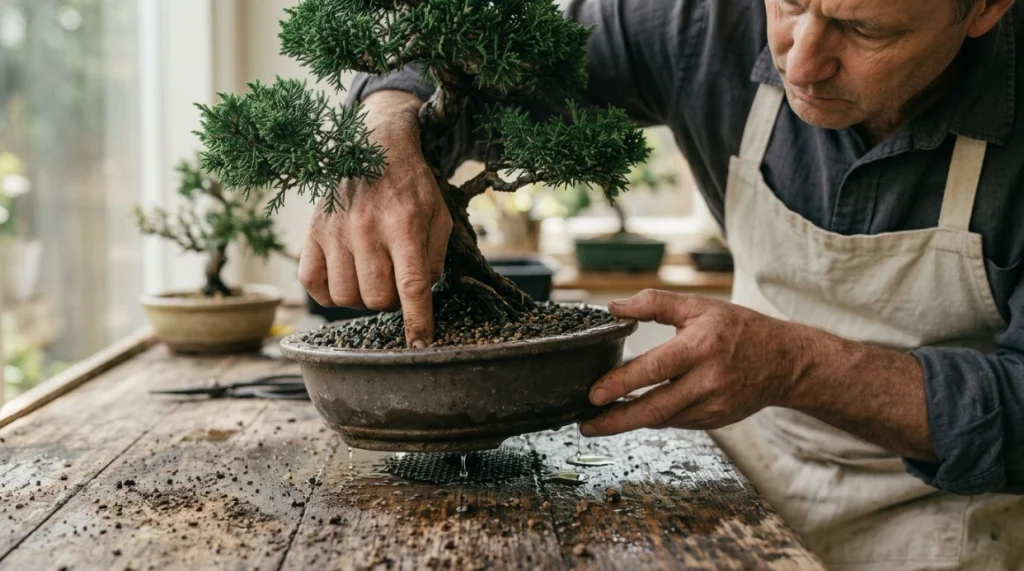
Wet soil becomes concerning when it stays saturated and poorly aerated rather than simply remaining moist. Look at drainage, smell, root condition, foliage, and recent weather together.
A single yellow leaf doesn’t diagnose overwatering. Several clues pointing in the same direction are much more useful.
| What you notice | Possible explanation | First check |
|---|---|---|
| Water pools on the surface | Compacted substrate or poor penetration | Soil structure and root density |
| Drainage is unusually slow | Blocked holes, fines, or dense roots | Bottom of pot and drainage mesh |
| Soil remains saturated during cool weather | Tree is using less water | Temperature, light, and watering frequency |
| Musty smell with weak growth | Possible declining root conditions | Moisture, drainage, and root health |
| Soft or decomposing roots | Root damage or rot may be present | Whether damaged tissue is widespread |
As a simple beginner check, I probe about 1 cm below the surface before deciding that a bonsai needs more water. Surface color alone can be misleading.
For container plants generally, the University of Minnesota Extension also advises maintaining moisture without leaving soil continuously soggy.
What Should I Check Before Repotting?
Don’t make repotting your first response to wet soil. A weak bonsai can be pushed backward by unnecessary root disturbance.
I work through these checks first.
- Stop watering automatically. Check whether the root ball is still moist before adding more water.
- Inspect every drainage hole. Make sure soil, roots, mesh, or the bench surface isn’t blocking water movement.
- Look underneath the pot. The drainage holes need open space below them.
- Empty standing water. Don’t leave an ordinary bonsai pot soaking in a full saucer.
- Check recent weather. Cool, humid, cloudy conditions can change drying time quickly.
- Evaluate the substrate. Look for mud-like fines, compacted peat, or particles that have broken down.
- Consider root density. A severely root-bound tree can sometimes drain unevenly because little functional substrate remains.
One mistake I see often is reacting to wilted foliage by immediately adding water. Damaged roots can leave foliage wilted even while the soil remains saturated.
The moisture reading matters more than the symptom alone. Check before you pour.
Can the Soil Mix or Bonsai Pot Cause the Problem?
Yes. Soil structure and container design strongly influence how quickly a bonsai root zone moves from wet to properly aerated.
A useful mix doesn’t need to become bone-dry instantly. It needs enough stable pore space for excess water to leave and fresh air to return.
Watch for soil that has lost structure
Common bonsai substrates include akadama, pumice, lava rock, fired clay, bark, and other coarse materials. The right blend depends on species, climate, pot size, and your watering habits.
- Akadama: Holds useful moisture but can break down gradually.
- Pumice: Adds pore space while retaining some moisture.
- Lava rock: Helps maintain a stable, open structure.
- Pine bark: Adds organic moisture retention but eventually decomposes.
- Fine organic soil: Can become too dense when used heavily in shallow bonsai pots.
Don’t copy a soil recipe blindly. A grower in a dry, windy climate may need more moisture retention than someone growing through a humid rainy season.
Check the pot as part of the system
A bonsai pot should have effective drainage openings. Drainage mesh should keep substrate inside without sealing those openings.
Also check where the pot sits. A flat surface can sometimes obstruct a hole that would drain freely on an open bench.
The National Bonsai & Penjing Museum is also a useful horticultural reference for understanding bonsai as living woody plants that need continual seasonal care rather than static decoration.
When Should I Repot a Bonsai That Stays Wet?
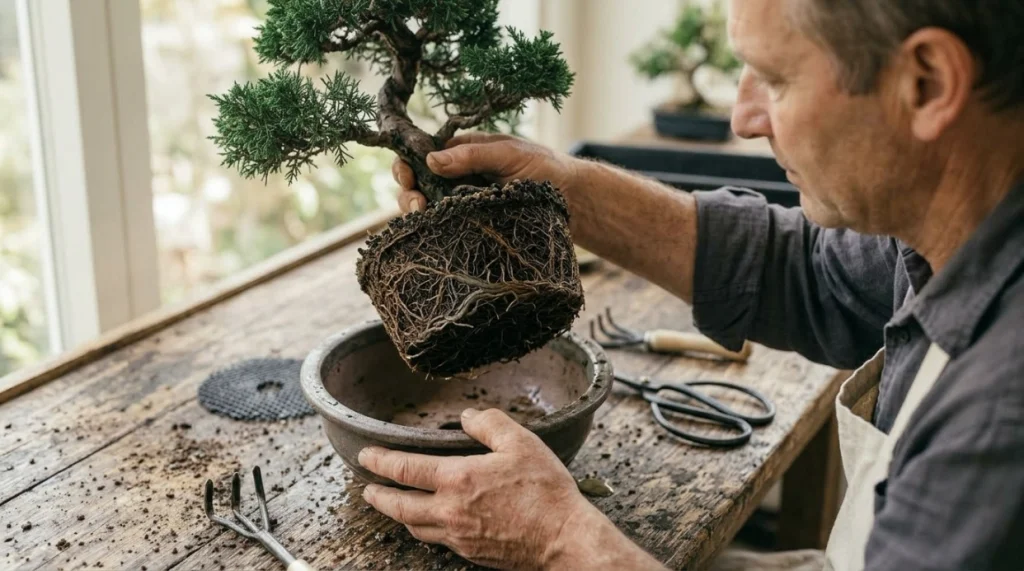
Repot when the underlying soil or root condition genuinely requires it, not simply because one watering took longer to dry. Timing also needs to suit the species and its growth cycle.
Repotting becomes more reasonable when several warning signs appear together.
- Water consistently struggles to enter or leave the root ball.
- The substrate has collapsed into dense, muddy material.
- Roots have packed the container so tightly that little usable substrate remains.
- Clearly dead, soft, or decomposing roots are present.
- The tree is declining despite corrected watering and drainage.
If the tree is healthy and the problem appeared after cooler weather arrived, changing your watering frequency may be enough. Don’t perform major root work just to make the pot dry faster.
If you do repot, remove only as much old substrate and root material as the species and situation safely allow. Follow proper seasonal timing whenever the situation isn’t an emergency.
Pro tip: Root pruning is irreversible. If you’re unsure how much root work your tree can tolerate, consult an experienced grower or local bonsai club before cutting live roots.
What should I do after correcting soggy soil?
Give the tree stable conditions and watch how the substrate behaves over several watering cycles. Avoid piling heavy fertilizing, major pruning, wiring, and root work onto a stressed tree at the same time.
In my own routine, drainage behavior becomes a useful baseline. Once I know how quickly a healthy root ball accepts and releases water, unusual changes become easier to spot.
Frequently Asked Questions
How long should bonsai soil stay wet after watering?
There is no universal number of hours or days. Drying time changes with species, temperature, humidity, light, pot size, root density, and substrate, so judge the moisture level and drainage rather than the calendar.
Should bonsai soil dry completely between waterings?
Usually not. Many bonsai need a balance where the substrate begins drying but doesn’t become completely desiccated throughout the root ball.
Species requirements differ, so learn the needs of your particular tree.
Can too much rain make bonsai soil stay wet?
Yes. Extended rain can keep a moisture-retentive substrate saturated much longer than normal, especially during cool weather.
Make sure drainage remains open and avoid adding routine irrigation while nature is already supplying enough water.
Does wet bonsai soil always mean root rot?
No. Wet soil is a condition, while root rot involves damaged or decomposing roots and may have several contributing causes.
Look for root deterioration, poor drainage, odor, weak growth, and persistent saturation before drawing conclusions.
Can I add sand to make wet bonsai soil drain faster?
Adding fine sand to an already dense mix can make compaction worse. Bonsai growers generally rely on appropriately sized granular components that preserve spaces between particles.
Why is my bonsai still wet even though I haven’t watered it?
Low light, cool temperatures, high humidity, dense soil, poor drainage, or reduced root activity may all slow moisture loss. Check those factors before assuming the tree simply needs more time.
Should I put my wet bonsai in direct sun to dry it?
Don’t suddenly expose a shade-acclimated or stressed tree to intense sun merely to dry the pot. Improve drainage and watering first, then provide the normal light conditions appropriate for that species.
What Should I Do Next?
If your bonsai soil is staying wet, start with the simplest fix: don’t water again until you’ve checked the substrate. Then confirm that water has a clear route through and out of the pot.
Next, consider weather, light, soil structure, pot size, and root health. Those factors usually explain why drying time has changed.
- Check moisture below the surface.
- Open blocked drainage holes.
- Remove standing drainage water.
- Adjust watering to current conditions.
- Evaluate whether the substrate has broken down.
- Repot only when the tree and root system truly need it.
As of 2026, that’s still the approach I trust most: diagnose the growing environment before reaching for drastic fixes. Good bonsai watering isn’t about keeping soil constantly wet or constantly dry; it’s about maintaining the right balance of moisture, drainage, and air around healthy roots.
