Can a Diseased Bonsai Recover?
Quick Answer
Yes, a diseased bonsai can often recover if enough healthy roots, branches, or foliage remain and you correct the underlying problem early. Recovery depends on the disease, tree species, root condition, season, and how much damage has already occurred. A sound bonsai care routine is usually more important than applying multiple treatments at once.
Check these signs first
- Living tissue: Green tissue beneath lightly scratched bark suggests that branch sections are still alive.
- Firm roots: Healthy roots are generally firm rather than soft, mushy, or decomposing.
- New buds: Fresh buds or shoots are among the strongest signs that recovery has started.
- Stable symptoms: Spots or dieback that stop spreading suggest the underlying problem may be controlled.
- Working drainage: Water should pass through the root ball instead of leaving it permanently saturated.
Most important recovery rule
- Identify the likely cause before pruning roots, applying pesticides, adding fertilizer, or repotting a stressed tree.
Seeing a bonsai suddenly develop yellow leaves, brown patches, weak shoots, or dying branches can be alarming. I’ve learned that the worst response is often trying five treatments before identifying the problem.
A sick-looking bonsai is not always suffering from an infectious disease. Watering mistakes, damaged roots, excessive heat, poor light, pests, fertilizer injury, and seasonal changes can produce similar symptoms.
In This Guide
Can a Diseased Bonsai Really Recover?
Yes. Many bonsai can recover from early disease, mild pest damage, watering stress, and some root problems when the cause is corrected before extensive tissue dies.
The word disease needs some clarification. Plant disease means a harmful biological process affecting the tree, often involving fungi, bacteria, viruses, or fungus-like organisms called oomycetes.
Growers also use “sick bonsai” more loosely. That description may include environmental problems that are not infectious at all.
- Good recovery potential: Limited leaf spots, minor mildew, light pest damage, temporary drought stress, or early drainage problems.
- Moderate recovery potential: Significant defoliation, several damaged branches, prolonged overwatering, or a weakened root system.
- Poorer recovery potential: Extensive trunk decay, severe root loss, widespread vascular disease, or most branches becoming dry and brittle.
A bonsai’s small container makes changes in moisture and root conditions happen quickly. Bonsai Empire also notes that trees in small pots have limited reserves of water and nutrients.
That works both ways. Problems can develop fast, but correcting growing conditions early can also give the remaining healthy tissue a chance to recover.
I pay more attention to living buds and firm roots than damaged old leaves. Old scars may stay visible long after the tree has started improving.
What Is Making Your Bonsai Sick?
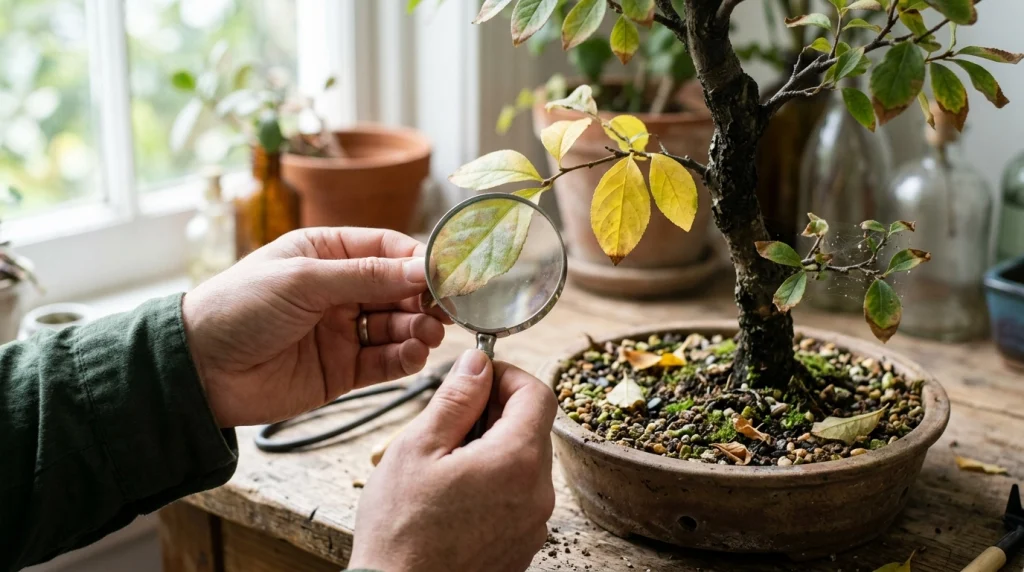
Start by separating infectious disease from pests and ordinary care stress. Similar symptoms can come from completely different causes.
A useful diagnosis combines the symptom, where it appears, how quickly it spreads, soil condition, recent care changes, and the species involved.
| What You See | Possible Cause | What to Check Next |
|---|---|---|
| Yellow leaves with constantly wet soil | Root stress, poor drainage, overwatering | Drainage holes, soil structure, root firmness |
| White powder on foliage | Possible powdery mildew | Repeated coating on leaves and young shoots |
| Sticky leaves or bumps on stems | Possible scale or other sap-feeding pests | Leaf undersides, branch forks, insects |
| Fine webbing and stippled foliage | Possible spider mites | Undersides of leaves and a white-paper tap test |
| Wilting while soil stays wet | Damaged roots or root disease | Root condition before adding more water |
| Brown edges after hot sun | Heat or sun scorch | Recent relocation and sun exposure |
Check what changed before symptoms appeared
Look back one or two weeks before the decline became obvious. A recent change often gives you the strongest clue.
- Was the tree repotted or root-pruned?
- Did you move it from shade into strong sun?
- Did temperatures rise sharply?
- Was fertilizer recently applied?
- Has the soil been staying wet longer?
- Did a new plant join the collection?
- Was the bonsai moved indoors?
Plant disease specialists at the University of Wisconsin recommend well-drained growing media, sanitation, and avoiding overwatering when dealing with bonsai root and crown diseases.
The American Bonsai Society also provides educational resources and access to clubs, which can be useful when a diagnosis is uncertain. Visit the American Bonsai Society for club and learning resources.
Section Takeaway: Diagnose the pattern before treating it. A yellow leaf is a symptom, not a diagnosis.
How Do You Save a Diseased Bonsai?
The safest recovery plan is usually simple: reduce stress, correct the cause, protect healthy tissue, and give the tree time. Avoid stacking several stressful treatments together.
1. Isolate the tree when infection or pests are possible
Move a suspicious bonsai away from healthy trees while you inspect it. Isolation helps reduce the chance of pests or infectious material moving through your collection.
Keep the tree in conditions suitable for its species. Do not place an outdoor bonsai in a dark indoor room just because it is isolated.
2. Check moisture before watering again
Never respond automatically to wilt by adding water. Damaged roots can leave foliage wilted even while the pot remains saturated.
- Feel or inspect the growing medium.
- Confirm drainage holes are open.
- Check whether water penetrates the root ball.
- Water according to moisture need, not a fixed calendar.
3. Remove obvious sources of infection carefully
Remove fallen leaves, dead twigs, and badly infected debris when appropriate. Use clean tools and avoid stripping large amounts of healthy foliage from a weak tree.
Clean tools between plants when disease is suspected. The University of Wisconsin Division of Extension horticulture program is a useful source for established plant-health guidance.
4. Improve airflow and species-appropriate light
Crowded foliage and stagnant air can favor some foliar diseases. Space trees enough for air to move around the canopy.
Light must match the species. A juniper and a tropical ficus should not receive identical indoor-outdoor care simply because both are bonsai.
5. Treat only what you can reasonably identify
Do not spray an insecticide for a fungal problem or apply fungicide because one leaf turned brown. Treatments should match the suspected pest or disease and the product label.
As of 2026, my preferred approach remains symptom-first. I would rather spend an extra day inspecting leaves, roots, and watering history than stress a declining tree with an unnecessary treatment.
Section Takeaway: Stabilize the tree before trying to make it grow aggressively. Recovery depends on removing the cause, not forcing new growth.
Should You Repot or Prune a Sick Bonsai?
Not automatically. Repotting and heavy pruning are stressful, so either can make a weak bonsai worse when the root zone is not the real problem.
Repotting becomes more reasonable when there is strong evidence that drainage, decomposed substrate, severe root damage, or root disease is driving the decline.
When root inspection may be justified
- Soil remains saturated for unusually long periods.
- Water no longer moves through the root ball correctly.
- The tree wilts while the soil stays wet.
- A rotting smell comes from the container.
- Visible roots are soft, dark, or decomposing.
- The substrate has physically broken down.
Healthy root color varies between species and growing media. Texture is often more useful, because functioning roots should generally feel firm rather than mushy.
If dead root tissue must be removed, preserve as much functioning root mass as possible. Do not turn emergency treatment into an aggressive styling session.
Pro tip: Root pruning and major branch removal are irreversible. For a valuable tree, severe root disease, or an unfamiliar species, consult an experienced grower or local bonsai club before cutting extensively.
Should you fertilize a sick bonsai?
Heavy fertilizer is not medicine for a stressed root system. If roots cannot function normally, pushing strong feeding may add another problem.
Resume an appropriate feeding schedule after the tree stabilizes and active growth returns. Species, season, substrate, and fertilizer type all matter.
University of Wisconsin plant-disease material specifically identifies drainage and overwatering as important considerations in bonsai root and crown rot management.
Section Takeaway: Repot because the root zone requires intervention, not simply because the foliage looks unhealthy.
How Do You Know a Bonsai Is Recovering?
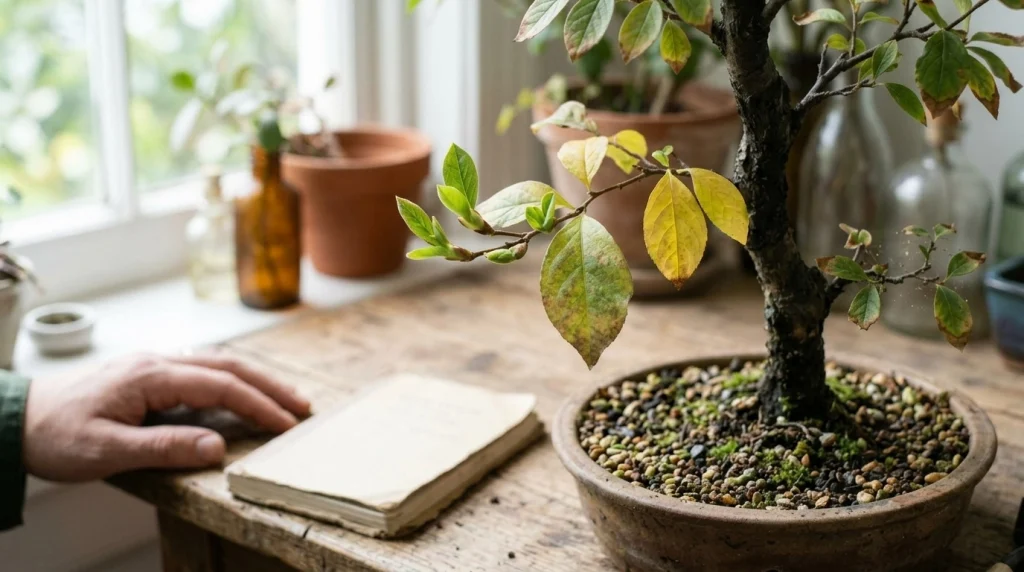
Watch new growth rather than expecting damaged old tissue to become perfect again. New buds, firm shoots, stable foliage, and halted dieback are more meaningful recovery signs.
Good signs to watch for
- New buds swell: Dormant buds begin opening normally.
- Fresh leaves stay healthy: New foliage appears without repeating the original symptom.
- Dieback stops: Damage no longer advances into healthy twigs.
- Water use normalizes: Soil begins drying at a more typical rate for the tree.
- Roots remain firm: Visible or safely inspected roots no longer show expanding decay.
- Pests disappear: Repeated inspections reveal no rebuilding infestation.
How long does bonsai recovery take?
There is no single recovery timetable. A tree recovering from mild leaf damage may improve within weeks, while one rebuilding a compromised root system may need much of a growing season.
Species and season matter as much as severity. A deciduous tree approaching dormancy may show little visible growth even after you correct the problem.
Evergreen foliage can also retain discoloration long after the cause is gone. Judge the direction of the tree’s health rather than waiting for old damage to disappear.
Use a simple weekly recovery record
- Photograph the tree from the same angle.
- Record when you water.
- Note new buds or leaves.
- Mark any branch dieback.
- Check pests under leaves and around branch joints.
- Record treatments and dates.
Photos prevent you from relying on memory when changes happen slowly. They also help a club member or horticulture professional understand the progression.
Section Takeaway: Healthy new growth and stopped decline matter more than cosmetic improvement in old leaves.
Frequently Asked Questions
Can a bonsai recover after losing all its leaves?
Sometimes. Deciduous trees can naturally lose leaves, while stressed trees may defoliate and later bud again if branches and roots remain alive. Evergreen species losing all foliage is usually more concerning, so confirm the species and inspect living tissue before assuming recovery is impossible.
Can a bonsai recover from root rot?
Recovery is possible when enough healthy roots remain and the cause is corrected early. Improve drainage, stop watering on a fixed schedule, and remove only clearly dead roots when root work is necessary. Advanced decay involving most of the root system has a much poorer outlook.
Should I cut dead branches off a sick bonsai immediately?
Clearly dead material can often be removed, but avoid major structural pruning while the tree is weak. When you are uncertain whether a branch is alive, wait for stronger evidence before making an irreversible cut.
Should I put a sick bonsai indoors?
Only if that environment suits the species. Outdoor trees such as many junipers, pines, and maples generally still need outdoor conditions. Moving them indoors can create extra light, humidity, and temperature stress instead of helping them recover.
Will fertilizer help a diseased bonsai recover faster?
Not necessarily. Fertilizer supplies nutrients but does not cure root rot, fungal disease, pests, or damaged roots. Correct the underlying problem first, then return to normal species-appropriate feeding once active recovery is visible.
How can I tell whether my bonsai is already dead?
Check several branches rather than judging one twig. Living tissue may appear green beneath a very lightly scratched surface, while dead twigs become dry and brittle. Root condition and bud activity provide additional clues.
When should I ask an expert for help?
Seek experienced help when decline continues despite corrected care, most roots appear damaged, trunk tissue is decaying, or you are considering major emergency root work. The American Bonsai Society lists bonsai resources and clubs where local expertise may be available.
Final Takeaway
A diseased bonsai can recover, and many struggling trees are more resilient than they first appear. The key is acting early without reacting aggressively.
Start with diagnosis. Check water, drainage, roots, light, recent care changes, pests, and the pattern of symptoms before choosing a treatment.
- Keep care stable.
- Protect healthy foliage and roots.
- Correct drainage or watering problems.
- Isolate possible pest or disease cases.
- Avoid unnecessary repotting and heavy pruning.
- Watch new growth for evidence of recovery.
If the tree is still producing healthy buds, maintaining firm roots, or holding living branches, give it time. Bonsai recovery is usually a gradual process, not an overnight change.
