When Should You Remove a Diseased Bonsai?
Quick Answer
Remove a diseased bonsai when the infection is severe, continues spreading after proper treatment, has reached major roots or trunk tissue, or poses a serious infection risk to nearby trees. Before discarding it, isolate the tree and confirm that the problem is truly disease rather than watering stress, dormancy, or another correctable issue using a reliable bonsai pest and disease guide.
Signs removal may be the safest choice
- Rapid spread: New branches, leaves, or roots keep becoming infected despite treatment.
- Trunk damage: Rot, cankers, or dead tissue surrounds a major part of the trunk.
- Root collapse: Large sections of the root system are dark, soft, foul-smelling, or dead.
- Confirmed serious disease: A diagnosed pathogen has no practical treatment and threatens other trees.
- No living tissue: Branches are brittle and the cambium beneath the bark is brown rather than green.
Before removing it
- Move the bonsai away from healthy trees, identify the problem, sanitize tools, and decide whether targeted pruning or treatment still has a realistic chance of working.
A sick bonsai can look far worse than it truly is. I’ve seen stressed trees drop most of their leaves and still recover once the real cause was corrected.
The difficult part is knowing when recovery is realistic and when keeping the tree creates unnecessary risk. This guide explains the difference.
In This Guide
- When should you remove a diseased bonsai completely?
- Should you quarantine a sick bonsai before removing it?
- How do you tell whether a diseased bonsai can still be saved?
- When should you remove diseased branches instead of the whole tree?
- How should you dispose of a badly diseased bonsai?
- How can you protect the rest of your bonsai collection?
- Frequently asked questions
When Should You Remove a Diseased Bonsai Completely?
You should remove the whole bonsai when the disease has become systemic, recovery is no longer realistic, or the tree threatens healthier specimens nearby. A few spotted leaves alone usually aren’t enough reason.
The first thing I look at is how quickly the symptoms are moving. A problem that stays limited to one twig is very different from one spreading through the crown in days.
- Remove the tree if trunk rot is extensive. Soft, collapsing, or deeply discolored trunk tissue can indicate severe decay.
- Remove it if most structural roots are dead. A bonsai cannot recover without enough functioning roots to absorb water and oxygen.
- Remove it if a confirmed disease has no practical control. This matters most when several valuable trees share the same growing area.
- Remove it if repeated treatment fails. Continued spread after appropriate care suggests the infection is beyond localized management.
- Remove it if the tree is already dead. Dry, brittle branches and brown tissue beneath lightly scratched bark are strong warning signs.
Bonsai Empire notes that stressed trees can resemble dying trees, so identification matters before disposal. Watering problems, poor light, and root stress can create similar symptoms.
That distinction has saved more than one tree in my own collection. I once had a Chinese elm shed nearly every leaf after a watering mistake, yet the branches stayed flexible and green beneath the bark.
What counts as a severe infection?
A severe infection affects essential tissues rather than only cosmetic foliage. Think trunk, major roots, primary branches, or a large percentage of the canopy.
| Condition | Typical action | Risk level |
|---|---|---|
| A few spotted leaves | Isolate, diagnose, monitor | Usually manageable |
| One infected twig | Prune affected tissue if appropriate | Moderate |
| Disease spreading across several branches | Quarantine and treat promptly | High |
| Major root or trunk decay | Consider complete removal | Very high |
Section Takeaway: Limited symptoms can often be managed, but widespread trunk or root disease changes the decision. Protecting healthy trees may become more important than saving one severely compromised bonsai.
Should You Quarantine a Sick Bonsai Before Removing It?
Yes. Isolate a suspicious bonsai as soon as you notice unexplained spotting, dieback, fungal growth, unusual insects, or rapidly worsening symptoms.
Quarantine gives you time to diagnose the problem without exposing the rest of your collection. It also makes monitoring easier.
- Move the tree away from other bonsai.
- Avoid letting foliage touch neighboring plants.
- Use separate tools when possible.
- Water carefully to reduce splashing between pots.
- Inspect nearby trees for matching symptoms.
- Clean your hands and tools after handling the sick tree.
The University of Minnesota recommends regular disease inspection and removing infected plant material when needed. It also emphasizes airflow, dry foliage, and sanitation as key disease-management practices.
Those same principles translate well to a bonsai bench. Small pots sit close together, so careless handling can move contaminated water, soil, or debris quickly.
How long should quarantine last?
There isn’t one universal quarantine period for every pathogen. Keep the bonsai separated until you understand the cause and the symptoms have stopped progressing after treatment.
I prefer diagnosis over arbitrary waiting periods. A fungal leaf spot, root rot problem, and insect infestation need different timelines and different controls.
How Do You Tell Whether a Diseased Bonsai Can Still Be Saved?
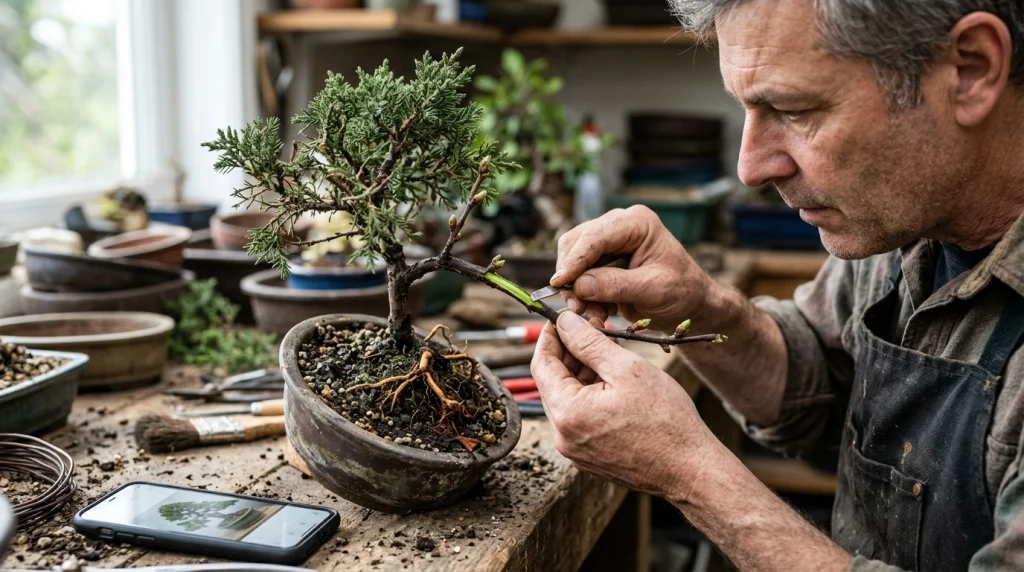
A bonsai is worth treating when it still has substantial live tissue, functioning roots, and a disease that can reasonably be controlled. Start with basic health checks before doing aggressive work.
Check whether the tree is still alive
Lightly scratch a tiny section of bark on a questionable branch. Green or moist tissue underneath usually means that section is alive.
Also check buds and branch flexibility. Dry branches that snap cleanly throughout the entire tree are a worse sign.
Inspect the roots only when necessary
Healthy roots are generally firm rather than slimy or collapsing. Root color varies by species, so texture and smell can be more useful than color alone.
Extensive soft, foul-smelling root tissue is concerning. A tree with only minor root damage may still recover with corrected watering and drainage.
Look for new progression
Mark or photograph affected areas so you can compare them later. If lesions, dieback, or discoloration keep advancing, the problem remains active.
- Good sign: No new symptoms appear after treatment.
- Good sign: Buds swell or new growth starts.
- Warning sign: Fresh branches die each week.
- Warning sign: Trunk lesions continue expanding.
- Warning sign: Roots continue deteriorating despite corrected care.
As of 2026, extension guidance still stresses early identification because severe plant disease becomes harder to manage once large amounts of tissue are affected. The University of Minnesota Extension disease-management guidance also recommends removing badly affected material when appropriate.
For an important or old tree, I’d get a second opinion before discarding it. A local bonsai club, horticulturist, or plant disease clinic may spot something you missed.
Section Takeaway: Don’t judge a bonsai by leaf loss alone. Living cambium, stable symptoms, viable roots, and new buds all improve the case for continued treatment.
When Should You Remove Diseased Branches Instead of the Whole Tree?
Remove individual diseased parts when the problem is clearly localized and healthy tissue remains beyond the affected area. This can stop some infections from producing or spreading more inoculum.
For example, tip blight on a juniper may begin on individual shoots rather than the entire plant. Localized pruning may therefore make sense when diagnosis supports it.
- Identify the affected branch and confirm that pruning is appropriate for the suspected disease.
- Cut back into healthy tissue when disease-management guidance calls for it.
- Remove fallen leaves, dead needles, and infected debris from the soil surface.
- Disinfect tools before moving to another tree.
- Watch the remaining canopy closely for new symptoms.
Pro tip: Cutting live bonsai branches is irreversible. If the affected limb is important to the design or you’re unsure where disease ends, consult an experienced grower or local bonsai club before making a major cut.
Don’t strip a weak tree simply because several leaves look damaged. University of Minnesota guidance notes that removing too much foliage can place additional stress on a plant.
A weak bonsai needs enough healthy foliage to photosynthesize and rebuild reserves. Prune disease, not panic.
How Should You Dispose of a Badly Diseased Bonsai?
Dispose of a severely infected bonsai in a way that prevents contaminated tissue, roots, or soil from returning to your growing area. Avoid casually dropping diseased debris beneath the bench.
- Bag infected foliage and branches before carrying them through the collection.
- Keep suspect soil away from healthy bonsai containers.
- Clean the pot thoroughly before reusing it.
- Sanitize cutting and root tools.
- Wash the working surface after cleanup.
- Follow local disposal rules for diseased plant material.
Composting diseased material is risky unless your composting process reliably reaches temperatures capable of destroying the pathogen involved. Home piles often don’t heat evenly enough.
Penn State Extension also emphasizes strict sanitation for serious bacterial diseases, including cleaning tools, benches, pots, and other reusable equipment. You can review its broader ornamental plant disease sanitation guidance for context.
Can you reuse the bonsai pot?
Usually, yes, but clean and disinfect it before planting another tree. Remove all old root fragments and soil first.
Porous unglazed pots deserve extra attention because organic material can lodge in textured surfaces. Let the pot dry fully after cleaning.
How Can You Protect the Rest of Your Bonsai Collection?
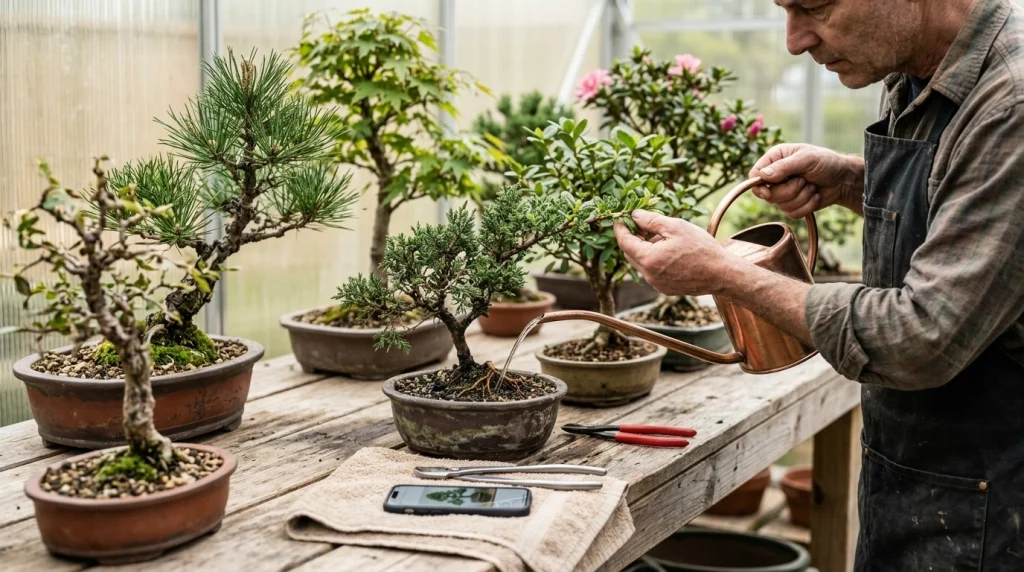
Prevention starts with hygiene and observation. Disease management is much easier when you find a problem on one leaf instead of twenty branches.
- Inspect weekly: Look at leaf surfaces, branch tips, bark, soil, and drainage holes.
- Improve airflow: Avoid crowding foliage tightly together.
- Water carefully: Reduce unnecessary splashing between pots.
- Clean tools: Sanitize shears and cutters after working on suspicious tissue.
- Remove debris: Dead leaves and infected material should not accumulate beneath trees.
- Match care to species: Incorrect light, watering, and soil can weaken a tree and make disease harder to manage.
The U.S. National Arboretum’s National Bonsai & Penjing Museum maintains living bonsai as horticultural specimens that need continual care throughout the seasons. That principle matters at home too.
I’ve found that the simplest habit is also the most useful: look closely at every tree while watering. A ten-second inspection often catches problems before they become removal decisions.
Section Takeaway: Quarantine, sanitation, airflow, correct watering, and frequent inspection reduce the chance that one sick bonsai becomes a collection-wide problem.
Frequently Asked Questions
Can a diseased bonsai recover completely?
Yes. Many bonsai recover when disease is caught early and the underlying cause is correctly identified. Recovery depends on the pathogen, species, amount of healthy tissue remaining, and whether root and trunk damage has occurred.
Should I throw away a bonsai with fungal leaf spots?
Not automatically. Localized fungal leaf problems can often be managed with isolation, improved airflow, sanitation, removal of affected material, and an appropriate treatment when needed.
Can a bonsai with root rot be saved?
Sometimes. A tree with limited root damage may recover if drainage and watering are corrected, but extensive loss of structural and feeder roots greatly reduces its chances.
Should I remove all infected leaves at once?
No. Removing excessive foliage from an already weak bonsai can create additional stress. Remove only what disease-management guidance supports, and preserve healthy foliage whenever possible.
How do I know whether my bonsai is dead or dormant?
Check small branches for flexibility, swelling buds, and green tissue beneath a lightly scratched patch of bark. Dormant deciduous bonsai can appear lifeless during winter while remaining healthy.
Can disease spread from one bonsai to another?
Yes. Some fungal, bacterial, viral, and pest problems can move through water splash, contaminated tools, plant contact, soil, insects, or infected debris. Isolation and sanitation reduce that risk.
When should I ask an expert before removing a bonsai?
Get expert help when the tree is old, valuable, difficult to replace, or showing symptoms you cannot identify. A bonsai club, extension service, horticulturist, or plant disease clinic may help confirm the diagnosis.
Final Takeaway
Remove a diseased bonsai only when the infection is severe, uncontrollable, structurally destructive, or dangerous to the rest of your collection. Mild disease, leaf loss, or temporary stress does not automatically mean the tree is finished.
My rule is simple: isolate first, diagnose second, and remove last. That gives a recoverable tree a fair chance without putting healthy bonsai at unnecessary risk.
