Bonsai Disease Causing Branch Dieback: How to Diagnose and Save Your Tree

Quick Answer
A bonsai disease causing branch dieback may involve a canker, root disease, vascular wilt, or another fungal infection. However, drought, waterlogged roots, damaged branches, wire injury, and temperature stress can create similar symptoms, so diagnosis should come before treatment. A useful starting point is this bonsai pests and diseases guide.
Signs I Check First
- Localized dieback: One branch dies while nearby branches remain healthy.
- Sunken bark: A discolored, cracked, or depressed patch can indicate a canker.
- Wet-soil wilting: Wilting while the soil stays wet points toward damaged or diseased roots.
- Internal streaking: Dark discoloration beneath bark may occur with some vascular diseases.
- Progressive decline: Dieback that keeps moving toward the trunk deserves immediate attention.
Best First Move
- Isolate the tree, inspect the complete branch and root zone, and avoid spraying anything until you have narrowed down the cause.
Branch dieback is one of the bonsai problems I take most seriously because a tree can lose an important design branch before the underlying problem becomes obvious.
The difficult part is that disease is only one possibility. In this guide, I’ll show you how to separate infectious disease from root trouble, watering stress, physical damage, and other common causes.
In This Guide
What Does Branch Dieback Mean on a Bonsai?
Branch dieback means living tissue progressively dies from a shoot tip, section of branch, or other localized area. Leaves or needles often decline first, followed by twigs and woody tissue.
Dieback is a symptom, not a diagnosis. That distinction matters.
Definition: Branch dieback is the death of shoots, twigs, or branches that were previously alive. Disease, root failure, environmental stress, pests, physical damage, or vascular disruption can all cause it.
What does early branch dieback look like?
The first change may be subtle. New growth can stop extending before the foliage changes color.
I look for a pattern rather than one damaged leaf.
- Leaves on one branch wilt while the rest of the canopy remains firm.
- Needles fade, brown, or fall from one shoot.
- A branch tip becomes dry and brittle.
- Buds fail to swell during the normal growing period.
- Bark changes color near the base of the affected branch.
- A dark, cracked, or sunken lesion develops on the stem.
Is a dead branch always evidence of disease?
No. Bonsai branches can die from dehydration, root loss, freezing, excessive heat, broken tissue, wire damage, poor light, or a compromised branch junction.
That is why I never treat “dieback” as the name of a disease. I treat it as the starting clue.
As of 2026, sound plant diagnosis still relies heavily on examining patterns, recent care, environmental conditions, and the progression of symptoms.
Section Takeaway: Branch dieback describes what the tree is doing, not why it is happening. The pattern and location of damage provide the first useful diagnostic clues.
How Can You Tell Disease From Watering or Environmental Stress?
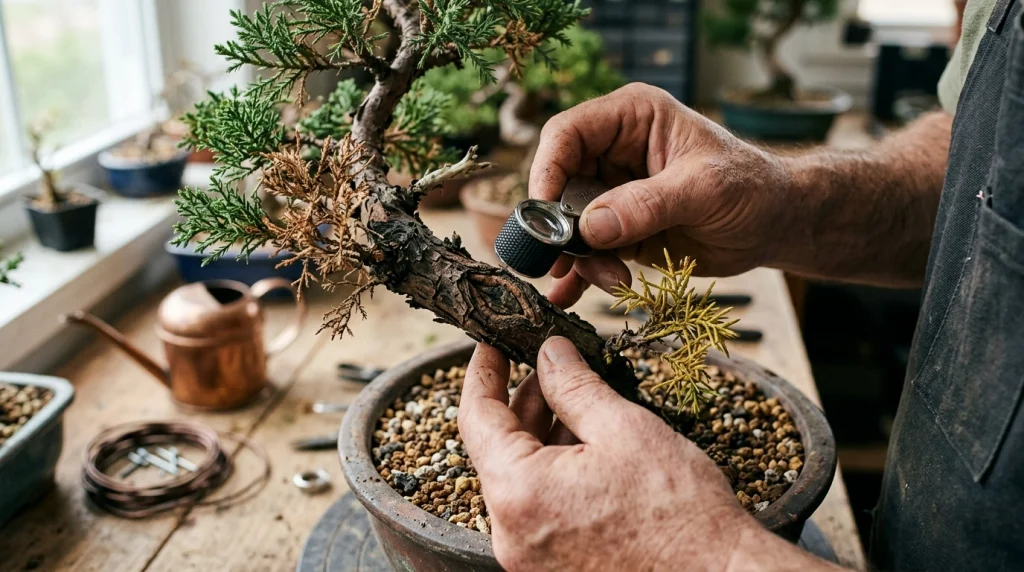
Disease becomes more suspicious when symptoms progressively spread through connected tissue or produce recognizable lesions, fungal structures, or vascular discoloration.
Stress problems often line up more closely with a recent change in watering, temperature, repotting, light, fertilizer, or physical damage.
Penn State Extension recommends considering cultural and environmental causes alongside pests and pathogens when diagnosing a plant problem.
| Pattern | Possible Cause | What to Check First |
|---|---|---|
| One branch dies beyond a sunken bark lesion | Canker or localized infection | Bark at the transition between healthy and dead tissue |
| Whole tree wilts while soil remains wet | Root damage, waterlogging, or root disease | Drainage, soil aeration, and root firmness |
| Several exposed tips dry during hot weather | Heat, wind, or drought stress | Recent weather and soil moisture |
| Branch declines directly below tight wire | Mechanical or vascular injury | Wire grooves and swollen bark |
| One side wilts with internal sapwood discoloration | Possible vascular disease | Species susceptibility and professional diagnosis |
Check the recent history before blaming fungus
I start by thinking back seven to fourteen days. A recent event often explains more than the appearance of one leaf.
- Was the bonsai recently repotted?
- Were substantial roots removed?
- Did the pot dry completely?
- Has the substrate remained saturated?
- Was the tree moved into stronger sun?
- Did temperatures suddenly rise or fall?
- Was fertilizer applied to a stressed tree?
- Has wire begun cutting into a branch?
Look at where healthy tissue meets damaged tissue
The border between healthy and declining wood is often the most informative area. Check it closely with good light and, if available, a 10× hand lens.
Sunken bark, cracking, unusual coloration, fruiting structures, or a sharp transition from healthy to dead tissue strengthens the case for a localized disease.
Section Takeaway: Diagnose the pattern before treating the symptom. Recent care history plus the transition between healthy and damaged tissue usually provides better clues than leaf color alone.
Which Bonsai Diseases Can Cause Branch Dieback?
Cankers, root diseases, and vascular diseases are among the more important disease categories associated with branch dieback.
The exact pathogen depends on the bonsai species, climate, season, and growing conditions.
Canker diseases
A canker is a localized area of dead bark and underlying tissue. When a canker interrupts enough conductive tissue, the branch beyond it may wilt and die.
Typical warning signs include:
- Sunken bark
- Cracked areas
- Unusual dark or reddish discoloration
- Dead tissue extending from a wound
- Dieback beyond the affected bark
- Occasional resin or sap around damaged tissue
Cytospora is one example of a canker disease affecting several woody hosts. Colorado State University Extension emphasizes reducing stress, sanitation, and removing infected limbs when managing Cytospora canker.
A particular pathogen should not be diagnosed from appearance alone. Different cankers can look surprisingly similar.
Root diseases and root decay
Root trouble can cause branch dieback even when nothing unusual appears on the branch itself.
Damaged roots cannot provide normal water uptake. Individual branches or the whole canopy may begin declining as root function drops.
- Persistent wilting despite wet soil
- Weak spring growth
- Yellowing foliage
- Premature leaf loss
- Multiple dying branches
- Dark, soft, or easily damaged feeder roots
- Sour or unpleasant-smelling substrate
Constantly saturated soil deserves special attention. Poor aeration can damage roots directly and may also favor moisture-related root pathogens.
Vascular wilt diseases
Vascular diseases interfere with tissues that transport water through a tree. Verticillium wilt is one example that affects susceptible woody plants.
University of Minnesota diagnostic guidance notes that Verticillium symptoms on susceptible hosts may occur on only one or several branches, sometimes with dark discoloration in the sapwood. You can review an example through its tree disease diagnostic resource.
- One-sided or irregular wilting
- Small or yellow foliage
- Brown leaf margins
- Progressive branch death
- Dark streaking in sapwood on some affected hosts
These signs are not enough for a certain diagnosis. Root damage and severe drought can create a similar appearance.
Section Takeaway: Cankers usually produce localized stem damage, root diseases often cause decline from below, and vascular diseases can create irregular branch-by-branch wilting. Laboratory diagnosis may be needed when symptoms overlap.
What Should You Do When a Bonsai Branch Starts Dying?
Start with diagnosis and stabilization rather than heavy pruning or spraying. A stressed bonsai has less margin for additional mistakes.
My first pass follows the same order every time.
- Separate the tree. Keep a suspicious bonsai away from healthy trees while you investigate.
- Photograph the symptoms. Record the whole tree, damaged branch, bark, foliage, and soil surface.
- Check soil moisture. Determine whether the root zone is dry, normally moist, or continuously saturated.
- Inspect foliage. Look for spots, powdery growth, mites, scale, webbing, or distorted shoots.
- Trace the branch backward. Follow dead tissue toward healthy wood and inspect that boundary.
- Check physical damage. Look for wire injury, broken branches, rubbing, or recent pruning wounds.
- Review the roots if justified. Root inspection makes sense when the entire tree declines, wet-soil wilting persists, or root disease is strongly suspected.
Should you prune a dying branch?
A branch that is fully dead will not recover. Removing diseased tissue may also be part of managing some confirmed canker problems.
However, do not rush to remove an important branch just because a few leaves have wilted. Confirm that the wood is dead or that removal is appropriate for the suspected disease.
Pro tip: Cutting live bonsai wood is irreversible and can change the design permanently. If disease appears close to the trunk or an important primary branch, consult an experienced grower, local bonsai club, or plant diagnostic service before making a major cut.
Keep pruning tools clean
Use sharp tools that make clean cuts. Sanitize tools when moving between suspicious and healthy tissue.
Do not leave infected clippings lying beneath nearby trees.
- Remove diseased debris from the growing area.
- Avoid working on healthy trees immediately after a diseased tree with dirty tools.
- Prune during suitable weather for the species and suspected problem.
- Do not repeatedly reopen or carve suspicious wounds without a clear reason.
Should you use fungicide?
Only use a fungicide when the suspected problem fits the product label and the bonsai species can safely receive it. Fungicide is not a cure for drought, damaged roots, wire injury, or bacterial disease.
Old spots and dead wood usually remain damaged after successful treatment. Judge recovery by stable symptoms and healthy new growth.
Section Takeaway: Isolate, inspect, document, and stabilize the tree first. Prune or apply pesticides only after the evidence supports that action.
How Can You Prevent Future Branch Dieback?
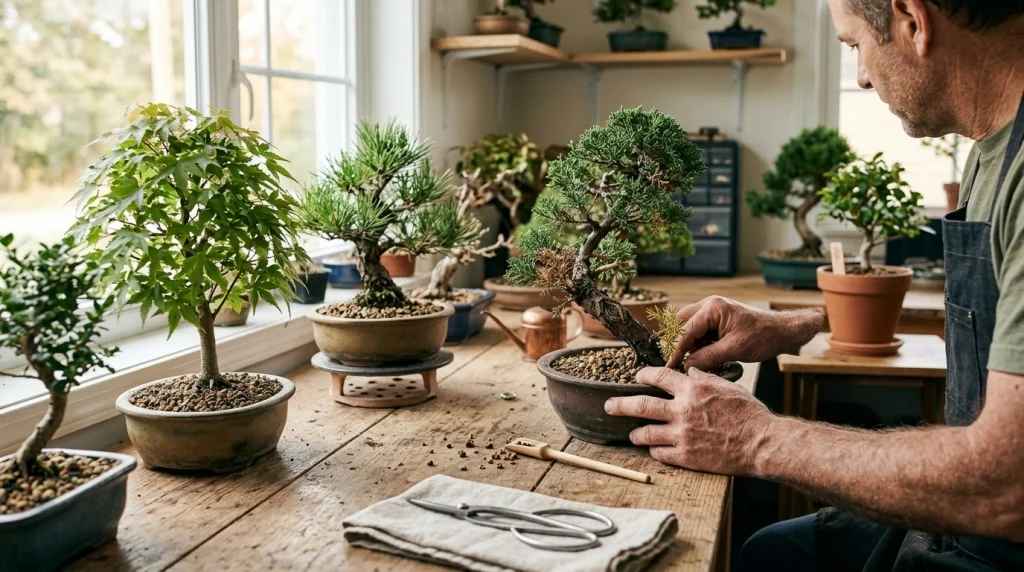
The most useful prevention strategy is keeping the bonsai vigorous enough to tolerate normal environmental pressure.
Good prevention is mostly ordinary bonsai care done consistently.
- Water by need: Check the substrate instead of following an automatic daily schedule.
- Maintain drainage: Use a substrate appropriate for the species, climate, pot size, and watering routine.
- Provide airflow: Avoid crowding canopies so tightly that foliage remains damp for long periods.
- Match the light: Give the species the sun or shade conditions it needs.
- Inspect often: Look at foliage, branch forks, bark, surface roots, and drainage holes.
- Protect wounds: Avoid careless branch breakage and unnecessary damage.
- Clean tools: Keep cutting tools clean, particularly when disease is suspected.
- Quarantine additions: Observe newly acquired trees before placing them among an established collection.
Watch the tree while watering
Watering time is an excellent inspection opportunity. It takes only seconds to notice a wilted shoot or changing bark color when you already have the tree in front of you.
I pay extra attention during active spring growth and hot summer weather because conditions can change quickly in a shallow pot.
Keep stress low after repotting
A freshly repotted bonsai has fewer functional roots until recovery begins. Excessive sun, drying wind, fertilizer, or additional major work can increase the strain.
Follow species-specific timing and aftercare whenever you repot or root-prune.
Pro tip: Major root pruning can seriously weaken a tree when done at the wrong time or on an unhealthy specimen. Get species-specific guidance from an experienced bonsai grower if you are uncertain.
Learn what is normal for your species
Normal seasonal behavior differs between Japanese maple, juniper, pine, ficus, elm, azalea, and other common bonsai.
That context prevents unnecessary treatment of normal leaf drop while helping you notice genuine changes sooner.
The American Bonsai Society at absbonsai.org can also help growers locate educational resources and the wider bonsai community.
Section Takeaway: Healthy roots, appropriate watering, suitable light, good airflow, clean tools, and routine inspection reduce many of the conditions that allow branch decline to become severe.
Frequently Asked Questions
Can a bonsai branch recover after it turns brown?
A completely dead woody branch will not return to life. If only the leaves or branch tip are damaged and living tissue remains farther back, part of the branch may survive once the underlying problem is corrected.
How do I know if a bonsai branch is dead?
A dead branch is usually dry, brittle, and lacks living green tissue beneath the bark. Check cautiously because scratching bark unnecessarily can create a wound, especially on thin bonsai branches.
Does branch dieback always mean root rot?
No. Root problems are one possibility, but branch dieback can also result from cankers, vascular disease, drought, wire damage, pests, cold injury, heat, physical damage, or other stresses.
Can overwatering cause bonsai branches to die?
Yes. A constantly waterlogged root zone can reduce oxygen around roots and damage root function. Severe root decline can eventually cause weak growth, yellowing, wilting, and branch dieback above the soil.
Should I cut off a branch as soon as it starts dying?
Not automatically. First determine whether the branch is completely dead and investigate why it declined. Premature removal of a major bonsai branch can permanently alter the design without solving the underlying problem.
Can branch dieback spread to other bonsai trees?
Some infectious diseases can spread through contaminated plant material, water, tools, insects, or other pathways. Environmental damage itself is not contagious, which is another reason correct diagnosis matters.
Should I fertilize a bonsai with branch dieback?
Avoid trying to force a severely stressed tree back to health with heavy fertilizer. Diagnose watering, root, light, temperature, pest, and disease problems first, then return to an appropriate feeding schedule as the tree stabilizes.
Final Takeaway
A bonsai disease causing branch dieback deserves attention, but disease should not be your automatic conclusion. Cankers, root diseases, and vascular problems can cause dieback, while watering mistakes, damaged roots, weather, pests, and wire injury can look remarkably similar.
Start with the pattern. Inspect the branch from the dead tip back toward healthy wood, check the root zone, review recent care, and look for repeated disease signs.
- Isolate suspicious trees.
- Correct obvious growing-condition problems.
- Remove confirmed diseased material carefully.
- Use pesticides only when the diagnosis and product label support them.
- Get expert diagnostic help when dieback reaches the trunk or continues spreading.
The earlier you notice the change, the more options you usually have. Make close inspection part of your normal watering routine rather than waiting for an entire branch to turn brown.
