How to Prune Ficus Bonsai: Step-by-Step Guide

This post contains affiliate links. As an Amazon Associate, OurBonsai earns from qualifying purchases at no extra cost to you. Read our disclosure.
In this guide
Learning how to prune ficus bonsai is the fastest way to turn a leggy indoor tree into a compact, mature-looking bonsai. Ficus are among the most forgiving trees to prune: they grow fast, bud back on old wood and recover from mistakes quickly. The basic method is simple: let new shoots grow six to eight leaves, then cut them back to two. Repeat that through the growing season and the canopy becomes dense and full. Bigger structural cuts are best done in early summer, when the tree is at its strongest.
This step-by-step guide covers when to prune, the tools you need, maintenance trimming, structural pruning, leaf pruning and aftercare.
When to prune a ficus bonsai
Ficus are tropical, so the timing follows growth rather than a strict season:
| Type of pruning | Best time | Notes |
|---|---|---|
| Maintenance trimming | Spring to late summer, or year round under grow lights | Whenever shoots reach 6 to 8 leaves |
| Structural pruning | Early summer | Heat and light give the fastest recovery |
| Leaf pruning (defoliation) | Early to mid summer | Only on strong, healthy trees |
| Root pruning | Late spring to early summer | During repotting |
Avoid heavy pruning in winter if your tree is indoors in low light. It will recover slowly and may push weak, pale shoots. Our guide to how much light a bonsai tree needs explains why light matters so much for regrowth.
Tools you need
- Sharp bonsai scissors for shoots and leaves.
- Concave cutter for removing branches flush to the trunk. Our concave cutter review explains why it heals better.
- Cut paste for large wounds.
- A damp cloth for the sap.
If you do not have a set yet, our guide to the best bonsai pruning shears for beginners covers good starter tools, or browse bonsai pruning shears.
How to prune ficus bonsai: maintenance trimming
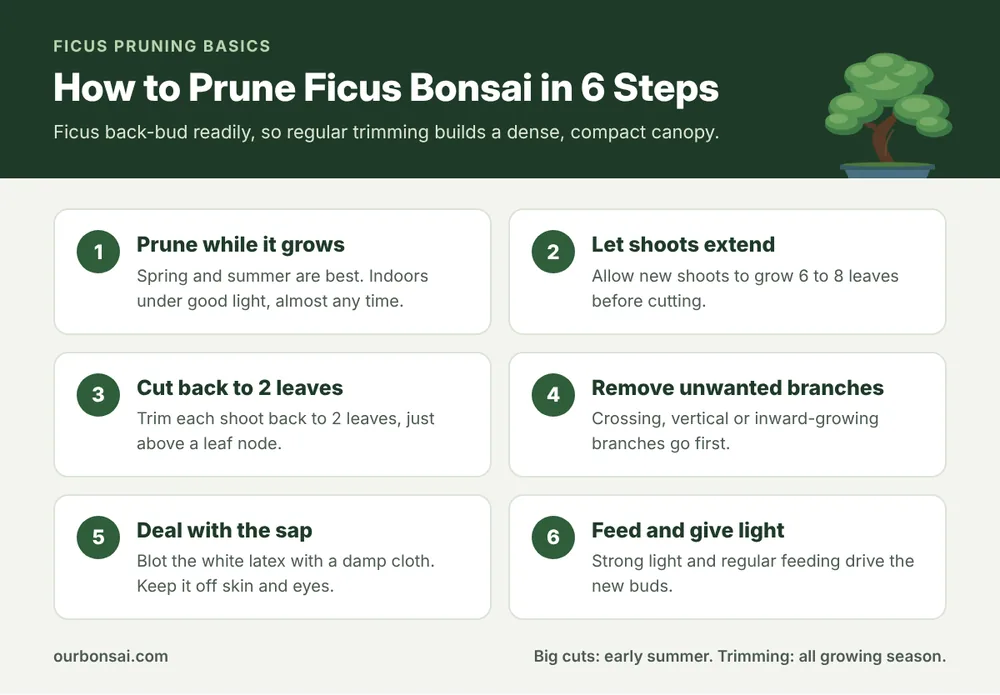
Step 1: Let the shoots grow
Leave new shoots alone until they have six to eight leaves. Letting them grow first feeds the tree and thickens the branch it grows from.
Step 2: Cut back to two leaves
Cut each shoot back to two leaves, just above the second leaf. The tree will push new buds from the leaf axils below your cut, often two or three at once. Over time that turns one shoot into a small cluster of twigs.
Step 3: Follow the outline
Trim to keep the canopy within the shape you want. Most ficus bonsai are styled as broad, rounded domes, often in the informal upright style. Shoots that stick out past the outline get cut back first.
Step 4: Balance the tree
The top and outer branches of a ficus grow the strongest. Trim those harder and more often, and let the lower and inner branches grow a little longer. This keeps the lower branches from weakening.
Structural pruning
Structural pruning changes the shape of the tree, so plan it first. Stand back and decide which branches to keep. Then remove:
- Branches that cross other branches.
- Branches growing straight up or straight down.
- Branches growing toward the front (toward the viewer) low on the trunk.
- One of two branches growing from the same point (bar branches).
- Long, thick branches that spoil the taper, which can be cut back to a smaller side branch.
Cut close to the trunk with a concave cutter and seal larger wounds. Ficus heal quickly, and a wound often rolls over within a season or two in a warm spot. The Wikipedia article on Ficus retusa notes how widely this species is used for bonsai, and its vigor is one of the reasons.
Leaf pruning and reducing leaf size
Ficus leaves can grow large. To reduce leaf size, a strong, healthy ficus can be fully or partially defoliated in early summer. Cut each leaf off at its stalk, give the tree bright light, and a new set of smaller leaves will appear within a few weeks. Only do this to vigorous trees, and not every year.
Another simple trick is to cut off the largest individual leaves throughout the year. The tree replaces them with smaller ones.
Pruning aerial roots and trunk shoots
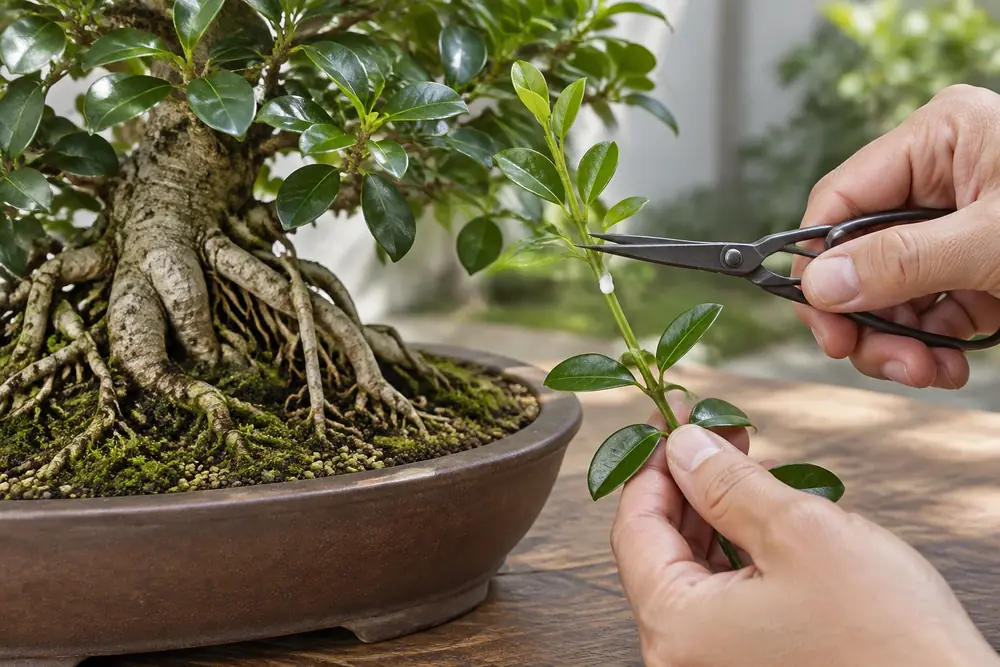
Many ficus, especially Ficus microcarpa, grow aerial roots from the branches in warm, humid conditions. They are one of the most attractive features of a ficus bonsai, so think before you cut them. Keep the ones that drop cleanly toward the soil, because once they reach it they thicken into extra trunks and give the classic banyan look. Cut off aerial roots that hang in odd places or cross in front of the trunk.
Ficus also push shoots from the trunk and from the base of branches. Rub off or cut the ones you do not want while they are small, unless you need a new branch in that position. A shoot left to grow on a bare part of the trunk is an easy way to fill a gap. If you are working on a ginseng ficus, the same rules apply; our ginseng ficus bonsai styles guide shows shapes that suit its thick root bulb.
Dealing with ficus sap
Ficus bleed a milky white latex when cut. It is harmless to the tree and stops in a few minutes. Blot it with a damp cloth or let it dry. Some people get skin irritation from it, so wear gloves if you are sensitive and keep it away from your eyes. A little cut paste on larger wounds stops the bleeding faster.
Aftercare after pruning
- Bright light. New buds need strong light to grow compact. Indoors, a south or west window or a grow light is ideal; see our guide to the best indoor grow lights for bonsai.
- Regular feeding. Feed every two weeks in the growing season to fuel regrowth.
- Normal watering. A pruned tree uses a little less water, so check the soil before watering.
- Patience. Ficus usually show new buds within two to three weeks in warm conditions.
Common ficus pruning mistakes
- Cutting every shoot as soon as it appears. The tree never builds strength, and branches stay thin.
- Pruning heavily in low winter light. Regrowth is weak and leggy.
- Leaving long stubs. They die back and look untidy.
- Ignoring the top. The apex grows strongest; if you do not trim it hard, the lower branches weaken.
- Removing too much at once. Keep at least two thirds of the foliage on a healthy tree.
FAQ: how to prune ficus bonsai
How often should I prune my ficus bonsai?
Trim new shoots whenever they reach six to eight leaves, which can be every few weeks in summer. Structural pruning is usually needed once a year at most.
Can I prune my ficus bonsai in winter?
Light trimming is fine. Save heavy pruning for early summer unless your tree is under strong grow lights.
Will a ficus bonsai grow back after hard pruning?
Yes. Ficus bud back readily from old wood, even after a hard cut, as long as the tree is healthy and gets good light.
Should I prune my ficus right after buying it?
Wait a few weeks until it has settled in its new spot and is pushing new growth.
Final thoughts
Now you know how to prune ficus bonsai: let shoots grow, cut them back to two leaves, remove badly placed branches in early summer, and give the tree plenty of light afterwards. Ficus reward regular pruning with dense, healthy growth, which makes them the perfect tree to learn on. For care beyond pruning, our golden gate ficus bonsai care guide covers watering, light and feeding.